http://www.veteranstoday.com/2012/10/19/obamas-october-surprise-nuke-deal-with-iran/

http://www.washingtontimes.com/blog/watercooler/2012/oct/20/picket-israel-says-obama-admin-had-not-informed-th/
and....
Obama’s “October Surprise,” Nuke Deal with Iran
Details for Nuke Enrichment Settlement “Mostly Complete”
Ayatollah ali Khamenei of Iran
by Gordon Duff, Senior Editor
The Obama administration is taking significant risks in sitting on recent negotiations with Iran that could bring an end to American sanctions on Iran’s central bank and bring about a lifting of current UN sanctions by spring 2013.
In secret negotiations confirmed by official sources in the EU, the US has received assurances that nuclear enrichment in Iran will be curtailed until an agreement can be reached that is acceptable to Israel and the Netanyahu government.
Privately, all parties admit that this is a “win-win” situation with Netanyahu looking “statesmanlike” while, if all parties agree to time their actions in accordance with the Israeli and American election cycles, the issue of Iran can be put away.
With deteriorization in Afghanistan, increased Russian influence in Iraq and Pakistan and terrorism spreading across Central Africa, the potential gain from confrontations with Iran are negligible.
Iran has bolstered its international standing through its leadership position with the Non-Aligned Movement, it’s new alliance with Azerbaijan, supplanting Israel there, the new government in Georgia and the recent visit by Iran’s foreign minister to Iraq.Conversely, Iran’s media outlets to the west have been blocked through a combination of Israeli influence and hacking of satellite channels, Lebanon’s Shiite media similarly silenced and relative control of all mainstream world media has been achieved in a matter of days.
Earlier today, a car bomb in Beirut killed nearly 80, in what is believed the first stage of a conflict to isolate Hezbollah and place additional pressure on Syria.
Also, from Syria, come reports of advanced shoulder mounted air defense equipment being distributed to rebel armies, assuring the continuance of that conflict for months to come.
What is at risk is a matter of timing. This will not be the first time Iran has become a deciding vote in an American presidential election.
In 1980, vice presidential candidate George H.W. Bush flew to Paris to meet with Iranian officials to hold off settlement of the Carter era hostage crisis.Bush promised Iran advanced US weapons including thousands of TOW missiles, many of which were used in Lebanon against Israel. The missiles used against Israel were actually shipped through Israel by Israel.
Similarly, as part of the deal, profits were invested in setting up narcotics pipelines into the US under the guise of arming “anti-communist” forces in Central America, the foundation of the Romney/Bain and Bush “mega-fortunes.”
http://www.washingtontimes.com/blog/watercooler/2012/oct/20/picket-israel-says-obama-admin-had-not-informed-th/
UPDATE 1: (Via Politico ) The White House is denying the U.S. will be engaging in one on one talks with Iran:
National Security Council spokesman Tommy Vietor offered a denial."It’s not true that the United States and Iran have agreed to one-on-one talks or any meeting after the American elections," he said in a statement."We continue to work with the P-5 on a diplomatic solution and have said from the outset that we would be prepared to meet bilaterally. The president has made clear that he will prevent Iran from getting a nuclear weapon, and we will do what we must to achieve that. It has always been our goal for sanctions to pressure Iran to come in line with its obligations. The onus is on the Iranians to do so, otherwise they will continue to face crippling sanctions and increased pressure."
The New York Times is reporting the Obama administration and Iran have agreed to direct one on one talks regarding Iran's nuclear program:
The United States and Iran have agreed for the first time to one-on-one negotiations over Iran’s nuclear program, according to Obama administration officials, setting the stage for what could be a last-ditch diplomatic effort to avert a military strike on Iran.Iranian officials have insisted that the talks wait until after the presidential election, a senior administration official said, telling their American counterparts that they want to know which American president they would be negotiating with.News of the agreement — a result of intense, secret exchanges between American and Iranian officials that date almost to the beginning of President Obama’s term — comes at a critical moment in the presidential contest, just two weeks before Election Day and a day before the final debate, which is to focus on national security and foreign policy.
However, The New York Times noted that Israel is critical of these direct talks and said that the Obama administration "had not informed" the Israeli government of the negotiations with Iran:
Israeli officials initially expressed an awareness of, and openness to, a diplomatic initiative. But when asked for a response on Saturday, Israel’s ambassador to Washington, Michael B. Oren, said the administration had not informed Israel, and that the Israeli government feared Iran would use new talks to “advance their nuclear weapons program.”
“We do not think Iran should be rewarded with direct talks,” he said, “rather that sanctions and all other possible pressures on Iran must be increased.”Direct talks would also have implications for an existing series of negotiations involving a coalition of major powers, including the United States. These countries have imposed sanctions to pressure Iran over its nuclear program, which Tehran insists is for peaceful purposes but which Israel and many in the West believe is aimed at producing a weapon.
On September 12, President Barack Obama was criticized for not meeting with Israeli Prime Minister Benjamin Netanyahu regarding the threat of a nuclear Iran. According to CNN:
President Barack Obama talked with Israeli Prime Minister Benjamin Netanyahu in a call Tuesday night about the threat posed by Iran's nuclear program, according to a White House statement.Obama placed the call to Netanyahu, a senior administration official told CNN.The one-paragraph statement from the White House, which referred to the Obama-Netanyahu discussion as "a part of their ongoing consultations," followed reports earlier in the day that the White House had rejected a request by Netanyahu to meet with Obama this month to discuss Iran's nuclear program.CNN's Wolf Blitzer, citing Israeli sources, reported that the Israelis were told Obama's schedule would not permit a meeting even though Israel offered to have Netanyahu travel to Washington.Red line for action in Iran U.S.-Israel heated exchange over Iran? Can music 'heal' Israel-Iran relations?Obama and Netanyahu are both due to address the United Nations in New York in late September but not at the same time.
The Obama administration pushed back later Tuesday."Contrary to reports in the press, there was never a request for Prime Minister Netanyahu to meet with President Obama in Washington, nor was a request for a meeting ever denied," the White House said Tuesday night in its statement, which made reference to "our close cooperation on Iran and other security issues."Netanyahu has shown growing impatience with what he says is a lack of clarity by the Obama administration on articulating so-called "red lines" that Iran cannot cross if it wants to avoid war over its nuclear ambitions.The administration has resisted pressure to take that step.
Vice President Joe Biden went after Vice Presidential Republican nominee Congressman Paul Ryan at the vice presidential debate in Danville, Kentucky when Rep. Ryan criticized the administration for freezing out Netanyahu.
"They see us saying when we come into the administration, when they’re sworn in, we need more space with our ally, Israel. They see President Obama in New York City the same day Bibi Netanyahu is and he, instead of meeting with him, goes on a — on a daily talk show," Rep. Ryan said.
Vice President Biden responded, "Now, with regard to Bibi, who’s been my friend 39 years, the president has met with Bibi a dozen times. He’s spoken to Bibi Netanyahu as much as he’s spoken to anybody. The idea that we’re not — I was in a, just before he went to the U.N., I was in a conference call with the — with the president, with him talking to Bibi for well over an hour, in — in — in stark relief and detail of what was going on."
and....
Iran denies report of nuclear talks with U.S.
DEBKAfile October 21, 2012, 2:14 PM (GMT+02:00)
http://www.wnd.com/2012/10/obama-cuts-deal-with-iran-over-nukes/
( We shall see if this has any basis.... )
WND piece seems to have some basis......
http://www.debka.com/article/22457/Obama-Khamenei-summit-would-cap-long-back-channel-dialogue

and.....
http://occupycorporatism.com/us-supported-free-syrian-army-are-salafi-jihadists-from-saudi-arabia/
 Footage provided by the FSA have turned up images of these cluster bombs, which explode mid-air and rain down smaller bomblets over a specified area. An anonymous “citizen journalist” just happened to capture photos of these cluster bombs located in a home.
 The globalists at the CFR believe that “al-Qaeda fighters . . . may help improve morale.” Husain asserts that Salafi jihadists bring “discipline, religious fervor, battle experience . . . and most importantly, deadly results.”
and Beirut gets drawn into the syria / Iran mix........
http://www.debka.com/article/22459/Iran%E2%80%99s-global-cyber-war-room-is-secretly-hosted-by-Hizballah-in-Beirut

http://www.zerohedge.com/news/2012-10-21/progress-heavy-gunfire-pm-office-stormed-beirut
 Submitted by Tyler Durden on 10/21/2012 10:11 -0400

and....
http://www.debka.com/article/22455/Syria-Iran-Hizballah-attack-while-US-and-Israel-play-computerized-war-games


and....
http://news.antiwar.com/2012/10/18/karzai-nato-can-expedite-afghan-handover/
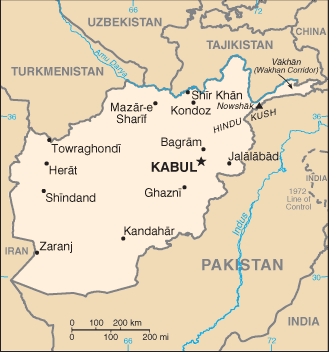 Karzai’s comments come as several NATO nations, Britain in particular, are pushing to speedtheir withdrawals from the nations and hoping to end their portions of the occupation, with most scheduled to be out by the end of 2014 and only the US committed through 2024.
http://www.nytimes.com/2012/10/19/world/africa/suspect-in-benghazi-attack-scoffs-at-us.html?hp&_r=1&pagewanted=all&
and Syria items of note........
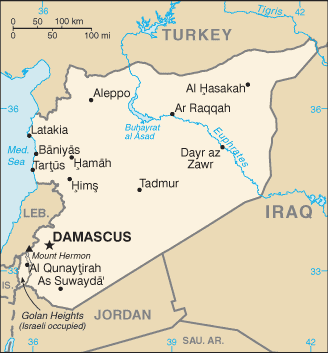 An estimated 35,000 villagers are trapped in the villages with no chance of escape, with rebel snipers gunning down anyone who tries to leave. The rebels claim that the villages were housing “pro-regime gunmen.”
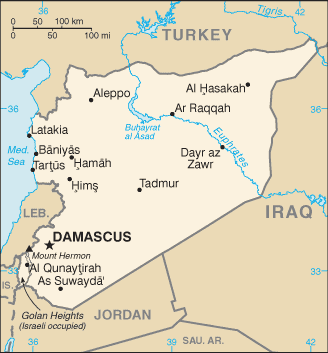 The attack on the gas pipeline occurred in the Kurdish dominated northeast, not far from the Iraqi border. Officials say they expect to begin repairs soon, but how easily they will be able to safely repair in a rebel-heavy region is unclear.
DEBKAfile October 21, 2012, 2:14 PM (GMT+02:00)
Iran denied Sunday holding direct talks with the United States over its disputed nuclear program.
The New York Times reported, citing Obama administration officials, that the United States and Iran had agreed in principle to one-on-one negotiations on Iran's nuclear program. The White House later denied the report.
"We don't have any discussions or negotiations with America," Iranian Foreign Minister Ali Akbar Salehi said in a news conference. "The (nuclear) talks are ongoing with the P5+1 group of nations. Other than that, we have no discussions with the United States."
The New York Times reported, citing Obama administration officials, that the United States and Iran had agreed in principle to one-on-one negotiations on Iran's nuclear program. The White House later denied the report.
"We don't have any discussions or negotiations with America," Iranian Foreign Minister Ali Akbar Salehi said in a news conference. "The (nuclear) talks are ongoing with the P5+1 group of nations. Other than that, we have no discussions with the United States."
http://www.wnd.com/2012/10/obama-cuts-deal-with-iran-over-nukes/
( We shall see if this has any basis.... )
Iranian and U.S. negotiators have reached an agreement that calls for Iran to halt part of its nuclear program in exchange for the lifting of many of the U.S. sanctions against the Islamic regime, according to a highly placed source.
Iran’s supreme leader, Ayatollah Ali Khamenei, expects a letter from President Obama in a few days guaranteeing the details of the agreement, arrived at recently during secret negotiations in Doha, Qatar.
The source, who remains anonymous for security reasons and is highly placed in Iran’s regime, said that once Khamenei receives Obama’s guarantees, he will authorize an announcement by Iran on a solution to the nuclear crisis before the U.S. presidential elections.
The agreement calls for Iran to announce a temporary halt to partial uranium enrichment after which the U.S. will remove many of its sanctions, including those on the Iranian central bank, no later than by the Iranian New Year in March. Iran is in the throes of massive inflation and citizen unrest because of the sanctions.
French intelligence verified today that Yukiya Amano, the current director general of the International Atomic Energy Agency, has been given the go-ahead by the U.S. to be ready to travel to Iran and announce the agreement, according to Hamid Reza Zakeri, a former intelligence officer in the regime who has defected to Europe.
The source in Tehran said Khamenei has made it clear that unless he receives Obama’s written guarantees, he will not begin the process, which would dramatically boost Obama’s re-election chances. If the guarantees are not given, Khamenei has warned, Iran will speed up its nuclear program.
The guarantees would ensure the regime’s right to peaceful enrichment, quickly remove many of the sanctions, accept that Iran’s nuclear program does not have a military dimension and relieve international pressure on the regime while it continues its nuclear program. Also, the U.S. would announce that the killing of Iranian nuclear scientists was the work of a foreign country, though Israel would not be named, to increase legal pressure on Israel.
According to the Iranian source, a previous Obama letter to Khamenei indicated that it’s best for the regime not to give any motive to Israeli Prime Minister Benjamin Netanyahu’s government to attack Iran’s nuclear facilities, a message that was re-emphasized in the Qatar negotiations.
As reported exclusively by WND Oct. 4, a three-person delegation led by a woman on behalf of the Obama administration traveled to Qatar about Oct. 1 and met with Iranian counterparts, including Ali Akbar Velayati, the former foreign minister of the Islamic regime and a close adviser to Khamenei on international matters.
In the meeting, according to the source, the U.S. delegation urged an announcement, even if only on a temporary nuclear deal, before the U.S. elections to help Obama get re-elected. A Romney presidency, the delegation said, would surely move more toward Israel, and the Iranians were reminded that Obama has stood up to Israel against any plans to attack Iran. The regime’s delegate was urged to understand that if Iran does not stand by Obama, Israel will attack Iran.
Days after the WND report, Ali Akbar Salehi, the regime’s foreign minister, in an
interview with the German magazine Der Spiegel, stated, “If our right to enrichment is guaranteed, we are prepared to offer an exchange.”
interview with the German magazine Der Spiegel, stated, “If our right to enrichment is guaranteed, we are prepared to offer an exchange.”
The same message was relayed by several other officials of the regime.
U.S. Secretary of State Hillary Clinton said recently in Kazakhstan that the sanctions can be lifted immediately if Tehran worked with world powers to address questions about its nuclear program.
In the Qatar meeting, according to the Iranian source, the American woman delegate, who has had several meetings with Velayati during the past several years, jokingly told Velayati that she will be the next secretary of the Department of Housing and Urban Development in a second Obama administration and that it would be wise for Iranians to invest in U.S. real estate.
In the past five months, four meetings were held in the U.S. with the Islamic regime’s surrogates to hash out what was to be discussed at the Doha meeting. The source identified Valerie Jarrett, a senior Obama adviser, as the head of the U.S. effort to engage Iran. Also identified was Cyrus Amir Mokri, assistant secretary of the Treasury Department for financial institutions, as another member advising the president on the issue.
Jarrett’s family has known the Velayati family since their stay in Iran in the 1950s, the source added. Jarrett’s father worked at the Namazi hospital in Shiraz, owned by an Iranian family that has been influential with the regime after the Islamic Revolution.
WND contacted both the U.S. State Department and the White House, asking about the Doha negotiations, who led the delegation from the U.S., whether Obama will provide the written guarantee, what negotiations the U.S. has pursued on its own and what is known about Amano’s plan to travel to Iran for the announcement.
The State Department declined to respond to multiple calls as well as email inquiries. A spokeswoman said the White House would not comment.
The European Union, which increased sanctions on Iran last week, fears back-channel negotiations between the Obama administration and Iran will leave it out. EU leaders are seeking to send a group of representatives from seven European countries to Tehran to strengthen their position with the regime over the nuclear program and their economic interests.
The Iranian currency, meanwhile, has hit another historic low, falling to 43,000 rials to one U.S. dollar. As reported recently, a secret memo by the Intelligence Ministry to regime officials has warned of major riots in Iran due to dire economic conditions.
Another internal report by the government’s Economic Commission indicated that government foreign currency reserves will run out in the coming months and that it will have difficulty meeting payrolls for public employees who could lose 50 percent of their pay.
Many within the Iranian opposition believe that if the West continues to pressure the Islamic regime and supports the aspirations of the majority of the Iranian people who resent the regime and its ideology, the regime will face a nationwide uprising and will collapse from within, changing the geopolitics of not only the region but the world.
However, if the regime is provided a lifeline for whatever reason, not only will it get the bomb but it will take Iranians and the world hostage for decades to come, they believe.
An Oct. 8 WND report revealed another secret nuclear site in Iran. The regime’s nuclear scientists have successfully completed testing of a neutron detonator and have nearly completed design of a nuclear warhead.
WND piece seems to have some basis......
http://www.debka.com/article/22457/Obama-Khamenei-summit-would-cap-long-back-channel-dialogue
Obama-Khamenei summit would cap long back-channel dialogue
DEBKAfile Exclusive Report October 21, 2012, 3:48 AM (GMT+02:00)
A pre-election summit?
US President Barack Obama has agreed to hold direct talks on Iran’s nuclear program with its leaders, Ayatollah Ali Khamenei and Mahmoud Ahmadinejad. Is this a surprise? On April 16, 2012, DEBKAfile disclosed that Washington and Tehran were conducting back-channel talks in Paris and Vienna, Sources close to Obama have now leaked word to the New York Times that the dialogue is to be elevated to direct talks at summit level. This disclosure, despite its subsequent denial by the White House, has three clear objects:
1. To slow down the Republican contender Mitt Romney’s momentum in opinion polls ahead of the Nov. 6 election. Obama’s campaign advisers believe the president’s willingness to engage Iranian leaders directly on their nuclear program, in contrast to Romney’s tougher stance, will appeal to the American voter’s reluctance for US military action.
2. To preempt Romney’s presumed plan to drop the disclosure of the back-channel dialogue as a bombshell in their last debate on foreign policy scheduled for Monday, Oct. 22 in Florida.
2. To preempt Romney’s presumed plan to drop the disclosure of the back-channel dialogue as a bombshell in their last debate on foreign policy scheduled for Monday, Oct. 22 in Florida.
3. To reassure Tehran that the Austere Challenge 12 joint US-Israeli war game starting Sunday Oct. 21 – albeit in reduced form - will not be the opening shot for an “October surprise” on Iran.
This kite was flown by David Rothkopf, who is close to the Democratic leadership, in Foreign Policy on October 9, although it was not picked up by anyone else in Washington or Jerusalem. Under the heading an “October surprise,” he cited a White House faction as recommending to Obama that the US join Israel in launching a surgical operation against Iran’s nuclear facilities before the US election.
Obama is now signaling Tehran that he has rejected this advice in favor of upgrading his dialogue with Iranian leaders.
However, beyond the calculus of campaign strategy, it is important to note that the clandestine dialogue in progress for the best part of a year has produced no breakthrough in the controversy on Iran’s nuclear aspirations. This is mainly because Obama’s emissaries have never stipulated plainly that Tehran must stop uranium enrichment as a quid pro quo for the dialogue to continue. Just the reverse: they let it be known that Washington does not object to Iran’s enrichment program per se so long as it is not used for building a nuclear weapon.The differences between the two sides centered on the American demand for the International Atomic Energy Agency to be allowed 24/7 monitoring access to the enrichment projects to determine that parts of the stock did not suddenly disappear for use in manufacturing a bomb. Tehran has only agreed to inspectors paying visits once a fortnight.
This kite was flown by David Rothkopf, who is close to the Democratic leadership, in Foreign Policy on October 9, although it was not picked up by anyone else in Washington or Jerusalem. Under the heading an “October surprise,” he cited a White House faction as recommending to Obama that the US join Israel in launching a surgical operation against Iran’s nuclear facilities before the US election.
Obama is now signaling Tehran that he has rejected this advice in favor of upgrading his dialogue with Iranian leaders.
However, beyond the calculus of campaign strategy, it is important to note that the clandestine dialogue in progress for the best part of a year has produced no breakthrough in the controversy on Iran’s nuclear aspirations. This is mainly because Obama’s emissaries have never stipulated plainly that Tehran must stop uranium enrichment as a quid pro quo for the dialogue to continue. Just the reverse: they let it be known that Washington does not object to Iran’s enrichment program per se so long as it is not used for building a nuclear weapon.The differences between the two sides centered on the American demand for the International Atomic Energy Agency to be allowed 24/7 monitoring access to the enrichment projects to determine that parts of the stock did not suddenly disappear for use in manufacturing a bomb. Tehran has only agreed to inspectors paying visits once a fortnight.
Vice President Joe Biden was outspoken about this during his debate with Paul Ryan on Oct. 11. He actually said that the quantities of enriched uranium accumulated don’t matter - only what Iran does with it. This admission aroused little notice although it implied that the Obama administration is willing to let Iran approach a very risky threshold.
It also indicated a very wide gulf still existing between the Obama administration’s indulgent attitude toward a nuclear Iran and Israel’s insistence on red lines for limiting the quantities and grades of enriched uranium Iran is permitted to accumulate.
It also indicated a very wide gulf still existing between the Obama administration’s indulgent attitude toward a nuclear Iran and Israel’s insistence on red lines for limiting the quantities and grades of enriched uranium Iran is permitted to accumulate.
At the same time, Israel keeps on backtracking on those red lines: When Iran moved its enrichment plant into an immune zone earlier this month, one red line disappeared. And Israel is no longer openly challenging Washington’s assurance that a decision by Khamenei to go forward and start building a weapon would reach US intelligence at the precise moment it is made.
Prime Minister Binyamin Netanyahu and Defense Minister Ehud Barak have therefore been forced back step by step and have silently fallen in behind Obama.
For his part, the US president believes a summit with Iran’s rulers will enhance his chances of reelection. But he is leaving Netanyahu to face the Israeli voter in three months with nothing remaining of his pledge to prevent a nuclear Iran, and clutching at the outward concurrence between Israeli and US intelligence appraisals of Iran’s nuclear progress.
There is no real concurrence; the gap is as wide as ever. But by failing to deny Israeli affinity with the United States on this issue, Netanyahu and Barak are not only helping Barack Obama but also encouraging Tehran to keep going.
Prime Minister Binyamin Netanyahu and Defense Minister Ehud Barak have therefore been forced back step by step and have silently fallen in behind Obama.
For his part, the US president believes a summit with Iran’s rulers will enhance his chances of reelection. But he is leaving Netanyahu to face the Israeli voter in three months with nothing remaining of his pledge to prevent a nuclear Iran, and clutching at the outward concurrence between Israeli and US intelligence appraisals of Iran’s nuclear progress.
There is no real concurrence; the gap is as wide as ever. But by failing to deny Israeli affinity with the United States on this issue, Netanyahu and Barak are not only helping Barack Obama but also encouraging Tehran to keep going.
and.....
http://occupycorporatism.com/us-supported-free-syrian-army-are-salafi-jihadists-from-saudi-arabia/
US-Supported Free Syrian Army Are Salafi Jihadists From Saudi Arabia

The UN sent a peace envoy headed by Lakhdar Brahimi, to assess the damage being inflicted on Syria by the US-supported terrorists called the Free Syrian Army (FSA). Brahimi requested a temporary cease fire while he was in Syria; as well as for the Muslim holiday beginning October 26th.
The FSA, being leaderless, is expected to have a difficult time signing an agreement of ceasefire.
Last week, the Human Rights Watch, a UN non-governmental organization (NGO) claimed that the Syrian government had used cluster bombs against the FSA. Assad denied having possession of these weapons. According to a statement: “The Syrian Arab Army does not possess these kinds of weapons and affirms that these reports (of their use) are completely untrue.”
 Footage provided by the FSA have turned up images of these cluster bombs, which explode mid-air and rain down smaller bomblets over a specified area. An anonymous “citizen journalist” just happened to capture photos of these cluster bombs located in a home.
The HRW asked Russian Foreign Minister Sergey Lavrov about the cluster bombs. Lavrov replied that he had no legitimate confirmation that suggested “the bombs could have been made by former Warsaw Pact countries. The region is full of weapons. Weapons are being sent to Syria and other countries of the region in huge quantities. It’s very hard to establish who is supplying ammunition and other types of weaponry and from where.”
The FSA are comprised of Salafi militants from Saudi Arabia. The same faction of terrorists that attacked the villa where US Ambassador Stevens was murdered is in Syria fighting the proxy war for the US.
The Salafi terrorist cells are given different names depending on their location geographically (such as al-Qaeda, FSA, etc. . . ) so that the idea that they are separate is purveyed to the general public. However, they are subscribing to an extreme form of Islam that is encompassing in Saudi Arabia.
The Partisans of Sharia (PoS), or Ansar al-Sharia, are directly connected to the Muslim Brotherhood who believe that those who do not adhere to Sharia law should be crucified. During the manufactured Arab Spring in Egypt, the Muslim Brotherhood was able to obtain power through violence against the Egyptian citizens. Partisans or followers of the Muslim Brotherhood are tied to the Salafi version of Islam that demand complete adherence to the religion, lest they be deemed an infidel and killed.
The Salafis being used in Syria are exceptionally violent and adhere to sectarianism with complete abhorrence for the US. This ideal is fostered because it helps to facilitate the psychological mindset necessary for manipulation.
Last week it was discovered that the FSA are being armed by Saudi Arabia. The attack in Aleppo was actually funded with ammunition and weaponry from the US-aligned Middle Eastern nation. The FSA denies knowledge of how they came to obtain this shipment from Saudi Arabia; however it is fairly obvious that the Salafi extremists in their country are supporting the US-backed terrorist faction. Saudi officials have also declined comment thinking that refusal to speak will correspond with their ignorance. Yet, Saudi ammunition has been used since the inception of the CIA-trained “rebels” paid for my “foreign aid” from the US and British governments.
This subversive supplying of weapons to terrorists has resulted in the use of IEDs and car bombs to destroy the intelligence headquarters of the Syrian government in Damascus.
Ed Husain, senior fellow of Middle Eastern Studies at the Council on Foreign Relations (CFR) publicly supports the use of Salafi terrorists in Syria.
Cloaked under the name FSA and al-Qaeda, these Islamic extremists are praised by the CFR for their successes over the Assad government.
Husain states: “The Syrian rebels would be immeasurably weaker today without al-Qaeda in their ranks. By and large, Free Syrian Army (FSA) battalions are tired, divided, chaotic, and ineffective. Feeling abandoned by the West, rebel forces are increasingly demoralized as they square off with the Assad regime’s superior weaponry and professional army.”
 The globalists at the CFR believe that “al-Qaeda fighters . . . may help improve morale.” Husain asserts that Salafi jihadists bring “discipline, religious fervor, battle experience . . . and most importantly, deadly results.”
The RAND Corporation, a globalist think-tank, supports Husain’s summation in a report citing the presence of “al-Qaeda fighters” in Syria as assets to the Salafi terrorists, NATO veterans, and other militants being used against the Syrian government.
In August, Obama signed a secret order authorizing US support of the Free Syrian Army (FSA). The CIA and other agencies were empowered by Obama earlier this year to provide intelligence and training.
The US Treasury has granted release of funds to the FSA through the Syrian Support Group (SSG), a Washington representative of the FSA to conduct financial transactions. The SSG’s “vision” is to “promote the establishment of a free, independent and democratic Syria.” Whenever the ideals of democracy are brought to a foreign nation, through the assistance of the US government, American interests in the resources of that nation are evident.
While the SSG claim to be a grassroots effort, they admit they are a nonprofit organization based in Washington, DC “committed to a pluralistic, civil and democratic Syria in which everyone, the military and the government included, are subject to the Rule of Law.”
Last month, the Saudi Arabian government, with support from Elite families in Qatar, Kuwait and Saudi Arabia, gave generously to the FSA. In a US State Department statement, it was explainedthat: “The battalion rep or commander travels to Turkey, where he meets Gulf individuals or Syrians who live in the Gulf. The battalion presents ‘projects’ that need sponsorship, for example: targeting a checkpoint costs $20-30K, while targeting an airport cost $200-300K. . . . A video taping . . . is required to provide evidence of the operation.”
In Turkey, officials have taken the task of distributing supplies of 50,000 Kalashnikov bullets and dozens of rocket-propelled grenades to several FSA factions.
and Beirut gets drawn into the syria / Iran mix........
http://www.debka.com/article/22459/Iran%E2%80%99s-global-cyber-war-room-is-secretly-hosted-by-Hizballah-in-Beirut
Iran’s global cyber war-room is secretly hosted by Hizballah in Beirut
DEBKAfile Exclusive Report October 21, 2012, 11:15 PM (GMT+02:00)
Iranian drone from Lebanon
Iran’s secret cyber war-room is located at Hizballah’s secret internal security apparatus headquarters in the Shiite Dahya district of South Beirut,DEBKAfile’s exclusive intelligence and counterterrorism sources reveal. The hackers and cyber experts who recently attacked American banks and Saudi oil sites and which guided an Iranian stealth drone into Israeli airspace on Oct. 6, operate from Hizballah’s premises in Beirut and its secret bunkers.
Wafiq Safa is head of the security apparatus and also deputy of the Iranian general, Hossein Mahadavi, who serves as the liaison and coordination officer with Hizballah in Lebanon.Safa’s son is married to the Hizballah chief Hassan Nasrallah’s sister.
Cyber intelligence experts explain Tehran uses its Lebanese surrogate to host its global digital war-room - firstly, to disguise the source of its cyber offensives and keep Iran clear of blame; secondly, because the Hizballah facility is protected from electronic penetration by exceptionally efficient firewalls.
They were strong enough to keep Israeli cyber experts from discovering the electronic center which dispatched the UAV over their country and reaching its controllers. Whenever Israel experts tried manipulating the drone’s movements, they found an external force overrode them and recovered control. Eventually, the Israeli commanders gave up and ordered the drone brought down with as little damage as possible.
The drone’s components have given up to its captors many secrets about Iran’s stealth UAV technology and capabilities, but very little about the Iranian cyber team operating out of the Hizballah facility in Beirut and their equipment.By cutting away from the captured UAV, the Iranian controllers also locked their operation away from outside access and any possible evaluation of their capabilities.
Cyber intelligence experts explain Tehran uses its Lebanese surrogate to host its global digital war-room - firstly, to disguise the source of its cyber offensives and keep Iran clear of blame; secondly, because the Hizballah facility is protected from electronic penetration by exceptionally efficient firewalls.
They were strong enough to keep Israeli cyber experts from discovering the electronic center which dispatched the UAV over their country and reaching its controllers. Whenever Israel experts tried manipulating the drone’s movements, they found an external force overrode them and recovered control. Eventually, the Israeli commanders gave up and ordered the drone brought down with as little damage as possible.
The drone’s components have given up to its captors many secrets about Iran’s stealth UAV technology and capabilities, but very little about the Iranian cyber team operating out of the Hizballah facility in Beirut and their equipment.By cutting away from the captured UAV, the Iranian controllers also locked their operation away from outside access and any possible evaluation of their capabilities.
The Americans encountered the same difficulty in early October when they tried to locate and identify the hackers who disabled 10 major US bank websites, attacked Saudi Arabia’s Aramco’s websites with a virus called Shamoon that replaced data with burning American flags, and invaded the computers of Qatar’s gas industry.
Six days after the drone’s penetration of Israel, US Defense Secretary Leon Panetta talked to reporters in New York about “a pre-9/11 moment” for the United States. He did not come right out and name Iran or mention its cyber war headquarters in Beirut. He did, however, warn “the attackers are plotting,” and that recent electronic attacks in US and abroad demonstrate the need for “a more aggressive military role in defense and to retaliate against organized groups or hostile governments.”
http://www.zerohedge.com/news/2012-10-21/progress-heavy-gunfire-pm-office-stormed-beirut
In Progress: Heavy Gunfire, Prime Minister Office Stormed In Beirut
Yesterday we made it very clear why with the Turkey provocation avenue to further Middle East escalation rapidly closing, the one pathway left is Lebanon. Sure enough, today the escalation playbook is firmly in play - from Reuters: "Heavy gunfire erupted in central Beirut on Sunday after protesters tried to storm the offices of Prime Minister Najib Mikati, demanding that he quit over the assasination of a top intelligence official. An official said security forces had fired in the air.Witnesses said at least two protesters had fainted, apparently as a result of tear gas fired by security forces after protesters breached an outer barrier around the prime minister's offices. Hundreds of protesters, waving flags from the anti-Syrian opposition Future Movement - a mainly Sunni Muslim party - and Christian Lebanese Forces as well as black Islamist flags, marched on Mikati's offices after the funeral of Wissam al-Hassan."

When in doubt blame Syria: after all the horribly split US congress needs some flag to rally behind two months ahead of a decision that will force it to come up with a grand compromise which in the absence of a foreign conflict (and a third presidential debate precisely forcusing on US foreing policy), just isn't happening: "They accused Syria of being behind Hassan's killing and called for Mikati to resign."
Supposedly this means Syria took some time off from its busy daily schedule of provoking Turkey and NATO, and lobbing artillery shells into Turkish territory fully aware it (any by it we mean 'flip-flops on the ground' sponsored branches Al Qaeda operating in its territory of course) is playing with a fully blown Western world retaliation.
More from AP:
Lebanese soldiers have fired machine guns and rifles into the air and lobbed volleys of tear gas at hundreds of angry protests who are trying to storm the Lebanese government headquarters in Beirut.The chaotic scene in Lebanon's capital on Sunday comes in the midst of a funeral for a top intelligence official who was killed in a massive car bombing that many blame on the regime in neighboring Syria.
The protesters believe the government is too close to Syria and Damascus' ally in Lebanon, the Shiite group Hezbollah.Finally, as a reminder - this is the regional sectarian powder keg just waiting for a "someone" to drop a lit match...

and....
http://www.debka.com/article/22455/Syria-Iran-Hizballah-attack-while-US-and-Israel-play-computerized-war-games
Syria, Iran, Hizballah attack while US and Israel play computerized war games
DEBKAfile Exclusive Analysis October 20, 2012, 1:15 PM (GMT+02:00)
Tags: Beirut  bombing attack Bashar Assad Hariri probe Iran nuclear Barack Obama Binyamin Netanyahu Erdogan
bombing attack Bashar Assad Hariri probe Iran nuclear Barack Obama Binyamin Netanyahu Erdogan
Bombing outrage in Beirut
The assassination of the anti-Syrian Head of the Lebanon's Internal Security Forces intelligence branch, Brig. Gen. Wissam al-Hasan, Friday, Oct. 19, by a huge car bomb blast in East Beirut’s Ashrafiya district marked the brutal spillover of the Syrian bloodbath into a second Arab capital and the threat of itsl spread towards Israel.
Eighteen months ago, in May 2011, shortly after Syrians rose up against Bashar Assad, Rami Makhlouf, a leading architect of his tactics of suppression, warned, “If there is no stability here, there’s no way there will be stability in Israel.”
Israel should take careful note of the outrage in Beirut in which seven Lebanese were killed and 73 injured in order to liiquidate Assad's foe in Beirut.
Eighteen months ago, in May 2011, shortly after Syrians rose up against Bashar Assad, Rami Makhlouf, a leading architect of his tactics of suppression, warned, “If there is no stability here, there’s no way there will be stability in Israel.”
Israel should take careful note of the outrage in Beirut in which seven Lebanese were killed and 73 injured in order to liiquidate Assad's foe in Beirut.
In August, Gen. Al-Hasan uncovered a Syrian plot to destabilize Lebanon by a bombing campaign and arrested the pro-Syrian politician and ex-information minister Michel Samaha for complicity in the plot. He also led the investigation that implicated Damascus in the 2005 bombing atrocity that killed former Prime Minister Rafiq Hariri.
Gen. Al-Hasan's murder brought forth angry protesters.They blocked roads and highways in several towns including the Beirut-Syrian road link as the Lebanese government met in emergency session Saturday, Oct. 20, and announced a day of national mourning.
In the wider sense, the murder of the Lebanese anti-Syrian terror crusader demonstrated that hopes in the West and Israel of the Syrian conflict eventually sundering the Tehran-Damascus-Hizballah axis were no better than pipedreams, just like the belief that liquidating Iran’s nuclear scientists or cyber warfare would turn Tehran back from its march towards a nuclear weapon.
After nearly two years, those illusions have been dissipated: The Syrian bloodbath is spreading more malignantly than ever with solid Iranian and Hizballah support and Tehran is closer than ever to realizing its nuclear aspirations.
This week, US President Barack Obama reined in Turkish Prime Minister Tayyip Erdogan and his chief of staff Gen. Necdet Ozel from expanding Turkish cross-border clashes with Syria by sending Gen. Martin Dempsey, Chairman of the US Joint Chiefs of Staff, to Ankara. His restraining hand kept Turkey from going beyond artillery backing for Syrian rebels inside a10-kilometer limit inside Syria. He also cautioned the Turks against sending their warplanes across the border into Syrian airspace.Because of these curbs, US Ambassador to Turkey Francis Ricciardone was able to state Tuesday “We don’t see a possibility of war between Syria and Turkey.” He spoke to reporters in Ankara with the top American soldier beside him.
Gen. Al-Hasan's murder brought forth angry protesters.They blocked roads and highways in several towns including the Beirut-Syrian road link as the Lebanese government met in emergency session Saturday, Oct. 20, and announced a day of national mourning.
In the wider sense, the murder of the Lebanese anti-Syrian terror crusader demonstrated that hopes in the West and Israel of the Syrian conflict eventually sundering the Tehran-Damascus-Hizballah axis were no better than pipedreams, just like the belief that liquidating Iran’s nuclear scientists or cyber warfare would turn Tehran back from its march towards a nuclear weapon.
After nearly two years, those illusions have been dissipated: The Syrian bloodbath is spreading more malignantly than ever with solid Iranian and Hizballah support and Tehran is closer than ever to realizing its nuclear aspirations.
This week, US President Barack Obama reined in Turkish Prime Minister Tayyip Erdogan and his chief of staff Gen. Necdet Ozel from expanding Turkish cross-border clashes with Syria by sending Gen. Martin Dempsey, Chairman of the US Joint Chiefs of Staff, to Ankara. His restraining hand kept Turkey from going beyond artillery backing for Syrian rebels inside a10-kilometer limit inside Syria. He also cautioned the Turks against sending their warplanes across the border into Syrian airspace.Because of these curbs, US Ambassador to Turkey Francis Ricciardone was able to state Tuesday “We don’t see a possibility of war between Syria and Turkey.” He spoke to reporters in Ankara with the top American soldier beside him.
If they were talking, Turkish Erdogan could compare notes with Israeli Prime Minister Binyamin Netanyahu, who has experienced similar Washington restraints against launching military action to curtail Iran’s nuclear program.
Whether or not the United States should step into the two blazing conflicts with two feet - or limit itself to extending military support from the outside to the forces willing to take on Syria and Iran - is a tough question which the two US presidential contenders, Barack Obama and Mitt Romney may address in their third and final pre-election debate in Florida, Monday, Oct. 22.
The differences between the rivals on this point don’t appear substantial. However their contest in the run-up to the Nov.6 election has diverted attention from Ankara and Jerusalem and rescued the Turkish and Israeli leaders from even tougher questions about their reluctance to act without America – Turkey versus Syria and Israel versus Iran - although the Syrian-Iranian-Hizballah menace is knocking on their doors.
They are not alone. The list of Middle East governments, shy of acting without America against encroaching threats from one or more of the three aggressors, includes Saudi Arabia, Qatar and the rest of the Gulf emirates.
The rulers of Russia, Iran and its Lebanese arm Hizballah, in contrast, were emboldened by the US ambassador’s comment in Ankara, its effect on Erdogan and Netanyahu’s non-response to the Iranian stealth drone’s invasion of Israeli air space. They concluded that both leaders would continue to sit on their hands.
And so Assad seized the moment for sending his air force to assault opposition forces with unprecedented fury. Cluster bombs were dropped without mercy on urban areas, causing an estimated 1,200 deaths and reducing entire villages and small towns to smoking rubble.
And his assassins struck across the border into the heart of Beirut for a devastating bombing attack that recalled the horrors of a former Assad bombing campaign against his Lebanese opponents, one of which dispatched the former Lebanese Prime Minister Rafiq Hariri in 2005.
Every few days, the Syria-Hizballah-Iran bloc ratchets up the violence with a new outrage in the certainty that there will be no comeback.
Sunday, Oct. 21, the US and Israel launch Austere Challenge 12, which they are calling their biggest joint war game ever, to practice defending Israel against a missile attack.
But in tune with the general air of denial hanging over Washington and Jerusalem, the exercise has been reduced in scale to just 1,000 soldiers on each side, with most of the action conducted through simulated computer games. As every soldier knows, this is a far cry from real operations on a battlefield.
The differences between the rivals on this point don’t appear substantial. However their contest in the run-up to the Nov.6 election has diverted attention from Ankara and Jerusalem and rescued the Turkish and Israeli leaders from even tougher questions about their reluctance to act without America – Turkey versus Syria and Israel versus Iran - although the Syrian-Iranian-Hizballah menace is knocking on their doors.
They are not alone. The list of Middle East governments, shy of acting without America against encroaching threats from one or more of the three aggressors, includes Saudi Arabia, Qatar and the rest of the Gulf emirates.
The rulers of Russia, Iran and its Lebanese arm Hizballah, in contrast, were emboldened by the US ambassador’s comment in Ankara, its effect on Erdogan and Netanyahu’s non-response to the Iranian stealth drone’s invasion of Israeli air space. They concluded that both leaders would continue to sit on their hands.
And so Assad seized the moment for sending his air force to assault opposition forces with unprecedented fury. Cluster bombs were dropped without mercy on urban areas, causing an estimated 1,200 deaths and reducing entire villages and small towns to smoking rubble.
And his assassins struck across the border into the heart of Beirut for a devastating bombing attack that recalled the horrors of a former Assad bombing campaign against his Lebanese opponents, one of which dispatched the former Lebanese Prime Minister Rafiq Hariri in 2005.
Every few days, the Syria-Hizballah-Iran bloc ratchets up the violence with a new outrage in the certainty that there will be no comeback.
Sunday, Oct. 21, the US and Israel launch Austere Challenge 12, which they are calling their biggest joint war game ever, to practice defending Israel against a missile attack.
But in tune with the general air of denial hanging over Washington and Jerusalem, the exercise has been reduced in scale to just 1,000 soldiers on each side, with most of the action conducted through simulated computer games. As every soldier knows, this is a far cry from real operations on a battlefield.
Both American and Israeli war planners also realize that even these games are only applicable to defenses against an Iranian ballistic missile attack - not a triple Iranian-Syrian-Hizballah missile assault. This would call for US-Israeli air force intervention. But the air force is not taking part in the war game.
Obama to Israel: Iran is piling up fissile material for 4-6 bombs - in Natanz too
DEBKAfile Exclusive Report October 19, 2012, 2:19 PM (GMT+02:00)
An extra 6,000 centrifuges for Natanz enrichment plant
President Barack Obama this week clued Prime Minister Binyamin Netanyahu in on the latest US intelligence input confirming that Iran will have enough enriched uranium for 4-6 bombs by March 2013,DEBKAfile reports from its Washington and intelligence sources. His update, which took place in the framework of quiet US-Israeli intelligence-sharing on the state of Iran’s nuclear program, was Obama’s first acknowledgment that sanctions and diplomatic pressure are not having any effect on that program.
It is now clear to his administration that Iran’s leader Ayatollah Ali Khamenei will press on toward a nuclear weapon capacity at any price - even if faced with a military threat. No pause is to be expected in Iran’s drive to accumulate enough enriched uranium to fuel a nuclear bomb arsenal, while advancing at the same time along a second track toward a plutonium bomb.
This updated US intelligence included three more data:
1. Most of the enriched uranium for the 4-6 nuclear bombs is scattered in 20-percent grade form among different caches. When vice-presidential candidate Paul Ryan revealed Iran’s possession of enough fissile material for five nuclear bombs during his debate with VP Joe Biden on Oct. 10, Biden waved the revelation away with contempt.It is now confirmed by his boss, the president.
It is now clear to his administration that Iran’s leader Ayatollah Ali Khamenei will press on toward a nuclear weapon capacity at any price - even if faced with a military threat. No pause is to be expected in Iran’s drive to accumulate enough enriched uranium to fuel a nuclear bomb arsenal, while advancing at the same time along a second track toward a plutonium bomb.
This updated US intelligence included three more data:
1. Most of the enriched uranium for the 4-6 nuclear bombs is scattered in 20-percent grade form among different caches. When vice-presidential candidate Paul Ryan revealed Iran’s possession of enough fissile material for five nuclear bombs during his debate with VP Joe Biden on Oct. 10, Biden waved the revelation away with contempt.It is now confirmed by his boss, the president.
2. After completing the transfer of advanced centrifuges to the fortified underground site at Fordo, Iran is now ready to expand uranium enrichment at Natanz by doubling the number of centrifuges working there to 6,000. The new annex to house them, on which building began in March 2011, is almost finished.
3. The technological infrastructure for the rapid conversion of 20-percent enriched uranium to the 90-percent weapons grade is now in place. It is estimated in Washington that no more than two to three weeks will elapse between a Khamenei order for the conversion to begin, to the production of enough weapons-grade material for Iran to build its first nuclear bombs.
The US intelligence experts keeping track of Iran’s program are sure they will know when that order is given.
Notwithstanding all the facts and figures from his own intelligence experts on the imminence of a nuclear Iran, President Obama is still leaning hard on Netanyahu to hold off a preemptive strike until after the Nov. 6 presidential election. He promises that, shortly after the vote, if he is reelected, he will put before Tehran the endgame document prepared by a White House team in the form of an ultimatum with a deadline for response.
But Obama is still not saying how he will respond to an Iranian rejection of the document’s main points, or whether he will again agree to return to the negotiating table while Iran is allowed to forge ahead on its bomb program. This had been the standard diplomatic format under his watch.
The US intelligence experts keeping track of Iran’s program are sure they will know when that order is given.
Notwithstanding all the facts and figures from his own intelligence experts on the imminence of a nuclear Iran, President Obama is still leaning hard on Netanyahu to hold off a preemptive strike until after the Nov. 6 presidential election. He promises that, shortly after the vote, if he is reelected, he will put before Tehran the endgame document prepared by a White House team in the form of an ultimatum with a deadline for response.
But Obama is still not saying how he will respond to an Iranian rejection of the document’s main points, or whether he will again agree to return to the negotiating table while Iran is allowed to forge ahead on its bomb program. This had been the standard diplomatic format under his watch.
DEBKAfile’s Washington sources disclose that a large group of former high-placed US diplomats, ex-officials and elder statesmen – Democrats and Republicans alike - has come forward to warn the Israeli prime minister to give up any expectation, ever, of Barack Obama’s cooperation on the Iranian nuclear issue. These former top Washingtonians all harbor strong reservations about the president’s foreign policy, especially on Iran.
Some have called Netanyahu in person and warned him that the White House instituted an intelligence-sharing dialogue with Israel only as a device for delaying an Israeli attack on Iran. If reelected, they say, he will weasel out of his repeated pledges to prevent Iran attaining a nuclear weapon and certainly not countenance preventive military action by Israel.
This is no secret to Tehran. Counting on Obama maintaining this posture and Israel’s compliance, the Iranians are certain they can go full speed ahead toward their nuclear goal without fear of interference.
Our sources also disclose that three questions on Iran will be put to the president and his Republican challenger Mitt Romney in their third and last debate at Lynn University in Boca Raton, Florida, Monday, Oct. 22.
Some have called Netanyahu in person and warned him that the White House instituted an intelligence-sharing dialogue with Israel only as a device for delaying an Israeli attack on Iran. If reelected, they say, he will weasel out of his repeated pledges to prevent Iran attaining a nuclear weapon and certainly not countenance preventive military action by Israel.
This is no secret to Tehran. Counting on Obama maintaining this posture and Israel’s compliance, the Iranians are certain they can go full speed ahead toward their nuclear goal without fear of interference.
Our sources also disclose that three questions on Iran will be put to the president and his Republican challenger Mitt Romney in their third and last debate at Lynn University in Boca Raton, Florida, Monday, Oct. 22.
and....
http://news.antiwar.com/2012/10/18/karzai-nato-can-expedite-afghan-handover/
Karzai: NATO Can ‘Expedite’ Afghan Handover
Insists Afghan Govt Ready for More Control
by Jason Ditz, October 18, 2012
Faced with growing NATO doubts about the 11-year war and hoping to increase government power, Afghan President Hamid Karzai today urged NATO to “expedite” the handover of primary control to security operations to the Afghan government.
Karzai’s comments come as several NATO nations, Britain in particular, are pushing to speedtheir withdrawals from the nations and hoping to end their portions of the occupation, with most scheduled to be out by the end of 2014 and only the US committed through 2024.
At the same time, the Afghan military’s capabilities are in serious doubt, with massive turnover for security forces as well as a growing number of insider attacks from Taliban infiltrators.
Karzai’s efforts may come at least in part because of his efforts to start negotiations with the Taliban, who have repeatedly spurned his offers saying that his government has no real power and isn’t worth negotiating with. If he can secure more control over the nation, it may convince them he is a “player” is the settlement talks.
and pertaining to Libya , famous last word from the State Department.......
http://www.washingtontimes.com/news/2012/oct/18/state-department-report-praised-diplomatic-securit/
A State Department report earlier this year lauded security at the U.S. diplomatic compound in Benghazi, Libya, just a few months before it was overrun by heavily armed Islamic extremists in an attack that killed four Americans.
The report, a 2011 review by the Bureau of Diplomatic Security, states that while the rebellion against Libyan strongman Moammar Gadhafi was still raging last year, diplomatic security staff went to Benghazi, the birthplace and center of the revolution, to find secure facilities there for U.S. diplomats.
“Due to existing and emerging threats,” State Department personnel in Benghazi were moved “to [a] more secure location, a large villa compound that significantly enhanced the security of all U.S. personnel” in the city, states the report, which was published in May.
The compound was one of two U.S. diplomatic buildings that were attacked Sept. 11 in what is now thought to be a planned assault by members of an Islamic extremist militia.
Security at the compound before the attack has come under close scrutiny since the deaths of Ambassador J. Christopher Stevens and three others that night.
Congressional testimony last week revealed that, in the months before the attack, Washington officials had rejected diplomats’ requests for more security in Libya, particularly in Benghazi.
The Bureau of Diplomatic Security is the law enforcement arm of the State Department.
and commentary from on of the alleged ringleaders of the raid on the Consulate - hiding in plain sight and talking trash....
BENGHAZI, Libya — Witnesses and the authorities have called Ahmed Abu Khattala one of the ringleaders of the Sept. 11 attack on the American diplomatic mission here. But just days after President Obama reasserted his vow to bring those responsible to justice, Mr. Abu Khattala spent two leisurely hours on Thursday evening at a crowded luxury hotel, sipping a strawberry frappe on a patio and scoffing at the threats coming from the American and Libyan governments.
Libya’s fledgling national army is a “national chicken,” Mr. Abu Khattala said, using an Arabic rhyme. Asked who should take responsibility for apprehending the mission’s attackers, he smirked at the idea that the weak Libyan government could possibly do it. And he accused the leaders of the United States of “playing with the emotions of the American people” and “using the consulate attack just to gather votes for their elections.”
Mr. Abu Khattala’s defiance — no authority has even questioned him about the attack, he said, and he has no plans to go into hiding — offered insight into the shadowy landscape of the self-formed militias that have come to constitute the only source of social order in Libya since the fall of Col. Muammar el-Qaddafi.
A few, like the militia group Ansar al-Shariah that is linked to Mr. Abu Khattala and that officials in Washington and Tripoli agree was behind the attack, have embraced an extremist ideology hostile to the West and nursed ambitions to extend it over Libya. But also troubling to the United States is the evident tolerance shown by other militias allied with the government, which have so far declined to take any action against suspects in the Benghazi attack.
Although Mr. Abu Khattala said he was not a member of Al Qaeda, he declared he would be proud to be associated with Al Qaeda’s puritanical zeal for Islamic law. And he said that the United States had its own foreign policy to blame for the terrorist attacks of Sept. 11, 2001. “Why is the United States always trying to impose its ideology on everyone else?” he asked. “Why is it always trying to use force to implement its agendas?”
Owing in part to the inability of either the Libyans or the Americans to mount a serious investigation, American dissections of the assault on the diplomatic mission in Benghazi have become muddled in a political debate over the identities and motivations of the attackers. Some Republicans have charged that the Obama administration initially sought to obscure a possible connection to Al Qaeda in order to protect its claim to have brought the group to its knees.
Mr. Abu Khattala, 41, wearing a red fez and sandals, added his own spin. Contradicting the accounts of many witnesses and the most recent account of the Obama administration, he contended that the attack had grown out of a peaceful protest against a video made in the United States that mocked the Prophet Muhammad and Islam.
He also said that guards inside the compound — Libyan or American, he was not sure — had shot first at the demonstrators, provoking them. And he asserted, without providing evidence, that the attackers had found weapons, including explosives and guns mounted with silencers, inside the American compound.
Although Mr. Abu Khattala’s exact role remains unclear, witnesses have said they saw him directing other fighters that night. Libyan officials have singled him out, and officials in Washington say they are examining his role.
But Mr. Abu Khattala insisted that he had not been part of the aggression at the American compound. He said he had arrived just as the gunfire was beginning to crackle and had sought to break up a traffic jam around the demonstration. After fleeing for a time, he said, he entered the compound at the end of the battle because he was asked to help try to rescue four Libyan guards working for the Americans who were trapped inside. Although the attackers had set fire to the main building, Mr. Abu Khattala said he had not noticed anything burning.
At the same time, he expressed a notable absence of remorse over the assault, which resulted in the deaths of four Americans, including J. Christopher Stevens, the American ambassador. “I did not know him,” he said.
He pointedly declined to condemn the idea that the demolition of a diplomatic mission was an appropriate response to such a video. “From a religious point of view, it is hard to say whether it is good or bad,” he said.
In Washington, a Republican member of the House committee investigating the attack scoffed at Mr. Abu Khattala’s account. “It just sounds fishy to say you are on the scene and not participating,” said Representative Jason Chaffetz, a Utah Republican. “It was pitch black at 9:40 at night.”
Mr. Abu Khattala contended that the United States had ulterior motives for helping Libyans during their revolution, and he asserted that it was already meddling in Libya’s planned constitution, even though the recently elected Parliament had not yet begun to discuss it.
He also said he opposed democracy as contrary to Islamic law, and he called those who supported secular constitutions “apostates,” using the terminology Islamist radicals apply to fellow Muslims who are said to disqualify themselves from the faith by collaborating with corrupt governments.
He argued that Islamists like those in the Muslim Brotherhood who embraced elections committed a “mix up” of Western and Islamic systems. And he acknowledged that his opposition to elections had been a point of dispute between his followers and the other Libyan militia leaders, most of whom had protected and celebrated the vote.
Still, he said, “we have a very good relationship” with the leaders of Benghazi’s largest militias — which constitute the only security force for the government — from their days fighting together on the front lines of the revolt against Colonel Qaddafi. He even pointedly named two senior leaders of those big brigades, whom he said he had seen outside the mission on the night of the attack.
Witnesses, Benghazi residents and Western news reports, including those in The New York Times, have described Mr. Abu Khattala as a leader of Ansar al-Shariah, whose trucks and fighters were seen attacking the mission. Mr. Abu Khattala praised the group’s members as “good people with good goals, which are trying to implement Islamic law,” and he insisted their network of popular support was vastly underestimated by other brigade leaders who said the group had fewer than 200 fighters.
“It is bigger than a brigade,” he said. “It is a movement.”
Mr. Abu Khattala said he was close to the group but was not an official part of it. Instead, he said, he was still the commander of an Islamist brigade, Abu Obaida ibn al-Jarrah. Some of its members joined Ansar al-Shariah, but Mr. Abu Khattala said that even though his brigade had disbanded he could still call it together. “If the individuals are there, the brigade is there,” he said.
During the revolt, the brigade was accused of killing a top general who had defected to the rebels, Abdul Fattah Younes. Mr. Abu Khatalla acknowledged that the general had died in the brigade headquarters, but declined to discuss it further.
Almost all Libyans are Muslims, alcohol is banned, polygamy is legal, almost every woman wears an Islamic head-covering. But all of that still fell short, he said, of true Islamic law.
and Syria items of note........
Syria’s Sunni Rebels Siege Shi’ite Villages
35,000 Shi'ite Civilians Trapped in Surrounded Villages
by Jason Ditz, October 18, 2012
Underscoring the increasingly sectarian nature of the Syrian Civil War, we get news today of the villages of Zahraa and Nubl, two Shi’ite dominated villages in the Aleppo region, both of which are completely surrounded by Sunni rebels.
An estimated 35,000 villagers are trapped in the villages with no chance of escape, with rebel snipers gunning down anyone who tries to leave. The rebels claim that the villages were housing “pro-regime gunmen.”
In theory Syria is a secular state, but with the leadership mostly made up of Shi’ites, the rebels have attracted a following of foreign Sunni Islamist factions, and some regional Shi’ites have flocked to Syria to fight against them.
What this means in the long run for Syria remains to be seen, but years of bloody violence in religiously split Iraq eventually forced minorities out of integrated districts and left the nation a patchwork of refugees on both sides. In the long run, sectarian tensions may also mean Shi’ite villages in a Sunni dominated portion of Syria are no longer sustainable.
and...
Rebels Attack Oil, Gas Pipelines in Eastern Syria
Strikes Add to Concern About Energy Security in War-Torn Nation
by Jason Ditz, October 18, 2012
Syrian rebels attacked a pair of key oil and gas pipelines today in the Deir al-Zour Province, two of the most serious sabotages of the nation’s energy infrastructure to date. Syrian state media claimed the attacks came after a clash in which dozens of rebels were slain.
The attack on the gas pipeline occurred in the Kurdish dominated northeast, not far from the Iraqi border. Officials say they expect to begin repairs soon, but how easily they will be able to safely repair in a rebel-heavy region is unclear.
The rebels hold a number of key areas around Syria’s oil and gas corridor, and between the attacks and the growing tensions with Turkey there is concern that the civil war could cut off yet more energy supplies from global markets at a time when supplies are already short because of the Iran embargo.
So far no rebel group has claimed credit for today’s attacks, which state media said caused millions of dollars in damages and forced the temporary shutoff of one of the nation’s largest gas pipelines to extinguish a fire.


No comments:
Post a Comment