Obama Aides Launch Preemptive Attack on New Iran Plan
by Gareth Porter, October 17, 2012
Although the place and time of the next round of talks on Iran’s nuclear program have not yet been announced, the maneuvering by Iran and the United States to influence the outcome has already begun.
Iran sought support for a revised proposal to the talks during the United Nations General Assembly (UNGA) last month, according to a New York Times report Oct. 4. Then, only a few days later, the Barack Obama administration launched a preemptive attack on the proposal through New York Times reporter David Sanger.
The officials suggested the Iranian proposal would give Iran an easier route to a “breakout” to weapons-grade uranium enrichment. But that claim flies in the face of some obvious realities.
An Oct. 4 story by Sanger reported that Iran had begun describing a “9-step plan” to diplomats at the UNGA and quoted administration officials as charging that the proposal would not “guarantee that Iran cannot produce a weapon.” Instead, the officials argued, it would allow Iran to keep the option of resuming 20% enriched uranium, thus being able to enrich to weapons grade levels much more quickly.
Iran’s nuclear negotiator Saeed Jalili issued a denial that Iran had “delivered any new proposal other than what had been put forward in talks with the P5+1.” But that statement did not constitute a denial that Iran was discussing such a proposal, because the Times story had said the proposal had been initially made to European officials during the P5+1 meeting in Istanbul in July.
Obama administration officials complained that, under the Iranian plan, Iran would carry out a “suspension” of 20% enrichment only after oil sanctions have been lifted and oil revenues are flowing again.
That description of the proposal is consistent with an Iranian “five-step plan,” presented during the talks with P5+1, the text of which was published by Arms Control Today last summer. In that proposal, the P5+1 would have ended all sanctions against Iran in steps one and two, but Iran would have ended its 20% enrichment only in the fifth step.
In that same final step, however, Iran also would have closed down the Fordow enrichment plant and transferred its entire stockpile of 20% enriched uranium to “a third country under IAEA [International Atomic Energy Agency] custody.”
Iran has made clear that it intends to use the 20% enrichment as bargaining leverage to achieve an end to the most damaging economic sanctions.
Ambassador Seyed Hossein Mousavian, the spokesperson for Iran’s nuclear negotiating team from 2003 to 2005 and now a visiting scholar at Princeton University, told IPS, “Iran is prepared to stop 20% enrichment and go below 5%. The question is, what will the P5+1 provide in return? As long as the end state of a comprehensive agreement is not clear for Iran, it will not consider halting enrichment at 20%.”
But the administration’s portrayal of the Iranian proposal as offering a sanctions-free path to continued 20% enrichment is highly misleading, according to close observers of the Iran nuclear issue. It also ignores elements of the proposal that would minimize the risk of a “breakout” to enrichment of uranium to weapons-grade levels.
The Obama administration criticism of the proposal, as reported by Sanger, was couched in such a way as to justify the U.S. refusal to discuss lifting the sanctions on Iranian oil exports during the four rounds of talks with Iran. A senior administration official was quoted as saying that Iran “could restart the program in a nanosecond,” whereas “it would take years” to re-impose the sanctions.
Paul Pillar, national intelligence officer for Near East and South Asia from 2000 to 2005, noted in a commentary at TheNationalInterest.org that it is “far easier to impose sanctions on Iran than to lift them” and that if Iran reneged on a nuclear agreement, “it would be easier still.”
Peter Jenkins, British permanent representative to the IAEA from 2001 to 2006, noted in an e-mail to IPS that it took the EU only two months to agree to impose oil sanctions, and that “political resistance among the 27 [EU member states] to imposing oil sanctions would probably be less if re-imposition were required by an Iranian breach of a deal with the P5+1.”
Jenkins pointed out that EU oil purchases from Iran now have experience in getting supplies from other countries, which could make re-imposing sanctions even easier.
One U.S. official was quoted by Sanger as complaining that the Iranian proposal would allow Iran to “move the fuel around, and it stays in the country.” That description appeared to hint that the purpose is to give Tehran the option of a breakout to weapons-grade enrichment.
But the biggest difference between the proposal now being discussed by Iranian diplomats and the one offered last summer is that the new proposal reflects the reality that Iran began last spring to convert 20% enriched uranium into U308 in powdered form for fuel plates for its Tehran Research Reactor.
The conversion of 20% enriched uranium to U308, which was documented but not highlighted in the Aug. 30 IAEA report, makes it more difficult to use that same uranium for enrichment to weapons-grade levels.
The new Iranian proposal evidently envisions U308 uranium remaining in the country for use by the Tehran Research Reactor rather than the entire stockpile of 20% enriched uranium being shipped to another country as in its previous proposal.
Former State Department official Mark Fitzpatrick of the International Institute of Strategic Studies, who has argued in the past that the only purpose Iran could have in enriching to 20% is a nuclear weapon, told the Times that the conversion “tends to confirm that there is a civilian purpose in enriching to this level.”
But Fitzpatrick told the Times that the Iranians know how to reconvert the U308 powder back to a gaseous form that can then be used for weapons-grade enrichment. “It would not take long to set it up,” Fitzpatrick said.
In an interview with IPS, Dr. Harold A. Feiveson, a senior research scientist at Princeton’s Woodrow Wilson school and a specialist on nuclear weapons, said “it would not be super hard” to carry out such a reconversion.
But Feiveson admitted that he is not aware of anyone ever having done it. The reconversion to 20% enrichment “would be pretty visible” and “would take some time,” said Feiveson. “You would have to kick the [IAEA] inspectors out.”
Even Israeli policymakers have acknowledged that Iran’s diversion of 20% enriched uranium represents a step away from a breakout capability, as Haaretz reported Oct. 9.
Defense Ministry sources told the Israeli daily that the Iran’s reduction of its stockpile of medium-enriched uranium had added “eight months at least” to what the Israeli government has cited as its “deadline” on Iran. The same sources said it was the justification for Prime Minister Benjamin Netanyahu’s dropping the threat of attack on Iran in his U.N. speech.
The deep reduction in Iranian oil revenues from sanctions and the recent plunge in the value of Iran’s currency may well have made Iran more interested in compromise than when the talks with the P5+1 started in April.
Mousavian told IPS, “I am convinced that Iran is ready for a package deal based on recognition of two principles.” The first principle, he said, is that “Iran recognizes the P5+1 concerns and will remove all such concerns”; the second is that the P5+1 “recognizes the rights of Iran and gradually lifts sanctions.”
But Iran’s supreme leader Ayatollah Ali Khamenei has expressed serious doubts about whether the Obama administration is willing to end the sanctions on Iran under any circumstances. In an Oct. 10 speech, Khamenei said the Americans “lie” in suggesting sanctions would be lifted in return for Iran giving up its nuclear program.
U.S. officials “make decisions out of grudge and aversion [toward Iran],” Khamenei said.
(Inter Press Service)
|

and beyond 2014 in Afghanistan subject to discussion - someone should mention this to Joe Biden .......
US Begins Talks to Extend Troop Presence in Afghanistan Beyond 2014
Reports say Washington is vying for an agreement with Kabul that would keep tens of thousands of troops there until 2024
by John Glaser, October 16, 2012
The US has begun negotiations with the Kabul government over the extension of troop presence past 2014, despite repeated claims by the Obama administration that the war in Afghanistan will come to an end that year.
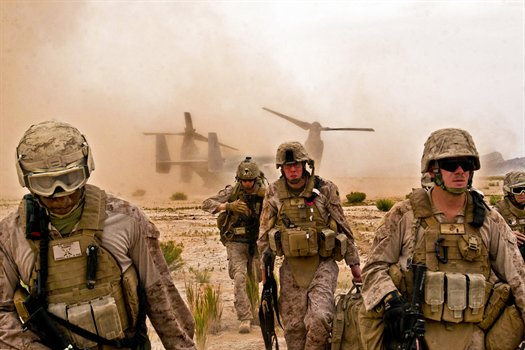 Vice President Joe Biden, during last week’s debate with VP candidate Paul Ryan, told tens of millions of Americans, yet again, that the US is leaving Afghanistan in 2014.
“We are leaving in 2014, period, and in the process, we’re going to be saving over the next 10 years another $800 billion,” Biden said. “We’ve been in this war for over a decade. The primary objective is almost completed. Now all we’re doing is putting the Kabul government in a position to be able to maintain their own security. It’s their responsibility, not America’s.”
But US and Afghan negotiators met in Kabul last week to talk about the formal security agreement that will govern the presence of US troops past 2014. And more such meetings are already set to take place.
This has been a long time coming. Reports have been coming out for almost a year saying that Washington has been working on a deal with Kabul to keep US troops in Afghanistan at least until 2024, a full decade beyond the withdrawal date the Obama administration has been touting.
NATO on Monday also announced it will also keep international troops in Afghanistan past 2014 alongside US troops, supposedly in training and advisory roles.
The Wall Street Journal reported last week that “Western officials have mentioned the residual American force as ranging from a few thousand to some 20,000.”
“In addition,” writes Micah Zenko, a fellow at the Council on Foreign Relations, “some US policymakers assume that Afghanistan will serve as hub for special operations raids and drone strikes into Pakistan.”
The complete and utter failure of the US and its NATO allies to get anything constructive done in Afghanistan for the past 11 years should be testament enough that another 11 years won’t do any good either.
The stated mission of the US in the war in Afghanistan has been to eliminate the Taliban and al-Qaeda and prevent their return by building up a stable Afghan government and independent security forces. Every one of these goals have been objective failures, and experts and commentators across the political spectrum acknowledge this.
The fact that the insurgency in Afghanistan is as strong as ever, even after 11 years of facing off against the world’s most advanced military, is an indication that it will remain alive and well so long as there are any occupation forces on the ground and so long as the Kabul government is propped up by hostile foreign governments. Staying in Afghanistan beyond 2014 – indeed, beyond tomorrow – makes no strategic, or moral sense.
- Shi'ite Iraqi Militants Fight Rebel Groups in Syria, in Increasingly Sectarian Proxy War - October 16th, 2012
and.....
Human Rights Violations 'Escalate Dramatically' on Both Sides
by Jason Ditz, October 16, 2012
Paulo Sergio Pinheiro, in charge of investigating alleged war crimes in Syria, has issued a report today at a news conference confirming that human rights violations are dramatically rising on both sides of the civil war.
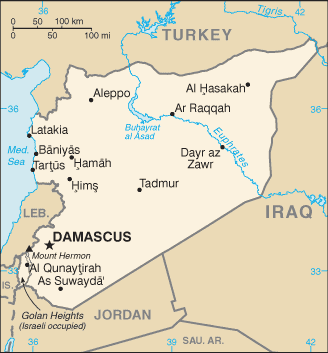 Pinheiro, a professor, also expressed major concerns about what he called the rise of “foreign militants and radical Jihadists” in the rebel movement, saying that they risk radicalizing the rest of the civil war.
Pinheiro also cautioned that the Free Syrian Army (FSA), the largest of the rebel factions and the one most overtly backed by Western nations, continued to commit some of the worst violations, adding that despite promises there is no sign the group is implementing any code of conduct for the war.
Concerns about human rights violations in the war have often ended up politicized at the UN, with Western nations shrugging off reports of rebel violations to focus on the regime, and Russia and China centering their criticism entirely on the rebels.
Last 5 posts by Jason Ditz
- Syrian Rebel Factions Unite Under Umbrella Group - October 16th, 2012
and......
Study Suggests US & Nato Munitions In Iraq Caused Surge In Birth Defects
October 16th, 2012 | Printable version |
Jasmin Ramsey

 After being asked to give his take on a recent report about the human costs of attacking Iran’s nuclear facilities, a prominent commentator on US-Iran relations said it was an “inexact science” and declined further comment even though he called the project a worthy endeavor. While the idea that inflicting physical damage on a nuclear site would cause serious harm to surrounding biological entities seems indisputable, at least the after-effects of the 2003 US-led invasion of Iraq tragically continues to serve as a case study for the impact a prolonged war with Iran — required if the goal is to set back Iran’s nuclear program by more than a few years — would have on the human population. According to a new study first reported on by the Independent, there has been a significant rise in Iraqi birth defects in cities that were hard-hit by US-led forces during the war:
The latest study found that in Fallujah, more than half of all babies surveyed were born with a birth defect between 2007 and 2010. Before the siege, this figure was more like one in 10. Prior to the turn of the millennium, fewer than 2 per cent of babies were born with a defect. More than 45 per cent of all pregnancies surveyed ended in miscarriage in the two years after 2004, up from only 10 per cent before the bombing. Between 2007 and 2010, one in six of all pregnancies ended in miscarriage.The new research, which looked at the health histories of 56 families in Fallujah, also examined births in Basra, in southern Iraq, attacked by British forces in 2003. Researchers found more than 20 babies out of 1,000 were born with defects in Al Basrah Maternity Hospital in 2003, a number that is 17 times higher than recorded a decade previously. In the past seven years, the number of malformed babies born increased by more than 60 per cent; 37 out of every 1,000 are now born with defects.


No comments:
Post a Comment