http://www.infowars.com/10-shocking-quotes-about-what-qe3-is-going-to-do-to-america/
10 Shocking Quotes About What QE3 Is Going To Do To America


Ready or not, QE3 is here, and the long-term effects of this reckless money printing by the Federal Reserve are going to be absolutely nightmarish. The Federal Reserve is hoping that buying $40 billion worth of mortgage-backed securities per month will spur more lending and more economic activity.
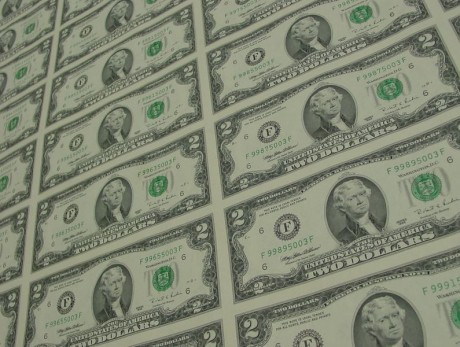
But that didn’t happen with either QE1 or QE2. Both times the banks just sat on most of the extra money. As I pointed out the other day, U.S. banks are already sitting on $1.6 trillion in excess reserves. So will pumping them up with more cash suddenly make them decide to start lending? Of course not. In addition, QE3 is not likely to produce many additional jobs. As I showed in a previous article, the employment level did not jump up as a result of either QE1 or QE2. So why will this time be different? But what did happen under both QE1 and QE2 is that a lot of the money ended up pumping up the financial markets. So once again we should see stock prices go up (at least in the short-term) and commodities such as gold, silver, food and oil should also rise. But that also means that average American families will be paying more for the basic necessities that they buy on a regular basis. The most dangerous aspect of QE3, however, is what it is going to do to the U.S. dollar. Most of the rest of the world uses the U.S. dollar to conduct international trade, and by choosing to recklessly print money Ben Bernanke is severely damaging international confidence in our currency. If at some point the rest of the world rejects the dollar and no longer wants to use it as a reserve currency we are going to be facing a crisis unlike anything we have ever seen before. The real debate about QE3 should not be about whether or not it will help the economy a little bit in the short-term. Rather, everyone should be talking about the long-term implications and about how QE3 is going to accelerate the destruction of the dollar.
But that didn’t happen with either QE1 or QE2. Both times the banks just sat on most of the extra money. As I pointed out the other day, U.S. banks are already sitting on $1.6 trillion in excess reserves. So will pumping them up with more cash suddenly make them decide to start lending? Of course not. In addition, QE3 is not likely to produce many additional jobs. As I showed in a previous article, the employment level did not jump up as a result of either QE1 or QE2. So why will this time be different? But what did happen under both QE1 and QE2 is that a lot of the money ended up pumping up the financial markets. So once again we should see stock prices go up (at least in the short-term) and commodities such as gold, silver, food and oil should also rise. But that also means that average American families will be paying more for the basic necessities that they buy on a regular basis. The most dangerous aspect of QE3, however, is what it is going to do to the U.S. dollar. Most of the rest of the world uses the U.S. dollar to conduct international trade, and by choosing to recklessly print money Ben Bernanke is severely damaging international confidence in our currency. If at some point the rest of the world rejects the dollar and no longer wants to use it as a reserve currency we are going to be facing a crisis unlike anything we have ever seen before. The real debate about QE3 should not be about whether or not it will help the economy a little bit in the short-term. Rather, everyone should be talking about the long-term implications and about how QE3 is going to accelerate the destruction of the dollar.
The following are 10 shocking quotes about what QE3 is going to do to America….
#1 Ron Paul
“It means we are weakening the dollar. We are trying to liquidate our debt through inflation. The consequence of what the Fed is doing is a lot more than just CPI. It has to do with malinvestment and people doing the wrong things at the wrong time. Believe me, there is plenty of that. The one thing that Bernanke has not achieved and it frustrates him, I can tell—is he gets no economic growth. He doesn’t do anything with the unemployment numbers. I think the country should have panicked over what the Fed is saying that we have lost control and the only thing we have left is massively creating new money out of thin air, which has not worked before, and is not going to work this time.”
“This is a disastrous monetary policy; it’s kamikaze monetary policy”
“This is the nuclear option for them. This is a never-ending weapon that is being fired at the middle class”
#4 Donald Trump
“People like me will benefit from this.”
“Quantitative easing—a fancy term for the Federal Reserve buying securities from predefined financial institutions, such as their investments in federal debt or mortgages—is fundamentally a regressiveredistribution program that has been boosting wealth for those already engaged in the financial sector or those who already own homes, but passing little along to the rest of the economy. It is a primary driver of income inequality formed by crony capitalism. And it is hurting prospects for economic growth down the road by promoting malinvestments in the economy.”
“That’s absolutely nonsense. The Fed is just propping up the banks.”
#7 Marc Faber
“I happen to believe that eventually we will have a systemic crisis and everything will collapse. But the question is really between here and then. Will everything collapse with Dow Jones 20,000 or 50,000 or 10 million? Mr. Bernanke is a money printer and, believe me, if Mr. Romney wins the election the next Fed chairman will also be a money printer. And so it will go on. The Europeans will print money. The Chinese will print money. Everybody will print money and the purchasing power of paper money will go down.”
“I think this will end up being a trillion-dollar commitment by the Fed”
“I want to be clear — While I think we can make a meaningful and significant contribution to reducing this problem, we can’t solve it. We don’t have tools that are strong enough to solve the unemployment problem”
“[T]he FED’s QE3 will stoke the stock market and commodity prices, but in our opinion will hurt the US economy and, by extension, credit quality. Issuing additional currency and depressing interest rates via the purchasing of MBS does little to raise the real GDP of the US, but does reduce the value of the dollar (because of the increase in money supply), and in turn increase the cost of commodities (see the recent rise in the prices of energy, gold, and other commodities). The increased cost of commodities will pressure profitability of businesses, and increase the costs of consumers thereby reducing consumer purchasing power. Hence, in our opinion QE3 will be detrimental to credit quality for the US….”
We have reached a major turning point in the financial history of the United States.
It would be hard to overstate how much damage that QE3 could potentially do to our financial system. If the rest of the world decides at some point that they no longer have confidence in our dollars and our debt then we are finished.
Sadly, the mainstream media does not seem to understand this, and most Americans gleefully believe whatever the mainstream media tells them.
So what do you think about QE3? Please feel free to post a comment with your opinion following this article….
and from Doug Noland.......
http://www.prudentbear.com/index.php/creditbubblebulletinview?art_id=10707
QE Forever
- September 14, 2012
“Congratulations Mr. Bernanke. I’m happy, my assets’ values go up. But as a responsible citizen I have to say the monetary policies of the U.S. will destroy the world.” Marc Faber, investor, analyst and writer extraordinaire, September 14, 2012
The S&P 400 Mid-cap Index enjoyed a two-week gain of 5.7%, closing today at a new record high. The small cap Russell 2000 gained 6.5% in 9 sessions, with the Nasdaq composite up 3.8%. Notable sector gains include the 16.1% two-week surge by the S&P 500 Homebuilding index (up 99% y-t-d). The KWB Bank index jumped 9.4% in two weeks, increasing 2012 gains to 31%. The Morgan Stanley Cyclical index rose 8.1% over the past 9 sessions. The Morgan Stanley Retail Index gained 6.2% in two weeks and closed today at a record high (up 23.5% y-t-d). Gains have certainly not been limited to the U.S. Spain’s IBEX 35 index has gained 14.7% in 10 sessions, outgained by the 14.9% rise in Italy’s MIB index. Germany’s DAX has gained 10.9% in two weeks to increase y-t-d gains to 25.7%. India’s Sensex enjoyed a two-week gain of 8.8%, with South Korea’s Kospi up 7.0%, Brazil’s Bovespa up 9.4% and Mexico’s Bolsa up 7.2%.
Thursday morning, as markets waited anxiously for the release of the FOMC policy statement, a CNBC anchor noted that a Twitter “Bernanke” imposter had tweeted something along these lines: “I put my pants on in the morning just like anyone else, one leg at a time. And when I have my pants on - I print money!”
If I can chuckle perhaps it will hold back the tears. It’s difficult not to be reflective – to ponder how things could ever have come to this. Thursday was another historic day for policymaking, for markets and for the perpetuation of history’s most spectacular financial mania. In the past I’ve noted that, in comparable circumstances, I have viewed my 14-year weekly chronicle of history’s greatest Credit Bubble as pretty much a great waste of effort. I have tried to warn of the dangers of an unanchored global financial “system.” I’ve done my best to illuminate the dangerous interplay between an unwieldy global pool of speculative finance and aggressive “activist” central bankers. I have forewarned of the perils of discretionary (as opposed to rules-based) policymaking - in particular highlighting the (long ago appreciated) fear that too much discretion ensures that monetary policy mistakes will only be followed by yet greater mistakes. I took strong objection to Dr. Bernanke’s doctrine and framework when he arrived at the Fed in 2002 and protested in vein when he was appointed Federal Reserve Chairman in early-2006.
In my initial CBB back in 1999, I tried to explain how an unfettered explosion of non-bank liabilities was fueling a dangerous Credit Bubble. Back then the consensus view held that “only banks created Credit.” What little Bubble analysis that existed at the time focused chiefly on Internet stocks. I was arguing that a radically changing financial landscape called for a new “Contemporary Theory of Money and Credit.” I also warned that new finance beckoned for judicious monetary management. Some years later (2007) Pimco’s Paul McCulley introduced the world to the phrase “shadow banking.”
I’ve never been fond of the term “shadow banking,” believing that the entire line of analysis was missing (avoiding) the most critical aspects of contemporary finance. From my analytical perspective, the issue was not so much that there were financial entities and institutions operating outside traditional banking channels and regulation. Rather, the momentous transformation of financial sector liabilities from (“staid”) bank loans/deposits to (“dynamic”) marketable debt instruments/obligations was altering traditional relationship between finance, the financial markets, asset prices and real economies. Importantly, unfettered Credit expansion was being driven by an explosion of securities and instruments changing hands – at, I might add, ever higher prices - in increasingly over-liquefied and ebullient markets. Certainly not coincidently, this was unfolding concurrently with the unprecedented proliferation of hedge funds, proprietary trading operations, derivatives and so forth. Our central bank was oblivious.
The confluence of proliferations in marketable debt and leveraged speculation profoundly altered the financial landscape. Fundamentally, there were no longer any restraints on Credit expansion. The old “fractional reserve banking” “deposit multiplier” was supplanted by the “infinite multiplier” associated with contemporary marketable Credit.
Essentially, speculative financial leveraging created an unlimited supply of Credit/marketplace liquidity. Unlimited supply, then, led to a wholesale mispricing (under-pricing) of finance. This was particularly problematic for asset markets, where the over-abundance of cheap Credit fueled asset price inflation. Higher asset prices, then, created heightened demand for additional Credit, which was satisfied at ongoing low borrowing costs. As Credit will do if not restrained, it all became self-reinforcing – or “recursive.” And as the quantity of unlimited, mispriced and asset-centric Credit exploded, resources throughout the entire economy were badly misallocated. A decade or so ago I explained the dangers of “Financial Arbitrage Capitalism.” Somehow, the notion that our system needs only greater quantities of mispriced and misallocated finance has yet to be discredited.
It was apparent by 1999 that the Greenspan Federal Reserve needed to respond aggressively to the changed financial landscape. The non-bank lenders, especially the GSEs, Wall Street firms and hedge funds, needed to come under more intensive regulation. Either that or Fed monetary management had to tighten significantly as part of a policy of “leaning against the wind” of rampant Credit expansion and associated asset inflation and Bubbles. Mounting systemic excesses were beckoning for tough love – but the Fed became comfortable doling out candy. It was always my hope that the Federal Reserve would eventually appreciate and respond to the increasingly obvious dangers associated with contemporary unfettered Credit and financial leveraging. As of approximately 12:30 p.m. Thursday, the little sliver of remaining hope was officially pronounced dead.
Instead of moving prudently to rein in egregious Credit and speculative excess, the Greenspan/Bernanke Fed’s went in the opposite direction and repeatedly provided extraordinary accommodation. Amazingly, each bursting Bubble led to only more aggressive monetary largess and more power for dysfunctional (Bubble-prone) markets. Thursday’s policy move by the Bernanke Fed essentially indicates full capitulation to what has become a highly speculative global marketplace. There is at this point no doubt in my mind that we are witnessing the greatest monetary fiasco ever.
In early-2009 I pleaded, “While I understand the necessity of stemming financial collapse, please don’t go down the policy path of fueling a Treasury and government finance Bubble – one at the very heart of our Credit system.” Never at the time could I have imagined the extent to which the Bernanke Fed would be willing to inflate history’s greatest Bubble. Chairman Bernanke has gone from resorting to radical policies during a period of acute financial crisis to one of imposing only more radical policymaking three years into recovery. He has gone from trying to stem Credit contraction to aggressively promoting rapid (non-productive) Credit expansion. Dr. Bernanke has evolved from radical liquidity injections meant to reverse marketplace illiquidity, to pre-committing to years of open-ended money printing in the midst of heightened inflationary pressures and dangerously speculative financial markets. Of course, justification and rationalization are everywhere. History will be unkind.
I have no reason to doubt the commonly held view that Dr. Bernanke is a decent and honorable man. I wish he was a scoundrel – then perhaps someone would do something to rein him in. Many of our nation’s leading economist lavish praise on Dr. Bernanke latest move, while some, amazingly, say he still hasn’t done enough. Quite regrettably, it will require a terrible crisis for the establishment to change policy doctrine, along with economic analysis more generally.
There’s no reasonable justification for Dr. Bernanke taking such extreme risks with financial and economic stability. And I struggle understanding how he doesn’t see the likely consequences. After the cult of Greenspan, I thought we had learned a lesson from having one individual exert such power and influence. Indeed, the Federal Reserve has now grossly overstepped its role. Never was it anticipated that the Fed would resort to massive purchases of Treasury bonds and mortgage-backed securities in a non-crisis environment. Never was it contemplated that our central bank would resort to pre-committing to massive ongoing money printing in the name of reducing the unemployment rate.
I’ll state what others hesitate to admit: this week our central bank took a giant leap from radical to virtual rogue central banking. If Bernanke’s plan was to leapfrog the audacious Draghi ECB, our sinking currency – even against the euro – is confirmation of his success. If his goal was to provide markets a Benjamin Strong-like “coup de whiskey” – he should instead fear the dangerous instability central bankers have wrought on global markets and economies. And I am all too familiar to the adversities of being a naysayer in the midst of Bubble mania. I’ve read about it, I’ve lived it and I’m ok with it – and actually am motivated by it. I highlighted last week the ominous divergence between world fundamentals and the markets. And this week, well, global markets enjoyed just a spectacular time of it. Away from the Bloomberg screen, it sure seemed like a less than comforting week for the world at large.
As an analyst of Bubbles, I often quip that they tend to “go to incredible extremes - and then double.” Timing the bursting of a Bubble is a very challenging – if not nearly impossible – proposition. Yet this in no way should cloud the harsh reality that the longer a Bubble is accommodated the more devastating the unavoidable consequences. It is, as well, the nature of speculative manias for things to turn crazy in the destabilizing terminal-phase. The past few weeks – with more than ample Bubble accommodation and craziness - really make me fear that eventual day of reckoning.
* * *
Commodities Watch:
September 12 – Bloomberg (Jeff Wilson): “The U.S. soybean crop will drop to the lowest in nine years after the hottest and driest June and July in the Midwest since 1936, the government said. Prices rose the most in three weeks. The harvest will total 2.634 billion bushels (71.69 million metric tons), down from 3.056 billion in 2011 and the lowest since 2003… ‘A third straight year of reduced U.S. production means soybean buyers face an unprecedented tight supply for the next 12 months,’ Jerry Gidel, the chief feed-grain analyst at Rice Dairy LLC in Chicago…”
September 12 – Bloomberg (Supunnabul Suwannakij and Luzi Ann Javier): “Thailand, the world’s largest rice shipper, will sell more than half of its record inventory to governments including China, according to Commerce Minister Boonsong Teriyapirom… The country will sell a total of 7.328 million metric tons…”
September 14 – Bloomberg (Debarati Roy and Maria Kolesnikova): “Platinum rose, capping the longest rally in 25 years, after the Federal Reserve took steps to bolster the U.S. economy and as strikes halted output at mines in South Africa, the world’s largest producer.”
The CRB index jumped 3.0% this week (up 5.1% y-t-d). The Goldman Sachs Commodities Index rose 2.6% (up 7.6%). Spot Gold jumped 2.0% to $1,770 (up 13.2%). Silver gained 2.9% to $34.66 (up 2%). October Crude jumped $2.58 to $99.00 (unchanged). October Gasoline was little changed (up 14%), while October Natural Gas surged 9.7% (down 1%). December Copper jumped 5.1% (up 12%). September Wheat added 1.4% (up 38%), while September Corn declined 2.2% (up 20%).
Global Credit Watch:
September 12 – Bloomberg (Karin Matussek): “Germany’s top constitutional court rejected efforts to block a permanent euro-area rescue fund, handing a victory to Chancellor Angela Merkel, who championed the 500 billion-euro ($645bn) bailout. The Federal Constitutional Court in Karlsruhe dismissed motions that sought to block the European Stability Mechanism, while ruling Germany’s 190 billion-euro contribution can’t be increased without legislative approval. The court said Germany can ratify the ESM if it includes binding caveats that it won’t be forced to assume higher liabilities without its consent. ‘We are an important step closer to our goal of stabilizing the euro,’ German Economy Minister and Vice Chancellor Philipp Roesler told reporters… ‘It has always been the goal of this government’ to establish a ‘clear limit and to include parliament in all important decisions.’”
September 14 – Bloomberg (Emma Ross-Thomas): “Spanish regions’ debt load continued to swell in the second quarter, as the cash-strapped local administrations urged the government to speed up its planned bailout fund. The regions’ debt rose to 14.2% of gross domestic product from 13.8% in the first three months of the year, the Bank of Spain in Madrid said… The overall public debt load rose to 75.9% of GDP from 72.9% in the prior quarter.”
September 11 – Bloomberg (Ben Sills): “Prime Minister Mariano Rajoy said he won’t allow the European Union or the European Central Bank to stipulate how Spain narrows its budget deficit as a condition for buying the country’s bonds. Rajoy pledged that Spain will meet its targets for reducing its budget shortfall this year and next and defended his government’s right to set spending limits on individual policies, in his first television interview since taking office in December. ‘We need to meet the budget deficit commitment, which is the most important challenge we have as a country,’ Rajoy said… ‘I won’t accept them telling us which are the specific policies where we have to cut or not.’”
September 12 – Bloomberg (Emma Ross-Thomas): “Spanish leaders said they can delay a decision on seeking a bailout as its bond yields ease, with their focus on ensuring any rescue doesn’t roil markets. Prime Minister Mariano Rajoy told Parliament it’s not clear if Spain needs help as the European Central Bank’s crisis plan has cut borrowing costs. There’s no ‘urgency’ because the ECB’s move put the Treasury in a more ‘comfortable’ position, Deputy Economy Minister Fernando Jimenez Latorre said. ‘The important thing is that when whatever assistance that is needed is requested, that it should be well received in the markets,’ Jimenez Latorre told reporters…”
September 14 – Bloomberg (Ben Sills and Emma Ross-Thomas): “Catalan President Artur Mas said Spain should debate staying in the euro as leaders consider seeking a European bailout, becoming the most senior Spanish official to question the nation’s single-currency membership. ‘If we want to have a serious debate, the first question has to be whether we want to be in the euro or not,’ Mas said… ‘If you say yes, you have to accept the rules of this game. You could say no.’ Catalonia, which accounts for 20% of the nation’s economy and is home to some of the country’s biggest companies, is battling Prime Minister Mariano Rajoy for greater control over taxes as austerity measures have undermined voters’ willingness to subsidize poorer regions. Mas raised the stakes this week, saying if Rajoy doesn’t give his administration in Barcelona greater autonomy, he’ll push for full independence. Mas said Catalonia and Spain are ‘tired of each other’…”
September 13 – Bloomberg (Jeff Black and Stelios Orphanides): “European Central Bank Governing Council member Panicos Demetriades said the bank might not have to spend a cent on government bonds. The threat of unlimited buying under the ECB’s new bond- purchase program may mean that ‘in the end, action is not needed,’ Demetriades, who heads the Central Bank of Cyprus… ‘No one will speculate against the unlimited firepower of a central bank. This is what stabilizes currencies of countries where investors know that. One wouldn’t gamble against the Federal Reserve, for example.’ Spanish and Italian bond yields have plunged since ECB President Mario Draghi pledged on July 26 to do what’s needed to preserve the euro.”
Global Bubble Watch:
September 13 – Wall Street Journal (Jon Hilsenrath and Kristina Peterson): “The Federal Reserve, frustrated by persistently high U.S. unemployment and the torpid recovery, launched an aggressive program to spur the economy through open-ended commitments to buy mortgage-backed securities and a promise to keep interest rates low for years. In the most significant of its new moves, the Fed said Thursday it would buy $40 billion of mortgage-backed securities every month and would keep buying them until the job market improves, an unusually strong commitment by the central bank. ‘We want to see more jobs,’ Fed Chairman Ben Bernanke said… explaining the rationale for the Fed's actions. ‘We want to see lower unemployment. We want to see a stronger economy that can cause the improvement to be sustained.’ The Fed's announcement sent investors piling into stocks, gold, the euro and other assets seen as likely to benefit from the extra liquidity."
September 14 – Associated Press: “Egan-Jones is downgrading its rating on U.S. debt to AA- from AA, citing Federal Reserve plans to try to stimulate the economy. The credit rating agency says the Fed's plans to buy mortgage bonds will likely hurt the economy more than help it. Egan-Jones says the plan will reduce the value of the dollar and raise the price of oil and other commodities, hurting businesses and consumers.”
September 14 – Bloomberg (Sarika Gangar): “Corporate bond offerings in the U.S. soared this week to the busiest pace in six months as borrowing costs tumbled and the Federal Reserve unleashed its third round of quantitative easing to stimulate the economy. Walgreen… and …AstraZeneca Plc led borrowers selling at least $43.2 billion in bonds, the most since $60 billion was issued in the week ended March 9… Yields on speculative-grade debt dropped to an unprecedented low, breaking the previous record set more than 15 months ago.”
September 11 – Bloomberg (Bradley Keoun): “JPMorgan… and Bank of America… are helping clients find an extra $2.6 trillion to back derivatives trades amid signs that a shortage of quality collateral will erode efforts to safeguard the financial system. Starting next year, new rules designed to prevent another meltdown will force traders to post U.S. Treasury bonds or other top-rated holdings to guarantee more of their bets. The change takes effect as the $10.8 trillion market for Treasuries is already stretched thin by banks rebuilding balance sheets and investors seeking safety, leaving fewer bonds available to backstop the $648 trillion derivatives market. The solution: At least seven banks plan to let customers swap lower-rated securities that don’t meet standards in return for a loan of Treasuries or similar holdings that do qualify, a process dubbed ‘collateral transformation.’ That’s raising concerns among investors, bank executives and academics that measures intended to avert risk are hiding it instead. ‘The dealers look after their own interests, and they won’t necessarily look after the systemic risks that are associated with this,’ said Darrell Duffie, a finance professor at Stanford University who has studied the derivatives and securities-lending markets. ‘Regulators are probably going to become aware of it once the practice gets big enough.’”
September 11 – Bloomberg (John Detrixhe): “Moody’s… said it may join Standard & Poor’s in downgrading the U.S.’s credit rating unless Congress next year reduces the percentage of debt- to-gross-domestic-product during budget negotiations. The U.S. economy will probably tip into recession next year if lawmakers and President Barack Obama can’t break an impasse over the federal budget and if George W. Bush-era tax cuts expire in what’s become known as the ‘fiscal cliff,’ according to a report by the nonpartisan Congressional Budget Office…”
September 14 – Bloomberg (Lisa Abramowicz): “Measures of [bond market] stress are at the lowest in more than two years following Federal Reserve Chairman Ben S. Bernanke’s unveiling of additional stimulus measures.”
September 14 – Bloomberg (Lisa Abramowicz): “Ben S. Bernanke is sending junk-bond bears into hiding. The number of shares borrowed to bet against State Street Corp.’s exchange-traded high-yield bond fund has plunged 49% since Aug. 30, pushing its price to a 15-month high… The most distressed securities are outperforming the highest speculative- grade tier this month by the most since February…”
September 12 – Bloomberg (Josiane Kremer): “Norway’s banks may face stricter lending rules as the country’s financial regulator fights to prevent a repeat of a 1980s housing market bust that triggered a banking crisis and plunged the economy into a recession. ‘The longer a situation where debt is growing more than income and housing prices grow substantially more than income, the higher the risk is for this development to end in a bubble that eventually bursts,’ Morten Baltzersen, director general at the Financial Supervisory Authority, said… ‘This development gives reason for concern.’ Property prices, already at a record, are rising an annual 8% on average as credit growth drives private debt burdens to more than 200% of disposable incomes next year, the central bank estimates. The FSA is stepping up its warnings one year after urging banks to rein in lending in the world’s third-richest nation per capita amid evidence overheating is threatening financial stability.”
September 14 – Bloomberg (Shamim Adam): “The Federal Reserve’s third round of quantitative easing prompted Hong Kong to say the monetary stimulus risks pushing up the city’s property prices while Thailand said it was a ‘good sign’ for the global economy. ‘The launch of QE3 and the short-term improvement of the European debt crisis will increase the risk of overheating in Hong Kong’s asset market,’ Norman Chan, chief executive of the Hong Kong Monetary Authority, said…”


No comments:
Post a Comment