http://www.guardian.co.uk/money/blog/2012/may/18/euro-crisis-cyprus-next
 Submitted by Phoenix Capital Research on 05/18/2012 11:41 -0400

Euro crisis: Is Cyprus next for the Grexit?
Cyprus, with its out-sized banking sector equal to 835% its GDP, could be the next knock-on from the Greek euro crisis
 Email
Email
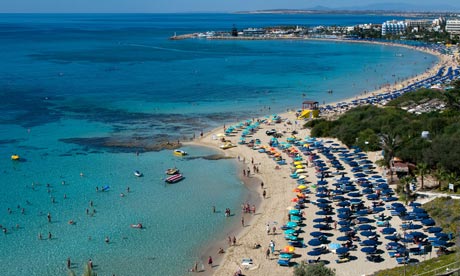
All at sea: What will the future hold for Cyprus if Greece exits the euro? Photograph: Alamy
One of the mysteries of the Greek financial crisis is that there are any deposits left in the stricken country's domestic banks. Since 2009, it's estimated that €2-€3bn has been withdrawn from Greek banks every month. The pace has picked up markedly in recent days; on Monday alone €700m was taken out of the banks, and the Greek president told reporters: "The strength of banks is very weak right now."
A friend recently returned from a 600km trek across the countryside outside of Athens. Many roadside shops and restaurants were abandoned or locked. Locals were not willing to accept cards. Everything had to be in cash, and she sensed a fear that money tied up in the banking system would be lost should it go into meltdown.
Yet according to Greece's central bank, total deposits held by domestic residents and companies stood at €165.36bn in March. Given the likely sequence of events should Greece leave the euro – accounts frozen, converted into new drachmas and then devalued by around half – it's extraordinary there is any money on deposit at all.
I can add little to the pundits speculating whether there will be a "Grexit". But the lack of focus on Cyprus is surprising, especially given the 80,000 Brits living there. It is, of course, an independent country with its own central bank. A blog for British residents I read this week tried to calm fears about a knock-on from Greece, claiming the island has a robust deposit protection scheme. So did Iceland. Cyprus's out-sized banking sector is equal to 835% of the island's GDP, says the FT.
More worryingly, the operations of the Cypriot banks in Greece alone are equal to 130% of Cypriot GDP. Some claim the island has benefited from flows out of Greece. But when one of the country's leading banks this week required a £2bn cash injection, it doesn't ring true. Economists who talk about contagion from Greece always point to Spain and Portugal. But surely it will be Cyprus next? And if the British in Cyprus have sense they won't rely on articles extolling the island's deposit protection scheme – although savers here with the Bank of Cyprus (UK) are covered by Britain's compensation scheme.
and....
I Just Got Back From the EU... and It's Worse Than You Imagined
I just got off the plane from Europe. I went there because I wanted to see the effects of the French election as well as get an "on the ground" perspective of what's really happening in Europe.
I can tell you, the situation in Europe is far FAR worse than the media is even willing to acknowledge.
See below:
The above image was taken at 9PM on Paris’ Avenue de Champs-Élysées (the road leading to the Arc de Triumph) on May 8th, the night Socialist Francois Hollande beat Nicolas Sarkozy.
This is a major four-way intersection, come to an almost complete gridlock as Parisian youth park their cars to block traffic.
The sound was deafening as these kids honked their horns, screamed, sang songs, and waved flags. Did they care about traffic? Nope. Some of them even got out on top of their cars to smoke and dance (like the young man in the white pants in the image above).
These kids, like most youth in the EU are sick of getting the shaft from the political elite. Youth unemployment in France is near 25%. It's at an astounding 50% in Greece and Spain.
So French youth, like others, voted to kick Nicolas Sarkozy out of office. But that's not the BIG story from the French elections.
You see, French Presidential elections take place in two rounds. During the first round, voters will vote for anyone running. The two candidates who receive the most votes will then proceed to the second round, the winner of which will become France's President.
Hollande and Sarkozy were the winners of the first round. But as the final tally in the second round revealed (51% vs. 48%) voters weren't exactly thrilled with either one of them.
Instead, the BIG STORY in the French elections was the fact that the hard right, anti-Euro, anti-immigration party, the Front National Party, or NFP, took the most votes from French youth.
That is correct. When it came time to vote in round one, more French youth voted for a party whose leader wants to break up the Euro, who wants to deal with immigration by kicking out any immigrant who cannot adhere to French principles or who commits a crime, and who once compared the legal French tolerance of Muslims praying in the streets to putting up with Nazi occupation.
Oh, and her father, who founded the NFP, wanted to do away with the concept of immigration completely and once commented that Germany's occupation of France during WWII was "not particularly inhumane..."
As a whole, the NFP took in 20% of ALL French votes during the first round of the French elections. That’s a record high for the party and not far off from Sarkozy’s and Hollande’s first round showings of 25% and 28% respectively.
Put another way, Nationalism is on the rise in France. And it's not over by any stretch.
France will be holding elections for its lower house, the National Assembly, on June 10th and June 17th.
Right now the socialists are in the lead to win, leaving the loosely organized center-right party, Union for a Popular Movement (UMP), with the following options:
1) Join forces with the NFP to take the control of the National Assembly, or...
2) Hand France completely over to the Socialists
I cannot say how this will play out. But for now, we must take into account that there is a very real possibility that the NFP may take control of France's lower house.
IF this happens and Francois Hollande proves to be a Presidential dud, then it is not a stretch to imagine that the NFP will gain even more traction in French politics.
Put another way, France could become a Nationalistic, anti-EU nation in the not so distant future.
And that is nothing compared to what's happened in Greece.
Greece has gone through two Governments since its Crisis began: one was the long- standing President, the other was an EU-appointed bureaucrat.
Now, Greece cannot even form a majority in its parliament. In fact, by the look of things there will be a run-off election in mid-June in which the ANTI-BAILOUT Syriza party will win the majority.
If this happens you can kiss the Second Greek Bailout good-bye. And that's the BEST potential outcome here: the alternative is once again Greece cannot form a majority in parliament and the country descends into total anarchy and chaos.
After all, if Greece cannot form a government... who will be negotiating on its debt/ bailout agreements/ etc. with the rest of the EU?
Make no mistake, the situation in Europe is bad... How BAD? Well, France, Spain, and Germany have ALL implemented border controls.
That's not a typo. Spain, France, and Germany can each close their borders for up to 30 days at any point if they so choose.
Why are they doing this? Because they know that when the stuff hits the fan and the EU collapses (which it will in the next few months) people are going to attempt to flee with their money... so they have made it so that no one can get it... and no one can get out.
The US media has completely ignored this story because the implications are truly horrifying: that the EU and its banking system could very easily collapse in the coming months.
After all, there are already bank runs taking place in Spain and Greece. Once things pick up steam NO ONE will be immune.
"So what?" You might say. "The EU won't affect the US or other banking systems."
WRONG.
According to Reuters once you include Spain and Italy as well as Credit Default Swaps and indirect exposure to Europe, US banks have roughly $4 TRILLION in potential exposure to the EU.
To put that number in perspective, the entire US banking system is $12 trillion in size.
Heck, no less than Ben Bernanke, Mr. "the sub-prime crisis is contained" has publicly admitted that if the EU goes down, it will potentially take the US with it.
Make no mistake, what's coming will be bigger and worse than 2008. We're talking about bank holidays, civil unrest, and the worse.
* * * *


No comments:
Post a Comment