http://www.zerohedge.com/contributed/2012-20-18/rumors-denials-and-visions-chaos
 Submitted by testosteronepit on 05/18/2012 22:19 -0400
http://theeconomiccollapseblog.com/archives/18-signs-that-the-banking-crisis-in-europe-has-just-gone-from-bad-to-worse
 and....
and....
http://www.guardian.co.uk/world/2012/may/18/g8-nato-summits-leaders-outcome-guide
Rumors, Denials, and Visions of Chaos
Wolf Richter www.testosteronepit.com
While the G-8 leaders are schmoozing with President Obama during their slumber party at Camp David, and while the parallel NATO summit and its protests and rallies are wreaking havoc on the streets in Chicago, Europe is re-descending into rumor hell—where good rumors, as we found out last summer and fall, are head fakes that cause huge rallies in the markets, and where bad rumors, though passionately denied by all sides, turn out to be true.
The latest was that the European Central Bank and European Commission were preparing contingency plans for Greece’s exit from the Eurozone. Actually, it wasn’t even a rumor. EU Trade Commissioner Karel De Gucht declared it during an interview: “A year and a half ago, there may have been the danger of a domino effect,” he said, “but today there are, both within the European Central Bank and the European Commission, services that are working on emergency scenarios in case Greece doesn't make it.”
A momentous statement. The first time ever that an EU official admitted the existence of contingency plans—though everyone had long assumed that they existed. Clearly, Europe’s political power brokers, disparate as they are, have gotten tired of bending to Greece’s wily political elite and their threats. Read.... The Greek Extortion Racket in its Final Spasm.
Alas, within hours, the very European Commission where De Gucht serves as the Trade Commissioner stabbed him in the back: “We completely deny that we are working on any such emergency plans,” said a spokesperson for the Commission. “We are concentrating all our efforts on supporting Greece and keeping it in the Eurozone. That is the scenario we are working on.”
Indeed. And then there was the rumor about printing money. Not the kind that the Fed, the ECB, and other central banks are printing, but real money. De La Rue, a British company that prints currency for 150 countries, among other business activities, has apparently been asked some time ago to prepare contingency plans for printing Greek drachma notes, according to unconfirmed rumors that just surfaced. People who got wind of it earlier have driven up the stock (DLAR.L) 11% since mid-April—possibly a confirmation.
Greece’s return to the drachma can’t be done overnight. It would be a complex and costly transition that would require time. The day Greece switches to the drachma, it will have to have huge quantities of drachma notes on hand; and preparations are apparently underway to print them. The Bank of Greece has its own printing outfit that has been printing euros ever since it stopped printing drachmas. It would pick up much of the volume, but any demand beyond its capacity would have to be farmed out to other printers. Hence De La Rue.
Banks have already been preparing for the drachma. Turns out, some banks never actually removed their drachma capabilities, perhaps because they lacked confidence in Greece’s ability to keep the euro, or perhaps because they—the banks, not the Greeks—were simply too lazy. And they’d be able to switch from one moment to the next. But it would still be a complicated mess laced with capital controls and all the banking nightmares associated with them. It would be fraught with risks, legal issues, and uncertainties.
A return to the drachma—and its rapid devaluation—would, however, do wonders for Greece's tourism industry, the second largest industry after shipping. In 2011, the number of international visitors actually rose by 9.5% from the prior year, and they spent 9.3% more. The industry is hugely important to Greece: it provides 18.4% of the country’s jobs and makes up 16.5% of the economy.
But now reservations for the summer have collapsed by a stunning 50%! "Political instability," explains Georgios Drakopoulos Director General of the Association of Greek Tourism Enterprises (SETE). And bad publicity, strikes, demonstrations, and images of Athens on fire—the only things foreign media showed, Drakopoulos lamented, though in the rest of Greece, “the conditions are the exact opposite.” And once those issues disappear from the media, a devalued drachma would turn Greece into an irresistible and highly affordable paradise for tourists of all types, including waves of budget tourists—all of whom would bring in hard currency.
“The Greeks are still debt slaves, and will be until they tell Brussels to take a hike,” said David Stockman, Director of the Office of Management and Budget under President Reagan. With similarly pungent flourishes, he talked of a “paralyzed” Fed that is in its “final days,” hostage of Wall Street “robots” trading in markets that are “artificially medicated.” For his awesome interview, read.... The Emperor is Naked: David Stockman.
and.....
With each passing day, the banking crisis in Europe escalates. European banks are having their credit ratings downgraded in waves, bond yields are soaring and billions of euros are being pulled out of banks all across the eurozone. The situation in Europe is rapidly going from bad to worse. It is almost like watching air being let out of a balloon. The key to any financial system is confidence, and right now confidence in banks in Greece, Italy, Spain and Portugal is declining at an alarming rate. When things hit the fan in Europe, it is going to be much safer to have your money in Swiss banks or German banks than in Greek banks, Spanish banks or Italian banks. Millions of people in Europe are starting to realize that a "euro" is not necessarily always going to be a "euro" and they are starting to panic. The Greek banking system is already on the verge of total collapse, and at this rate it is only a matter of time before we see some major Spanish and Italian banks start to fail. In fact it has already been announced that the fourth largest bank in Spain, Bankia, will be getting bailed out by the Spanish government. It is only a matter of time before we hear more announcements like this. Right now, events are moving so quickly in Europe that it is hard to keep up with them all. But this is what usually happens in the financial world. When things go well, it tends to happen over an extended period of time. When things fall apart, it tends to happen very rapidly.
And at the moment, things across the pond are moving at a pace that is absolutely breathtaking.
The following are 18 signs that the banking crisis in Europe has just gone from bad to worse....
#1 Moody's has announced that it has downgraded the credit ratings of 16 Spanish banks. Included was Banco Santander, the largest bank in the eurozone.
#2 Shares of the fourth largest bank in Spain, Bankia, dropped 14 percent on Thursday.
#3 Overall, shares of Bankia have declined by 61 percent since last July.
#4 Shares of the largest bank in Italy, Unicredit, dropped by about 6 percent on Thursday.
#5 According to CNBC, a Spanish bond auction on Thursday went very poorly....
The Spanish Treasury had to pay around 5 percent to attract buyers of three- and four-year bonds. The longer-dated paper sold with a yield of 5.106 percent, way above the 3.374 percent the last time it was auctioned.
#6 The yield on 10 year Spanish bonds is back above 6 percent.
#7 In recent days, about eight times more money than usual has been pulled out of Greek banks.
#8 Fitch has slashed the long-term credit rating for Greece from B- to CCC.
#9 The European Central Bank has cut off direct lending to at least 4 Greek banks.
#10 According to a recent German documentary, financial records at the Ministry of Finance in Athens are being stored in garbage bags and shopping carts.
#11 The euro hit a 4 month low against the U.S. dollar on Thursday.
#12 It has been announced that the Spanish economy and the Italian economy are officially in recession.
#13 The Spanish government is becoming increasingly concerned about the bad loans that are mounting at major Spanish banks. The following is from a recent Bloomberg article....
The government has asked lenders to increase provisions for bad debt by 54 billion euros ($70 billion) to 166 billion euros. That’s enough to cover losses of about 50 percent on loans to property developers and construction firms, according to the Bank of Spain. There wouldn’t be anything left for defaults on more than 1.4 trillion euros of home loans and corporate debt.Taking those into account, banks would need to increase provisions by as much as five times what the government says, or 270 billion euros, according to estimates by the Centre for European Policy Studies, a Brussels-based research group. Plugging that hole would increase Spain’s public debt by almost 50 percent or force it to seek a bailout, following in the footsteps of Ireland, Greece and Portugal.
#14 Civil unrest is rising to dangerous levels in Italy. The Italian government has assigned bodyguards to 550 individuals and has increased security at about 14,000 locations in response to recent violence related to the economic crisis.
#15 Governments all over Europe are rapidly making preparations for a Greek exit from the euro. The following is from a recent article in the Guardian....
The British government is making urgent preparations to cope with the fallout of a possible Greek exit from the single currency, after the governor of the Bank of England, Sir Mervyn King, warned that Europe was "tearing itself apart".
#16 According to CNBC, the banking crisis in Europe is beginning to affect global trade....
The euro zone debt crisis is affecting trade as companies shy away from dealing with firms and banks in countries deemed at risk of contagion, a senior banker said on Thursday.
#17 Moody's downgraded the credit ratings of 26 Italian banks on Monday.
#18 Moody's has announced that it is reviewing the credit ratings of 114 more European financial institutions.
Newspapers all over the globe are speaking breathlessly of a potential Greek exit from the euro, but it is very unlikely to happen before the next Greek election on June 17th.
The rest of Europe is going to continue to financially support Greece until a new government takes power.
If the new government is willing to accept the previous bailout agreements, then financial support for Greece will continue.
If the new government is not willing to accept the previous bailout agreements, then financial support for Greece will stop.
If that happens, the bank runs in Europe will likely become a lot worse.
But for now, Greece almost certainly has at least one more month in the euro.
Beyond that, there is no telling what is going to happen.
Greece is the first domino. If Greece falls, you can count on others to eventually start tumbling as well.
The second half of 2012 is going to be fascinating to watch.
Hopefully things will not be as bad as many of us now fear they may be.
and....G8 to discuss euro zone crisis at Camp David summit

Group of Eight leaders will discuss the euro zone crisis and other economic issues, including oil market pressures at a G8 summit in the US today.
The leaders, including newly elected French president Francois Hollande and Russian prime minister Dmitry Medvedev, agreed in their initial discussions at Camp David last night that Iran needs to disclose more about its nuclear ambitions and that it was time to focus on a political transition in Syria.
The leaders also stressed North Korea needed to adhere to international norms on nuclear issues and said it would face more isolation if it "continues down the path of provocation," an official said.
British prime minister David Cameron will today join the other world leaders in talks set to be dominated by the deepening crisis over the euro zone.
Greece confirmed today that it would a hold a repeat general election on June 17th, after party leaders failed to form a coalition government following an inconclusive election.
US president Barak Obama will press European leaders to ease up on fiscal austerity and focus on economic growth at a summit that will discuss ways to stem turmoil in the euro zone and head off the risk of global contagion.
Mr Obama and leaders from other large economic powers will try to forge a common approach to tackling a crisis that threatens the future of Europe's 17-nation single currency.
Though no major policy decisions are expected from the Group of Eight summit, leaders hope they can bridge enough of their differences to soothe rattled financial markets after worries about the risk of a Greek exit from the euro zone sent European stock prices to their lowest level since December.
"Hopefully we'll get some stuff done," Mr Obama told Italian prime minister Mario Monti as he and other summit participants arrived for evening dinner last night at a lodge at the secluded presidential retreat. Mr Obama earlier in the day aligned himself with Mr Monti and new French president Francois Hollande by urging a solution to the euro zone crisis that combines fiscal belt-tightening measures with a "strong growth agenda."
On the other side of the debate is German chancellor Angela Merkel, who has pushed fiscal austerity as a means of bringing down huge debt levels that are burdening European economies. Voters in euro zone countries have shown frustration with that approach, ejecting governments such as that of Nicolas Sarkozy, who was defeated by Mr Hollande, a socialist, in the May 6th French presidential election.
A draft of the summit communique shown to Reuters will stress an "imperative to create growth and jobs." Also on the summit agenda are concerns about oil and food prices as well as Afghanistan, Iran, Syria and North Korea.Speculation has grown that Mr Obama will use an energy session at the G8 to seek support to tap emergency oil reserves before a European Union embargo of Iranian crude takes effect in July.
But with oil prices already sliding, a move by Mr Obama to tap the strategic petroleum reserve - alone or along with other countries - could expose him to criticism that the emergency supply should only be touched in a supply crisis.
The Camp David summit kicked off four days of intensive diplomacy that will test leaders' ability to quell unease over the threat of another financial meltdown as well as plans to wind down the unpopular war in Afghanistan. After the Camp David talks wrap up late this afternoon, Mr Obama will fly to his home town of Chicago where he will host a two-day Nato meeting at which the Afghanistan war will be the central topic.
Mr Medvedev is standing in for Russian president Vladimir Putin at the meeting, which also draws together leaders from the United States, Canada, Britain, France, Germany, Italy and Japan.
At the end of last night's dinner, Mr Obama had a chocolate birthday cake delivered for Japanese prime minister Yoshihiko Noda, whose birthday is tomorrow.
http://www.guardian.co.uk/world/2012/may/18/g8-nato-summits-leaders-outcome-guide
G8 and Nato summits: will our world leaders get anything done?
As protesters and delegations descend on Chicago and Maryland this weekend, a guide to what's on (and off) the table
 Email
Email
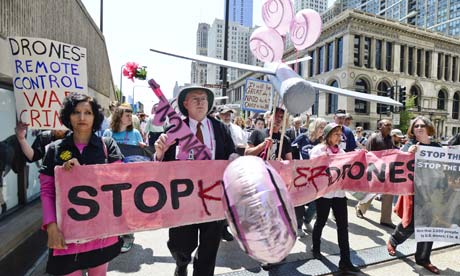
Protesters against Nato drone strikes march in Chicago ahead of what is likely to be a headache of a weekend for police. Photograph: Tannen Maury/EPA
World leaders will fly into the US on Friday for four days of intense diplomacy, against a backdrop of the deepening eurozone crisis and tension in the international military coalition in Afghanistan.
After delivering a speech on international development, Barack Obamawill meet new French president François Hollande at the White House before heading to Camp David on Friday evening to welcome the other leaders of the G8, the club of the wealthiest nations. After that winds up on Saturday, the leaders will move to Chicago for a meeting of Nato.
The discussions throughout the weekend will be dominated by the euro crisis and Afghanistan, but a few hours have been put aside for discussion about aid for the developing world.
Meanwhile, protesters are gathering in the small Maryland towns nearest Camp David and in Chicago. They will be joined by more than 2,000 journalists who have sought accreditation.
Motorcades from the airport to the city and around the various venues for 60 delegations translates into a security headache for Chicago police, with major traffic disruption and large sections of the city closed off. Is it worth it? And what is likely to have been accomplished when the delegations fly back home on Monday?
Eurozone crisis
Obama will use informal discussions at Camp David to see if he can push European leaders to move towards a strategy based on stimulus rather than spending cuts to help speed up an end to the economic crisis.
There are growing fears in the White House that Obama's re-election chances could be badly damaged by the eurozone crisis.
Obama has new ally in Hollande, who favours a stimulus package to help growth.
Heather Conley, a European specialist at the Washington-based Center for Strategic and International Studies, anticipated some intense conversations and walks in the woods – but said Obama's role is limited.
"Nevertheless, I think the president can play a role of listening, helping leaders find common ground … And we are going to have to watch how this plays out, with the frustration of recognising that it will have a profound impact for the global economy and for the US," Conley said.
Bruce Jones, a senior fellow at the Brookings Institution, acknowledged the potential impact on the US election. "Obama has a lot riding on the Europeans getting this right in terms of job impacts and the range of other impacts. But even if he wasn't in an election season, any president of theUnited States has a lot riding on the Europeans getting this right."
Outcome: Expect minimal progress.
Help for the world's hungry
The Group of Eight summit has traditionally been the venue for big pledges to help the developing world, as at Gleneagles in 2005. But, with G8 countries – France, Germany, the US, Britain, Japan, Italy, Canada and Russia – all facing major economic problems, a summit that makes the kind of major spending pledges of the past is not in the cards.
Instead, Obama, who will lay out his plans for helping the developing world, in particular Africa, in a speech Friday morning in Washington, will settle for a more modest programme. He will pledge to build on the agreement at the 2009 summit at L'Aquila, in Italy, one he helped broker, to help lift 50 million people out of hunger by 2015.
With austerity programmes in place in most of Europe, and Congress opposed to further stimulus measures in the US, there is little room for the G8 to promise significant new amounts of money to the developing world and instead Obama will trumpet an increased role for the private sector.
Aid agencies are not opposed to the involvement of the private sector, just wary of governments shifting responsibility and the onus. Gawain Kripke, Oxfam America policy & research director, expressed scepticism about the prospect of private investment in areas that were risky and fragile.
He said: "The G8 must not give in to the temptation to make bold and convenient assumptions about the private sector as a development panacea."
Outcome: Expect only a modest package of measures.
Afghanistan
Nato will announce it will meet its target of raising $4.1bn a year to fund a 228,000-strong Afghan army for 10 years from 2014.
The US is to pick up between a half to three-quarters of the costs.
There will be no detailed timetable of the phased withdrawal of US and other international forces from Afghanistan ahead of the 2014 deadline.
The complication will be the election pledge of Hollande to pull out French combat troops early, by the end of this year. Obama will at the White House seek to secure a compromise from Hollande that will keep French troops in Afghanistan longer.
The Afghanistan president Hamid Karzai is to attend the Nato summit and a last-minute addition will be the Pakistan president Asif Ali Zardari.
The US has not said yet how big the international force left in Afghanistan will be after the withdrawal of combat troops and is unlikely to say at the Nato summit. Michael O'Hanlon, a senior fellow at the Brookings Institution who was in Kabul last week talking with US commanders, estimated the Nato force would be in the range of 15,000-20,000.
"We're also going to have to help them with logistics still. They're not going to have an adequate way to resupply their own forces or, most importantly, to reinforce any forces that come under attack," O'Hanlon said. "And we're going to have to also, I think, provide attack helicopters and things like that into the 2015 and beyond period. Their air force is still a mess, and they're not going to fix that in two years."
Outcome: Expect Nato to trumpet as a success meeting the $4.1bn target, meaning the Afghan army will be funded for a decade beyond 2014. Obama is hoping to head off an early exit by the French that could disrupt withdrawal plans.
Missile defence and other Nato issues
With all summits, there is an element of window-dressing, with announcements that do not in the end amount to very much.
One of these at Chicago will be European missile defence.
There will be an announcement that the first phase of the European defence system is in place, able to block any missiles from Iran or North Korea. This sounds impressive but amounts to little more than what existed before: radar stations in Turkey, US ships in the Mediterranean and, the one fresh element, a new command team.
There is a continuing disagreement with Russia over this, with Moscow concerned that the defence system is being built by Nato less with Iran in mind than Russia.
Russian president Vladimir Putin has opted against attending the G8 and no-one in Washington outside the Russian embassy appears to know why. Foreign affairs analysts offer various suggestions, including that he does not want to come under pressure on issues such as Iran and Syria.
Iran is unlikely to come up this weekend mainly because of parallel talks underway with the Iranians. Syria is unlikely to be a major issue either as the Nato countries are divided over how to respond and there is not much appetite for intervention.
Outcome: Expect missile defence to be hailed as progress, even though only in embryonic stage. No intervention planned for Syria.
Obama's re-election chances
Candidates worldwide seem to think it is useful to be pictured in the company of other world leaders in the run-up to an election, projecting a view of them as being on top of world affairs.
The downside would be if protests were to turn violent or the Chicago police, in a reprise of the brutal tactics at the 1968 Democratic convention, responded in a heavy-handed way. That could be counter-productive to his campaign
Outcome: Impact on Obama's re-election chances will be minimal.


No comments:
Post a Comment