http://sinostand.com/2012/09/15/on-beijings-anti-japan-protests/
On Beijing’s Anti-Japan Protests
Posted: September 15, 2012 in PoliticsTags: Anti-japan protests, Beijing, Diaoyu Islands, Japan, japanese embasy, Senkaku Islands
Today saw huge demonstrations in front of Japan’s Embassy in Beijing to protest Japanese claims over the Diaoyu Islands. Two years ago when tensions last flared over this issue, I checked out the Japanese embassy in Beijing, where there were no more than about 50 people. This time, turnout was exponentially bigger and more serious.
I got to the embassy at about 1:00 this afternoon. The roads around it were all closed off to traffic with a few hundred riot police, regular police, public security volunteers and lord knows how many plain clothes officers. I estimate there were at least 2,000 people while I was there, although it’s unclear how many actively came to protest and how many were just curious onlookers.
In the middle of the street there was a partition with police directing people to parade around it in long circles. People had huge Chinese flags and banners saying things like “Fuck little Japan.” What I was most surprised by were the number of Chairman Mao posters floating around. I asked a few people about this and the consensus was “Mao would never let Japan get away with this.”
As the crowds paraded around, they sang patriotic songs, chanted “Little Japan, fuck your mother,” “Chairman Mao 10,000 years,” “China 10,000 years” and most significantly “Communist Party 10,000 years.” (“10,000 years” basically means “Long live…”)
This mass outpouring obviously had official sanction. The police’s presence was to direct the protests rather than try to hamper them in any way.
Later things started to get a bit more intense. While the crowds circled around they were allowed to stop briefly in front of the Japanese embassy itself. It was guarded by hundreds of riot police with helmets and shields. At first protestors threw water bottles and eggs at the embassy, which police made no attempt to stop. But gradually rocks and (I assume Japanese) cell phones started to be thrown. Many of them hit the Chinese police, who were covering themselves with shields.
One man brought a bucket full of rocks, which police came and confiscated somewhat violently. After a man chucked a rock, an officer wrestled him away and said, “Enough, they’re Chinese.” He then let him go. I caught up with the man and asked him what had happened. He said, “I just wanted to fuck Japan.”
Finally I went to interview a man on the side of the road holding a sign. As I was speaking with him a police officer grabbed my shoulder and turned me around. “What are you doing,” he asked forcefully in English.
I said I was just talking with people and taking pictures. He pulled me toward a small police post on the side of the road and demanded my passport. He looked at the visa page, handed it back and then seemed to get distracted with something else. I slowly but steadily walked away.
It was very strange. It seemed like coverage was being encouraged. I didn’t notice any of the other foreigners who were taking video/pictures being hassled. I’m not sure why I was singled out.
That was about the time I headed home. If you didn’t understand what the people were chanting, the whole atmosphere of the protests seemed very festive. People chanted things, others laughed. Families with little kids were out, young people, old people. It kind of felt like a 4th of July parade…until things began to be thrown at the embassy.
This whole uproar is a godsend for the Communist Party. I never imagined I’d see people marching down the street with pictures of Mao Zedong chanting “Long live Mao, Long live the Communist Party.” It was a bit surreal. (Though several people were chastising the government for sitting by too idly)
It’s interesting to speculate on how much of this was deliberately egged on by the CCP. The whole thing erupted when the Japanese government bought some of the islands from a private owner. The move was intended to put the islands under national control so Japanese activists could be prevented from planting flags on the island and stirring up tensions. But it seems that was a huge miscalculation by Japan on the eve of China’s 18th Party Congress.
The Chinese media could have lauded the move as an attempt to ease tensions and work toward a peaceful solution, but it went hard in the opposite direction, portraying it as an illegitimate slap in China’s face. It’s no wonder so many are riled up.
It is important to note that when you see Mao posters being paraded, it’s probably a pretty poor representation of Chinese people. And it’s hard to say how many people present at the protest were active nationalists, how many came because they thought it’d be cool or interesting, and how many just happened to walk by and stuck around.
But there was a lot of intensity. Whenever someone started a chant, most joined in. This is clearly the most serious clash between China and Japan in a long time, and it could be far from over. A few days from now will be September 18th, the anniversary of Japan’s invasion of Manchuria. Unless there’s a police clampdown, the protests are likely to continue through at least that day.
With Xi Jinping back and all this intense anger directed toward Japan, I predict China’s leadership transfer can now go off without a hitch.
[Update: Below is a video I threw together of the protests with subtitles. See the rock chucker and hear a "Fuck the USA" chant]
Pictures

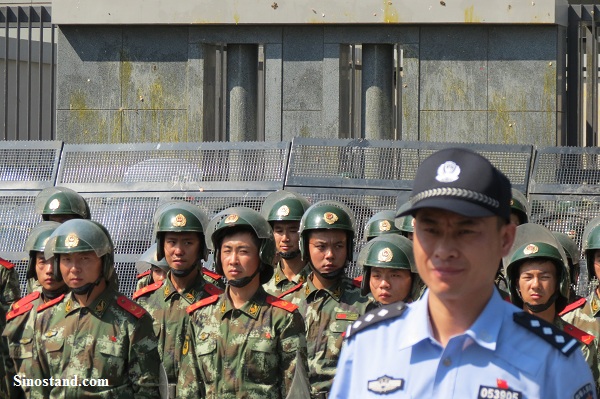


and....
http://www.aljazeera.com/news/asia-pacific/2012/09/201291663859335183.html
( Might China lose control of the protests ? )
| Anti-Japan protests continue in China | |||||
China urged to protect companies and diplomatic buildings from fresh assaults amid tensions over territorial dispute.
Last Modified: 16 Sep 2012 08:25
| |||||
| Protests against Japan have continued in Chinese cities for a second day, prompting Yoshihiko Noda, Japan's prime minister, to call on China to protect his country's companies and diplomatic buildings from fresh assaults. During the biggest flare-up in protests over East China Sea islands claimed by China and Japan, police fired tear gas and used water cannon on Sunday to repel thousands of protesters occupying a street in the southern city of Shenzhen, near Hong Kong. The protests erupted in Beijing and other cities on Saturday, when demonstrators besieged the Japanese embassy, hurling rocks, eggs and bottles, and testing cordons of anti-riot police. Thousands of people continued protesting in Beijing on Sunday. Al Jazeera's Marga Ortigas, reporting from Hong Kong, said that Chinese protesters are attacking anything with links to Japan. "Now it is spreading to more and more Chinese cities," she said. In at least four other Chinese cities, demonstrators looted shops and attacked Japanese cars. Protesters also broke into a dozen Japanese-run factories in the eastern city of Qingdao,according to the Japanese broadcaster NHK. "Regrettably, this is a problem concerning the safety of Japanese nationals and Japan-affiliated companies," Noda told a talk show on NHK. "I would like to urge the Chinese government to protect their safety." US warning In a further assertion of its sovereignty, China has been holding military drills near the disputed islands. Chinese state television has showed footage of navel ships, submarines and aircraft conducting operations with live rounds on Saturday and Sunday. US Defence Secretary Leon Panetta warned Sunday that territorial disputes involving China and other countries in Asia could end up in war if they are not toned down. "I am concerned that when these countries engage in provocations of one kind or another over these various islands, that it raises the possibility that a misjudgement on one side or the other could result in violence, and could result in conflict," he said. "And that conflict would then have the potential of expanding," he said, when asked about a worsening clash between China and Japan over an archipelago they both claim. Speaking to reporters before arriving in Tokyo on the first stage of a trip to Asia, Panetta appealed for restraint amid mounting tensions over territorial rights in the East China Sea and the South China Sea. Bitter memories Sino-Japanese ties have long been plagued by China's bitter memories of Japan's military aggression in the 1930s and 1940s and present rivalry over resources and regional clout. Relations between the two countries, whose business and trade ties have blossomed in recent years, chilled in 2010,
and.....
Weibo calls for Japanese boycott to remain ‘rational’
A microblog topic set by Sina Weibo, China’s Twitter-like service, urging for the “rational boycott of Japanese goods” over the weekend spread quickly online after protests over Japan’s “purchase” of the Diaoyu Islands turned violent in major Chinese cities.
The topic on Sina Weibo had garnered over 68,000 comments as of 5 pm on Sunday since Saturday. The Weibo topic follows demonstrations in major cities across the nation, including Xi’an, Shaanxi Province when protestors smashed Japanese cars. Protesters also broke into Japanese-run stores and factories in Qingdao, Shandong Province and Changsha in Hunan Province, according to the Phoenix Satellite TV Sunday. @慕容雪村: It is not enough to prove that Chinese are “superior” to Japanese just by shouting about our anger or criticizing Japan’s “purchase” of the Diaoyu Islands. We had better figure out how to be more civilized and respectful than Japanese rather than just criticize them. Even if there is a war between China and Japan, I still wish that we Chinese could act in a rational and civilized way rather than just with angry fists. @若水心舟: As the boycott continues, I feel proud to say that none of my home appliances were made in Japan. Personally, I feel much more patriotic and reassured using goods made in China, even if some can have their shortcomings. I buy goods made by other foreign nations, but not Japan, because of its past aggression that broke my heart, such as the Nanjing Massacre in 1937, the September 18 Incident, or the Mukden Incident in 1931, when many Chinese were killed by Japanese. @人民日报: Here are some suggestions Chinese nationals may follow to boycott Japanese goods. Initially, boycotting Japanese goods is a choice left to the consumer. Do not force people to follow suit. Secondly, do not smash Japanese goods owned by other Chinese, who had worked hard to purchase them. Meanwhile, we should understand that in some cases we have no choice but to buy Japanese goods, as there are no other alternatives. Finally, start with yourselves by turning you patriotism into resolution to advance our nation. |


 E-mail
and....
http://ex-skf.blogspot.com/2012/09/chinese-protest-against-japan-over.html
( Allowing destruction isn't what you would China to permit - what happens when angry , hungry folks want to protest ? )
SATURDAY, SEPTEMBER 15, 2012
Chinese Protest Against Japan Over Senkaku Island (Supposedly)
From a togetter compiling tweets by a Japanese person supposedly living in China, with links to photographs of the Chinese people in their protests against anything Japanese. No reason to believe they are genuine, no reason to believe they are not. Use your own judgment:
(Toyota dealership, top, and Nissan dealership, bottom)

(Mitsumi Electric)

(Department store)

It looks like the Chinese authorities are letting the air out of citizens, by directing their anger (or whatever it is) to things Japanese. I hope the authorities know what they are doing.
http://www.zerohedge.com/news/meanwhile-beijing-respect-motherland-we-must-go-war-japan
Meanwhile In Beijing: "For The Respect Of The Motherland, We Must Go To War With Japan"

Anti-US protests sweeping across the entire Muslim world (which arecontinuing today), besieging, attacking and burning down US embassies, are not the only thing that the central banker policy vehicle known as "the markets" have to ignore in the coming days and weeks. Cause here comes China: "Thousands besiege Japan's embassy in Beijing over Tokyo's assertion of control over disputed islands in East China Sea." And China is not happy: "For The Respect Of The Motherland, We Must Go To War With Japan." Sure enough, where would the US be if the focal point of this escalation in militant anger - the Senkaku Islands - was not merely the latest expression of Pax Americana, and America's national interests abroad.

We already discussed the inevitable implications of the meaningless populist agitation over the contested Senkaku Islands. Here it is playing out in real time:
Protests in China are growing over Japan's assertion of control of disputed islands.Thousands of Chinese besieged the Japanese embassy in Beijing on Saturday, hurling rocks, eggs and bottles with protests reported in other major cities over the territorial dispute in the East China Sea.Paramilitary police with shields and batons barricaded the embassy, holding back and occasionally fighting with slogan-chanting, flag-waving protesters who at times appeared to be trying to storm the building."Return our islands! Japanese devils get out!" some shouted.One of them held up a sign reading: "For the respect of the motherland, we must go to war with Japan."The protests were not confined in Beijing. In Shanghai, streets around the Japanese consulate, in the were cordoned off on Saturday even as hundreds of police allowed a small groups of people in at a time to protest."The Chinese government has not done much to quell the inflamed passions of its citizens," Al Jazeera's Marga Ortigas reported from Hong Kong on Saturday.
Protesters are also calling for a widespread boycott against Japanese businesses and products.
Liu Gang, a migrant worker from the southern region of Guangxi, said: "We hate Japan. We've always hated Japan. Japan invaded China and killed a lot of Chinese. We will never forget."Japanese media are also reporting that large anti-Japan protests were held in the Chinese cities of Xian, Changsha, Nanjing and Suzhou.Kyodo news agency said protesters attacked a dozen Japanese restaurants in Suzhou.Sino-Japanese ties have long been plagued by China's bitter memories of Japan's military aggression in the 1930s and 1940s and present rivalry over resources and regional clout.Relations between the two countries, whose business and trade ties have blossomed in recent years, chilled in 2010, after Japan arrested a Chinese trawler captain whose boat collided with Japanese Coast Guard vessels near the Japanese-controlled islands of Senkaku, called Diaoyu in China.Anti-Japanese sentiment surfaced anew in the last few weeks after the Japanese government purchased the islands from their private owners.Though Japan has controlled the islands for decades, China saw the purchase as further proof of Tokyo's refusal to negotiate.

and....
http://rt.com/news/china-anti-japan-protests-185/
Chinese protesters attack Japanese embassy in Beijing over island dispute (PHOTOS)
Published: 15 September, 2012, 11:58

A demonstrator throws an egg at the Japanese embassy during a protest in Beijing September 15, 2012 (Reuters / Jason Lee)

 Demonstrators hold Chinese flags and banners beside an overturned car of a Japanese brand during a protest in Xi'an (Reuters /R ooney Chen)
 A demonstrator holding a poster of China's late Chairman Mao Zedong yells slogans during a protest against Japan's purchase of the disputed Senkaku or Diaoyu islands outside the Japanese embassy in Beijing September 15, 2012 (Reuters / Jason Lee)
 Protesters burn Japanese flags during a protest against Japan's purchase of the disputed Senkaku or Diaoyu islands outside the Japanese embassy in Beijing September 15, 2012 (Reuters / Jason Lee)
 A protester uses megaphone to shout slogans during a protest outside the Japanese embassy (in the background) in Beijing September 15, 2012 (Reuters / Jason Lee)
 A man tries to climb over police lines during an anti-Japanese protest over the Diaoyu islands issue, known as the Senkaku islands in Japanese, outside the Japanese Embassy in Beijing on September 15, 2012 (AFP Photo / Mark Ralston)
funny how much restraint chinese soldiers showed during those protests , right ....
http://www.zerohedge.com/news/chinese-cat-equivalent-sany-finds-itself-liquidity-crunch-seeks-covenant-waiver
Chinese CAT-Equivalent, Sany, Finds Itself In Liquidity Crunch, Seeks Covenant Waiver
Over two weeks ago we first described what at that point was merely the hint of trouble at Australian mega-miner Fortescue which is slowly but surely losing the fight with insolvency courtesy of plunging iron ore prices, whereby it was once again proven that bonds always have a better grasp of the situation than equities. Sure enough the cash crunch which we predicted was imminent at Fortescue, has since hit the company over the past several days, as the firm is currently in dire liquidity straits, desperate to renegotiate covenants and get waivers that allow it to continue operations even as creditors get the short stick (in exchange for some serious money upfront). It is unknown whether it will succeed, although judging by its halt from trading until next week by which point it hopes to restructure its debt, things are certainly not rosy for the megalevered iron-ore company. In retrospect, FMG AU is lucky to be alive as is, having had a comparable near-death experience back in 2007/2008: should its bondholders end up owning the equity, so be it. However, another far more troubling and certainly underpriced covenant renegotiation has struck, this time impacting Chinese conglomerate Sany Heavy Industry, a company which is the Chinese equivalent of US Caterpillar and Japanese Komatsu, which is owned by Liang Wengen who is mainland China's richest man with a $10 billion net worth, and which is so big and diversified that under no circumstances should it be forced to request covenant waivers, especially not under a soft-landing scenario for China. And yet this is precisely what it did.
From Reuters:
Sany Heavy Industry Co Ltd, a major heavy machinery maker controlled by one of China's richest men, is asking its lenders to waive a financial covenant on $510 million of loans, Basis Point reported, highlighting the growing risks facing the industry in an economic downturn.
Why is this mega-corporation, which has RMB 50 billion in income in a good year, has a $12 billion market cap, and 70,000 employees,suddenly in liquidity crisis?
Unpaid bills owed to companies in China's coal, steel and heavy machinery sectors jumped by a fifth in the six months to June as growth in the world's second-largest economy slowed, reducing manufacturing, and demand for a range of commodities.Sany, which competes with Caterpillar Inc and Japan's Komatsu Ltd and which this year bought privately-owned German concrete pump maker Putzmeister for an estimated 360 million euros ($464.6 million), has $160 million in onshore loans and $350 million in offshore loans, according to Thomson Reuters data.
Which covenant is being breached:
The company, controlled by Liang Wengen - who is worth $8.1 billion, according to Forbes - is asking its lenders to waive the net debt to tangible net worth covenant - one of the terms of its loans - and to respond by the end of next week, Thomson Reuters publication Basis Point reported, citing sources. It did not name the lenders.
The company, controlled by Liang Wengen - who is worth $8.1 billion, according to Forbes - is asking its lenders to waive the net debt to tangible net worth covenant - one of the terms of its loans - and to respond by the end of next week, Thomson Reuters publication Basis Point reported, citing sources. It did not name the lenders.According to sources, the current requirement on net debt to tangible net assets is at less than 0.8 times, Basis Point reported.
And the punchline:
Its loans receivable - amounts creditors expect to be repaid at a specific date - more than doubled to almost 23 billion yuan ($3.63 billion) at end-June from six months earlier.
In other words the company which competes with Caterpillar (which already warned about some truly scary global trends) not only has a major debt problem, not only suddenly can not collect what is owed to it by various trade partners (which is the real red flag here), but also is suddenly facing collapsing profits: "The shares fell to more than 2-year lows late last month after Sany posted a 28 percent drop in second-quarter net profit - its biggest quarterly fall since 2008."And that, ignoring the propaganda for a second, is what is really going on in the Chinese economy: a gradual and encroaching halt, in which vertical trade linkages are collapsing as there is simply not enough loan growth and liquidity (either localized or global) to keep the run-rate in place.Hopefully the Fed and ECB can print enough "wealth" to somehow bail China out soon, because any hopes of the contrary are now forever dashed.
and......
http://www.alsosprachanalyst.com/economy/china-economy-hard-landing-and-beyond.html
For almost the past year, the Chinese economy has defied expectation and slowed much more dramatically; sometimes even more so than pessimists such as ourselves. Signs of stabilisation all turned out to be a blip, and just as one thought it was not slow enough, it got even worse.
There remains a lot of people who argue that the landing will be a soft one, and that the slowdown is “intentional”, the slowdown is “planned”. Meanwhile, others are probably contemplating a hard landing. Needless to say, if hard landing is defined as sub-7% yoy growth, we are probably very close to it if not already in one (there are reasons which suggest that the economy is already a hard landing, of course).
 |
| By NASA photo (ID: EC84-31805) [Public domain], via Wikimedia Commons |
But please make no mistake: as pessimistic as we were, that is not the end of the world. If we take out some of the tail risks such as political and social instability or a war (something outside of our core consideration but cannot be ruled out), theeconomy will slow, and perhaps slow much more from here, and we feel that we cannot rule out contractions for short period of time in the most extreme cases. However, just as the high growth scenario which cannot be sustained forever, hard landing, or economic contraction, whatever you call it, will not last forever.
Of course, it will depend on government actions and many other factors, and it is very hard to get everything precisely right. But our main point is this: as investors, whether China will grow at 7-8% per annum in perpetuity in the long run should not be the main concern, and there are reasons to be cheerful even if China can only grow 3-5% per annum in the coming decade. Make no mistake however, hard landing will be painful, and it will come with risks such as social instability. Asset prices will fall and wealth will be destroyed. But once the worst is behind us, we think we can see some hope.
People’s Bank of China has injected RMB55 billion of liquidity to the system today via reverse repurchase operation.
PBOC conducted a 7-day reverse repo of RMB35 billion at 3.35% rate, and a 28-day reverse repo of RMB20 billion at 3.6%. This is the first time we see 28-day reverse repo being done.
Including today’s operation, the PBOC will be draining a net of RMB8 billion of liquidity from the banking system for the week. This is the third consecutive week of net withdrawal by the PBOC after weeks of record injections.
As we have recently noted, the recent strength of Chinese Yuan against the US dollar relative to the PBOC daily fixing is a hint that funds flow might be once again favourable to China’s liquidity condition. As a result, we are expecting less aggressive action from PBOC for the time being.

and you know China needs a distraction badly so this action should not be a shocker.....
| China sends six ships to disputed islands | |
Deployment dubbed "unprecedented" by Tokyo comes as reports emerge that Japanese nationals had been attacked in China.
Last Modified: 14 Sep 2012 09:20
| |

Anti-Japanese demonstrators held banners and shouted slogans outside the Japanese embassy in Beijing [AFP]
| |
| Six Chinese ships have sailed into waters around a disputed archipelago, with Beijing saying they were there for "law enforcement" around islands Japan nationalised earlier this week. The move, dubbed "unprecedented" by Tokyo, came on Friday as it was reported Japanese nationals had been physically attacked in China, marking the latest stage in a deteriorating row between Asia's two biggest economies.
Japanese living or visiting China were warned to take extra precautions after assaults and harassment were reported to the consulate in Shanghai, a base for Japanese businesses and a popular tourist destination.
Tokyo summoned the Chinese ambassador to protest what it insists is an incursion into territorial waters around islands it controls, called Senkaku, but claimed by Beijing as Diaoyu. Al Jazeera's Marga Ortigas, reporting from Hong Kong, said protesters in Beijing have called for a boycott of Japanese products to defend their country’s interests. The latest tension surfaced after Yoshihiko Noda, the Japanese prime minister, announced that Japan is buying the disputed private islands and transferring control to the government. Commentators say Noda's solution, nationalising the islands and continuing its policy of doing nothing with them, was an attempt to navigate between rising nationalism at home and China's growing assertiveness on the oceans. "We'll do our utmost in vigilance and surveillance," said Noda when asked about Japan's response to the latest move by China. He also established a task force to deal with the issue. Harassment claimsFujimura's comments come as the Japanese consulate in Shanghai reported physical attacks on its nationals. "A group was dining late at night, and they were harassed and assaulted by Chinese," said a statement on the consulate's website. The consulate said bottles were thrown at some Japanese, and drinks and food were poured over others, while one person reported having a pair of glasses broken. Japan's foreign ministry has warned its nationals who are in China or who are planning to visit there to be aware of anti-Japanese demonstrations and to avoid drawing attention to themselves. The embassy in Beijing said Japanese should avoid approaching the building, where protests have been reported, unless absolutely necessary. Economic ties
|


No comments:
Post a Comment