http://online.wsj.com/article/SB10000872396390444405804577560413178678898.html?mod=WSJ_hpp_LEFTTopStories
![[image]](http://si.wsj.net/public/resources/images/WO-AK632A_IPOWE_NS_20120731184504.jpg)
http://www.zerohedge.com/news/what-670-million-people-without-power-look-pictures-blacked-out-india
NEW DELHI—India suffered the world's biggest-ever power outage Tuesday as transmission networks serving areas inhabited by 680 million collapsed, putting the nation's ramshackle infrastructure on stark display.
The grid failure, the second massive blackout in as many days, happened around 1 p.m. local time and affected 18 states and two union territories in north and eastern India, grinding trains across large swaths of the country to a halt, forcing thousands of hospitals and factories to operate on generators, temporarily stranding hundreds of coal miners underground and causing losses to businesses estimated in the hundreds of millions of dollars.
The government said power was about 80% restored in north India by late Tuesday evening.
Access to electricity is far from universal in India, and Indians are accustomed to regular power outages in particular neighborhoods or sections of cities. Many businesses and farmers see backup diesel-run generators as an absolute necessity. Still, Tuesday's massive breakdown was unprecedented, impacting a population larger than the U.S., Brazil and Russia combined.
For a nation that sees itself as an emerging global power, the event was a huge embarrassment. It put on vivid display, for Indians and the world, how rickety the country's basic infrastructure is. And it could further tarnish the perception of India among foreign companies who have long viewed the country's outdated roads, ports and power networks as major drawbacks of doing business here.
The power outage wreaked havoc on businesses and travelers. About 200 trains stopped operating for several hours. Metro rail services in the national capital of New Delhi and its suburbs were halted. About 270 miners were stuck in two underground coal mines in eastern India as elevators stopped working. All had been rescued by late Tuesday.
At the Nigambodh Ghat, a New Delhi crematorium, three dead bodies were cremated using wood after the power failure, an official at the crematorium said. In India, Hindus generally try to cremate bodies the same day a person dies if the death occurs before dusk, and furnaces generally run on electricity.
The All-India Institute of Medical Sciences, one of Delhi's main state-run hospitals, ran its diesel generators for almost two hours.
A tea plantation in the foothills of the Himalayas, Kailashpur Tea Estate, said it had to give its generators a rest every few hours, stalling production. And since the generators don't supply power to street lights on the estate, which is surrounded by forests, the power outages raised some specific concerns. "Leopards and elephants often wander into the plantation," said senior manager Manas Bhattacharya. "About three months ago, two female workers were mauled by a leopard on the estate. Wild elephants are everyday visitors."
In the western city of Jaipur, Swati Jain, co-founder of the Happy Store, which sells handicrafts there, said there was no electricity between 11 a.m. and around 4 p.m. It was "awfully bad," said Ms. Jain, adding that even during peak summer hours, locals are used to only two-hour power cuts at most.
The tiny Himalayan kingdom of Bhutan, which borders India, came to its much larger neighbor's aid this week, releasing additional power from its hydroelectric plants while India worked to restore its networks to full capacity.
The government Tuesday even extended the deadline for filing of income-tax returns by a month to Aug. 31, citing "reports of disturbance of general life caused due to failure of power," among other reasons.
The blackout on Tuesday was the largest known blackout in history in terms of the population affected, according to an estimate by the Associated Press. The second-worst was India's outage Monday, which affected a population of 370 million followed by a 2005 outage in Indonesia which left almost 100 million in the dark, the AP said.
The cause of the outages will be investigated by a three-member, government-appointed committee.
Capping a surreal day when the power outage dominated cable news channels—which continued to broadcast for the benefit of those who still had power—Prime Minister Manmohan Singh gave an effective promotion to Power Minister Sushil Kumar Shinde, on whose watch the blackouts have occurred. Mr. Shinde was named the next home minister, the nation's top security official and one of the Cabinet's most prominent posts. He will replace P. Chidambaram, who will take on the post of finance minister; Prime Minister Singh had been in charge of finance.
Corporate Affairs Minister Veerappa Moily will take over the power portfolio. Analysts said the cabinet shuffle had been in the works and its timing was coincidental.
Associated Press


A Kolkata barber cut a customer's hair by candlelight Tuesday as India's power grid suffered a second massive power outage in as many days, this one affecting half the country's population and further showing the inadequacy of efforts to boost infrastructure.
The Congress Party-led national government headed by Prime Minister Singh is already fighting to dispel the perception that it is mismanaging the country's economy and failing to follow through on promises to carry out big-ticket reforms, including promises to spend $1 trillion on infrastructure projects by 2017. Gross-domestic-product growth is expected to slow to 6.5% in this fiscal year, the central bank said Tuesday.
A communications adviser for Mr. Singh, Pankaj Pachauri, said the prime minister had spoken to Mr. Shinde, the current power minister, and "asked him to urgently look into the matter."
The blackout adds to an array of woes in India's crisis-ridden power sector. Generous power subsidies for farmers and politicians' reluctance to raise electricity rates for consumers have left state utilities with billions of dollars of accumulated losses. Shortages of fuels including coal and natural gas have forced power plants to run well below capacity. Nuclear-power projects have been stalled by environmental protests and equipment vendors' concerns about India's accident-liability regulations.
The upshot is that many parts of India suffer chronic power shortages. In several large states, electricity demand outstrips supply at peak hours by more than 12%. Many rural hamlets still have no electricity at all. The government has failed to carry out its own relatively modest plans: It was only able to meet 64% of its target of adding roughly 78,000 megawatts of electricity generation in the five years through 2012. In recent years, China has added six times more power than India to its electricity grid annually.
The outage highlighted another problem that policy makers must address: Some states are drawing more power from the national grid than they have indicated they will use in the daily forecasts they provide to the government. Officials said they're investigating whether such overdraws were responsible for initiating the cascading outages. Although states are fined when they don't stick to their plans, experts say the penalties aren't a deterrent. "The penalties need to go up—they aren't sufficient to stop this undisciplined behavior," said Kameswara Rao, head of the power and utilities practice at PricewaterhouseCoopers India.
Mr. Rao said Indian policy makers didn't anticipate how quickly electricity demand would rise in the past few years as economic growth has expanded the ranks of the middle class and created more consumers of power-hungry modern appliances like air-conditioners. He said state transmission utilities badly need investment and skilled manpower to cope with grid problems and provide protections against massive outages.
Some analysts said public outrage over the widespread outages may force Prime Minister Singh's government to tackle reforms in the power sector.
"Unless this government wants to commit political suicide, there's no way they can ignore this," said Abhey Yograj, managing director of Tecnova, a consulting firm that advises foreign companies on India. He said the government must not only deal with the immediate crisis–the failure of the grid–but the underlying issue of chronic shortages in electricity generation, which means boosting production and imports of fuels for power plants and doing away with counterproductive energy subsidies.
The Congress-led government's leading opposition, the Bharatiya Janata Party, seized on this week's blackouts. "This is a manifestation of mismanagement," party spokesman Prakash Javadekar told reporters. "The prime minister owes an answer to the people of this country."
Industry critics were equally tough on the government after the back-to-back days of outages. "The developments of yesterday and today have created a huge dent in the country's reputation that is most unfortunate," said Chandrajit Banerjee, the head of the Confederation of Indian Industry, a leading trade group, in a statement.
Rabindra Nath Nayak, chairman of state-run Power Grid Corp. of India Ltd., said it would take some time for the government to ascertain the reason for the power failure. The panel investigating the incident is expected to turn in its report in two weeks. Mr. Nayak said "tripping at several interconnectivity points of the [northern] grid could have had a cascading effect".
"Even before we could figure out the reason for yesterday's failure, we had more grid failures today," he said. Power Grid operates India's five regional grids comprising more than 62,000 miles of electricity transmission lines.
http://www.zerohedge.com/news/what-670-million-people-without-power-look-pictures-blacked-out-india
This Is What 670 Million People Without Power Look Like: Pictures From A Blacked Out India

First thing today we reported that India just suffered what may have been the biggest blackout in history, after half of the country's population of 1.2 billion, or just under 700 million was without power, as the electric grid of more than a dozen states suffered an epic collapse. Below we shares some pictures courtesy of Times of India giving some sense of what it means for two Americas worth of people to live without electricity indefinitely. Of note: the calm, peace and order despite the epic traffic jams and crowds. One wonders what would happen in the US if the entire country was without electrcity for even just one hour. Finally, one wonders what the impact to the Indian, Asian, and Global economy will be as a result of the complete halt that at least half of India - one of the world's core marginal economies - has ground to do.
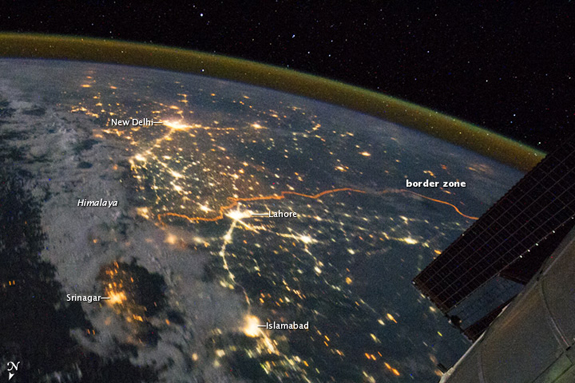
India’s northwestern boundary with neighboring Pakistan is so brightly lit that the thin orange line tracing its path can be seen from space. Photo: NASA/EO

A road is packed in heavy traffics following power outage and rains in the central part of New Delhi, India, Tuesday, July 31, 2012. India's energy crisis spread over half the country Tuesday when both its eastern and northern electricity grids collapsed, leaving 600 million people without power in one of the world's biggest-ever blackouts. Traffic lights went out across New Delhi.

Heavy traffic moves along a busy road as it rains during a power-cut at the toll-gates at Gurgaon on the outskirts of New Delhi July 31, 2012. Grid failure hit India for a second day on Tuesday, cutting power to hundreds of millions of people in the populous northern and eastern states including the capital Delhi and major cities such as Kolkata.

Commuters wait for buses outside a Metro station after Delhi Metro rail services were disrupted following power outage in New Delhi, India, Tuesday, July 31, 2012. India's energy crisis cascaded over half the country Tuesday when three of its regional grids collapsed, leaving more than 600 million people without government-supplied electricity in one of the world's biggest-ever blackouts.

Commuters wait for buses outside a Metro station after Delhi Metro rail services were disrupted following power outage in New Delhi, India, Tuesday, July 31, 2012. A massive blackout hit northern and eastern India on Tuesday afternoon, leaving 600 million people without electricity in one of the world's most widespread power failures. The outage came just a day after India's northern power grid collapsed for several hours leaving cities and villages across eight states powerless.

Commuters wait in line at a Metro station after Delhi Metro rail services were disrupted following power outage in New Delhi, India, Tuesday, July 31, 2012. India's energy crisis cascaded over half the country Tuesday when three of its regional grids collapsed, leaving more than 600 million people without government-supplied electricity in one of the world's biggest-ever blackouts. The city's Metro rail system, which serves about 1.8 million people a day, immediately shut down for the second day in a row.

Passengers sit on a platform for their train to arrive as they wait for electricity to be restored at a railway station in New Delhi July 31, 2012. Grid failure hit India for a second day on Tuesday, cutting power to hundreds of millions of people in the populous northern and eastern states including the capital Delhi and major cities such as Kolkata.

Passengers rest on a platform for their train to arrive as they wait for electricity to be restored at a railway station in New Delhi July 31, 2012. Grid failure hit India for a second day on Tuesday, cutting power to hundreds of millions of people in the populous northern and eastern states including the capital Delhi and major cities such as Kolkata.

A passenger looks through the window of a train as he waits for electricity to be restored at a railway station in New Delhi July 31, 2012. Grid failure hit India for a second day on Tuesday, cutting power to hundreds of millions of people in the populous northern and eastern states including the capital Delhi and major cities such as Kolkata.

Commuters crowd a busy road outside a Metro station after Delhi Metro rail services were disrupted following power outage in New Delhi, India, Tuesday, July 31, 2012. Indian officials say the nation's northern and eastern power grids have failed, leaving about half the country without power. The collapse of the grids Tuesday afternoon came a day after the northern grid failed and left eight states without power for much of the day.

Indian stranded passengers wait on a platform and some of them on rail tracks for the train services to resume following a power outage at Sealdah station in Kolkata, India, Tuesday, July 31, 2012. India's energy crisis cascaded over half the country Tuesday when three of its regional grids collapsed, leaving 620 million people without government-supplied electricity for several hours in, by far, the world's biggest-ever blackout. Hundreds of trains stalled across the country and traffic lights went out, causing widespread traffic jams in New Delhi.

Stranded passengers wait on a railway tracks for the train services to resume following a power outage at Sealdah station in Kolkata, India, Tuesday, July 31, 2012. India's energy crisis cascaded over half the country Tuesday when three of its regional grids collapsed, leaving 620 million people without government-supplied electricity for several hours in, by far, the world's biggest-ever blackout. Hundreds of trains stalled across the country and traffic lights went out, causing widespread traffic jams in New Delhi.


Commuters wait for a metro train, in New Delhi, India, Monday, July 30, 2012. Northern India's power grid crashed Monday, halting hundreds of trains, forcing hospitals and airports to use backup generators and leaving 370 million people - more than the population of the United States and Canada combined - sweltering in the summer heat.

Muslim girls study in the light of candles inside a madrasa or religious school during power-cut in Noida on the outskirts of New Delhi July 30, 2012. Grid failure left more than 300 million people without power in New Delhi and much of northern India for hours on Monday in the worst blackout for more than a decade, highlighting chronic infrastructure woes holding back Asia's third-largest economy.
and.......
| Mass blackout strikes India for second day | |||
Northern and eastern grids reported to have failed, leaving millions without electricity for second consecutive day.
Last Modified: 31 Jul 2012 11:31
| |||

All traffic lights in the capital were affected by the outage, forcing policemen to take over [AFP]
| |||
| A massive power cut has hit a huge swathe of India for the second day in the row, as the country's northern and eastern power grids have collapsed, officials say. The blackout affects about half of India's population, and knocked out power to more than a dozen states that are home to more people than live in the entire European Union.
The blackout comes a day after a mass outage left eight states without power for much of the day.
Shailendre Dubey, an official at the Uttar Pradesh Power Corp, says the northern grid collapsed at about 1:05pm (07:35 GMT) on Tuesday. VK Agrawal, the general manager of the grid, confirmed the outage. "We are busy with the revival right now... Both the northern and eastern grids have collapsed. Please allow us to address the problem," Agrawal told AFP. Trains suspended "Initial reports are saying that [electric] trains have stopped, [as well] as the Delhi Metro," reported Nilanjan Chowhdhury, an Al Jazeera producer in New Delhi. Traffic lights were also reported to not be operational in the capital.
About 400 trains were affected by the power outage, a spokesman for the railways told AFP. SK Mohanty, a power official in the eastern state of Orissa, confirmed that the eastern grid had also been knocked out. He said the fault could take several hours to resolve. Power was also cut in the main eastern city of Kolkata, and in most parts of West Bengal state, a local official said. The eastern grid covers five states, including West Bengal, Bihar, Jhakhand, Sikkim and Orissa. Trapped miners Hundreds of coal miners, meanwhile, were trapped in West Bengal because the power cut left them unable to operate their lifts. "We are trying to rescue the coal miners. All efforts are on to resume power supplies. You need power supplies to run the lifts in the underground mines," Mamata Banerjee told reporters in the state capital Kolkata.
She said that hundreds of miners were trapped in Burdwan, about 180km northwest of Kolkata.
"Over 200 miners are stuck in several coal mines. They cannot come out till the power service is restored," Niladri Roy, general manager at Eastern Coalfields in Kolkata, told AFP. Roy said that the miners were "in no danger", as they were in a well-ventilated area. Earlier outage Sushilkumar Shinde, the federal power minister, blamed Tuesday's outage on states drawing more than their allotted share of electricity. `'Everyone overdraws from the grid. Just this morning I held a meeting with power officials from the states and I gave directions that states that overdraw should be punished. We have given instructions that their power supply could be cut,'' he told reporters. On Monday, the northern grid collapsed for six hours shortly after 2:00am (20:30 GMT Sunday), causing travel chaos and widespread inconvenience in nine states and the capital New Delhi. Major hospitals and airports in the region were able to function normally on emergency back-up power on both days, but train services were severely disrupted. Industrial lobby groups say the power outages underline the government's inability to address India's acute electricity shortfall. "The increasing gap between electricity supply and demand has long been a matter of concern," said Chandrajit Banerjee, director general of the Confederation of Indian Industry. The CII, Banerjee said, has "consistently highlighted" the need for urgent steps to improve supplies of coal to thermal power plants and reforming state distribution utilities. "This latest outage is just an urgent reminder for addressing these issues as a priority," he added. India's demand for electricity has soared along with its economy in recent years, but it has been unable to meet growing energy needs.
|


http://www.zerohedge.com/news/670-million-people-india-without-power-electric-grid-fails
670 Million People In India Without Power As Electric Grid Fails
Two weeks ago we touched upon the possibility that the US climatic deep fried black swan could soon stretch to India where the Monsoon season was 22% below normal conditions for this time of year. Today India is the locus of another flightless bird sighting following an epic powergrid meltdown which left half of its 1.2 billion people without power on Tuesday "as the grids covering a dozen states broke down, the second major blackout in as many days and an embarrassment for the government as it struggles to revive economic growth... More than a dozen states with a total population of 670 million people were without power, with the lights out even at major hospitals in Kolkata." Indicatively this is the same as every man, woman and child in America having no electricity. Twice over."Stretching from Assam, near China, to the Himalayas and the deserts of Rajasthan, the power cut was the worst to hit India in more than a decade. Trains were stranded in Kolkata and Delhi and thousands of people poured out of the sweltering capital's modern metro system when it ground to a halt at lunchtime. Office buildings switched to diesel generators and traffic jammed the roads." Hopefully, two events in a row don't confirm a trend. Although if indeed systemic, and if suddenly the Indian power infrastructure is unable to handle the local drought-related conditions, thus serving as a natural cap on economic expansion, all bets may be off as to the unlimited upside potential capacity of the BRICs.
More from Reuters:
"We'll have to wait for an hour or hour and a half, but till then we're trying to restore metro, railway and other essential services," Power Minister Sushilkumar Shinde told reporters.Shinde blamed the system collapse on some states drawing more than their share of electricity from the overstretched grid. Asia's third-largest economy suffers a peak-hour power deficit of about 10 percent, dragging on economic growth."This is the second day that something like this has happened. I've given instructions that whoever overdraws power will be punished."The country's southern and western grids were supplying power to help restore services, officials said.
The immediate reason for this freak occurrence? Precisely what we alone noted as a potential black swan two weeks ago:
The problem has been made worse by weak a monsoon in agricultural states such as wheat-belt Punjab and Uttar Pradesh in the Ganges plains, which has a larger population than Brazil. With less rain to irrigate crops, more farmers resort to electric pumps to draw water from wells.
Surely record blackouts qualify as an "unexpected consequence" arising from an "unexpected event." And it will only get worse before it gets better.
Power shortages and a creaky road and rail network have weighed heavily on the country's efforts to industrialize. Grappling with the slowest economic growth in nine years, Delhi recently scaled back a target to pump $1 trillion into infrastructure over the next five years.Major industries have dedicated power plants or large diesel generators and are shielded from outages -- but the inconsistent supply hits investment and disrupts small businesses.High consumption of heavily subsidized diesel by farmers and businesses has fuelled a gaping fiscal deficit that the government has vowed to tackle to restore confidence in the economy. But the poor monsoon means a subsidy cut is politically difficult.
Finally, the RBI apparently is unclear that one can solve every problem and created endless wealth and prosperity by printing.
On Tuesday, the central bank cut its economic growth outlook for the fiscal year that ends in March to 6.5 percent, from the 7.3 percent assumption made in April, putting its outlook closer to that of many private economists.
And yes, India does have its own currency. It also happens to have a population that is just chomping at the bit to regain its status as the biggest demand driver of gold prices in the world.


No comments:
Post a Comment