http://www.foreignpolicy.com/articles/2012/06/07/good_leak_bad_leak

http://hotair.com/archives/2012/06/09/wh-scrambles-on-leaks-after-press-conference/
and.....
http://www.guardian.co.uk/world/2012/jun/07/congressional-committee-legislation-leaks
Good Leak, Bad Leak
A look at the Obama administration's hot-and-cold approach to secrets.
BY URI FRIEDMAN | JUNE 8, 2012
There's something troubling about the recent leaks to the New York Times about President Barack Obama's involvement in authorizing the targeted killings of suspected terrorists andlaunching cyberattacks against an Iranian nuclear enrichment facility: they're coming from the same administration that has prosecuted more government officials under the Espionage Act of 1917 for sharing classified information with the media than all previous administrations combined. (As Director of National Intelligence James Clapper wrote in a 2010 memo, "People in the intelligence business should be like my grandchildren -- seen but not heard.") Just this week, an American general who suggested that U.S. and South Korean Special Forces were parachuting into North Korea to conduct espionage was replaced in what the military insisted, amid murmurs of disbelief, was a routine personnel change.
http://hotair.com/archives/2012/06/09/wh-scrambles-on-leaks-after-press-conference/
WH scrambles on leaks after press conference
POSTED AT 9:31 AM ON JUNE 9, 2012 BY ED MORRISSEY
Looks like Barack Obama’s statement on the private sector doing “fine” wasn’t the only booby trap from his press conference yesterday. Asked during the morning event about the series of leaks from his administration and their oh-so-coincidentally complimentary view of his own leadership, Obama pronounced himself offended by the insinuation that his team would leak sensitive information in an election year to save their jobs:
Later that evening, however, Attorney General Eric Holder announced that the Department of Justice had opened an investigation into these very leaks:
Attorney General Eric Holder said on Friday he had assigned two U.S. attorneys to lead investigations into the possible leaking of state secrets.“The unauthorized disclosure of classified information can compromise the security of this country and all Americans, and it will not be tolerated,” he said in a statement.Holder assigned U.S. Attorney for the District of Columbia Ronald C. Machen Jr., a Democratic appointee, and U.S. Attorney for the District of Maryland Rod J. Rosenstein, a holdover GOP appointee, to lead the investigations.“These two highly respected and experienced prosecutors will be directing separate investigations currently being conducted by the FBI. I have every confidence in their abilities to doggedly follow the facts and the evidence in the pursuit of justice wherever it leads,” said Holder.
This looks like a compromise between an internal DoJ probe and the appointment of a special prosecutor. Obama and the White House had rejected the appointment of the latter just a day earlier, but the rising bipartisan anger — and then the press interest in it — clearly forced their hand. While Democrats objected to the Republicans’ accusation of political motivation behind the leaks, everyone on Capitol Hill was outraged by the leaks themselves, and refusing to investigate it at all was simply not an option after yesterday’s presser.
I’m no fan of special prosecutors; the mechanism almost always produces a prosecutor running amok, looking for any crime to justify the continuing probe, without any effective oversight or accountability. That’s true in Republican and Democratic administrations. The Department of Justice should normally conduct its own investigations and ensure that the investigations don’t run far afield from their mandate and the purported crime that required the probe in the first place. In Holder’s DoJ, however, there is little confidence that they have the integrity and competence to investigate this issue, after the serial misrepresentations made to Congress by Holder himself and his deputies in the Fast and Furious probe. This choice, to have two competing probes by US Attorneys appointed by different Presidents, looks like a good compromise.
That should not keep Congress from conducting its own investigation, however. The DoJ is part of the executive branch, and it’s Congress’ duty to ensure that the executive branch hasn’t indulged in corruption or worse in pursuit of its own power. The Senate and the House could follow up on Holder’s actions by appointing ad hoc bipartisan panels of inquiry into White House leaks, or perhaps form a joint committee where Republicans in the House balance out Democrats in the Senate.
Clearly, that’s what Holder’s announcement is intended to prevent. It shows that the White House may be hitting the panic button over more than just a revealing remark about Obama’s cluelessness on economics.
and.....
http://www.guardian.co.uk/world/2012/jun/07/congressional-committee-legislation-leaks
Senators plan legal crackdown on Obama administration leaks
White House faces accusations it endangered American lives by leaking information that would show the president as powerful
 Email
Email
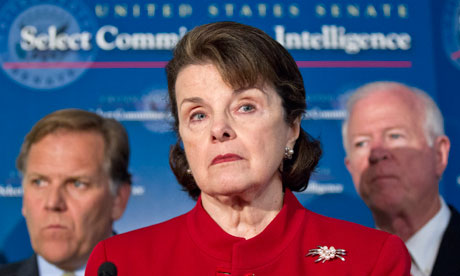
Senate Intelligence Committee chair Dianne Feinstein flanked by Saxby Chambliss and House Intelligence Committee chairman Mike Rogers. Photograph: J Scott Applewhite/AP
The heads of Congressional intelligence committees say they will pass new laws to prevent leaks of highly classified information as the White House fends off accusations that it has endangered American lives by releasing secrets to make the president appear strong.
The FBI is already investigating the source of a story in the New York Times about the joint US-Israeli assault on Iran's nuclear programme, codenamed Olympic Games, using a computer virus known as Stuxnet, and revelations about a CIA sting operation in Yemen that blocked an attempt to blow up a transatlantic flight.
Senator John McCain, the highest ranking Republican on the armed services committee, has called for a special counsel to investigate those leaks and the origins of another New York Times story about Obama's close involvement in deciding a "kill list" of targets of drone strikes in Pakistan.
The chairs of the Senate and House of Representative intelligence committees, Dianne Feinstein and Mike Rogers, said on Thursday that leaks "jeopardise American lives" and that they will write legislation to curb unauthorised disclosures by limiting the number of people who have access to classified information.
McCain has accused the White House of "an intentional breach" intended to "paint a portrait of the president of the United States as a strong leader on national security issues" in the run up to November's election. He said the revelations endanger American lives.
"These leaks clearly were not done in the interest of national security or to reveal corrupt or illegal actions about which the public has a right to know, as in the case of legitimate whistle-blowers," McCain said on Thursday. "It is difficult to escape the conclusion that these recent leaks of highly classified information, all of which have the effect of making the president look strong and decisive on national security in the middle of his re-election campaign, have a deeper political motivation."
Another Republican senator, Lindsey Graham, agreed.
"I don't think you have to be Sherlock Holmes to figure out what is going on here. You've had three leaks of intelligence that paint the president as a strong leader," he told Fox News.
However others did not go that far. Rogers said he was not prepared to accuse the White House.
"I don't think we ought to make that determination," he said.
But Rogers said there should be an independent probe because it "appears sources of these leaks could be in position to influence these investigations".
There has also been strong criticism from leading Democrats, including Feinstein although she too does not say the leaks were politically motivated on behalf of the president.
"It's very, very disturbing. You know, it's dismayed our allies. It puts American lives in jeopardy. It puts our nation's security in jeopardy," she said. "When people say they don't want to work with the United States because they can't trust us to keep a secret, that's serious."
The senators were to hold meetings with the heads of the FBI and national intelligence on Thursday to discuss the leaks.
The White House has denied feeding classified information to reporters.
"Any suggestion that this administration has authorised intentional leaks of classified information for political gain is grossly irresponsible," said Obama's press secretary, Jay Carney.
"Any suggestion that this administration has authorised intentional leaks of classified information for political gain is grossly irresponsible," said Obama's press secretary, Jay Carney.
Suspicion has fallen on the administration because of the level of detail in the accounts that could only have come from senior officials in the know, particularly about the president's role in deciding who should be on the "kill list" for drone strikes.
Peter King, head of the House of Representatives homeland security committee, said the evidence points to information released at the highest level.
"You're talking about conversations among very small numbers of people in the Oval Office or in the national security council in the Situation Room," he told CNN. "We're talking about the people closest to the president. This isn't a big political gathering. We're talking about people with top secret clearances and it should be easy enough to find out who was at these meetings."
However, the investigation itself may amount to little more than an attempt to embarrass the president. If the information came from officials with White House approval then it would not be illegal.
Dean Baquet, managing editor of the New York Times, has defended the stories in the face of Congressional criticism that it has been a party to White House political manipulation. He said the rise in the use of drones and the increased use of cyber warfare should be part of a national debate. Baquet questioned whether politicians were missing the point in focussing on the leaks instead of the substance of the information that has been revealed.
"I wonder if only Washington is having the debate about [the stories'] timing, as opposed to what they actually said," he told the Huffington Post.


No comments:
Post a Comment