http://original.antiwar.com/porter/2012/06/08/changes-at-parchin-suggest-an-iranian-bargaining-ploy/
http://www.businessweek.com/news/2012-06-08/iaea-disappointed-as-iran-fails-to-agree-to-wider-atom-probe
The United Nations nuclear agency said it was disappointed that Iran failed to agree on a deal that would allow wider inspections of alleged nuclear facilities inside the Persian Gulf nation.
http://www.atimes.com/atimes/Middle_East/NF09Ak01.html
Iran prepares for Moscow
Two days of talks between the world powers and Iran in Baghdad late last month produced few tangible results, save an agreement to continue for another round set in Moscow, due to start on June 17. On Monday, International Atomic Energy Agency Director General Yukiya Amano said his organization would meet with Iran on June 8. Ali Asghar Soltanieh, Iran's Ambassador to the International Atomic Energy Agency (IAEA), spoke with Kaveh L Afrasiabi in an exclusive interview for Asia Times Online.
Kaveh Afrasiabi: Your Excellency, the Governing Board of the International Atomic Energy Agency (IAEA) just concluded a two-day meeting. Regarding Iran, what happened at this meeting?
Ali Asghar Soltanieh: This was one of the routine meetings of the IAEA's Board of Governors that dealt with a number of issues including membership, nuclear supply, implementation ofagreements, agenda of future meetings, etc. With respect to Iran, once again, the representatives of the Non-Aligned Movement consisting of more than 100 countries supported Iran and Iran's nuclear rights in a statement that was read by the Egyptian ambassador. I presented a statement that tried to focus on the status quo, identifying the shortcomings, the worrying trends, and recommending constructive improvements.
Specifically, I warned that a couple of Western governments want to manipulate and divert the IAEA from its mandate. They are trying to turn the Agency's "nuclear material driven safeguards" into an "intelligence driven safeguards". But the IAEA is an international technical organization, not an intelligence service. As a result, the IAEA inspectors are forced by a couple of member states to be involved in intelligence activities, receiving fabricated information from the intelligence services of certain countries, or allegations of activities not involving nuclear activities. This is not acceptable at all and ultimately damages the trustful relation expected between the Secretariat and Member States.
With respect to Iran, following the recent Tehran visit of the Director-General, we are trying to open a new chapter in our relations with the agency, which is why another meeting with the IAEA officials has been scheduled for June 8 to discuss a modality that would provide a structured approach to cover all the issues of concern in the annex section of the November 2011 IAEA report on Iran.
KA: What is your reaction to the recent reports in the Western media alleging that Iran has "cleansed" and then destroyed a suspected building at Parchin military complex and removed the soil?
AAS: Unfortunately we have seen many examples of such baseless noise based on lousy intelligence during the past 10 years or so. To give an example, in 2004 I accompanied the IAEA inspectors to a site that had been cited in the intelligence reports based on satellite images and there were a lot of noise at the time about secret uranium mine, enrichment and so forth. And yet, the inspectors clearly confirmed that those allegations were false and the site was a normal factory with nothing suspicious. KA: So, is the IAEA's request to visit the Parchin military complex on the agenda of the new framework for cooperation?
AAS: As I said, all the issues raised in the annex of November 2011 report will be covered by this modality.
KA: Since the IAEA's requests go beyond the present safeguard agreement with Iran, isn't the new modality tantamount to a de facto implementation of the intrusive Additional Protocol by Iran and, if so, what are the chances that Iran will formally adopt the Additional Protocol in the future?
AAS: Well, Iran was implementing the Additional Protocol for two-and-a-half years until Iran was unjustly referred to the UN Security Council. Parliament then directed the government to limit its cooperation with the IAEA, to limit it to within the framework of the safeguard agreement. Therefore any possibility for re-adopting the Additional Protocol depends on the resolution of the issues with respect to the UN Security Council.
KA: Will the implementation of the new modality lead to the possibility of "routine" treatment of Iran's nuclear file?
AAS: We are determined to engage intensively with the Secretariat, especially the Director-General, with the expectation of prompt closure of the issue. As I have repeatedly said, unfortunately Iran's file has been politicized and manipulated by raising a lot of old and irrelevant issues.
We had another agreement, a workplan, with the IAEA a few years ago that called for routine treatment of Iran's file after all the outstanding issues were resolved, which were in fact resolved entirely in Iran's favor, and yet unfortunately that did not happen solely as a result of IAEA's manipulation by certain governments.
Iran has provided one the most robust inspections in IAEA's history, in light of more than 4,000 man-days of inspections as well as over 100 unannounced inspections in Iran. These inspections have confirmed that not even one gram of nuclear material has been diverted to military purposes, and the various reports of the current Director-General and his predecessor confirm this. Frankly, the only reason the Iran file is still open is due to the politically-motivated allegations by a couple of western countries influencing the IAEA. But, we remain hopeful that the IAEA will conduct itself toward Iran in a more balanced and professional way far from political and media noise.
KA: What is your reaction to the recent US media news that the US President Barack Obama had authorized the Stuxnet cyber attack on Iran?
AAS: Our position is very simple: Neither the Stuxnet nor Flame [the latest cyber attack] nor other acts of sabotage or attacks on our scientists, etc, will have any effect on our determination to pursue our nuclear rights within the framework of NPT [the nuclear Non-Proliferation Treaty]. In fact, such illegal actions against Iran increase our determination to continue the path of Iran's peaceful nuclear program.
KA: In the past you have criticized the IAEA leadership's bias with respect to Iran. Are you hopeful that the agency will now conduct itself in a more balanced way toward Iran?
AAS: We certainly hope so. The Director-General's recent visit to Iran was a positive step forward and we are determined to cooperate with the IAEA and to make sure that it will have less problematic reports on Iran, such as avoiding hasty conclusions without the completion of technical studies, as was the case with the report on the 27% enrichment. But, in light of the steady progress on the issue of modality, we are expecting a better and friendlier approach toward Iran.
KA: What is the connection between the Iran-IAEA talks and the parallel multilateral talk between Iran and the "P5 +1" nations [the five UN Security Council permanent members plus Germany] which is scheduled to continue in Moscow later this month? AAS: The issue is very simple. The other side in the negotiations between Iran and the "P5 +1" have been insisting for several years to talk about the nuclear issue and for the first time in Istanbul [host to a P5+1 meeting with Iran in April], Iran made a compromise and let the issue to be discussed. Therefore, it is only natural to expect that the matter of Iran's comprehensive cooperation with the IAEA will be spotlighted at those meetings.
KA: Are you optimistic about the prospects for the upcoming meeting in Moscow?
AAS: As I mentioned in my statement today, on the eve of the Moscow meeting I advise the parties to refrain from making any statements and initiatives that can create a negative environment. For the Moscow talks to be constructive, it has to have the right atmosphere that is not polluted by the negative input of false allegations and propaganda. We must build on the confidence-building that has been generated as a result of the talks. At the moment, attempts are underway to prepare the provisional agenda of the Moscow meeting and to make other preparatory agreements in order to facilitate an effective meeting in Moscow.
http://news.antiwar.com/2012/06/07/iran-eu-negotiating-disagreement-could-delay-moscow-talks/
 Iran’s top nuclear negotiator Saeed Jalili on Wednesday criticized the European Union diplomat Catherine Ashton, who acts as a middle -man between Iran and the P5+1, for dragging her feet in setting up smaller meetings with deputies and experts in between the major talks.
 “There will not be a Security Council mandate for outside intervention, I guarantee you that,” Lavrov told reporters, while speaking out against efforts by the U.S. and its allies to bring down the regime of Bashar al-Assad.
 Panetta couched the US “anger” at Pakistan in the terms of their long-standing demands that Pakistan launch an offensive against North Waziristan, insisting that the site remains a “safe haven” for terrorist groups to launch attacks into Afghanistan.
Changes at Parchin Suggest an Iranian Bargaining Ploy
by Gareth Porter, June 09, 2012
The International Atomic Energy Agency (IAEA) and Western governments acted this week to escalate their accusations that Iran has "sanitized" a site at its Parchin military complex to hide evidence of nuclear weapons work, showing satellite images of physical changes at the site to IAEA member delegations.
The nature of the changes depicted in the images and the circumstances surrounding them suggest, however, that Iran made them to gain leverage in its negotiations with the IAEA rather than to hide past nuclear experiments.
The satellite images displayed to IAEA member delegations last week by Deputy Director General Herman Nackaerts, head of the agency’s Safeguards Department, showed a series of changes that have been the subject of leaks to the news media: a stream of water coming out of building at a site at Parchin, the demolition of two small buildings nearby the larger building said by the IAEA to have housed a bomb containment chamber, and earth moved from locations north and south of the site to be dumped further north.
After seeing the pictures, U.S. Permanent Representative to the IAEA Robert Wood declared, "It was clear from some of the images that were presented to us that further sanitization efforts are ongoing at the site."
But the activities shown in those satellite images show activities appear to be aimed at prompting the IAEA, the United States and Israel to give greater urgency and importance to a request for an IAEA inspection visit to Parchin in the context of negotiations between Iran and the IAEA.
The latest round in those negotiations, on a framework for Iran’s cooperation with the IAEA in clearing up allegations of Iranian covert nuclear weapons work, failed to reach agreement on Friday.
Greg Thielmann, former director of Strategic, Proliferation and Military Affairs Office of the State Department’s Bureau of Intelligence and Research, said in an interview with IPS that he didn’t know whether the changes shown in satellite images were part of a conscious Iranian negotiating strategy.
But Thielmann, now a senior fellow at the Arms Control Association, said the effect of the changes is to "increase the interest of the IAEA in an inspection at Parchin as soon as possible and to give Iran more leverage in the negotiations".
Nuclear scientist Dr. Behrad Nakhai, who has worked at Oak Ridge National Laboratory and has closely followed the Iranian nuclear program, suggested that Iran’s overt moves on the ground in Parchin were a way of ensuring that "the IAEA will be enticed to give more value to an inspection of Parchin".
Muhammad Sahimi, who tracks news coverage and comments on Iran’s nuclear program for the PBS Frontline website "Tehran Bureau", agrees that Iranians have made physical changes at Parchin "so that when they allow the IAEA in, it will be at a higher price."
Access to Parchin has been recognized implicitly by both sides as Iran’s primary leverage in those negotiations. The IAEA has insisted in the past that a Parchin visit must come before reaching the broader agreement on Iran’s cooperation, while Iran has refused to permit a visit to the site until after the agreement is completed.
The primary issue in the wider negotiations has been whether the IAEA inquiry would end if and when Iran answered all the questions that have been raised by the IAEA or whether the agency could go back to issues as often and whenever it wishes.
The charge that Iran is "sanitizing" the site assumes that Iran believes that the activities depicted would actually eliminate traces of radioactivity left by past testing at the site. The IAEA’s November 2011 report said a bomb containment chamber at the site in Parchin was used for "hydrodynamic tests", which utilize natural or depleted uranium as a substitute for fissile materials.
David Albright, director of the Institute for Science and International Security (ISIS), suggested in a May 11 commentary on the organization’s website that if Iran were to grind down the surfaces inside the building, collect the dust, wash, repair and repaint the building, and remove dirt around the building, it "could be effective in defeating environmental sampling".
But nuclear experts have contradicted that statement.
Pierre Goldschmidt, IAEA deputy director general for safeguards from 1999 to 2005, responding to an e-mail query from IPS, said, "Of course there would be no way to remove the traces of a nuclear test."
Robert Kelley, who has also managed the U.S. Department of Energy’s Remote Sensing Laboratory, which specializes in high-tech detection of nuclear activities, and was twice head of the IAEA’s Iraq inspection group, has pointed out that Syria was sent to the U.N. Security Council over a site that had been bulldozed a year earlier, because of the discovery of tiny microscopic particles of radioactive material found at the site.
Nuclear scientist Nakhi told IPS, "It’s virtually impossible to clean up radiation from a nuclear test completely."
Referring to the charges of "sanitization" of evidence of nuclear device testing at the Parchin site, Seyed Hossein Mousavian, Iran’s lead nuclear negotiator with the European states in 2005, told IPS, "Iranians know very well they couldn’t eliminate traces of such activities even after 10 years."
Mousavian, now a visiting scholar at Princeton University’s Woodrow Wilson School, added, "I personally cannot imagine there were such activities (at Parchin)."
Nakhai told IPS in an interview that Iranian officials are also acutely aware of the fact that everything they are doing at the site is being tracked by Western intelligence agencies through spy satellites. The physical changes that have been carried out at Parchin, he suggests, have been deliberately staged for IAEA and Western governments.
"The only thing missing is somebody waving to the satellite," Nakhai said.
Former nuclear negotiator Mousavian would not comment directly on whether Iran is making changes at Parchin to increase the negotiating value of permitting an IAEA inspection. But he told IPS that, in the end, "Iran will be able to prove to international opinion that this accusation is false."
The satellite images shown to the IAEA member states were published May 8 and May 30 by ISIS. The earlier picture, dated Apr. 9, showed the stream of water emanating from the building. The later images, dated May 25, showed the demolished buildings and evidence of earth having been moved.
The changes at the site shown on the satellite images appear to have one thing in common: they all lead the IAEA directly to places on or near the site where environmental sampling can be done easily by an IAEA team.
The water shown in the Apr. 9 image appears to collect in a ditch a short distance away from the building. Former IAEA senior inspector Kelley observed in a May 23 article on the website of the Stockholm International Peace Research Institute that the IAEA team would have an "enhanced opportunity" to find uranium particles if they were present.
The May 25 image appears to show soil that was moved from two areas roughly 200-300 feet north of the building and 100-200 feet south of it. But the soil appears to have been carried only a few hundred feet further north of the former area where it is shown to have been dumped, offering another inviting target for environmental sampling.
The fragments of the two small buildings demolished at the site appear in the May 25 image to have been left intact on the ground, offering yet another easy objective for a visit.
Meanwhile, the building in which the IAEA reported last November that a bomb containment chamber had been used for hydrodynamic testing and the soil south and east of it remain undisturbed.
The claim that such a chamber was installed at a site in Parchin in 2000 to carry out hydrodynamic testing appears to depend entirely on unspecified information from unidentified countries. The claim has been challenged by Kelley, making no sense on the basis of technical inconsistencies.
and....
http://www.businessweek.com/news/2012-06-08/iaea-disappointed-as-iran-fails-to-agree-to-wider-atom-probe
The United Nations nuclear agency said it was disappointed that Iran failed to agree on a deal that would allow wider inspections of alleged nuclear facilities inside the Persian Gulf nation.
International Atomic Energy Agency Chief Inspector Herman Nackaerts met with Iran’s IAEA envoy, Ali Asghar Soltanieh, for eight hours today in Vienna. It was the first meeting after the agency’s May 22 announcement that the sides decided to reach an accord.
“The agency came to the meeting in a positive spirit in the desire and intention of finalizing the paper,” Nackaerts said in a prepared statement, standing next to Soltanieh. “We presented a draft which addressed Iran’s earlier concerns.”
“However, there has been no progress,” Nackaerts added. “Iran raised issues we have already discussed and presented new ones. This is disappointing.”
The failure came two days after Soltanieh accused the IAEA of spying for Western intelligence agencies. Inspectors had sought to conclude an arrangement to visit facilities, including the Parchin military complex, that may have housed work on nuclear weapons. Iran says its atomic program is peaceful.
Both the IAEA “and Iran have to work very carefully because this is a special case on how to deal with these kinds of allegations,” Soltanieh said. “This is a very delicate matter and we have to work quietly and without politicization.”
Inspections
IAEA inspectors want to go to places inside Iran beyond what is permitted under the Nuclear Non-Proliferation Treaty. While Iran has been subject to about 4,000 man-days of inspections inside its declared nuclear facilities since 2003, the Vienna-based agency has repeatedly said that it cannot ensure they’ve seen the full scope of the country’s atomic work.
While Nackaerts and Soltanieh appeared together for the IAEA statement, the agency’s inspectors walked out of the press briefing while the Iranian envoy stayed to answer questions. The sides couldn’t agree on a time or place to resume talks.
“The more time we spend now, the better for future implementation” of a deal, Soltanieh said. “We have to be very careful in crafting this text.”
Soltanieh said the issue of Parchin, which the IAEA reported in November may have been the site of experiments on a trigger for a nuclear weapon, had become an “obstacle” because it had become “politicized.”
Iran says IAEA inspectors should be sticking to their core duty of accounting for nuclear material and shouldn’t be asked to investigate alleged missile and military activities.
Diplomats from China, France, Germany, Russia, the U.K. and the U.S. meet their Iranian counterparts in Moscow on June 18-19. It will be the third round of talks in three months over Iran’s nuclear work, which the West says is a cover for nuclear weapons development and Iran says is peaceful.
and....
http://www.atimes.com/atimes/Middle_East/NF09Ak01.html
Iran prepares for Moscow
Two days of talks between the world powers and Iran in Baghdad late last month produced few tangible results, save an agreement to continue for another round set in Moscow, due to start on June 17. On Monday, International Atomic Energy Agency Director General Yukiya Amano said his organization would meet with Iran on June 8. Ali Asghar Soltanieh, Iran's Ambassador to the International Atomic Energy Agency (IAEA), spoke with Kaveh L Afrasiabi in an exclusive interview for Asia Times Online.
Kaveh Afrasiabi: Your Excellency, the Governing Board of the International Atomic Energy Agency (IAEA) just concluded a two-day meeting. Regarding Iran, what happened at this meeting?
Ali Asghar Soltanieh: This was one of the routine meetings of the IAEA's Board of Governors that dealt with a number of issues including membership, nuclear supply, implementation ofagreements, agenda of future meetings, etc. With respect to Iran, once again, the representatives of the Non-Aligned Movement consisting of more than 100 countries supported Iran and Iran's nuclear rights in a statement that was read by the Egyptian ambassador. I presented a statement that tried to focus on the status quo, identifying the shortcomings, the worrying trends, and recommending constructive improvements.
Specifically, I warned that a couple of Western governments want to manipulate and divert the IAEA from its mandate. They are trying to turn the Agency's "nuclear material driven safeguards" into an "intelligence driven safeguards". But the IAEA is an international technical organization, not an intelligence service. As a result, the IAEA inspectors are forced by a couple of member states to be involved in intelligence activities, receiving fabricated information from the intelligence services of certain countries, or allegations of activities not involving nuclear activities. This is not acceptable at all and ultimately damages the trustful relation expected between the Secretariat and Member States.
With respect to Iran, following the recent Tehran visit of the Director-General, we are trying to open a new chapter in our relations with the agency, which is why another meeting with the IAEA officials has been scheduled for June 8 to discuss a modality that would provide a structured approach to cover all the issues of concern in the annex section of the November 2011 IAEA report on Iran.
KA: What is your reaction to the recent reports in the Western media alleging that Iran has "cleansed" and then destroyed a suspected building at Parchin military complex and removed the soil?
AAS: Unfortunately we have seen many examples of such baseless noise based on lousy intelligence during the past 10 years or so. To give an example, in 2004 I accompanied the IAEA inspectors to a site that had been cited in the intelligence reports based on satellite images and there were a lot of noise at the time about secret uranium mine, enrichment and so forth. And yet, the inspectors clearly confirmed that those allegations were false and the site was a normal factory with nothing suspicious. KA: So, is the IAEA's request to visit the Parchin military complex on the agenda of the new framework for cooperation?
AAS: As I said, all the issues raised in the annex of November 2011 report will be covered by this modality.
KA: Since the IAEA's requests go beyond the present safeguard agreement with Iran, isn't the new modality tantamount to a de facto implementation of the intrusive Additional Protocol by Iran and, if so, what are the chances that Iran will formally adopt the Additional Protocol in the future?
AAS: Well, Iran was implementing the Additional Protocol for two-and-a-half years until Iran was unjustly referred to the UN Security Council. Parliament then directed the government to limit its cooperation with the IAEA, to limit it to within the framework of the safeguard agreement. Therefore any possibility for re-adopting the Additional Protocol depends on the resolution of the issues with respect to the UN Security Council.
KA: Will the implementation of the new modality lead to the possibility of "routine" treatment of Iran's nuclear file?
AAS: We are determined to engage intensively with the Secretariat, especially the Director-General, with the expectation of prompt closure of the issue. As I have repeatedly said, unfortunately Iran's file has been politicized and manipulated by raising a lot of old and irrelevant issues.
We had another agreement, a workplan, with the IAEA a few years ago that called for routine treatment of Iran's file after all the outstanding issues were resolved, which were in fact resolved entirely in Iran's favor, and yet unfortunately that did not happen solely as a result of IAEA's manipulation by certain governments.
Iran has provided one the most robust inspections in IAEA's history, in light of more than 4,000 man-days of inspections as well as over 100 unannounced inspections in Iran. These inspections have confirmed that not even one gram of nuclear material has been diverted to military purposes, and the various reports of the current Director-General and his predecessor confirm this. Frankly, the only reason the Iran file is still open is due to the politically-motivated allegations by a couple of western countries influencing the IAEA. But, we remain hopeful that the IAEA will conduct itself toward Iran in a more balanced and professional way far from political and media noise.
KA: What is your reaction to the recent US media news that the US President Barack Obama had authorized the Stuxnet cyber attack on Iran?
AAS: Our position is very simple: Neither the Stuxnet nor Flame [the latest cyber attack] nor other acts of sabotage or attacks on our scientists, etc, will have any effect on our determination to pursue our nuclear rights within the framework of NPT [the nuclear Non-Proliferation Treaty]. In fact, such illegal actions against Iran increase our determination to continue the path of Iran's peaceful nuclear program.
KA: In the past you have criticized the IAEA leadership's bias with respect to Iran. Are you hopeful that the agency will now conduct itself in a more balanced way toward Iran?
AAS: We certainly hope so. The Director-General's recent visit to Iran was a positive step forward and we are determined to cooperate with the IAEA and to make sure that it will have less problematic reports on Iran, such as avoiding hasty conclusions without the completion of technical studies, as was the case with the report on the 27% enrichment. But, in light of the steady progress on the issue of modality, we are expecting a better and friendlier approach toward Iran.
KA: What is the connection between the Iran-IAEA talks and the parallel multilateral talk between Iran and the "P5 +1" nations [the five UN Security Council permanent members plus Germany] which is scheduled to continue in Moscow later this month? AAS: The issue is very simple. The other side in the negotiations between Iran and the "P5 +1" have been insisting for several years to talk about the nuclear issue and for the first time in Istanbul [host to a P5+1 meeting with Iran in April], Iran made a compromise and let the issue to be discussed. Therefore, it is only natural to expect that the matter of Iran's comprehensive cooperation with the IAEA will be spotlighted at those meetings.
KA: Are you optimistic about the prospects for the upcoming meeting in Moscow?
AAS: As I mentioned in my statement today, on the eve of the Moscow meeting I advise the parties to refrain from making any statements and initiatives that can create a negative environment. For the Moscow talks to be constructive, it has to have the right atmosphere that is not polluted by the negative input of false allegations and propaganda. We must build on the confidence-building that has been generated as a result of the talks. At the moment, attempts are underway to prepare the provisional agenda of the Moscow meeting and to make other preparatory agreements in order to facilitate an effective meeting in Moscow.
http://news.antiwar.com/2012/06/07/iran-eu-negotiating-disagreement-could-delay-moscow-talks/
Iran-EU Negotiating Disagreement Could Delay Moscow Talks
The West has been aggressive and stubborn in the talks, which could lead to a complete failure of diplomacy
by John Glaser, June 07, 2012
A public back-and-forth between Iranian and Western diplomats may lead to a delay in the nuclear negotiations with world powers in Moscow later this month.
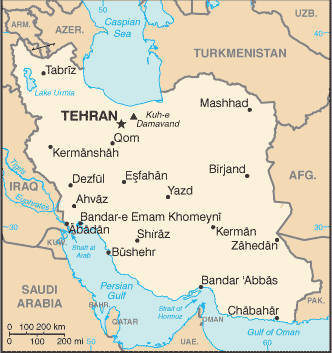 Iran’s top nuclear negotiator Saeed Jalili on Wednesday criticized the European Union diplomat Catherine Ashton, who acts as a middle -man between Iran and the P5+1, for dragging her feet in setting up smaller meetings with deputies and experts in between the major talks.
In a letter to Ashton’s office, Jalili said, “The other side’s delay in holding meetings between deputies and experts put into question their determination to hold positive negotiations in Moscow. The Islamic Republic of Iran, with a clear logic and definite initiatives, is ready to engage in forward-looking negotiations for cooperation.”
Iran sought an experts meeting ahead of the Moscow talks. But EU diplomats refused, claiming to be weary of getting bogged down before getting to the substance of a political resolution.
“I am not saying technical issues are irrelevant,” a European diplomat told Al Monitor Thursday. “We need Iran to engage seriously on the substantial proposal we have put forward…as this is a political decision for them to make that cannot be solved at a technical level. We cannot be drawn into long procedural and protocol discussions without substance for the sake of buying time.”
But Western powers have not put forth a “substantial proposal.” Instead, they’ve demanded Iran halt all or most of its uranium enrichment – thus denying the rights afforded them under international treaties – and have refused to ease the harsh economic sanctions dragging down Iran’s economy.
All of this is being done in an environment of intimidation. As Reza Nasri over at PBS Frontline’s Tehran Bureau put it recently, “world powers are again poised to ‘solve’ an international crisis through an ‘agreement’ that is essentially predicated on intimidation, illegal threats of military action, unilateral ‘crippling’ sanctions, sabotage, and extrajudicial killings of Iran’s brightest minds.”
After the failed talks in 2009 and 2010, wherein Obama ended up mysteriously rejecting the very deal he demanded the Iranians accept, as Harvard Prof. of international affairs Stephen Walt wrote last week, the Iranian leadership “has good grounds for viewing Obama as inherently untrustworthy.”
The Iranians have offered a full stop to uranium enrichment at 20 percent – the supposed pretext for these talks – so long as the West agrees to ease the economic warfare crippling Iran’s energy and banking sector. But the West has not yet responded to such overtures, which could lead to a breakdown of talks altogether.
and......
http://news.antiwar.com/2012/06/07/russia-vows-to-block-any-un-mandate-for-intervention-in-syria/
Russia Vows to Block Any UN Mandate for Intervention in Syria
The Russian FM denounced efforts of foreign meddlers to bring down Assad
by John Glaser, June 07, 2012
Russian Foreign Minister Sergei Lavrov Thursday stated unequivocally there would be no UN Security Council mandate for outside interventionin Syria, making clear Moscow would use its veto to block any military action.
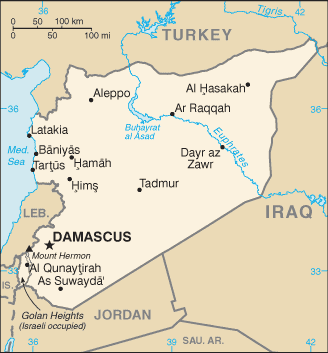 “There will not be a Security Council mandate for outside intervention, I guarantee you that,” Lavrov told reporters, while speaking out against efforts by the U.S. and its allies to bring down the regime of Bashar al-Assad.
“Either we gather everyone with influence at the negotiating table or once again we depart into ideology… where it is declared shamelessly that everything is the fault of the regime, while everyone else are angels and therefore the regime should be changed,” he said.
As Joshua Landis, director of the Center for Middle East Studies at the University of Oklahoma and an expert on Syria, wrote in Foreign Policy this week, “Let’s be clear: Washington is pursuing regime change by civil war in Syria. The United States, Europe, and the Gulf states want regime change, so they are starving the regime in Damascus and feeding the opposition.”
But Lavrov argued the opposition could not be trusted. ”There are sides in the Syria conflict, especially the so called Syrian National Council, who are saying no negotiations with the regime, only continued armed battle until the Security Council gives a mandate for outside intervention,” he said.
Russia’s interests in Syria, which acts as a sort of client state for Moscow, have lead to consistent promises of vetoes for any UN Security Council resolution justifying intervention. There might have been some kind of international intervention back in early February, when China and Russia vetoed a resolution that very well could have led to military action.
For now, the White House has officially opposed direct military intervention on the grounds that it would lead to greater chaos and escalate the humanitarian crisis in the country.
“We do not believe that militarization, further militarization of the situation in Syria at this point is the right course of action,” White House Spokesman Jay Carney said. “We believe that it would lead to greater chaos, greater carnage.”
While the Obama administration rightly opposes military intervention, they have unfortunately already begun providing lethal and non-lethal aid to the Syrian opposition. This, despite the fact that the rebel fighters have committed serious atrocities themselves and that al-Qaeda elements are known to cooperate in the rebel fight against Assad.
This aid to the opposition is likely to spread the violence and increase the number of Syrian dead without increasing the likelihood of Assad’s departure. Also, as we saw in Libya, such policies tend to boost the power of fighting groups and marginalize those who favor peaceful political transition.
The foreign meddling in Syria is almost certainly prolonging the conflict. Support for the Assad regime from Russia and Iran and for the opposition from the U.S. and its allies in Europe and the Persian Gulf is emboldening both sides and preventing either from giving up and ceding to a political transition.
But Russia’s threat of a veto is at least blocking another Western war in the Middle East and marginalizing somewhat the very transparent calls for U.S. intervention which are being made by hawks who want to stick it to Iran as opposed to save the Syrian people.
and.....
Panetta: US Losing Its Patience With Pakistan
As US Drones Continue to Pound Tribal Areas, Who Should Be Mad at Who?
by Jason Ditz, June 07, 2012
Long touted as the one irreplaceable ally in the US global war on terror, Secretary of Defense Leon Panetta was defiant on the ever worsening relationship with Pakistan today, saying the the US is “reaching the limits of our patience” with the nation.
Panetta couched the US “anger” at Pakistan in the terms of their long-standing demands that Pakistan launch an offensive against North Waziristan, insisting that the site remains a “safe haven” for terrorist groups to launch attacks into Afghanistan.
On that count, both Afghanistan and Pakistan have had beefs with the other side, as militant factions operate freely across both sides of the rugged border. For every strike into Afghanistan staged from the Pakistani tribal areas, Pakistan can cite a similar strike against Bajaur or Peshawar that came from militants in Afghanistan’s Kunar Province.
This is, of course, only part of the issue, and the real changes in the US-Pakistan relationship have been in relation to the closed border crossings, and negotiations in which Panetta accused Pakistan of trying to “price gouge” the US, as well as Pakistan’s growing public criticism of the US drone strikes pounding their tribal areas.
Indeed, between the Raymond Davis fiasco, the constant drone strikes and the November US attack which killed 24 Pakistani soldiers, one must marvel that Pakistan isn’t simultaneously “reaching the limits” of its own patience with the US, particularly as massive anti-US protests conducted regularly in Pakistan make it a core issue in their next election.
Still, Panetta’s position seems to be well supported among the US political class. During a debate last night on BBC Radio 5, high profile neo-con Richard Perle told me that “I don’t have a lot of sympathy for the Pakistanis in this situation,” citing the recent Pakistani decision to sentence a CIA doctor for “high treason” for conducting a phony vaccination program aimed at collecting the DNA of children in Pakistan. The US Senate revoked some aid from Pakistan for this same reason, arguing that without the covert program, Osama bin Laden would never have been successfully assassinated.


No comments:
Post a Comment