http://www.guardian.co.uk/business/2012/may/18/eurozone-crisis-stock-markets-greece-spain
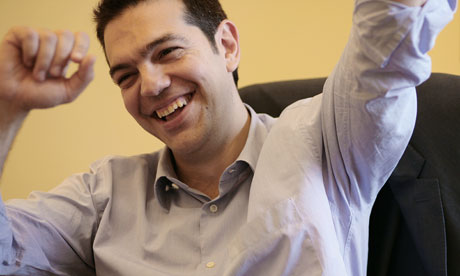 Alexis Tsipras in his office at the Greek parliament building on Friday. Photograph: Martin Godwin
According to reports from Athens, the Greek government is now rejecting Berlin's denial, insisting that Merkel did suggest running a referendum alongside the June 17 vote.....

and.....
http://www.cnbc.com/id/47471171
 Text Size

Eurozone crisis live: Row after Angela Merkel 'suggests Greece holds euro referendum'
 Email
Email
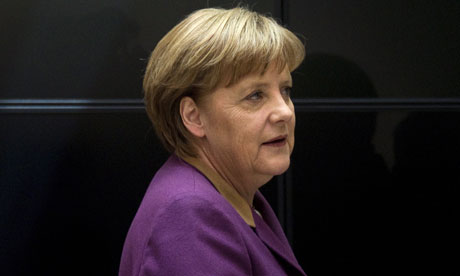
German government spokesman denies that Angela Merkel suggested a Greek euro referendum, as Greece's political parties attack the news. Photograph: John Macdougall/AFP/Getty Images
And with that, we're done for the day, What a dramatic week, in which the prospect of Greece leaving the eurozone grew, and stock markets fell steadily in the face of a flood of bad news.
Greek leftist leader Alexis Tsipras has given an interview to the Guardian in which he describes the election campaign as "a war between people and capitalism".
Alexis Tsipras in his office at the Greek parliament building on Friday. Photograph: Martin Godwin
It begins:
"I don't believe in heroes or saviours," says Alexis Tsipras, "but I do believe in fighting for rights … no one has the right to reduce a proud people to such a state of wretchedness and indignity."The man who holds the fate of the euro in his hands – as the leader of the Greek party willing to tear up the country's €130bn (£100bn) bailout agreement – says Greece is on the front line of a war that is engulfing Europe.Helena Smith, our Athens correspondent, had the pleasure of meeting London Mayor Boris Johnson yesterday (he was in Athens to play his part in the Olympic Torch exchange).Helena reports that while Boris comes from the opposite end of the political spectrum, he seems to agree with Greek far left leader Alexis Tsipras that Greece is in a much stronger position than might at first seem. She writes:"I don't think for a moment Greece is going to be thrown out of the EU," Boris told me. "To do so would be to throw out the baby with the water ... and I don't think for a moment Tsipras will do anything that would lead the country [to exiting the euro zone]," said the former journalist, who it would seem is a keen follower of Greek affairs.The prospect of Greece returning to the drachma was, Johnson agreed, as remote as the UK joining EMU. But for safety's sake he had some of the old currency in his pocket - and what would have been back in 2001, when Athens signed up to the euro, a reasonable amount."I was told to come back in a month," he joked, after trying to pay his dinner bill with it.Only Boris....World leaders have been discussing the Greek crisis in America, where they are gathering for the G8 summit.François Hollande, the new French president, said it was essential that Greece remains in the eurozone, adding that he had told Barack Obama that economic growth must be a priority for Europe.David Cameron has also been speaking, and repeating his line that the eurozone must take "decisive action" on Greece, and that Greeks must "make their minds up" about the country's future plan (as, indeed, they should do on June 17)
* * * *
According to reports from Athens, the Greek government is now rejecting Berlin's denial, insisting that Merkel did suggest running a referendum alongside the June 17 vote.....
The German government has now denied that Angela Merkel suggested that Greece should hold a referendum.
Reuters is quoting a German government spokesman that:
This is false and we completely dismiss this.
But as reported at 6.26pm, the statement from the Greek prime minister is pretty clear. It says that: "She [Merkel] also conveyed to the President of the Republic thoughts about the holding of a referendum parallel to the elections on the question of whether the Greek citizens wish to remain in the eurozone."
So what exactly were Merkel's thoughts on the idea of a euro referendum, which wasn't being discussed until this evening....
There's been a rapid backlash in Greece to the news that Angela Merkel had proposed that Greece should hold a referendum on its euro membership.
Alexis Tsipras, head of the Syriza coalition, reacted quickly, saying Merkel had grown used to treating Greece "like a protectorate". He blamed the leaders of the mainstream political parties for encouraging this attiture.
Tsipras (rising a wave of popularity by arguing that Greece's austerity package must stop), added that the June 17 elections will allow the Greek people to end their "austerity, subordination and indignity" in favour of "progressive developments across Europe".
Antonis Samaras, the head of the conservative New Democracy party, also rejected the suggestion of a referendum, but for different reasons. Samaras said:
The Greek people don't need a referendum to prove they're pro-euro.
And Pasok MP Eva Kaili has also rejected Merkel's suggestion, tellingBusiness Insider that the referendum:
won't and can't happen. It is ironic and it is blackmail.
Efthimia Efthimiou, financial journalist at Capital.gr, suggests that Merkel would have been aware that Greece's current coalition government lacked the authority to call a referendum, but wanted to ensure that the June 17 election was seen as a vote on Greece's future in the eurozone.
Angela Merkel's jaw-dropping suggestion that Greece should hold a referendum on its membership of the eurozone (as the Athens government stated at 6.26pm) comes exactly 190 days after former prime minister George Papandreou resigned, after enraging European leaders including the German chancellor by suggesting the Greek people should vote on the terms of their second bailout.
The Greek government has released a statement, confirming that Angela Merkel suggested to president Karolos Papoulias that Greece should hold a referendum on its membership of the eurozone.
The idea was then rejected by interim prime minister Panagiotis Pikramenos, as his caretaker administration simply does not have the authority to call a referendum.
It's here, in Greek. Here's a translation of the key section in English, viaDiane Shugart, who does a brilliant job of reporting Greek events on Twitter.
Mrs Merkel reiterated the EU's support for Greece's efforts to overcome the crisis. She also mentioned that the EU intended to examine bolstering of policies aimed at growth and combatting unemployment in the European area. The issue of growth is, in any case, the basic issue that will occupy the extraordinary EU summit on May 23 in Brussels.She also conveyed to the President of the Republic thoughts about the holding of a referendum parallel to the elections on the question of whether the Greek citizens wish to remain in the eurozone. It is evident nonetheless that the issue is beyond the scope of the caretaker government.
Some remarkable late breaking news in Greece – national TV are reporting that Angela Merkel, the German chancellor, told Greek president Karolos Papoulias today that Greece should hold a referendum on its membership of the eurozone, alongside the election of June 17.
We knew that Merkel and Papoulias had spoken by phone earlier today (see 10.55am), but this is an unexpected development....
and.....
http://www.cnbc.com/id/47471171
Ex-ECB Chief Trichet Unveils Bold Plan to Save Euro
Published: Thursday, 17 May 2012 | 11:30 PM ET
Text Size
By: Reuters


Europe could strengthen its monetary union by giving European politicians the power to declare a sovereign state bankrupt and take over its fiscal policy, the former head of the European Central Bank said on Thursday in unveiling a bold proposal to salvage the euro.
 |
Getty Images
Jean-Claude Trichet
|
The plan offered by Jean-Claude Trichet, who stepped down last November as ECB president, would address a fundamental weakness of the 13-year-old single currency[EUR= 1.2782  0.0098 (+0.77%)
  ], the survival of which is threatened by the Greek crisis.
0.0098 (+0.77%) ], the survival of which is threatened by the Greek crisis.
The monetary union has always defied economic principles, because the euro was launched ahead of European fiscal or political union. This has caused strains for countries running huge budget deficits - namely Greece, Portugal, Ireland, Spain and Italy - that have led to financing difficulties and over-stretched banking systems.
For the European Union, a fully fledged United States of Europe where nation states cede a large chunk of fiscal authority to the federal government appears politically unpalatable, Trichet said.
An alternative is to activate the EU federal powers only in exceptional circumstances when a country's budgetary policies threaten the broader monetary union, he said.
"Federation by exception seems to me not only necessary to make sure we have a solid Economic and Monetary Union, but it might also fit with the very nature of Europe in the long run. I don't think we will have a big (centralized) EU budget," Trichet said in a speech before the Peterson Institute of International Economics here.
"It is a quantum leap of governance, which I trust is necessary for the next step of European integration," he said.
His proposal was presented in Washington on the eve of the G8 meeting of the world's major economies, hosted by U.S. President Barack Obama who will press Europe to intensify its efforts to resolve the sovereign debt crisis, which threatens a fragile global recovery.
It also comes ahead of a critical meeting of EU leaders on May 23 to discuss ways to support growth. Its strict budgetary policies to date have led to recessions in many countries, political unrest and in Greece a political stalemate after recent elections.
Trichet said the building blocks already are in place for moving ahead with his fiscal plan.
Countries have agreed to surveillance of each other's budgets and they have agreed to levy fines on countries that run excessive budget deficits, giving them fiscal oversight authority.
The next step would be to take a country into receivership when its political leaders or its parliament cannot implement sound budgetary policies approved by the EU. The action would have democratic accountability if it were approved by the European Council of EU heads of states and the elected European Parliament, he said.
The idea earned a warm reception from leading economists and prominent Europeans attending the session.
"It is a very radical proposal, couched as a modest step," said Richard Cooper, international economist at Harvard.
Caio Koch Weser, former German economics minister, said he found it "very attractive" because it addresses the problem of a strong European Central Bank, a weak European Commission which acts as the EU's executive branch, and a confused European Council, which provides political leadership.
.


No comments:
Post a Comment