http://www.german-foreign-policy.com/en/fulltext/58304
http://www.telegraph.co.uk/finance/economics/9292146/No-German-money-for-Greek-bottomless-pit.html
and....
and....
http://www.guardian.co.uk/world/2012/may/26/greece-crisis-tourism-germany
On the Relevance of Democracy
2012/05/21

A Last Chance
After all attempts to form a government in Greece failed, last week, it appears that in the elections set for June 17, those forces will win a majority that are strictly opposing the German austerity dictate. Even with their slight majority in parliament, the three parties willing to implement the austerity program have not succeeded in forming a government. Polls are predicting their defeat. The fact that a majority in the Greek population would like to keep the Euro, is seen in Berlin and Brussels as a last chance to achieve a change in public opinion. Already before the announcement of new elections, German Finance Minister Wolfgang Schäuble declared that the Euro zone could easily cope with Greece's withdrawal. EU Trade Commissioner Karel De Gucht has just confirmed that the EU Commission and the European Central Bank (ECB) are already preparing for Greece's withdrawal. And, Jean-Claude Juncker, head of the Euro Group, is quoted saying that "if we would take a poll with secret ballots on Greece remaining in the Euro zone, an overwhelming majority would vote against it." The new elections are Greece's "last chance." If they do not furnish a majority for the austerity dictate, "it will be over."[1]
No Right to Respect
In addition, Berlin has obviously applied pressure on Athens to combine a referendum on remaining in the Euro zone with the elections. This tactic is aimed at weakening the opponents of austerity. According to reports, German Finance Minster Schäuble made this proposal already last Monday to his Greek counterpart at the meeting of the Euro finance ministers.[2] This proposal is obviously supported by the Chairman of the CDU/CSU parliamentary group in the Bundestag, Volker Kauder ("Now German will be spoken in Europe" [3]). A Greek government spokesman confirmed that Chancellor Angela Merkel urged Greek President Karolos Papoulias last Friday to implement the German plan for a Greek referendum, whereas in November 2011, Berlin briskly rebuffed the Prime Minister at the time, Giorgos Papandreou, when he publicly announced his proposal to hold a referendum. This led to his demise. Berlin's open interference is met with outrage in Athens. The Greek population has a "right to respect," the chairperson of the conservative Nea Dimokratia, Antonis Samaras, was quoted as saying. And the chairman of the opposition party Syriza, Alexis Tsipras, declared that Berlin is acting as if Greece "is a protectorate."[4]
Euro Dusk
Berlin is gruffly rebuffing every deviation from the severe austerity policy, ruining Greece, (german-foreign-policy.com reported [5]) - in spite of the fact that this will accelerate the collapse of the entire Euro zone. A few days ago, the economist and Nobel laureate Paul Krugman, was not the first to describe such a scenario. Soon, "most likely, next month," Greece will exit the Euro zone, according to Krugman. Immediately thereafter, a comprehensive capital flight can be expected to Germany - at least from Spain and Italy, out of fear of also these two countries' economic collapse. This would necessitate drastic measures - limitations of money transfer or new support measures for Spanish and Italian banks, and possibly both. In the long run, however, support particularly for the Spanish economy with stimulus programs cannot be avoided. This would mean a strategy change for combating the crisis that Berlin from the very beginning has been trying to avoid at all costs. "Germany has the choice," explains Krugman, accept the change of course or "the end of the Euro" is imminent. Concerning the time span of the "Euro dusk," Krugman says, "we are speaking in terms of months, not years."[6]
Protectorate
The sectors of the German elite, which refuse to consider this change of course proposed by Krugman and numerous other experts outside Germany,[7] are now publicly debating scenarios involving the use of force. In a newspaper interview early this month, the director of the prominent Hamburg Institute of International Economics, Thomas Straubhaar, called for establishing a protectorate in Greece - "regardless of the outcome of the elections." The country is a "failed state," he says, which is unable to raise itself "to a new start" under "its own steam."[8] Athens needs "help in establishing viable state structures." It, therefore, must be transformed into "a European protectorate." "The EU must do it," affirms Straubhaar. The EU "would have to help Greece modernize its institutions at every level, particularly with administrative staff, tax experts, and tax inspectors." However, refounding Greece would demand "intuition" to "overcome national pride, conceit, and the resistance of interest groups." This is referring to a sovereign democracy, a German ally in the EU and NATO.
Putsch
In the meantime, there is even discussion of a putsch in Athens. Greece threatens to sink into complete chaos, warned a long time companion of Germany's former Foreign Minister, Joseph Fischer, Daniel Cohn-Bendit, a European parliamentarian for the French Green Party. Cohn-Bendit explained that it is impossible to avoid extensive foreign interference. "If you leave the Greeks to muddle through alone, you are risking a military putsch."[9] German commentators are drawing comparisons to the situation in the later stages of Germany's Weimar Republic. "In the Greek situation, the worst case would be a reversion to a dictatorship," warned an influential commentator. "This scenario becomes more probable as instability grows." In reference to the links between a possible dictatorship and Berlin's austerity dictate, the commentator writes, "already today, it seems as though Merkel's austerity policy can, at best, be imposed on the streets of Athens by force of arms."[10]
Protection Forces
Last week, a leading German daily discussed the issue of dispatching troops to Greece. Should the country go bankrupt, it would then, as a "'failing state,' (...) be less in a position" to shore up its borders against migrants, writes the Frankfurter Allgemeine Zeitung. Just recently, the EU Commission announced that it finds itself forced to prolong the mission of its EU border troops at the Greek/Turkish borders. If Athens "should no longer be able to pay its officials, or can pay only in Drachmas," the situation risks "chaotic."[11] The country could possibly "be rocked by rebellions." "Help for Greece would then no longer be on credit, but be transformed into a sort of humanitarian emergency aid," prophesied the journal in its front-page lead editorial. "Hopefully, an international protection force, such as is stationed in the teetering countries further to the north, will not become an option."[12]
Further information and background on Germany's policy toward Greece can be found here: Impoverishment Made in Germany and The Traits of the Crisis.
http://www.telegraph.co.uk/finance/economics/9292146/No-German-money-for-Greek-bottomless-pit.html
Hans-Peter Friedrich, the German interior minister, said Europe's largest economy was prepared to help rescue Greece but only if it helps itself and honours agreements.
"We're not willing to pour money into a bottomless pit," he told Leipziger Volkszeitung newspaper.
"Anyone who wants to see help and solidarity from us has to accept that we expect from that country a certain amount of seriousness and a certain amount of reasonableness."
The comments come as Euler Hermes SA, a French-German trade-credit insurer, said it may reduce its coverage of exports to Greece because of the risk of the country exiting the euro. A decision is planned before the end of May.
A spokesman asid: “In light of the recent developments, Euler Hermes will most probably have to switch to a more prudent approach, also in the interest of its customers.
and....
German exports to Greece decline on default risk
The crisis also has prompted Euler Hermes, Germany’s biggest export insurer, to frequently reject risk coverage, the newspaper said. The company may announce in the next few days that it is ending new business with Greece, Bild added. [Bloomberg] |


and....
http://www.guardian.co.uk/world/2012/may/26/greece-crisis-tourism-germany
Fearful Germans add to Greece's woes by staying away in droves
Images of anti-German protests have caused 50,000 holiday cancellations in 10 days
 Email
Email
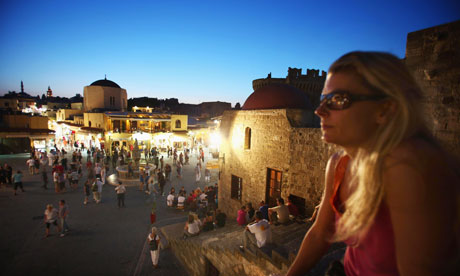
German holidaymakers normally flock to Greek destinations such as Rhodes, the largest of the Dodecanese Islands. Photograph: Eyeswideopen/Getty Images
Every May, coaches carrying German tourists would cruise up the long winding road that leads from Pyrgos to ancient Olympia. There they would decant in en masse, a permanent fixture in the tavernas, bars and shops that line the Peloponnesian town's cobbled thoroughfare. But things have changed.
"They're just not coming," says Dimitris Tyligadas, a local hotelier. "And if they do, they kind of look at us through half-closed eyes, as if they don't really trust us."
Olympia is not alone. The German reaction to the economic crisis engulfing Greece has been to stay away. In the 10 days after the inconclusive election on 6 May an extraordinary 50,000 bookings – half of those usually made every day at this time of year – were cancelled, theObserver has learned. Most were Germans fearing the consequences of being seen as the source of the austerity regime enforced in return for EU-International Monetary Fund rescue loans to prop up Greece's moribund economy.
"The drop was considerable," said Andreas Andreadis, president of the Association of Greek Tourism Enterprises. "We estimate that German arrivals will be down by about 25% by the end of the year."
Germans exceed even Britons in their lust for the sun, sea and freedom of spirit associated with Greek resorts. Close to four million visit each year – more than any other EU member state. For a country that depends on tourism, with one in five working in it, their absence could have a devastating effect; never more so than now when the future of Greece, either in or out of the eurozone, is likely to have ramifications not only forEurope but the world economy.
Earlier this year Athenian newspapers were full of reports of Germans "fearing for their lives" if they visited Greece. Violent street protests, peaking with the burning of the German flag outside the Greek parliament in February, at the height of the booking season, spurred the first wave of cancellations.
It was a far cry from the image Germans such as Andrea Schale had in mind when they booked their Greek holiday months earlier. For Schale, a 27-year-old sales assistant from Potsdam, the resort of Malia in Crete conjured "fishing boats, a white, sun-baked terrace, a bottle of ouzo to wash down after a plate of souvlaki". On Friday as she prepared to board a flight from Berlin to the island's capital, Heraklion, she found herself wondering whether she had made the right choice.
"We've seen lots of images on TV of Greeks burning the German flag, setting fire to rubbish bins and of stones flying. I just hope the anti-German sentiment isn't going to ruin our holiday. I think I'll pretend to be Austrian just in case, or better still, speak English."
According to a poll by the Foundation for Future Studies, which interviewed 4,000 Germans, only 1.1% are planning a holiday in Greece this summer, a drop of almost a half since last year, and of two-thirds since the start of the economic crisis in 2009.
"The dominant image of Greece right now is not of sunny islands, beautiful beaches or cosy little tavernas, rather of strikes, anti-German sentiment and corruption," said Ulrich Reinhardt, the foundation's scientific head. "These negative associations have led to a huge amount of unease."
The German foreign office has advised tourists to check on the current situation before any holiday and to avoid "demonstrations and large gatherings".
Ironically, Greece could not be quieter, less strike-plagued or better value for money. Walkouts that saw thousands of tourists being stranded at harbours and airports last year have dropped as unions lay down their arms ahead of general elections on 17 June.
"We don't have plans to stage any strikes until September although much will depend on whether the new government chooses to continue with these barbaric austerity measures that Merkel is demanding," said Ilias Iliopoulos at the civil servants' union, Adedy.
Even Athens, the focus of fiery demonstrations since Europe's debt crisis erupted beneath the Acropolis, has calmed down dramatically despite the political uncertainty that has followed this month's poll. "Last year in April and May there were 54 strikes, according to the public order ministry. This year there have only been four," said Andreadis.
"And precisely because of the crisis Greece is the best value it's ever been for the past decade. To fight the bad press and re-energise demand we have reduced rates dramatically and have far better offers compared with Italy, Spain, Turkey and Portugal," he said. "This is actually an incredible opportunity. The Greece we dream about and want our children to live in could be born out of this crisis."
But it is a perilous balancing act. Although Greece attracted an unprecedented 16.5 million tourists last year – with record numbers from Russia and other new markets across the Balkans and Turkey – falling prices could lead to the sort of revenue losses that will exacerbate what is already the worst recession in living memory for Greeks.
A 10% drop in GDP would equate to 100,000 job losses say industry experts, many of whom are bracing for the worst.
Adding to the pressure, German tour operators such as TUI have demanded that Greek resorts not only cut the price of holidays by up to 35% but have insisted they also add "drachma clauses" to cover themselves should the euro be scrapped and replaced by a seriously devalued drachma.
Under such circumstances, Greece is in danger of becoming a bargain basement destination if it cut its prices too sharply, said Claudia Brözel, a German professor of tourism marketing, noting that the country usually appeals to Germans from the higher income bracket.
"This could really damage its image in the long-term, and attract the type of tourist Greece doesn't want," she said.
and......
http://www.athensnews.gr/portal/11/55814
| French banks readying for Greek eurozone exit | |||
| |||

French banks, which are among the lenders most exposed to Greece, have stepped up their efforts on contingency plans for a possible Greek euro exit, sources familiar with the situation said.
The heightened preparations by banks, including Credit Agricole (CAGR.PA), BNP Paribas (BNPP.PA) and Societe Generale (SOGN.PA), come after euro zone sources told Reuters earlier this week that each member of the common currency would have to prepare a plan for a possible Greek exit.
"The banks are doing contingency planning concerning a Greek exit, but you can understand why they wouldn't say so publicly," a consultant to French banks said.
An investment banker who advises European banks, said French lenders had all stepped up their contingency preparations for a Greek pull-out at regulators' request over the past two weeks.
Such preparations would contradict some French regulatory sources' contention that a Greek exit remained such a remote possibility that there was no point in drawing up plans for it.
Bank of France Governor Christian Noyer said last week that French regulators were not actively stress-testing banks for the scenario of Greece leaving the single currency, although he said none would be "put in a situation of difficulty" in the event of a Greek exit.
More Reticent
Newly inaugurated French President Francois Hollande said earlier this week that he viewed a Greek exit as out of the question and that no contingency plans were being drawn up.
"Over in the UK, the financial sector began this kind of contingency planning weeks, months ago," said Hubert de Vauplane, a partner at Kramer Levin in Paris. "I find there is a higher degree of preparation in London than in Paris. For political reasons, the French banks have been more reticent."
French banking and insurance regulator ACP's head declined to comment earlier on Friday on possible contingency planning.
The regulators "would be completely failing in their fiduciary duties if they were not asking for it," the banker said.
BNP Paribas, SocGen and Credit Agricole declined to comment.
The loss risk of a Greek exit would be an estimated 5.2 billion euros for Credit Agricole, 2.9 billion for BNP Paribas and 400 million euros for Societe Generale, according to Natixis analyst Alex Koagne.
Credit Agricole, which has the biggest exposure to Greece of any French lender via its Emporiki unit, said earlier this month that it had a team working to prepare for possible outcomes from a Greek exit even if it saw that as a less probably scenario.
BNP Paribas and Societe Generale have slashed their exposure to Greek sovereign debt over the past year: at end-April, both banks said their Greek bondholdings stood at 0.2 billion euros in their banking books.
SocGen, unlike BNP, also owns local bank Geniki, but the French group's chief executive Frederic Oudea told shareholders this was a "manageable" exposure at around 500 million euros.
Credit Agricole has also managed to cut its exposure to Emporiki by more than half, but that still leaves it at 5.2 billion euros. The bank recently renewed a request for access to emergency funding which have helped prop up domestic Greek banks. (Reuters)
and.....
http://globaleconomicanalysis.blogspot.com/2012/05/merkels-6-point-plan-to-save-europe.html
Friday, May 25, 2012 12:10 PMMerkel's 6-Point Plan to Save Europe; Merkel Backed Into Tight Corner: Social Democrats Threaten to Not Ratify Merkozy Treaty Without Growth Measures; Merkel Coalition at Risk
It would be quite ironic and rather fitting if Germany and France fail to ratify the Merkozy treaty. 25 Nations have ratified the treaty but France and Germany still have not.
French president Francois Hollande has already threatened non-ratification unless the treaty is revised. The Leader of the Social Democrat Party (SPD)in Germany, Frank-Walter Steinmeier, is making similar threats for the first time.Effectively chancellor Merkel is painted into a huge corner with no wiggle room. "I guarantee you, there will only be a fiscal pact if it includes complementary growth elements," Steinmeier said. Specifically, Steinmeier wants a financial transaction tax, expansion of loan volume to the European Investment Bank, and a nebulous "strengthening of investment power". Steinmeier also called for the creation of a European debt repayment fund. He said that euro bonds could only be introduced "if they come with strict conditions and we have harmonized European economic and finance policy." Merkel needs those SPD votes because treaty ratification takes a two-thirds majority in the Bundestag, Germany's parliament. Merkel's 6-Point Plan to Save Europe Backed into a corner, Berlin Proposes European Special Economic Zones. With Europe beginning to look for alternatives to its exclusive focus on austerity, the German government has developed a six-point plan to foster economic growth in Europe, SPIEGEL has learned. Included in the proposal is the creation of special economic zones in struggling euro-zone countries. The proposal is part of a six-point plan the German government plans to introduce into the discussion on measures to stimulate economic growth taking place in the European Union. The proposal also calls for the countries to set up trusts similar to the Treuhand trust created in Germany at the time of reunification that then sold old off most of former East Germany's state-owned enterprises in order to divest those countries' numerous government-owned companies.Too Little Too Late Some of those ideas seem quite reasonable. However, haven't they been agreed to before?How many times has Greece promised work-rule reform only to see nothing happening? Spain has not done much either. Nor has Italy. Merkel Coalition at Risk At every juncture, Merkel is increasing backed into a corner - by French President Francois Hollande, by ECB president Mario Draghi who sides with Hollande, by Mario Monti, Prime Minister of Italy, and now by the SPD. As I see the demands, I fail to see how the 6-point proposal comes close to what SPD wants. Here is the key question: Will the plan satisfy Social Democrats? If not, Merkel's coalition government itself is at risk.
and....
| |||


No comments:
Post a Comment