http://www.shtfplan.com/headline-news/u-s-army-general-the-whole-northern-hemisphere-is-at-risk-of-becoming-largely-uninhabitable_05252012
You may have entertained the idea of an improbable civilization ending events such as a ‘global killer’ asteroid, earth crust displacement or massive solar storms, but what if there existed a situation right now that was so serious that it literally threatened our very existence?
According to a host of scientists, nuclear experts and researchers, were are facing exactly such a scenario – and current efforts may not be able to stop it.
When the Fukushima nuclear plants sustained structural damage and a catastrophic failure of their spent fuel cooling systems in the aftermath of the Japanese earthquake and Tsunami in 2011, it left the government of Japan, Tokyo Power and nuclear regulatory agencies around the world powerless to contain the release of deadly radiation. A year on, the battle for control of Fukushima continues to no avail.
It’s estimated that tens of thousands of people in Japan and the whole of North America have been affected, with reports indicating that children in Japan and the U.S. are already being born with birth defects, as well as thousands who have already succumbed to radiation related illness. As we initially followed the breaking news during the first thirty days of the accident, we suggested the Fukushima disaster would be worse than Chernobyl. Not even we could have imagined how much worse it would be.
If current estimates are correct, Fukushima has already released as much radiation into the atmosphere and Pacific Ocean as Chernobyl, and the potential for a disaster at least ten times worse is highly probable in the event of another earthquake or accident that leads to a collapse of the cooling structures which are above ground and have already suffered significant damage.
According to U.S. Army General Albert N. Stubblebine (ret.) of the Natural Solutions Foundation, the situation is extremely serious and poses a significant danger to our entire civilization. Since TEPCO and the Japanese government have refused the entombment option (as the Russians did with Chernobyl) the world is at the mercy of nature. A mistake here would cause the deaths of tens of millions of people across the globe.
http://mainichi.jp/english/english/newsselect/news/20120525p2a00m0na016000c.html
http://enenews.com/govt-tmi-investigator-fukushima-daiichi-requires-a-manhattan-project-approach-virtually-100-probability-of-large-quake-in-10-years-required-to-defuel-plant
You may have entertained the idea of an improbable civilization ending events such as a ‘global killer’ asteroid, earth crust displacement or massive solar storms, but what if there existed a situation right now that was so serious that it literally threatened our very existence?
According to a host of scientists, nuclear experts and researchers, were are facing exactly such a scenario – and current efforts may not be able to stop it.
When the Fukushima nuclear plants sustained structural damage and a catastrophic failure of their spent fuel cooling systems in the aftermath of the Japanese earthquake and Tsunami in 2011, it left the government of Japan, Tokyo Power and nuclear regulatory agencies around the world powerless to contain the release of deadly radiation. A year on, the battle for control of Fukushima continues to no avail.
It’s estimated that tens of thousands of people in Japan and the whole of North America have been affected, with reports indicating that children in Japan and the U.S. are already being born with birth defects, as well as thousands who have already succumbed to radiation related illness. As we initially followed the breaking news during the first thirty days of the accident, we suggested the Fukushima disaster would be worse than Chernobyl. Not even we could have imagined how much worse it would be.
If current estimates are correct, Fukushima has already released as much radiation into the atmosphere and Pacific Ocean as Chernobyl, and the potential for a disaster at least ten times worse is highly probable in the event of another earthquake or accident that leads to a collapse of the cooling structures which are above ground and have already suffered significant damage.
According to U.S. Army General Albert N. Stubblebine (ret.) of the Natural Solutions Foundation, the situation is extremely serious and poses a significant danger to our entire civilization. Since TEPCO and the Japanese government have refused the entombment option (as the Russians did with Chernobyl) the world is at the mercy of nature. A mistake here would cause the deaths of tens of millions of people across the globe.
If there ever existed a threat that could cause the end of the world as we know it, it’s the ongoing and unresolved nuclear saga in Japan:
When the highly radioactive Spent Fuel Rods are exposed to air, there will be massive explosions releasing many times the amount or radiation released thus far. Bizarrely, they are stored three stories above ground in open concrete storage pools. Whether through evaporation of the water in the pools, or due to the inevitable further collapse of the structure, there is a severe risk. United States public health authorities agree that tens of thousands of North Americans have already died from the Fukushima calamity. When the final cataclysm occurs, sooner rather than later, the whole Northern Hemisphere is at risk of becoming largely uninhabitable.
…
Fact. On March 11, 2011, Fukushima Daichi nuclear power station with six nuclear reactors suffered cataclysmic damage that some believe was a man made event,and the resulting Tsunami. Hydrogen explosions…at least one nuclear explosion… and then subsequent deterioration of the visible plants at five of those reactors have created a threat situation unparalleled in human history.
Fact. Despite denial and cover-up, the reality has emerged, that enormous amounts of radioactive material has been spewing into the atmosphere, polluting the groundwater, and the food of Japan, and entering by the tens of millions of gallons the waters of the Pacific.
…
There’s no way to sugarcoat these facts. Denying them, blocking them out, pretending that they are not real is of no help to you and your family, and it leaves you totally unprepared for a danger that the Natural Solutions Foundation has been warning about since the first day. As of three weeks ago the levels of radiation inside of the spent fuel pools of unit no. 2 are too high to measure. Get that… too high to measure. And, the water there is evaporating, meaning that heat and radiation could easily build to very high levels.
…
Very simply put, if this much Cesium 137 is released, it will destroy the world environment and our civilization. This is not rocket science, nor does it connect to the pugulistic debate over nuclear power plants.
This is an issue of human survival.We can play the denial game all day long and pretend that, because the mainstream media is not reporting on it, there is no threat, but the facts are quite clear.
This is, without a doubt, the most immediate threat faced by the world. It’s so serious, in fact, that the Japanese government has considered and put into place evacuation plans for the whole of Tokyo – some 40 million people. Reports are also emerging that suggest a collapse of the spent fuel pools would be so serious that the entire country of Japan may have to be evacuated. The entire country – that’s 125 million refugees that will cause an unprecedented humanitarian disaster.
Before you argue that these are the ravings of just alternative media conspiracy theorists and fearmongers, consider the assessment put forth by Robert Alvarez , a senior policy adviser to the Secretary for National Security and the Environment for the US Department of Energy:
The No. 4 pool is about 100 feet above ground, is structurally damaged and is exposed to the open elements. If an earthquake or other event were to cause this pool to drain this could result in a catastrophic radiological fire involving nearly 10 times the amount of Cs-137 released by the Chernobyl accident.
The infrastructure to safely remove this material was destroyed as it was at the other three reactors. Spent reactor fuel cannot be simply lifted into the air by a crane as if it were routine cargo. In order to prevent severe radiation exposures, fires and possible explosions, it must be transferred at all times in water and heavily shielded structures into dry casks.. As this has never been done before, the removal of the spent fuel from the pools at the damaged Fukushima-Dai-Ichi reactors will require a major and time-consuming re-construction effort and will be charting in unknown waters.
…
The total spent reactor fuel inventory at the Fukushima-Daichi site contains nearly half of the total amount of Cs-137 estimated by the NCRP to have been released by all atmospheric nuclear weapons testing, Chernobyl, and world-wide reprocessing plants (~270 million curies or ~9.9 E+18 Becquerel).
It is important for the public to understand that reactors that have been operating for decades, such as those at the Fukushima-Dai-Ichi site, have generated some of the largest concentrations of radioactivity on the planet.
Regulatory agencies all over the world are warning of the potentiality of a further degradation of the Fukushima nuclear reactors and spent fuel pools, and the subsequent nuclear fallout that would follow.
If these reactors go – and they could at any moment for any number of reasons – we’re looking at a situation for which you simply cannot stock enough food, or water, or supplies. Radiation would spread across the entire northern hemisphere and would be impossible to contain.
While we’ve argued in the past that there is no place we’d rather be than in the United States of America in the event of a socio-economic collapse or global conflict, if these spent fuel pools collapse, then an international exit strategy may be the only option.
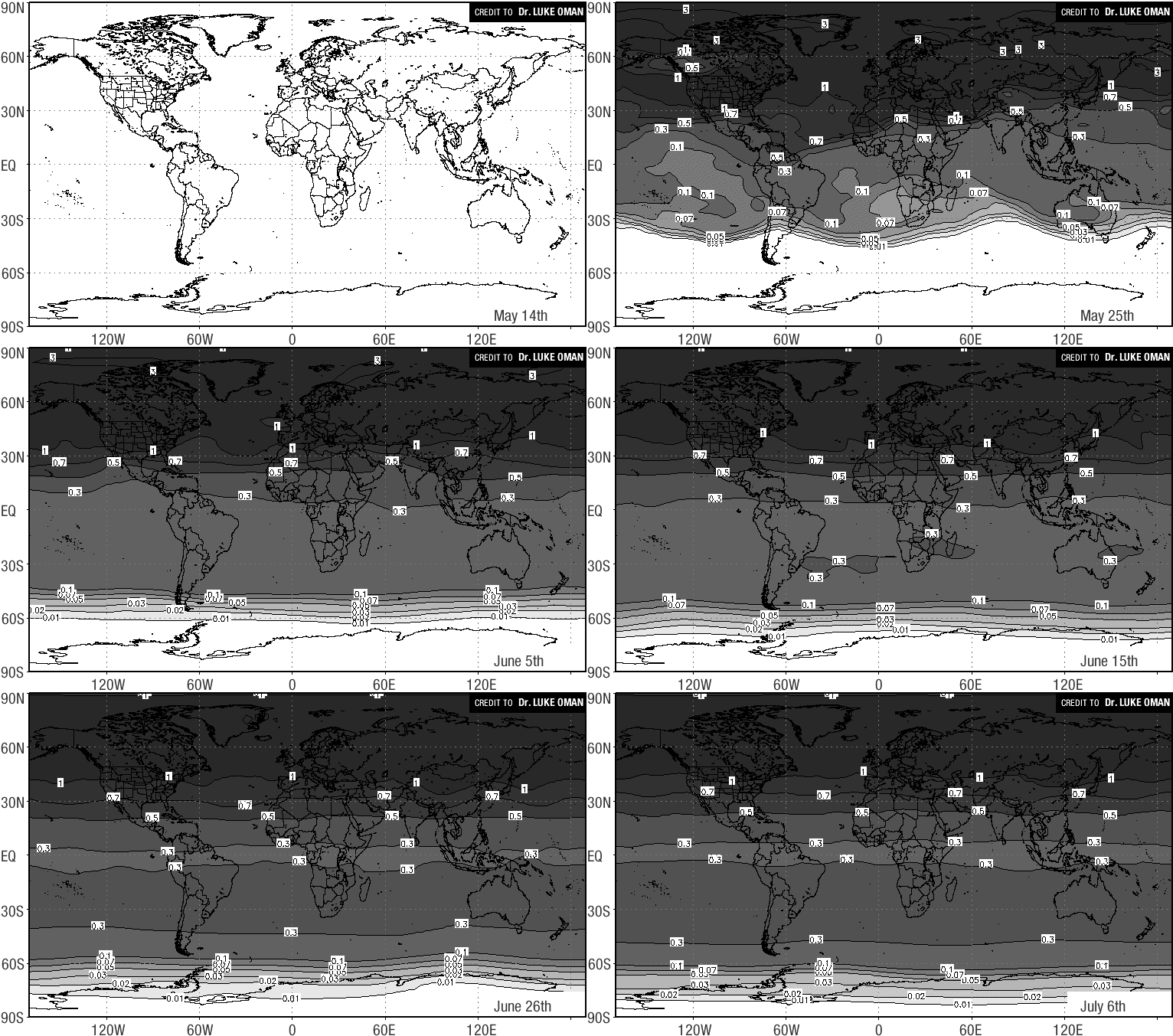
Because details are sparse and research limited, it is difficult to predict what nuclear fall out from Japan may look like. The following map may be of some help, as it details the estimated fallout pattern resulting from a nuclear war between Russia and the United States. You’ll note that, while most of the world would be irradiated, the southern hemisphere would be your best bet to avoid the brunt of it:
Beachfront property in Antarctica sounds quite appealing right about now.
http://mainichi.jp/english/english/newsselect/news/20120525p2a00m0na016000c.html
Edano creates stir with suggestion gov't could partially bear nuclear decontamination costs
Economy, Trade and Industry Minister Yukio Edano's suggestion that the national government may partially bear the costs of decontaminating areas tainted with radioactive substances leaking from the tsunami-hit nuclear plant has created a stir within the government.
The Finance Ministry, in particular, is wary of Edano's suggestion, fearing that the costs that the government is required to shoulder could snowball.
In a May 10 television program, Edano commented, "It's possible that the national government will bear the expenses to a certain extent as part of its responsibility." The industry minister then said the government will choose between another raise in electricity charges, or use of taxpayers' money to cover the costs.
"After having fully decontaminated affected areas, we'll decide whether we'll ask TEPCO customers to shoulder the costs or the nation as a whole to do so," he said.
The Environment Ministry, which is responsible for decontamination, says the national government will decontaminate eight municipalities in Fukushima Prefecture that are close to the crippled Fukushima No. 1 Nuclear Power Plant and are designated as evacuation zones.
Another 104 municipalities in eight prefectures in the Tohoku and Kanto regions where radiation from the nuclear crisis exceeds 1 millisievert a year face the task of decontaminating affected areas by themselves, while receiving financial assistance from the central government. Under government plans, TEPCO will later be billed for the total cost of decontamination.
The national government has set aside approximately 1.15 trillion yen in taxpayers' money to temporarily finance decontamination work from fiscal 2011 to 2013, but the amount does not include the expenses of building facilities to temporarily store soil contaminated with radioactive substances and other relevant costs.
Some officials fear that the decontamination-related costs could reach 5 trillion yen, even though the government has not exactly predicted how much such work will cost.
"I wonder why (Edano) made such a suggestion when the prospects of the ongoing debate on increasing the consumption tax hike remain uncertain," said a high-ranking official of the Finance Ministry's Budget Bureau.
The Environment Ministry, meanwhile, is taking a wait-and-see approach.
"We don't know what he actually meant. In any case, the current framework, in which we'll demand that TEPCO cover the decontamination costs, remains unchanged," an official with the Environment Ministry said.
TEPCO's rehabilitation plan, which the government has recently endorsed, makes no mention of who will bear the costs of decontamination. However, TEPCO will be forced to review the plan if it is required to fully cover the costs of decontamination, due to stiff opposition from the public to raising electricity charges and reactivating its Kashiwazaki-Kariwa Nuclear Power Plant, which are prerequisites for its plan to improve its profitability.
Speculation is growing within the government that Edano deliberately made the controversial remarks to test public opinion on possible financial assistance to TEPCO.
"I suspect that (the comment) is a trial balloon to explore the possibility of extending financial assistance to TEPCO in the future," a government source said.
and....
http://ajw.asahi.com/article/0311disaster/fukushima/AJ201205250053
Tokyo Electric Power Co. has come up with a new mind-boggling figure to explain the amount of radiation that spewed in the three weeks following the Fukushima nuclear disaster last year.
It is 900 quadrillion becquerels: That's 17 zeros (a quadrillion is one thousand trillion).
The latest figure, announced May 24, reflects findings by TEPCO a little more than a year after the crisis triggered by the Great East Japan Earthquake.
It is also about 1.2 times the estimate of 770 quadrillion becquerels made last June by the Nuclear and Industrial Safety Agency and represents about 17 percent of the volume released in the 1986 Chernobyl nuclear disaster.
The radiation was primarily released by the stricken No. 2 reactor of the Fukushima No. 1 nuclear power plant. This would explain the high levels of contamination found in an area to the northwest of the Fukushima No. 1 plant on March 15, 2011, four days after the Great East Japan Earthquake that triggered the disaster.
TEPCO also said a large volume of radioactive materials was released in the direction of the Pacific Ocean the following day. Although it is unable to pinpoint the source, it said the No. 3 reactor was the most likely culprit.
The volume of radioactive materials released between March 12 and March 31, 2011, was calculated on the basis of figures for airborne radiation levels detected in the vicinity of the Fukushima No. 1 plant.
A breakdown by source of the contamination showed that 130 quadrillion becquerels were released from the No. 1 reactor, 360 quadrillion becquerels from the No. 2 reactor and 320 quadrillion becquerels from the No. 3 reactor. While no radioactive materials are believed to have been emitted from the No. 4 reactor, TEPCO was uncertain of the source for 110 quadrillion becquerels.
Around 9 a.m. on March 15, 2011, a monitoring post by the main gate of the plant recorded the highest radiation level of 11,930 microsieverts per hour.
TEPCO officials said the high radiation level detected must have come from the No. 2 reactor because the pressure within the containment vessel, where a meltdown had occurred, fell sharply.
That would imply that around 40 percent of the radioactive materials from the No. 2 reactor was released March 15.
TEPCO officials suspect the radioactive materials leaked from cracks in the containment vessel.
Because venting at the No. 2 reactor did not pass through water as in the No. 1 and No. 3 reactors, radioactive materials from the No. 2 reactor spewed directly into the atmosphere from the cracks in the containment vessel.
A wind was blowing from the southeast at the time, sending radioactive materials in a northwesterly direction from the plant.
Radioactive materials contaminated the soil as rain fell on the evening of March 15.
TEPCO officials also believe a large volume of radioactive materials was released from the No. 3 reactor on March 16. They said pressure within the containment vessel also fell at that time, but so far no one knows precisely what happened within the No. 3 reactor.
This could be important because an estimated 180 quadrillion becquerels in terms of radioactive iodine spewed out between 10 a.m. and 1 p.m. on March 16, making it the largest amount released.
The wind was blowing out to sea and there was no rain, so the radioactive materials likely did not contaminate the soil.
TEPCO officials also analyzed the release of radioactive materials into the ocean between March 26 and Sept. 30 of last year. The estimated amount was 11 quadrillion becquerels of iodine and 7.1 quadrillion becquerels of cesium. No data exists for the period between March 11 and March 25 because TEPCO did not begin collecting data for radiation levels in the ocean until March 26.
The estimates made by TEPCO also indicate that venting to lower pressure within the containment vessels played a key role in determining the level of radioactive materials released.
While venting was carried out at the No. 1 and No. 3 reactors before hydrogen explosions at the two reactor buildings on March 12 and March 14, respectively, venting was not done at the No. 2 reactor, which discharged the largest volume of radioactive materials.
Although the emergency core cooling mechanism was in operation the longest at the No. 2 reactor, among the No. 1 to No. 3 reactors where meltdowns occurred, officials as of noon March 14 could not confirm that cooling water continued to be pumped into the No. 2 reactor.
From the evening of March 14, pressure within the No. 2 reactor containment vessel rose sharply. Due to concerns about an explosion and massive leaks of radioactive materials, TEPCO began to consider whether to evacuate its workers.
An explosion at the No. 4 reactor building around 6 a.m. on March 15 made it much more difficult to determine what was happening inside the No. 2 reactor.
At about 8:30 a.m. on March 15, white smoke was detected from the upper wall of the No. 2 reactor building. Pressure within the containment vessel also dropped sharply.
However, venting of the gases through the water of the suppression chamber did not work. The valve itself was not working properly, partly due to insufficient air pressure to open the valve. While an attempt was made to directly vent gases from the containment vessel into the atmosphere, officials were unable to determine if the effort was successful.
TEPCO officials have no explanation for the failure of the venting.
and....
By Robert X. Cringely
May 25, 2012
May 25, 2012
This is my sixth column about the Fukushima Daiichi nuclear accident [...] this one looks forward to the next Japanese nuclear accident, which will probably take place at the same location.That accident, involving nuclear fuel rods, is virtually inevitable, most likely preventable, and the fact that it won’t be prevented comes down solely to Japanese government and Tokyo Electric Power Company (TEPCO) incompetence and stupidity.[...]Understand that I have some cred in this space having worked three decades ago as an investigator for the Presidential Commission on the Accident at Three Mile Island and later wrote a book about that accident. I also ran for 20 years a technology consulting business in Japan.
[...]Fukushima has always been a seismically active area. Called the Japan Trench Subduction Zone, it has experienced nine seismic events of magnitude 7 or greater since 1973.[...]An earthquake of 7.0 or greater is likely to disrupt cooling water flow and further damage fuel storage pools possibly making them leak. If this happens the fuel rods will be exposed, will get hotter and eventually melt[...]The probability of a large earthquake in the 10+ years required to completely defuel the plant is virtually 100 percent. If a big earthquake happens before that fuel is gone there will be global environmental catastrophe with many deaths.[...]Fukushima Daiichi requires a Manhattan Project approach. The sole role of the Japanese government should be to pay for the job.


No comments:
Post a Comment