http://www.irishtimes.com/newspaper/ireland/2012/0528/1224316807607.html
http://www.telegraph.co.uk/news/worldnews/europe/ireland/9292422/All-pain-no-gain-the-Irish-backlash-that-could-mean-a-No-to-Europes-austerity-plans.html
http://www.guardian.co.uk/world/2012/may/27/ireland-euro-uncertainty-reviving-punts
Bad debt banks 'should go bankrupt'
PAMELA DUNCAN
RULES OF CAPITALISM: IF BANKS obey the rules of capitalism and make a bad debt they should go bankrupt, the outspoken US financial analyst and former stockbroker Max Keiser said at an event in Dublin yesterday.
“If they are capitalists they should obey the rules of capitalism; if you make a bad debt and screw up then you’ve got to pay the consequences. You can’t go to the government and get a bailout . . . that’s not capitalism, that’s not even socialism, that’s crapitalism,” Mr Keiser said in a talk marked by black economic comedy.
Mr Keiser also referred to the case of Anglo Irish Bank, saying there was no such thing as a “bond fairy” which should have allowed the bank’s unsecured bondholders to get paid. “There is no argument that can be substantiated for paying off that bond.”
Anthony Coughlan, economist and professor emeritus in Trinity College Dublin and director of the National Platform EU Research and Information Centre, spoke against the treaty.
He said he was hopeful that an action by Donegal TD Thomas Pringle, which is to be heard before the High Court next month, would result in the holding of a referendum on the separate European Stability Mechanism treaty, which the Government plans to ratify in June.
The ESM treaty is different from the fiscal treaty that will be voted on on Thursday.
“I’m reasonably confident that we will probably have a referendum down the road on the ESM treaty because it’s monumentally illegal under EU law and Irish law.”
Mr Coughlan said it would be “absurd” for Irish voters to vote in favour of the fiscal referendum on Thursday given that the ESM would not be set up until July.
“It would be absurd for Irish voters next Thursday . . . to agree to a permanent . . . balanced budget in perpetuity in order to have access to a fund that doesn’t yet exist, which Ireland and other EU states has not yet ratified, and that in turn depends upon an amendment of EU treaties on which this State has a veto.”
He added that there was “no legal obstacle whatever” to Ireland re-running a referendum.
“We are at this moment in time at a moment in European history, a very important moment. It would be foolish for the Irish voters to just be good, compliant servants of the euro zone by voting Yes next Thursday.”
http://www.irishtimes.com/newspaper/ireland/2012/0528/1224316807644.html
Ross breaks his silence and calls for No vote
HARRY McGEE, Political Correspondent
VOTING INTENTIONS: INDEPENDENT DUBLIN South TD Shane Ross has ended weeks of silence by declaring he will be calling for a No vote in the referendum.
Mr Ross used the pages of his former employer the Sunday Independent to announce his decision yesterday. In a column, he claimed he was “passionately pro-European”, but said he could not vote Yes because “we are being compelled to vote in a twilight zone”.
“The full package is shrouded in uncertainty. Little light will be shed on it until long after the polls close on Thursday,” he said.
The normally outspoken politician had previously refused to state his voting intentions. He had been one of six parliamentarians who had called for the referendum to be postponed and had unsuccessfully tried to introduce legislation in the Dáil that would have had the effect of delaying it.
He had denied, when asked, that his refusal to state his intention was due to the strong support for the fiscal treaty in his constituency, among the most prosperous of all the State’s 43 constituencies.
Citing French and German reluctance to ratify the treaty, Mr Ross said yesterday that both states knew their vital national interests were at stake.
He described as an “empty threat” the clause in the treaty that would deny European Stability Mechanism funds to states that didn’t ratify.
“It is inconceivable that Greece would be saved and Ireland abandoned,” he said.
http://www.telegraph.co.uk/news/worldnews/europe/ireland/9292422/All-pain-no-gain-the-Irish-backlash-that-could-mean-a-No-to-Europes-austerity-plans.html
Written in fading letters that no-one any longer believes, the banner above Dublin's Ballymun shopping precinct hails it as "the heart of Europe's most successful urban regeneration project".
Instead, it has become a showpiece not for Ireland's economic success, but its spectacular downfall. The regeneration that transformed parts of Dublin's toughest district into gleaming new flats ground to a halt after the 2008 financial crisis, and today the shopping centre remains as it was, a drab 1960s throwback of boarded-up shops, a fortress-like pub, and a small crowd of drunks who gather out front.
Little wonder, then, that there is scant enthusiasm among Ballymun's residents for this Thursday's national referendum on Europe's fiscal treaty, a German-backed plan that will legally bind Ireland and 25 other European signatories to much tighter public spending limits.
The Irish government, which has already had an €85 billion bailout in 2010, insists that only by signing up will they get the further loans for economic recovery, although the stakes go far beyond simply rescuing the Celtic tiger from extinction. Failure to endorse the treaty could encourage other nations to follow suit, putting the entire austerity project and the very survival of the euro at risk.
Yet here in Ballymun, where debt for many is already a way of life, that is someone else's problem. The referendum ballot paper might as well simply offer "No" or "Unprintable", if inquiries by The Sunday Telegraph last week were anything to go by.
"All the government has done is look after the wealthy bankers," said Joe Redmond, a hospital care worker, 54, nursing a pint in the shopping centre's pub. "My own wages have dropped by nearly €1,000 a month because overtime has been banned, and everything is just done with less staff. Now they want me to vote for a system where Europe has a say in our budget, and stops me ever getting a pay rise."
His brother Paul, 47, a local drug outreach worker, nodded. "My unit has been cut from 12 staff to eight, just when there's more people doing drugs around here than ever before. Besides, just like you Brits, we Irish don't like being told what to do, especially by Germans. Two world wars, and they're still controlling Europe."
With Ireland the only country in the 17 member eurozone to be putting the fiscal treaty to a popular vote, this week's referendum is seen as a key test for the viability of the Europe-wide belt-tightening package, which needs the backing of at least 12 nations to go through.
Treaty supporters say there is actually no real choice to be had - Ireland must balance its books anyway, and besides, only by signing it will Dublin have access to the EU's new emergency assistance fund, the European Stability Mechanism, should it need a second bail-out in the tough times ahead.
But after three grim years as the "poster child" for austerity measures - unlike Greece, Ireland has not baulked at painful cost-cutting programmes - there is already a growing sense of all pain and no gain. The recent election of anti-austerity parties in Greece and the socialist Francois Hollande as French president has further boosted a Left-driven "no" campaign, to the point where the referendum is no longer the certain "Yes" that the government had hoped.
The campaign posters that line Dublin streets argue the toss in stark terms. "For a working Ireland, vote Yes," reads one. "Warning, permanent austerity ahead, vote No," reads a second, shaped like a road-sign. Other "No" posters show a touch of xenophobia in a traditionally pro-European nation, depicting the treaty's most powerful backer, the German Chancellor, Angela Merkel, under the slogan "Treaty Destroys Democracy". Some had removed after being daubed with a Hitler moustache.
An Irish "No" would not by itself derail the fiscal treaty, because only 12 eurozone countries are required to ratify it for it to come into force. Already, Romania, Portugal, Greece, Slovenia and Slovakia have done so. However, it would embolden increasingly powerful anti-austerity campaigns in bigger eurozone countries like Italy and Spain, any of whose failure to participate could effectively sink the project.
"A No vote in the only popular poll on current efforts to save the euro would be hugely damaging to the treaty, in that it would signal to investors that if it was put to a vote in many countries, it would not get past," said Hugo Brady, of the Centre for European Reform.
"The sense of a backlash against austerity would be much enforced."
Leading the No vote is Sinn Fein, whose combination of Irish nationalism and hard-left economics has struck a chord with many. The party, which now has 20 per cent support in southern Ireland, puts much of the blame on Ireland's banks, whose reckless lending inflated an unsustainable property bubble during the boom years.
But Sinn Fein's nationalists have also made much of how the new treaty will leave Ireland open to huge European Court of Justice fines if it breaches spending rules. In comments that give him unlikely common cause with the Euro-sceptic wing of Britain's Tory Party, the Sinn Fein leader, Gerry Adams, said: "We believe in the democratic rights of our citizens, who have the right to sack governments. You can't do that with the European Commission or the European Court of Justice."
Like Leftist parties in Greece, Sinn Fein says that even if Ireland were to say No, Europe would still have no choice but to offer bail out-cash, a claim denounced as dangerously misleading by its opponents.
"They have said that we would have access to funding, but the stabilty treaty explicitly says that we will not," said Timmy Dooley, director of elections for Ireland's centrist Fianna Fail party, which is backing the Yes vote. "Also, without showing that we had put fiscal discipline measures in place, we would not be seen as an attractive prospect to market lenders."
The Yes campaign, though, has likewise been accused of overstating its case, with its spectre of a second bail-out derided as a "blackmail clause". Its public relations drive has not been helped by the "lofty" attitude of the Taoiseach, Enda Kenny, whose Fine Gael party formed a ruling coalition last year after voters angry over the economic crash gave the incumbent Fianna Fail its worst election result in 85 years.
Mr Kenny has declined a televised debate with Mr Adams, preferring a formal address to the nation on Sunday night, which, critics say, simply reinforces the idea that there is no real discussion to be had.
One area where Yes canvassers expect to do well is Clongriffin, an affluent private housing development just a few minutes drive from Ballymun.
They do, however, have to be careful where they knock: as one of the "ghost estates" built before the property crash, many of Clongriffin's houses are still unsold, with weeds springing up on empty driveways, despite being slashed in price from €900,000 to €625,000.
Still, resident Graham Parker, 32, a shipping agent, believes that a Yes vote is his best way of ensuring that he gets some neighbours.
"We will probably need another bail-out anyway," said Mr Parker, whose business folded last year thanks to clients failing to pay bills. "So getting on the wrong side of Brussels will not help."
In nearby Malahide, a pretty seaside village whose residents include the actor Brendan Gleeson and Boyzone singer Ronan Keating, there is a similar willingness to hold out. Many of luxury yachts in the local marina have now been sold off, and the smart Cruzzo restaurant shut down in January, but Fiona Gillespie, a member of a local scuba diving club, sees Ireland coming up for air soon. "I'm a pharmaceutical engineer, and there has definitely been an upturn in my work in the last 12 months," said Ms Gillespie, 40, whose industry is now one of Ireland's biggest exporters. "That suggests the economic measures are working, so I will probably vote Yes, it's the vote of least uncertainty."
Back in Ballymun, the referendum was put to a public debate last week at a gleaming civic centre, built during the boom years. Mindful that many voters have complained of difficulty understanding the treaty's small print, debate chairman Dr Eion O'Malley, a lecturer in government at Dublin City University, tailored his explanation to his 30-strong audience.
"If you go drinking one Thursday night when you don't get paid until Friday morning, you have to borrow," he told them. "If you do that every Thursday night, and you are borrowing ever more money to get ever drunker, that's a structural deficit. The referendum is on whether governments should be allowed to run structural deficits or not."
Putting the "Yes" and "No" cases respectively were Blair Horan and Mick O'Reilly- both trade unionists by background, but divided over what concessions Irish workers should give. "We trade unionists might not like tight budget rules as they reduce our negotiating capacity, but we joined the euro to have a hard currency, and the euro could fail if this treaty fails at European level," said Mr Horan.
"Sure, if you fight for what you want, you might not get it," warned Mr O'Reilly. "But if you don't fight, you'll certainly get nothing."
In an audience show of hands afterwards, it was 12 votes against, 16 abstentions, and not a single "Yes" - a pattern that could help deliver a "No" verdict if repeated in other working class districts.
Recent polls put the "Yes" vote at 47 per cent and the "No" at 35 per cent, with 18 per cent undecided, but privately "Yes" campaign strategists fear their opponents are building momentum that could tip the outcome against the treaty.
"The problem is that many working class and non-working people aren't interested in the economics of it," said one source close to the "Yes" campaign. "They see that as being above their pay grade."
The "Yes" camp had also hoped that France's Mr Hollande, who says Europe needs a state-led growth package hand-in-hand with the fiscal pact, might have wrung some concessions from Mrs Merkel during last week's European summit in Brussels. Instead, the German chancellor dug in her heels, dismissing calls for a "eurobond" which would allow all European nations to borrow at the same rate by effectively pooling Germany's creditworthiness with that of Greece.
The "No" campaign has also acquired the backing of Euro-sceptic businessman Declan Ganley, whose independent Libertas movement helped deliver a "No vote" to the first Lisbon treaty. According to the lecturer, Dr O'Malley, that could encourage Ireland's better off to say No too.
"The middle classes will not want to vote the same way as Sinn Fein," he said. "But the support of a well-spoken businessman like Ganley makes the No vote rather more respectable."
Indeed, the contest has now evened to the point where Dr O'Malley, in time-honoured Irish fashion, has put €20 on the No vote at his local bookmakers, who recently shortened the odds from 10:1 against to 5:1. The Yes campaigners might point out that if his bet pays off, the really big gamble may be on Ireland's future - and, ultimately, that of the euro itself.
http://www.guardian.co.uk/world/2012/may/27/ireland-euro-uncertainty-reviving-punts
Ireland's small-town solution to euro uncertainty: bringing back the punt
Shopkeepers in border town of Clones use loophole to bring back Irish notes – and boost the local economy
 Email
Email
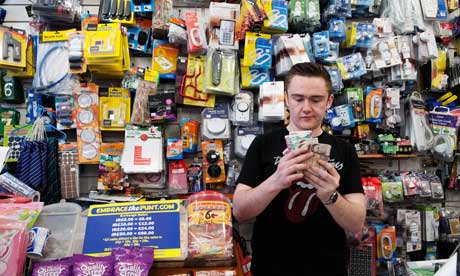
Ciaran Morgan counts punts which he accepts in the family store, Liptons, in the border town of Clones, Co Monaghan. Photograph: Kim Haughton for the Guardian
The only euros visible inside Lipton's mini market are the joke ones printed on toilet rolls and tissue paper. Almost everything else in the shop – and in this town, close to the Northern Ireland border – from a pint of Guinness to a bag of animal feed, can now be bought with the pre-euroIrish currency, the punt.
Three days before Ireland's crucial referendum on the eurozone's fiscal pact – a vote that could complicate further the debate over austerity in Europe – the citizens of Clones are already taking matters into their own hands. Butchers, bar owners, shopkeepers, barbers and ordinary citizens of the County Monaghan town have in effect resurrected the old Irish currency bearing the faces of past Irish heroes such as Catholic emancipator Daniel O'Connell as the punt exchanges hands and is tucked into the tills.
They are all taking part in an experiment to boost a town ravaged by the economic downturn. It exploits a financial loophole which deems that up to 285m punts stuffed under Irish mattresses, inside piggy banks, salted away as souvenirs in shoeboxes or in latent bank accounts, are still legal currency.
Holders of the old currency are invited to visit Clones and hand over their punts in exchange for blue and yellow laminated vouchers which are then usable at any of the 45 businesses that have signed up for the scheme.
"There have been people coming from as far south as Kerry and as far north as Antrim to spend money in the town since it began this spring," explains Ciaran Morgan, the 21-year-old university student who, along with his father, dreamed up the idea.
Inside his family's store on the road up to the border, where crucifix nightlights are on sale alongside tins of pet food, Morgan explains that he came up with the plan after seeing a report on the internet about a village in Spain that was using the old peseta as an alternative to the euro.
"We checked with the central bank in Dublin and we were staggered to find there was around 285m punts that could still be exchanged as legal currency.
"We got the plastic vouchers printed in China and then started the project in March. Customers who have punts come to the town, go into a shop or business, and they then get the euro equivalent on the voucher which they must spend here in Clones."
Morgan adds: "In our shop alone we've taken in over 1,000 punts."
The embracethepunt.com scheme offers to take old punts at a rate of 1 to €1.20. They then sell the punts back to the Irish Central Bank at a rate of 1 punt to €1.27.
"The seven cents made on each transaction isn't used for profit in the shops," stresses Morgan. "Each seven cents made is put into a central fund to pay for things like Clones's Christmas lights or the St Patrick's Day parade."
Ten of the business owners taking part in the scheme who spoke to the Guardian this week reported that trade was up dramatically since customers across the island dug out their old punts and started flocking to Clones.
But despite the unexpected boost, the signs of the Irish economic crash are still stark along Clones' main thoroughfare, Fermanagh Street. Finbarr Dunwoody, the president of Clones Chamber of Commerce, points to the boarded up shops as and the many for sale and to let signs.
"As you can see, 50% of the businesses in our main street are closed," he says.
"If we take one more euro into the town as a result of this scheme then it is surely a good thing. I was absolutely bowled over by the amount of punts still out there in the country so hopefully if we got 1% of that 285m it would be great."
The reintroduction of the euro in this border town, whose shops also accept sterling from Northern Ireland customers, has focused minds on the future of the single currency as the Greek crisis rages on and ahead of the republic's referendum on the EU fiscal treaty on Thursday.
Dunwoody like the overwhelming majority of people in Clones, is glad to see the familiar faces on the punt but uncertain about which way to vote on 31 May.
The chartered surveyor displays the kind of ambivalence towards the single currency and the EU treaty that should worry the pro-European government urging a yes vote back in Dublin.
"Isn't it a real sign of the times that a town like Clones has to examine the potential of bringing back the old currency?" he says. "Maybe it's a flavour of what's to come, maybe it's a little warning to Brussels that the likes of Clones and indeed Ireland may have to find their own way out of this mess.
"Look, I would hate to see us leaving the euro – we got a 20% boost to our economy when we joined – but who's to say? I am wavering on the yes-no – one day I'm yes and one day I'm no. I've not made up my mind yet."
Across the street in the SuperValu store, the owner, Bernard McNally, has reported an extra €1,000-worth of trade since around Easter when "punt tourism" began. "Last Friday we had a couple from Templepatrick in Northern Ireland who had 80 punts and used it on a day trip to stock up for the week. Yesterday we had another couple from Portadown who spent 50 of their old punts. So the word has spread that far up north.
"Already 90% of the people coming through the door are customers I have never seen before."
His father-in-law, Londoner Raymond Hickey, who moved from Walthamstow to Clones in 1972, says he is delighted to see the punt come back. Hickey, who owns a shop called Sweets and Treats, says he prefers the punt to the euro.
He also agrees that disillusionment over the euro will have an impact on next week's referendum vote.
"When you start talking about Europe there is the whole thing about them dictating over what you can and what you can't do," Hickey says. "People get a little bit sick of that. I am undecided. I would have said yes at the beginning but I am questioning that now."
Slaking his thirst after a stroll in 20-degree heat, Rory Hamill hands a surprisingly crisp, purple 20-punt note across the bar in Treanor's pub.
Hamill, who lost his job in the recession, says: "Whatever brings people into the town will always be good for Clones and it seems to be helping so far."
Despite losing out personally in the eurocrisis, Hamill doesn't think the Clones experiment will be rolled out across the republic. "This is just a one-off as I don't think we are going to abandon the euro in its entirety," he says. "We are stuck with the euro."
In the town centre, meanwhile, armed Irish soldiers are protecting a security van delivering cash (presumably euros) to a local bank.


No comments:
Post a Comment