http://www.debka.com/article/21934/
Praise for the Iranian negotiating team’s “achievements” at Istanbul along with a demand to end sanctions highlighted the sermon delivered on April 20 by the powerful provisional Friday Prayers Leader Ayatollah Ahmad Jannati, who is also Chairman of the Guardian Council and Imam of Tehran.
Since the western side had officially accepted “Iran’s right to peaceful nuclear enrichment,” he said, the talks with the six world powers were a success for Iran. However, “if Western hostility continues by the stretch of sanctions and pressures, Iran will leave the negotiating table,” Ayatollah Jannati warned.
DEBKAfile’s Iranian sources say that Tehran is making no secret of its substantial gains on the diplomatic front or its tactics. The US framework proposals submitted in secret, direct talks with Iran, although not yet finalized, are being treated in Tehran as a done deal. Iran is therefore hailing US offers to acknowledge its right to enrich uranium and relieve Iran’s nuclear program of international inspection as concessions already in the bag. Sensing they are on a winning streak against the West, Tehran is now pushing for the lifting of Western sanctions, “to gain the trust of the Iranian people.”
European sources calculate that the Obama administration will soon decide to lift sanctions in stages.
The unfinished, unsigned US-Iranian deal is gaining traction as a done deal in America too.
The unfinished, unsigned US-Iranian deal is gaining traction as a done deal in America too.
Friday, April 20, the military historian Prof. Frederick W. Kagan of the American Enterprise Institute, published an article under the heading “P5 plus 1 Ceding Red Lines in Iran Nuclear Talks.”He said the United States had flouted UN Security Council resolutions and IAEA demands of Iran (to make its military installations transparent) in exchange for an Iranian commitment to stop its nuclear development on the threshold of “breakout capability.”
DEBKAfile’s military sources report that Prof. Kagan did not seem to share the Obama administration’s confidence that Tehran would stand by any commitment to refrain from building a nuclear weapon, particulaly since it stands on shaky ground.
On April 3, US Secretary of State Hillary Clinton announced after long conversations with Iranian and religious experts that she had been impressed by a seven-year old fatwa issued by supreme leader Ayatollah Ali Khamenei on May 10, 2005, which ruled the construction and possession of nuclear weapons a sin. The edict was forwarded to the International Atomic Energy Agency in Vienna at the time.
This is what Secretary Clinton had to say, “And if it is indeed a statement of principle, of values, then it is a starting point for being operationalized, which means that it serves as the entryway into a negotiation as to how you demonstrate that it is indeed a sincere, authentic statement of conviction. So we will test that as well.”
This is what Secretary Clinton had to say, “And if it is indeed a statement of principle, of values, then it is a starting point for being operationalized, which means that it serves as the entryway into a negotiation as to how you demonstrate that it is indeed a sincere, authentic statement of conviction. So we will test that as well.”
No one asked her if Washington and the IAEA had found out whether the fatwa had been upheld in the seven years since it was issued, or why President Barack Obama had suddenly dredged the old edict up now as sufficient warranty for Tehran to stand by its commtments in return for the sweeping concessions it has won from Washington for its nuclear program.
Three Israeli researchers, Y. Carmon of MEMRI, Ayelet Savyon and former UN ambassador Dore Gold, reported Friday, April 20, that they had found no evidence of Khamenei ever issuing a fatwa banning the building and possession of a nuclear weapon under Islamic law.
Israel’s drive to stop a nuclear Iran as an existential threat is becoming a personal campaign against President Obama for letting go on agreed principles for the sake of what its leaders regard as a dangerous deal with Tehran.
In his public address on the eve of the Day of the Holocaust and Remembrance, Wednesday, April 18, Prime Minister Binyamin Netanyahu said bluntly: “I will not hold back from telling the truth [about the Iranian nuclear threat] at the UN, in Washington and in Jerusalem.”
Israel’s drive to stop a nuclear Iran as an existential threat is becoming a personal campaign against President Obama for letting go on agreed principles for the sake of what its leaders regard as a dangerous deal with Tehran.
In his public address on the eve of the Day of the Holocaust and Remembrance, Wednesday, April 18, Prime Minister Binyamin Netanyahu said bluntly: “I will not hold back from telling the truth [about the Iranian nuclear threat] at the UN, in Washington and in Jerusalem.”
But his words fell on deaf ears in Israel, where people have become inured to his highflown talk and by now wonder if it will ever lead to action.
and....
http://www.aljazeera.com/news/middleeast/2012/04/201242115244542654.html
| Security Council to vote on Syria monitors | |||||||||
New resolution aims to raise observer strength to 300 amid reports by opposition activists of fresh wave of violence.
Last Modified: 21 Apr 2012 08:17
| |||||||||
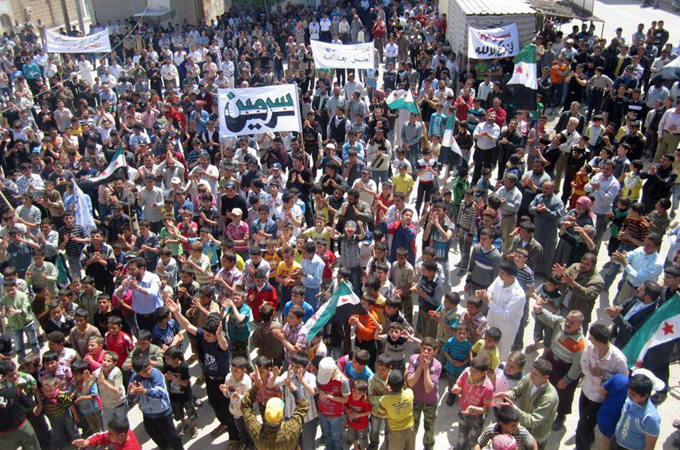
Protesters took to the streets in many town on Friday, including in Sarmeen in the north [AFP]
| |||||||||
| The UN Security Council has scheduled a vote on a draft resolution on Saturday to send up to 300 unarmed military observers to Syria, despite US and European concerns that the government has yet to fully implement a ceasefire. The 15-nation council held three hours of closed-door discussions late on Friday to iron out differences between separate draft resolutions submitted by the US and Russia.
The drafts called for an "immediate end to all violence and human rights violations, securing humanitarian access and facilitating a Syrian-led political transition leading to a democratic, plural political system".
Envoys reached a preliminary agreement on a draft resolution on the Syrian conflict, a crisis that has left the council divided since it erupted 13 months ago.
"It's possible not everybody will have instructions at that point [11am]," Susan Rice, the US ambassador to the UN and president of the Security Council this month, said. "It's possible there will not be an agreed text at that point, we'll see, and we'll regroup accordingly." Britain, France and Russia would also like a deal. "I hope there's going to be a unanimous vote tomorrow," Vitaly Churkin, the Russian ambassador, said. "The Syrian government and the opposition must know that the Security Council will be authorising the full-fledged mandate so we hope it's going to send a strong and good political signal." The diplomatic developments came as activists said government troops fired tear gas and bullets on thousands of protesters who spilled out of mosques after noon prayers on Friday. State media reported that bombs and shootings killed 17 soldiers. 'Further steps' Under the proposed Security Council resolution, the full mission would have an initial three-month mandate to monitor the cessation of hostilities which started on April 12. Activists say more than 130 people have been killed since the ceasefire started, however, and UN chief Ban Ki-moon pointedly told the council this week that President Bashar al-Assad had not kept a commitment to withdraw troops and heavy weapons from population centres.
European nations had wanted the threat of sanctions to be included in the resolution if Assad did not keep the commitments. But the final draft text talks only of backing the resolution with "further steps as appropriate".
It calls for Ban to report back to the council on Syria's compliance within 15 days. There are eight monitors already in Syria from Morocco, Brazil, Belgium, Switzerland and Norway after the council authorised an advance team of up to 30 on Saturday. A new resolution is needed for a further "initial deployment" of up to 300 as recommended by Ban. 'Violations of human rights' Some council members have expressed reluctance to give swift approval for an expanded observer mission because of concern about the failure of the Syrian government to halt the violence, return troops to barracks and withdraw heavy weapons. The US and European countries have insisted that Syria must accept the use of UN planes and helicopters by the UN mission, which will be called UNSMIS. The Russian draft resolution did not mention air assets and was less critical of Syria's government than the European text. The compromise draft urges Syria to reach an agreement with the UN on "appropriate air transportation assets" and condemns the government for "widespread violations of human rights". Syria has dismissed any need for UN aircraft. Ban has said helicopters and other military hardware would be needed by the monitors. Annan's peace plan calls for an end to fighting by government security forces and rebels, withdrawal of heavy weapons from towns, the return of the army to barracks, humanitarian access and dialogue between the government and opposition aimed at a "political transition". Friday violence Opposition activists reported that at least 11 civilians were killed in government shelling and other attacks on Friday, the main day of the week for protests calling for the overthrow of Assad.
|


 Japan’s government may insure tankers carrying Iranian oil, joining China and India in responding to European sanctions blocking private providers.

No comments:
Post a Comment