http://www.infowars.com/syria-regime-change-on-bilderberg-agenda/

http://news.antiwar.com/2012/06/01/panetta-us-wont-attack-syria-without-un-ok/
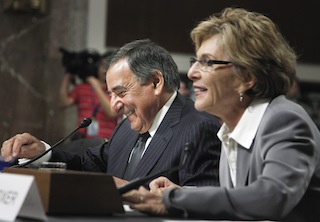 Instead, Panetta insisted that the US would only attack Syria after the United Nations had given them official permission to do so, saying that “the international community and the president are going to have to decide what steps we take.”
Syria Regime Change On Bilderberg Agenda


Pro-NATO intervention SNC head in attendance at elite confab
Paul Joseph Watson
Infowars.com
Saturday, June 2, 2012
Infowars.com
Saturday, June 2, 2012
The presence of Syrian National Transitional Council head Bassma Kodmani at the 2012 Bilderberg conference clearly indicates that power brokers at the elite confab will be discussing the effort to topple President Bashar Al-Assad and install a NATO-friendly administration in the violence-stricken country.
Kodmani is the Head of Foreign Affairs with the SNC, a coalition of Syrian opposition groups based in Istanbul, Turkey. While at the Bilderberg meeting she will be in the company of the likes of former Secretary of State and accused war criminal Henry Kissinger, warhawk Richard Perle, and Thomas E. Donilon, National Security Advisor for the Obama White House.
Having overseen numerous wars during his tenure in the White House, Kissinger is a staunch advocate of so-called “humanitarian” interventions. Before last year’s toppling of Colonel Gaddafi, he advocated a U.S. ground invasion of Libya.
During last year’s Bilderberg conference in St. Moritz, Switzerland, members discussed expanding the war in Libya. Four months later, Gaddafi was killed and the country was under the control of NATO-backed rebels and the National Transitional Council of Libya.
Kodmani is a darling of the establishment, having written op-eds for the New York Times calling for the overthrow of Assad. In recent months her position has become increasingly hardline and pro-NATO intervention. In January she called for “greater militarization of local resistance or foreign intervention.” Kodmani has also called for Syria to form an alliance with Israel.
Hostility towards Syria from the international community has intensified in recent weeks, particularly after last weekend’s massacre in Houla which was blamed on Assad’s forces despite the fact that eyewitnesses in Houla said opposition rebels were responsible for the slaughter, which killed 108 people – mostly women and children.
On Thursday, Secretary of State Hillary Clinton said the Houla massacre will be used to build an international consensus for military intervention. “Every day that goes by makes the argument for it stronger,” she said while addressing Danish university students.
This followed U.S. Ambassador Susan Rice adopting a more hardline approach following a UN Security Council meeting. “Members of this Council and members of the international community are left with the option only of having to consider whether they are prepared to take actions outside of the Annan plan and the authority of this Council,” said Rice.
US Secretary of Defense Leon Panetta has repeatedly stated that Congressional authorization for a military assault on Syria will not be sought by the Obama administration, which considers NATO and the UN to be the supreme authority.
In June last year, President Obama arrogantly expressed his hostility to the rule of law when he dismissed the need to get congressional authorization to commit the United States to a military intervention in Libya, churlishly dismissing criticism and remarking, “I don’t even have to get to the Constitutional question.”
http://news.antiwar.com/2012/06/01/panetta-us-wont-attack-syria-without-un-ok/
Panetta: US Won’t Attack Syria Without UN OK
Can't Envision War Without UN Support
by Jason Ditz, June 01, 2012
Just one day after US Ambassador to the United Nations Susan Rice insisted that attacking Syria without UN backing was “the most probable scenario” for the next presumptive military adventure by the US, Secretary of Defense Leon Panetta insisted he “cannot envision” such a thing.
Instead, Panetta insisted that the US would only attack Syria after the United Nations had given them official permission to do so, saying that “the international community and the president are going to have to decide what steps we take.”
US officials have been changing their position on attacking Syria on a nearly hourly basis, at times insisting that they oppose doing so under any circumstance and at other timesinsisting they are just waiting for the go-ahead.
Panetta’s comments reflect those he made in early March, in which he told the US Senate that the administration’s goal was “international permission” for the war, and downplayed the idea of seeking Congressional authorization, saying only that Congress would be “informed” about the attack once the president decided.
and.....
Syria Simmers Amid UN Security Council Deadlock
by Haider Rizvi, June 02, 2012
The United States and its Western allies appear increasingly inclined to push for regime change in Syria, although the latest round of diplomatic talks at the U.N. Security Council Wednesday suggest that it remains a distant possibility.
Both Russia and China, the two leading members of the Shanghai Cooperation Pact, a growing military alliance in Asia, have made it clear that they do not wish Syria to become another Libya.
"The opposition groups are taking opportunities for killings," said Russian ambassador Vladimir Churkin, alluding to the mass slaughter of civilians in the Syrian town of Houla last weekend.
The United States, Britain and 11 other nations jointly expelled Syrian ambassadors and diplomats following the May 25 killings of more than 100 people, including dozens of children, which the U.N. and witnesses say were likely perpetrated by pro-government militias known as Shabiha.
In contrast, the Russian envoy asserted Wednesday that all the parties involved in the Syrian conflict were responsible for the incident and said that they must resolve their differences by peaceful means.
Churkin seemed supportive of the Syrian government’s contention that Al-Qaeda and other extremist elements were being armed by outside forces, but did not give details.
"I don’t know," he told IPS in response to a question the sources of funding and weapons to the Syrian opposition.
Syrian ambassador Dr. Bashar Ja’afar, however, reiterated that weapons were coming from Saudi Arabia and Qatar, the closest U.S. allies in the region and major suppliers of oil to the West.
On Wednesday, following the Security Council meeting, U.S. ambassador Susan Rice hinted that Washington and its European allies might take action "outside" the fold of the U.N.-Arab League special envoy Kofi Annan’s plan for peaceful settlement of the Syrian conflict.
The plan put forth by Annan, a former U.N. secretary general, calls for an end to the violence, access for humanitarian agencies to provide relief, the release of detainees, the start of political dialogue, and access for the media.
Talking to reporters after the closed-door meeting, Rice acknowledged that there were "serious differences" on the question of possible sanctions against the Syrian government in the Security Council.
"We need to explore with Russia and others about what other steps can be taken," she said. "We will continue negotiations in the next few days."
Some long-time observers of political conflicts in the Middle East see a certain degree of ambivalence in the West’s posture toward Damascus.
"I think the U.S. and its Western allies are desperate to figure out a strategy in Syria, and they don’t have one," Phyllis Bennis, a senior research fellow at the Institute for Policy Studies, a progressive think-tank in Washington, told IPS. "Although regime change is clearly on their wish list now, it wasn’t until pretty recently.
"Syria, despite its anti-imperialist rhetoric, was pretty useful for Israel. (It) kept the Golan Heights quiet. (It kept) the Israeli border relatively peaceful," although it was "a bit troublesome hosting/supporting Hamas and Hezbollah", she added.
"The recent massacre in Houla meant they had to figure out an immediate response, and this was about all they could think of that wouldn’t make everything worse. It’s a disaster on all fronts."
The Golan Heights of Syria were occupied by Israel during the 1967 war with Egypt and other Arab nations. Since then, Syria has continued to support not only the Palestinians, but also democratic struggles in several countries in the so-called Islamic world.
In addition to Russia, Syria has close ties with Iran and Lebanon’s Shia leadership, as well as with the militant Palestinian groups, which has become a constant source of irritation for the West and Israel.
On Wednesday, U.N. observers reported that 13 more bodies were discovered in eastern Syria. All the victims had their hands tied behind their backs and some appear to have been shot in the head from a short distance.
The U.N. estimates that more than 9,000 people, mostly civilians, have been killed and tens of thousands displaced since the opposition campaign against President Bashar al-Assad began some 15 months ago.
The massacre in Houla will be the subject of a special session of the U.N. Human Rights Council on Friday.
"It’s important that the truth, the facts be established in a way that nobody can challenge," Annan’s deputy, Jean-Marie Guehenno, said in a statement. "That is essential."
"The government of Syria needs to take steps to convince, I would say, not only the international community but more importantly the Syrian people that it is ready for a new course," he said.
As chief mediator of the conflict, Annan is due to attend the Arab League meeting on Jun. 2 in Doha on the Syrian situation.
The Russians say they want to see Annan’s plan implemented effectively and that any move by the West to oust the government by force would be unacceptable.
The U.N. Security Council president’s statement concerning the killings in Houla "is a strong enough signal to the Syrian parties and is a sufficient reaction," Churkin told Interfax news agency earlier this week.
Any new measures to affect the situation, he said, "would be premature for the Security Council".
China is siding with Russia regarding the Syrian conflict. On Wednesday, the spokesperson of the Chinese Foreign Ministry, Liu Weimin, confirmed that Beijing would oppose any foreign military intervention into Syrian affairs.
France, the former occupying power in Syria, appears to be taking a middle path. In a recent statement, the French president noted that "another solution" is preferable. He called for more sanctions to be imposed on the Syrian government.
On Wednesday, the administration of U.S. President Barack Obama, who faces a general election in November, added new sanctions on a Syrian bank to increase the pressure on the Assad government.
"Elections do affect these things," James Paul of the Global Policy Forum, which tracks international politics at the U.N., told IPS. "It’s a way of saying they have no rights. It’s part of a propaganda campaign."
Paul, who is critical of the regime in Syria, described the Syrian situation as a "conundrum".
"The regime in Damascus has more support internally," he said. "It’s a very complicated issue."
In his view, much of the media reporting on Syria is "basically Western propaganda, which does everything to prevent focus on Palestine.
"The press has brought this campaign to turn Assad into Hitler of the month, but it has failed."


No comments:
Post a Comment