http://ex-skf.blogspot.com/2012/04/mind-gap-in-fukushima-reactor-3.html
Now the company shows us the photograph that the Packbot took last November, showing the gap between the shield plug and the CV.
From TEPCO's Photos for Press page in English, 4/19/2012 (emphasis is mine):
Inspection of the equipment hatch of PCV in Unit 3 of Fukushima Daiichi Nuclear Power Station
[Object]To check the situation of water leakage from the equipment hatch of PCV at the northeast on the first floor, as the water injected to the PCV has been leaked to the reactor building.
[Detail]
・A crevice between the shield plug and the reactor building was confirmed in the past video
・Inspection of the situation of water leakage from the flange of the equipment hatch, by inserting an image scope into the crevice between the shield plug and the reactor building

[Result of the work]
・Time:1:27 pm – 1:48 pm on April 19, 2012 (Time stayed in the reactor building : Approx. 4 minutes)・Workers :2 TEPCO employees (Maximum radiation exposure :8.01mSv Planned:15mSv)
[Situation of the equipment hatch of the PCV]
・We checked the situation around the equipment hatch flange of PCV, and we confirmed floor surface where the water leakage could have occurred.
・Hereafter, we will study the result of the inspection in detail.
Gap:

FRIDAY, APRIL 20, 2012
Mind the Gap in #Fukushima Reactor 3 Containment Vessel Equipment Hatch
TEPCO now admits that there is a gap in the shield plug on the Containment Vessel of Reactor 3, and the water may have leaked from the equipment hatch flange into the reactor building.
What a surprise. Last November, TEPCO sent a Packbot inside the Reactor 3 building and had it survey the guide rails in front of the same equipment hatch. The robot detected the maximum 1.6 sievert/hour radiation, and the guide rails filled with water and sludge-like material. The robot was seen trying to wipe off the water with cloth. There was no further announcement from TEPCO on this, until today (April 19, 2012).This time, TEPCO sent out two of its employees for a 4-minute work of inserting an image scope through the gap to get the image of the floor in front of the equipment hatch flange.
What a surprise. Last November, TEPCO sent a Packbot inside the Reactor 3 building and had it survey the guide rails in front of the same equipment hatch. The robot detected the maximum 1.6 sievert/hour radiation, and the guide rails filled with water and sludge-like material. The robot was seen trying to wipe off the water with cloth. There was no further announcement from TEPCO on this, until today (April 19, 2012).This time, TEPCO sent out two of its employees for a 4-minute work of inserting an image scope through the gap to get the image of the floor in front of the equipment hatch flange.
Now the company shows us the photograph that the Packbot took last November, showing the gap between the shield plug and the CV.
From TEPCO's Photos for Press page in English, 4/19/2012 (emphasis is mine):
Inspection of the equipment hatch of PCV in Unit 3 of Fukushima Daiichi Nuclear Power Station
[Object]To check the situation of water leakage from the equipment hatch of PCV at the northeast on the first floor, as the water injected to the PCV has been leaked to the reactor building.
[Detail]
・A crevice between the shield plug and the reactor building was confirmed in the past video
・Inspection of the situation of water leakage from the flange of the equipment hatch, by inserting an image scope into the crevice between the shield plug and the reactor building

[Result of the work]
・Time:1:27 pm – 1:48 pm on April 19, 2012 (Time stayed in the reactor building : Approx. 4 minutes)・Workers :2 TEPCO employees (Maximum radiation exposure :8.01mSv Planned:15mSv)
[Situation of the equipment hatch of the PCV]
・We checked the situation around the equipment hatch flange of PCV, and we confirmed floor surface where the water leakage could have occurred.
・Hereafter, we will study the result of the inspection in detail.
Gap:
Dry floor surface:

Floor surface where leak may have occurred:
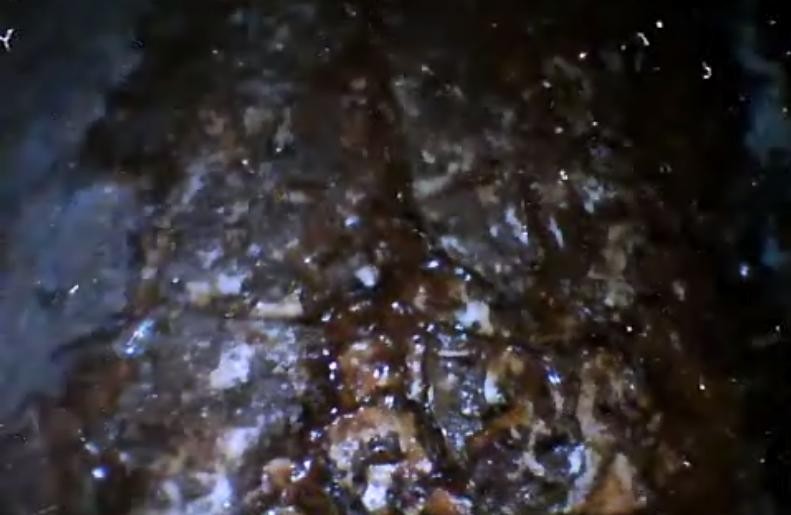
Floor surface where leak may have occurred:
and.....
http://ex-skf.blogspot.com/2012/04/only-two-thermocouples-remaining-to.html
THURSDAY, APRIL 19, 2012
Only Two Thermocouples Remaining to Measure Reactor 2 Pressure Vessel Temperature?
TEPCO's "Status of TEPCO's Nuclear Power Stations after the Tohoku-Chihou-Taiheiyou-Oki Earthquake (Daily Report as of 3:00 pm, April 19)" states:
On April 18, we evaluated the reliability of the thermometer (RPV bottom head 135°) which was monitored for reference based on safety regulations 138 through direct current resistive measurement. We evaluated the thermometer broken down based on the increase in direct current resistance. No large swings confirmed at other thermometers, monitoring posts, and PCV gas management system indicators. We will continue monitoring PCV temperature by thermometers (RPV bottom upper head 270° and RPV upper skirt junction 135°)
The failure of the thermocouple "69H2" (at RPV bottom head at 135 degrees) was noted in the blog post on April 15. So now there are two thermocouples left on the RPV of Reactor 2 - 69H3 and 69F2 - to measure temperatures to make sure the reactor is in the "cold shutdown state".
(Pay attention to the word "state", which makes this "cold shutdown" uniquely Japanese.)
(Pay attention to the word "state", which makes this "cold shutdown" uniquely Japanese.)
and......
http://enenews.com/japan-govt-monitoring-indicates-relatively-high-radiation-dose-rate-in-chiba-tochigi-gunma-200km-from-fukushima-daiichi-it-is-necessary-to-confirm-the-status-on-accumulation-and-migration-o
Title: Results of the Research on Distribution of Radioactive Substances Discharged by the Accident at TEPCO’s Fukushima Dai-ichi NPP (PDF:5203KB)
Source: MEXT: Monitoring information of environmental radioactivity level
Date Published: April 20,2012
Source: MEXT: Monitoring information of environmental radioactivity level
Date Published: April 20,2012
Next ChallengesMEXT conducting the second investigation about the distribution status of radioactive substances○Only a part of the results of I-131 analysis are obtained.
○Only 100 sampling points of Pu and Sr are analysed.>> The radioactive substances contained in soil need further to be investigated for the detailed check of the diffusion condition of radioactive substances.○The results of aerial monitoring indicate a relatively high dose rate in Tochigi, Gunma,
Chiba prefecture.>> There is need to expand the area of soil survey.○The accumulation status of the radioactive substances on the ground surface significantly change due to the influences of rain and storm, etc.>> It is necessary to confirm the status on accumulation and migration of radioactive substances continuously.
and......
http://enenews.com/msnbc-fukushima-radiation-higher-expected-biologist-negative-effects-happen-quicker-chernobyl-be-worse
Title: World News – Fewer female birds after Chernobyl, study finds; same true at Fukushima?
Source: msnbc.com
Author: Miguel Llanos
Date: Apr. 19, 2012
Emphasis Added
Source: msnbc.com
Author: Miguel Llanos
Date: Apr. 19, 2012
Emphasis Added
Scientists are focusing on Japan’s Fukushima area after a study published this week found an alarming development at another nuclear disaster site — Chernobyl.The proportion of female birds has fallen off since the 1986 disaster at Chernobyl, the study found [...][Study co-author Tim Mousseau, a University of South Carolina biologist is]expecting even worse results at Fukushima. [...]
Mousseau interviewed by msnbc.com
- “The Chernobyl zone is a population sink, or an ecological trap, that brings in new birds each year but these birds suffer lower survival”
- “In the more contaminated areas, most birds were yearlings, suggesting that survival rates were significantly lower in these areas than in clean ones”
- [At Fukushima] “our expectation was that it would take many years and many generations of exposure for the cumulative effects” to show as they have in Chernobyl
- “However, once we started our field work we realized that contamination levels were much higher than expected, even in July when we did our surveys and it is likely that doses to these birds were very high in March and April when many of the birds were arriving to the area to initiate breeding”


No comments:
Post a Comment