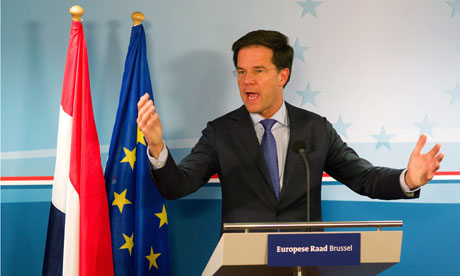
Dutch prime minister Mark Rutte faces a political crisis after crucial budget talks collapsed over the weekend. Photograph: Evert-Jan Daniels/EPA
The latest opinion polling data from the Netherlands shows that 11 parties would probably win seats in a general election, and that no leader would secure an overall majority.
A poll published yesterday, conducted by Maurice De Hond, showed that Mark Rutte's People's Party for Freedom and Democracy (VVD) would hold the most seats – 33, up from 31 at the 2010 election.
But the big winner would be the eurosceptic Socialist (SP) party, which is on track to double its number of MPs from 15 to 30.
The poll also indicates that Geert Wilders's Party for Freedom (PVV) would secure 19 seats, down from 24, while the Christian Democrat (CDA) party's powerbase would shrink to 11 seats, from 21.
The Dutch Labour (Pvda) party would secure 24 seats, down from 30, while the Democrats 66 (D66) party would win 15 seats, up from 10 at present.
Smaller parties would take the remainder of the 150 seats in the Netherlands' parliament.
Dutch prime minister Mark Rutte's imminent resignation (see11.05am) comes just 18 months after he took office.
There may be some Schadenfreude within the eurozone corridors of power, given the tough line that the Netherlands has taken with other struggling European countrie since the debt crisis began.
Reuters has already found one Brussels diplomat who sees rich irony in Rutte's predicament, saying:
Dutch broadcasters are now reporting that PM Mark Rutte will meet with Queen Beatrix at around 2pm local time (1pm BST) to tender his government's resignation.First you have a big mouth towards budget offenders and then you yourself can't deliver, and instead have to have new elections only one-and-a-half years after the new government took office.
Dutch finance minister Jans Kees De Jager has insisted that the Netherlands can still hit its budget targets, despite the apparent collapse of the country's coalition government today (there's no official word from The Hague yet).
De Jager, who had taken a hard line during previous episodes of the eurocrisis, claimed that the Dutch situation was "better than peripheral countries", and that the country could continue "demanding fiscal discipline" from the rest of the eurozone.
De Jager added that the current government (which could remain in power for another five months), would seek support for its austerity measures within the Dutch parliament, even though the far-right Freedom Party has now walked away.
Several Dutch government ministers refused to speak to the media as they left this morning's emergency cabinet meeting in The Hague. That follows reports that they had agreed that prime minister Rutte should tender the cabinet's resignation to Queen Beatrix of the Netherlands.
Under Dutch electoral rules, it is unlikely that an election could be held before September. Brussels, though, wants to see the details of next year's austerity budget in a week's time.

Breaking news from the Netherlands -- Dutch broadcaster RTL reports that prime minister Mark Rutte will offer the cabinet's resignation to the country's monarch, Queen Beatrix.
Rutte's decision comes after this morning's emergency cabinet meeting, which was called after his far-right junior coalition partner walked out of negotiations over the country's austerity budget (see 7.50am for details)
More as we get it....
Despite boasting a AAA credit rating, the Netherlands actually posted a larger deficit in 2011 than Portugal or Italy.
Data released this morning by Eurostat (the EU's statistics office) showed that the Dutch deficit was 4.7% of GDP in 2011. That compares with 4.2% for Portugal and 3.9% for Italy, although rather better than Spain's 8.5%.
The austerity negotiations in the Netherlands had floundered over the government's attempt to cut its defiict to 3% in 2013. After walking out of the talks on Saturday, Geert Wilders condemned the 3% target as a "'strangulation limit" and vowed to fight the next election on the issue of Europe and the euro.
Meanwhile, over in Greece there have also been developments this weekend with Antonis Samaras, the man tipped to win general elections on May 6, unveiling his own economic policies to exit the crisis.
Helena Smith, our correspondent in Athens, has all the details:
No country is more desperate for growth than Greece, the country that triggered the debt crisis. Presenting his economic policies to a nation now wearily preparing to go to the polls, Antonis Samaras, the leader of the centre right New Democracy party said he was poised to make a root-and-branch change of the way Greece works."Our aim to change everything, both the system of governance and the economic policy," he said.New Democracy, he said, would take an axe to the public sector by slashing "state wastefulness" and privatizing "whatever can be privatized." What it would not do was add to the tax burden of Greeks already subjected to a barrage of new levies as part of austerity measures prescribed by the country's international creditors at the EU and IMF."The middle class, the hardest hit by taxes, needs to breath," said Samaras unveiling the program. "People don't have money to pay new taxes," added the leader referring to the unprecedented cuts ordinary Greeks have sustained to pensions and wages since the outbreak of the crisis in Athens in late 2009."The only thing to do is to reduce wasteful public spending, which is huge."What Greece needed was a flat 15% corporate tax rate, lower sales taxes to boost growth and investment and an amnesty for those bringing deposits back to Greece [around €20 bn is believed to have left the country in an unprecedented cash flight]. Further across-the-board cuts that have plunged the economy into its worst recession since WWII would be avoided because they were "self-defeating."
"The turnaround must begin. Out of a million businesses in Greece in 2009, 250,000 have closed and 300,000 can no longer pay [taxes] and also face closure which will make unemployment soar … especially among the young for whom the jobless rate is more than 50%."
Pundits believe New Democracy will come out on top in the vote described as "critical" by Samaras, Helena explains. But polls show that the party is unlikely to capture enough votes to win an outright majority – which opens the way to political instability if New Democracy is also unable to form a coalition government with Pasok, the centre-left party that backs the tough reforms and austerity measures demanded of Athens in return for aid.If both parties are unable to garner at least 50% of the vote with anti-austerity groups instead coming to the fore, analysts fear that Greece will be in for a period of intense political and social turmoil as the opponents to the measures step up protests and strikes. "It's a hair-raising prospect that would be the worst possible scenario for Greece," said a senior official in the interim coalition government that under the stewardship of unelected technocrat Lucas Papademos has ruled the country since November last. "It's vital that the two [main] parties cooperate again but, even more significantly, much will depend on them also clinching at least 50 % of the vote. If not, the anti-austerity front will be emboldened to step up protests and strikes which would be very debilitating to implementing reforms."Although Samaras, crucially reiterated his commitment to the EU-IMF reform program, lenders worry that the leader will under popular pressure to "renegotiate" the measures adding to the fiscal pressure on Greece.
The political uncertainty in France and the Netherlands, and today's poor eurozone economic data, are conspiring to forcing stock markets to new lows.
The Dutch stock market has been hit hard, as prime minister Mark Rutte holds an emergency cabinet meeting to discuss whether to seek a general election.Here's a round-up:Dutch AEX: - 2.49%, down 7.69 points at 301
German DAX: -2.38%, down 160 points at 6589
FTSE 100: -1.5%, down 90 points at 5681
French CAC: -1.58%, down 49 points at 3138
Spanish IBEX 35: -2.9%, down 205 points at 6834
The Spanish central bank has reported this morning that Spain has slumped back into recession.
In its latest monthly report, the Bank of Spain said it believes that the country's GDP fell by 0.4% in the first three months of 2012. That follows a 0.3% contraction in Q4 2011, and zero growth in the third quarter of last year.François Hollande has pledged to challenge Europe's obsession with austerity if (as seems likely) the socialist leader succeeds Nicolas Sarkozy as France's president.The prospect of eurozone's fiscal compact being renegotiated has caused some alarm in the markets today. Jane Foley of Rabobank says the uncertainty could hit the euro (which has already fall today to around $1.314).
Hollande won the first round of the Presidential election with 28% of the vote, followed by Nicolas Sarkozy with 27% and Marine Le Pen with 20%.
Nicolas Doisy of Cheuvreux, part of Crédit Agricole, says the results show the French people do not support economic reforms. Doisy writes:The main message from the first round is indeed that a large section of the population already rejects the policies called by the economic situation, who-ever the next President is.They fear that the so-called French social model will broken with deep fiscal austerity and the liberalisation of the labour market and non-financial services.
The latest economic data from France and Germany paints an unexpectedly bleak picture, and added to the gloom in the financial markets.
Germany industrial sector suffered its sharpest contraction in three years this month. The monthly manufacturing PMI fell sharply to 46.3, from 48.4 in April (on this index, the 50-point mark separates expansion from contraction).While France's manufacturing output picked up (to 47.3), its service sector PMI fell to a six month low of 46.4. And in another blow, French manufacturing sector confidence also dropped in April -- with factory owners saying they were worried by falling overseas orders.With the eurozone already thought to be in recession, this is not a great start to the second quarter of the financial year.The Netherlands is one of just four eurozone members who still holds an AAA credit rating with all three major credit rating agencies.Analysts believe that the political crisis that now grips the country could prompt a downgrade. Without the support of Geert Wilders' Freedom Party, Mark Rutte is clinging onto power as the leader of a minority party. He admitted over the weekend that elections are the "logical next step".Arnold Heertje, a former political economics professor at the University of Amsterdam, predicted:
This story is going to cost the Netherlands their triple A....Interest rates on the bond markets will increase.


No comments:
Post a Comment