Israel Air Force now holds key to fate of Damascus, Assad regime
DEBKAfile Exclusive Report February 9, 2013, 2:06 PM (GMT+02:00)

Israeli Air Force F-15-E figher-bombers
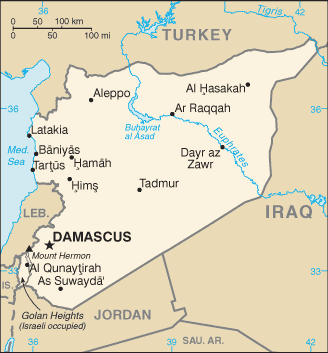
The Syrian rebels’ hyped up “Great Confrontation” to capture Damascus the capital has ended in a draw with Bashar Assad’s army like all their previous offensives in recent months. They failed to break through to the heart of the capital past the powerful Syrian army’s 4th Division standing in their path under the command of Gen. Maher Assad, the president’s brother. The rebels also lost their position on the Damascus-Aleppo highway. But amid heavy battles with the division's troops, the rebels are still clinging to the southern suburbs of Damascus.
The Syrian capital (1.9 million inhabitants) is therefore the second city after Aleppo (2.3 million) to be divided between the combatants.
DEBKAfile’s military sources report that, notwithstanding the bitter fighting, the flow of refugees fleeing Syria has slowed down substantially, as many choose life in war zones over the wretched conditions prevailing in Turkish, Lebanese and Jordanian refugee camps, where rudimentary essentials such as food, clean water, heating and basic medical services are lacking for the hundreds of thousands of dispossessed Syrians. Adding to these horrors, some Syrian families are said to be selling their daughters for food.
The Syrian outward refugee movement now tends to be internal, people in embattled areas seeking asylum in regions outside the war zones, such as the Druze Mountains southeast of the Golan and Kurdish areas in the north.
Since the Israeli air strike on the Syrian military complex of Jamraya on Jan. 30, Syria’s warring sides have been looking over their shoulders to assess Israel’s moves before embarking on the next stage of their contest because of two considerations:
The Syrian capital (1.9 million inhabitants) is therefore the second city after Aleppo (2.3 million) to be divided between the combatants.
DEBKAfile’s military sources report that, notwithstanding the bitter fighting, the flow of refugees fleeing Syria has slowed down substantially, as many choose life in war zones over the wretched conditions prevailing in Turkish, Lebanese and Jordanian refugee camps, where rudimentary essentials such as food, clean water, heating and basic medical services are lacking for the hundreds of thousands of dispossessed Syrians. Adding to these horrors, some Syrian families are said to be selling their daughters for food.
The Syrian outward refugee movement now tends to be internal, people in embattled areas seeking asylum in regions outside the war zones, such as the Druze Mountains southeast of the Golan and Kurdish areas in the north.
Since the Israeli air strike on the Syrian military complex of Jamraya on Jan. 30, Syria’s warring sides have been looking over their shoulders to assess Israel’s moves before embarking on the next stage of their contest because of two considerations:
1. DEBKAfile’s military sources report that when the rebels first looked like breaking through to the heart of Damascus in the early part of their offensive – and so forcing Syrian President Bashar Assad to flee the capital – he ordered his army’s 4th Division tanks and short-range surface missiles to be armed with chemical weapons. They were to be used if the city’s defenses were breached. This would have made the battle for Damascus the first Syrian war engagement to deploy chemical weapons in combat.
The only military force close enough to prevent this happening and destroying the forces wielding chemical arms was the Israel Air Force. Its intervention would have been critical in giving the rebels victory.
The only military force close enough to prevent this happening and destroying the forces wielding chemical arms was the Israel Air Force. Its intervention would have been critical in giving the rebels victory.
2. Ever since the Jamraya episode, Lebanon military sources report Israel Air Force fighters and surveillance planes are conducting over flights almost every day.According to our military sources, the Israeli aircraft are densely deployed over Syria’s borders with Israel, Jordan and Lebanon, to guard against two eventualities, which the Netanyahu government is bound to preempt:
a) Information has reached US and Israeli intelligence that Bashar Assad has vowed to his close circle that he will make Israel pay for Jumraya.
b) Iran’s supreme leader Ayatollah Ali Khamenei has directed the Syrian ruler to make every possible effort to transfer to Hizballah in Lebanon the batch of Iran-supplied sophisticated weapons stored in Syria. This directive was handed to Assad by Iran’s National Security Director Saeed Jalilee when they met in Damascus last Sunday, Feb. 3.
All the parties concerned understand that Israel is just as determined to block this transfer as Tehran and Damascus are resolved to get it through.
All the parties concerned understand that Israel is just as determined to block this transfer as Tehran and Damascus are resolved to get it through.
In view of these challenges and their potential for an armed clash, Israel is keeping an eagle eye on every twist and turn of Assad’s forces in Damascus for any indications of the onset of chemical warfare or traffic on the move toward the Lebanese border with Hizballah’s weapons.
The Syrian ruler for his part is busy hatching schemes for keeping this arms traffic out of the electronic sight of the Israel Air Force, whereas the Syrian rebels are laying plans for provoking a clash between the Syrian army and the Israeli air force to provide them with an opportune moment for bringing their “great confrontation” in Damascus to a successful conclusion.
The Syrian ruler for his part is busy hatching schemes for keeping this arms traffic out of the electronic sight of the Israel Air Force, whereas the Syrian rebels are laying plans for provoking a clash between the Syrian army and the Israeli air force to provide them with an opportune moment for bringing their “great confrontation” in Damascus to a successful conclusion.
and Syrian Islamists hit factory run by civilian workforce - no weapons being produced here...........
http://news.antiwar.com/2013/02/08/report-54-civilians-killed-as-bus-bomb-attacked-syrian-military-factory/
Report: 54 Civilians Killed as Bus Bomb Attacked Syrian Military Factory
Attack Sparks Anger Against Islamist Rebels
by Jason Ditz, February 08, 2013
At least 54 people were killed today when a minibus packed with explosives detonated at a bus stop next to a Syrian military supply factory in Buraq, a suburb of Hama. The slain are all civilians, mostly workers at the factory.
 Both Syrian state media and rebel sources were quick to condemn the attack, with one rebel outlet noting that the factory did not make weapons, but rather made other supplies for the Syrian Defense Ministry.
No group has yet claimed responsibility, but the general consensus is that it is one of the Islamist factions in the rebel movement, with the al-Nusra Front seen as a likely culprit given their past use of similar tactics.
This has sparked a backlash against the Islamists, particularly since 11 of the workers were women. Though rebels regularly attack government-held areas, and government-run buildings, the huge civilian toll is not sitting well with many of the more moderate factions.
http://news.antiwar.com/2013/02/08/kerry-threatens-iran-ahead-of-upcoming-talks/
Kerry Threatens Iran Ahead of Upcoming Talks
US 'Prepared' to Allow Diplomacy, But Demands Quick Results
by Jason Ditz, February 08, 2013
With P5+1 talks with Iran just two weeks away, Secretary of State John Kerry took a little time out of his schedule to threaten Iran, insisting that while the US is “prepared to talk” with Iran at the meeting they will take no option off the table, including military force.
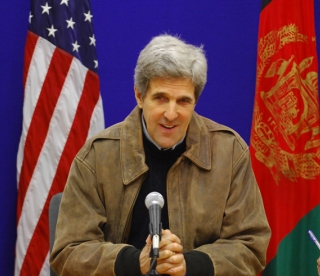 Kerry went on to insist that Iran has to address all US concerns or it would face further isolation and other unspecified actions, adding that the US will do “whatever it takes” to stop their nuclear program.
Iran’s existing nuclear program is entirely civilian in nature, a fact the IAEA has repeatedly confirmed. That the IAEA cannot conclusively disprove the notion of a secret secondary program operating entirely separately and located somewhere totally unknown, however, leaves the US deciding Iran hasn’t answered “all questions.”
Every round of P5+1 talks begins with a 2-3 week preface of US officials threatening Iran and adding more onerous demands right before the meeting. It then follows with condemnation of Iran for refusing the deal or, on the one occasion Iran accepted a US proposal, with the US withdrawing the offer and condemning Iran for accepting it.
http://www.atimes.com/atimes/Middle_East/OB09Ak03.html
Khamenei plays hardball with Obama
By M K Bhadrakumar
It was an extraordinary week in the politics of the Middle East and it ended appropriately by being rounded off with a reality check lest imaginations ran riot.
Three major happenings within one week would have to be taken as the inevitable confluence of a flow of developments and processes: the offer by the Syrian opposition of a bilateral dialogue with the Bashar al-Assad regime; the historic visit of an Iranian president to Egypt; and the public, unconditional offer by the United States of direct talks with Iran and the latter's ready acceptance of it.
Yet, they are interconnected. First, the Syrian kaleidoscope is dramatically shifting despite the continuing bloodbath. Unless the European countries drop their arms embargo on Syria (which expires on March 1 anyway) and decide to arm the rebels, the stalemate will continue.
By M K Bhadrakumar
It was an extraordinary week in the politics of the Middle East and it ended appropriately by being rounded off with a reality check lest imaginations ran riot.
Three major happenings within one week would have to be taken as the inevitable confluence of a flow of developments and processes: the offer by the Syrian opposition of a bilateral dialogue with the Bashar al-Assad regime; the historic visit of an Iranian president to Egypt; and the public, unconditional offer by the United States of direct talks with Iran and the latter's ready acceptance of it.
Yet, they are interconnected. First, the Syrian kaleidoscope is dramatically shifting despite the continuing bloodbath. Unless the European countries drop their arms embargo on Syria (which expires on March 1 anyway) and decide to arm the rebels, the stalemate will continue.
The mood in Western capitals has shifted in the direction of caution and circumspection, given the specter that al-Qaeda affiliates are taking advantage. If anything, the hurricane of militant Islamism blowing through Mali only reinforces that concern and reluctance.
Suffice to say, what prompted the Islamist leader of the Syrian National Coalition, Moaz al-Khatib, last weekend to show willingness to take part in direct talks with representatives of the Syrian regime - and pushed him into meeting with Russian and Iranian foreign ministers - was as much the disarray within the Syrian opposition and his failure to form a credible "government-in-exile" as his acute awareness that the Western mood is now cautious about Syria.
To be sure, Iran played a signal role in the grim battle of nerves over Syria through the recent months. Strangely, it is Iran today, which is on the "right side of history", by urging dialogue and negotiations and democratic elections as holding the key to reform and change in Syria - or, for that matter, in Bahrain.
The shift in Syria has actually enabled Iran to cross over the Sunni-Shi'ite barriers that were tenaciously put up to isolate it. Thus, President Mahmud Ahmedinejad's historic visit to Egypt this week has a much bigger regional dimension to it than the restoration of the Iran-Egypt bilateral relationship. The trilateral meeting held between Ahmedinejad and his Egyptian and Turkish counterparts Mohammed Morsi and Abdullah Gul signified Iran's compelling relevance as an interlocutor rather than as an implacable adversary for the two major Sunni countries.
Interestingly, Morsi added, "Egypt's revolution is now experiencing conditions similar to those of Iran's Revolution and because Egypt does not have an opportunity for rapid progress like Iran, we believe that expansion of cooperation and ties with Iran is crucially important and necessary."
|  |


No comments:
Post a Comment