http://news.antiwar.com/2012/09/10/syrian-rebels-execute-captured-soldiers-in-aleppo/
 The video also showed the bodies lined up after the executions, with at least 20 slain soldiers shown. The rebels in the video cheered for the camera and taunted the bodies of the captives.
http://www.timesofisrael.com/us-russia-pounce-at-syrian-chemical-weapons-transfer/
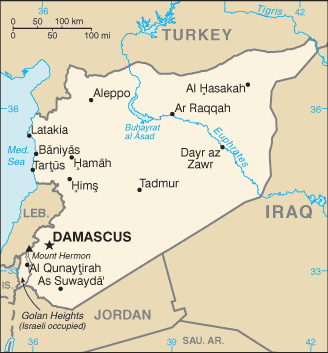
Syrian rebels have executed at least 20 Syrian soldiers, according to a new video released by the London-based Syrian Observatory for Human Rights, a pro-rebel outlet. The video showed blindfolded soldiers with their hands tied behind their backs executed over the weekend in eastern Aleppo.
The video also showed the bodies lined up after the executions, with at least 20 slain soldiers shown. The rebels in the video cheered for the camera and taunted the bodies of the captives.
Human rights groups were critical of the move, saying the killings were carried out by the Free Syrian Army (FSA) the largest and most heavily Western-backed of the various rebel factions in the nation.
Navi Pillay, the UN Human Rights Commissioner, called the killings an “extra-judicial execution” and expressedconcern about the rebels’ growing use of torture as well as IED attacks.
and...
http://www.timesofisrael.com/us-russia-pounce-at-syrian-chemical-weapons-transfer/
The Syrian regime transferred chemical weapons from a storage base near Damascus to the port city of Tartus last month, sparking American and European concerns that the weapons could fall into the hands of Hezbollah in Lebanon or other extremist organizations inside Syria, Kuwaiti daily Al-Rai reported Sunday.
On August 20, US President Barack Obama declared that the US would consider military intervention if Syria deployed or used chemical weapons in its possession. British diplomatic sources told the Kuwaiti paper on Sunday that Obama issued the strongly-worded warning following the transfer of weapons from Damascus to Tartus.
On Thursday, The Washington Post reported that US and Middle Eastern officials were concerned that Syria had dispersed its chemical weapons stockpile, considered to be the third-largest in the world, to 20 sites around the country.
It did not detail where those sites were.
Officials in Israel and the West fear that chemical weapons may fall into terrorist hands in the chaos surrounding Syria’s bloody civil war. They also fear Assad may use the weapons on rebels or transfer them to Hezbollah, the Lebanese Shiite terror group .
In a speech delivered on September 3, Hezbollah Secretary General Hassan Nasrallah declared that his organization does not possess chemical weapons and that such weapons are banned under Islamic law, a claim voiced in the past by Iran’s Supreme Leader Ali Khamenei.
Nasrallah’s reference to chemical weapons may have followed pressure from Syria’s ally, Russia. Lebanese daily Al-Nahar reported Sunday that a Russian envoy recently arrived in Beirut and warned Nasrallah against accepting chemical weapons from Syria. According to the daily, Russian President Vladimir Putin assured Israel that Syria’s chemical weapons will not leave their storehouses. Al-Nahar is staunchly opposed to Hezbollah and aligned with the March 14 movement led by Saad Hariri.
The diplomatic sources who spoke to Al-Rai speculated that the weapons were moved to Tartus as part of the Assad regime’s “plan B” to flee to an Alawite-majority region of Syria if the regime is in jeopardy.
The ancient port of Tartus, along the country’s coast, is one of the country’s few Alawite majority enclaves. In August, Jordan’s King Abdullah speculated that Assad may try to create a mini-state in the area should he lose control of Damascus.
Ten thousand soldiers are on permanent alert to take over 31 bases inside Syria where chemical weapons are stored, if the West becomes convinced that those weapons may no longer be secure, the British diplomatic sources told Al-Rai.
and.....
http://www.aljazeera.com/news/middleeast/2012/09/2012911896184389.html
| UN rights chief denounces violations in Syria | ||||||||||||||||
Navi Pillay accuses both sides in conflict of rights violations, as violence continues in Aleppo and other cities.
Last Modified: 11 Sep 2012 09:51
| ||||||||||||||||
Navi Pillay, the United Nations human rights chief, has blamed both sides in the Syrian conflict of being guilty of what may amount to war crimes and crimes against humanity, and called for the international community to take "protective action".
Speaking to the UN human rights council in Geneva on Monday, Pillay was harsh in her criticism of both sides, but stopped short of calling for a no-fly zone or military intervention.
"The use of heavy weapons by the government and the shelling of populated areas have resulted in high numbers of civilian casualties, mass displacement of civilians inside and outside the country and a devastating humanitarian crisis," Pillay said.
She was equally concerned at violations by anti-government forces, including murder, extra-judicial execution and torture, and an increased use of improvised explosive devices.
Pillay, a former UN war crimes judge, has repeatedly called for alleged crimes in Syria to be referred to the International Criminal Court.
Such a referral can only be made through the UN Security Council, which is split on what action the international community should take, if any, on what has become an increasingly violent uprising against the government of Syrian President Bashar al-Assad.
"A referral will make it abundantly clear to all actors in Syria that they will not escape justice and will be held accountable for alleged violations of international human rights law and international humanitarian law," Pillay said on Monday in a separate speech.
"Opposition forces should be under no illusion that they will be immune from prosecution," she added.
Amateur video posted on YouTube on Monday showed images of 20 dead Syrian soldiers, blindfolded and handcuffed, after they were apparently executed in the northern city of Aleppo.
The Syrian Observatory for Human Rights, an anti-government rights group, said that the killings had occurred in the Hanano district of the city at some point over the weekend.
It was not possible to verify the video's authenticity.
The Human Rights Council has repeatedly condemned Syria's government for its handling of an uprising that began as a peaceful protest movement but has now escalated into a civil war.
China, Russia and Cuba have consistently voted against its resolutions.
Independent UN investigators, in a report last month, said that Syrian government forces and allied militia have committed war crimes including murder and torture of civilians in what appears to be state-directed policy.
Violence continues
Meanwhile, violence continued in Syria on Monday, with reports of the executions accompanied by air raids on Aleppo. Government forces used MiG warplanes and helicopters to assault several areas of the city, the AFP news agency's correspondent reported.
The SOHR, a UK-based group, said that at least five people jad died in morning bombing raids on the Marjeh, Sakhur, Hanano, Tariq al-Bab and Sheikh Khodr neighbourhoods of Aleppo, among a total of 95 civilians killed nationwide. Sixty-three of the dead were civilians, the SOHR said.
On the diplomatic front, Lakhdar Brahimi, the joint UN-Arab League envoy on the conflict, was in Cairo on Monday for talks with Egyptian and Arab League officials, ahead of a planned trip to Damascus.
Russia, an ally of the Syrian government, called on Monday for a comprehensive peace agreement to be drawn up at a conference involving all domestic participants in the conflict.
"We are proposing to our Western partners the organisation of a 'Taif conference' between all the players of the conflict," Mikhail Bogdanov, a Russian deputy foreign minister, said, alluding to a 1989 peace deal signed in the Saudi city between the parties to the Lebanese civil war.
"This conference should bring together opposition and regime figures, as well as Christian, Alawite and Druze community members," Bogdanov added.
Syrian hostagesMeanwhile, in neighbouring Lebanon, security forces released four Syrian hostages in a raid in Beirut.
Mahed Meqdad, a spokesman for the clan that was holding the hostages, told Al Jazeera that the Lebanese army had raided four locations in southern Beirut at dawn on Tuesday.
The four Syrians were taken by Lebanese forces after a gun battle in which, Meqdad said, a Turkish captive was wounded.
The Meqdad family kidnapped several Syrians and a Turkish national after a member of their family was kidnapped by the armed Syrian opposition in Damascus.
and.....
http://www.dailystar.com.lb/News/Politics/2012/Sep-10/187407-sayyed-accompanied-samaha-while-moving-bombs-to-lebanon-sources.ashx#axzz26A5aAMkI
Sources: Sayyed in Samaha's car during Syria-Lebanon bombs transportSeptember 10, 2012 06:38 PM (Last updated: September 10, 2012 07:38 PM)
BEIRUT: Former General Security head Maj. Gen. Jamil al-Sayyed accompanied former MP Michel Samaha, who is being probed on terror charges, when he transported explosives from Syria to Lebanon, sources said Monday. Sayyed would not confirm or deny the report.
"We have put forward incriminating evidence that Jamil Sayyed was with Michel Samaha while he was transporting explosives [from Syria to Lebanon]," a high-ranking security source, speaking on condition of anonymity, told The Daily Star. "The evidence was taken from a DNA sample that was analyzed after being taken from Samaha's vehicle, which was transporting 24 different explosives to be distributed in different areas in the north [of the country]," the source added. Samaha, who is close to the Syrian government, has been charged with plotting to carry out terrorist attacks in the country, assassinations of religious and political figures. The accusations are also directed at the head of Syria’s Intelligence Gen. Ali Mamlouk and another Syrian army officer. Samaha was also charged with transporting explosives from Syrian into Lebanon. In his confession to the Internal Security Forces Information Branch shortly after his arrest on Aug. 10, Samaha said Syrian President Bashar Assad wanted bomb attacks in Lebanon, according to security sources. A judicial source, who also requested anonymity, told The Daily Star Monday that both the interrogation with Samaha and DNA tests of samples from the seats of the former minister’s car proved Sayyed was in the vehicle during the trip. “Investigations with Samaha proved that the person who was with him while transporting explosives from Syria to Lebanon is retired Maj. Gen. Jamil Sayyed,” the source said. “The judiciary has the prerogative to decide on the issue of Sayyed and measures to be taken against him,” the source added. The military prosecutor referred the results to Investigative Judge Riyad Abu Ghida presiding over Samaha’s case. Sayyed was among three other high-raking pro-Syrian Lebanese generals who were arrested in 2005 in connection with the assassination of former Prime Minister Rafik Hariri in a car bomb. The four were released nearly four years later without charges or trial.
Speaking to The Daily Star, Sayyed would not confirm or deny the reports.
He slammed Internal Security Forces chief Brig. Gen. Ashraf Rifi and Information Branch head Brig. Gen. Wissam Hasan, saying the two were behind the reports and were trying to implicate him in the Samaha case. “This is the fourth time they [Rifi and Hasan] have tried to drag my name into the Samaha case,” he said. “The judge who is looking into the case has clear information about the case. Therefore, I will not respond to leaks from Rifi and Hasan,” he said, adding that the “leaks” were meant to be exploited politically. “Whether I was with Samaha in his car or not, I am not denying or confirming it but I don’t think Samaha’s car would fit two donkeys,” he said. – With dditional reporting by Mirella Hodeib and Youssef Diab and....
http://www.dailystar.com.lb/News/Middle-East/2012/Sep-11/187493-blast-outside-a-police-station-in-istanbul-some-wounded-turkish-ntv-television.ashx#axzz26A5aAMkI
Suicide bomber kills one at Istanbul police stationSeptember 11, 2012 11:15 AM (Last updated: September 11, 2012 01:36 PM)By Ece Toksabay
ISTANBUL: A suicide bomber threw a grenade into a police station in a suburb of Turkey's largest city Istanbul on Tuesday then blew himself up, killing one police officer and wounding at least seven other people.
There was no claim of responsibility and it was not immediately clear whether the attacker had acted alone. Separatist Kurdish militants, far-left groups and Islamic radicals have all carried out attacks in Istanbul in the past. "First (the attacker) threw a grenade, then blew himself up at the entrance of the police station, where the X-ray machines are located," Istanbul police chief Huseyin Capkin told reporters at the scene. "The policeman working at the entrance was killed. Another four personnel were wounded, as well as three others who are civilians," he said, adding that the attacker was aged around 25 but declining to comment further on his identity. The front doors of the police station in Sultangazi, a working class and largely residential district on the northern edge of central Istanbul, were destroyed in the blast. Medics ferried the wounded into a local hospital while armed police sealed off streets around the building. The main domestic security threat in Turkey comes from the separatist Kurdistan Workers Party (PKK), deemed a terrorist group by the United States, European Union and Turkey. But the PKK has focused its campaign largely on targets in the mainly Kurdish southeast. The Kurdistan Freedom Hawks (TAK), a group linked to the PKK, has claimed responsibility for previous bomb attacks in Istanbul and other cities around the country. Far-left groups and Islamic radicals have also carried out bomb attacks. Turkey has seen some of the fiercest fighting this summer between PKK militants and the security forces since the separatist rebels took up arms in 1984 with the aim of carving out their own state in the southeast. The clashes, which have involved air strikes on Kurdish militants in northern Iraq, have taken place hundreds of kilometres (miles) away from Istanbul in the mountainous border region with Iraq and Syria on the other side of the country. More than 40,000 people have been killed since the start of that conflict almost three decades ago.
The most serious recent attacks in Istanbul occurred in November 2003, when car bombs shattered two synagogues, killing 30 people and wounding 146 in what the authorities said bore the hallmarks of al Qaeda.
Part of the HSBC Bank headquarters was destroyed and the British consulate damaged in two more explosions a week later, which killed a further 32 people. |


No comments:
Post a Comment