http://www.zerohedge.com/news/goldman-spains-tension-inducing-arrogance
( Hmm , is GS giving the signal to target Spain's sovereign debt until they beg for the bailout everyone is demanding Spain take ? Meanwhiel as Spain's bond yields and CDS have plummeted , PM Rajoy refuses to eat his Troika peas.... ) )
 Submitted by Tyler Durden on 09/12/2012 17:20 -0400
and Italy gets some focus from Mish.....
( Hmm , is GS giving the signal to target Spain's sovereign debt until they beg for the bailout everyone is demanding Spain take ? Meanwhiel as Spain's bond yields and CDS have plummeted , PM Rajoy refuses to eat his Troika peas.... ) )
Goldman On Spain's Tension-Inducing Arrogance
Spain needs external financial support – a view that is now clearly held by the consensus. A swift and smooth move by Spain to request external support is needed to validate the recent improvement in market sentiment towards Spain (and an improvement in financial markets more broadly). Mr Draghi's announcement of the ECB's new Outright Monetary Transactions (OMT) scheme offers a vehicle for that support. Goldman believes that the Spanish authorities now need to get on board the vehicle by requesting EFSF support.
Goldman Sachs: Tensions With Spain Set To Increase, Sooner Or Later
Spain's larger size implies that this external support needs to be more flexible than was the case for Greece, Ireland and Portugal. This flexibility is what the ECB's OMT scheme provides: the ECB's balance sheet can be used to purchase short-dated sovereign debt when a country has accepted the conditionality that accompanies a request for parallel support from the EFSF.
Yet the effectiveness of the ECB's initiative requires governments to act responsibly: both over the longer term in making the fundamental reforms to meet the conditions set by the EFSF and in the shorter term by moving smoothly to accept EFSF conditionality.
We had previously expected Spain to make a request for EFSF support at the Eurogroup meeting at the end of this week. This has proved overly optimistic and we therefore revise our view. While a later formal request to the EFSF ahead of Spain's end-October redemptions should prove sufficient to contain re-emergence of intense market pressures, some disruptions cannot be ruled out. And while Spain is seen to prevaricate on the basis of domestic political concerns, German public and political opinion can become further inflamed. With German sentiment already sensitive to announcements, seeking protection in the form of tighter conditionality may only make Spain more reluctant to request help and therefore intensify the difficulty.
Near-term and medium-term risks becoming evident
Beyond the weak economic fundamentals that imply Spain will ultimately require further external support, the main risk currently stemming from Spain is that the government loses the incentive to reform if it is guaranteed that the ECB will purchase its debt.
- Near-term risk – current deliberations over Spain’s agreement to conditionality suggest Spain is willing to push to the limit the market’s tolerance for a slower transition to EFSF support.
- Medium-term risk – even when Spain is subject to conditionality within an EFSF programme, the imperfect nature of monitoring could tempt Spain to exploit the ECB’s preparedness to buy its debt.
In European Economics Daily ‘The ECB’s new measures: Bridging and/or breaking Europe’s ‘red line’’, we forecast that Spain would submit a formal request for external support at this week’s Eurogroup meeting. That request would then be followed in the second half of September with broader agreement on EFSF support with other Euro area member states. We also noted an alternative view where Spain delays seeking EFSF support so as to meet domestic political constraints. On account of signs of that reluctance – against a background of improved market conditions – we believe that the risk of this delay is materialising. Other interpretations of the delay are possible: Spain may be delaying on account of the publication of bank-by-bank stress tests at the end of September. Nonetheless, we are revising our view of the base case.
We also highlight, however, that the timing of any formal request will depend on market tensions, which in the past have proved a forcing mechanism for (often overdue) political action. We continue to believe that Spain will need to submit a request for EFSF support before its redemptions on October 29 and 31.
While – as we have seen in the case of Greece – various forms of cash management allow Spain to avoid a hard 'cash flow' constraint should support not be in place prior to the October redemptions, we would see a failure to deliver the anticipated programme request by then as disruptive.
Beyond the near term, a problem with incentives
As we have pointed out in the past, we continue to believe that a move by Spain to require EFSF/ESM support will ultimately prove inevitable. This suggests that the more substantial risk is the medium-term risk of a more awkward relationship developing between Spain and the broader Euro area. Based not merely on the latest signals from Spain but also on the incentives we have noted above, we believe this risk applies. Applying conditionality is always difficult in practice – still more so when a country has a large primary deficit, as Spain does, and can be perceived as taking undue advantage of central bank financing.
Beyond Spain, beyond the near term
Looking beyond Spain – specifically to Germany – brings together the two factors we have highlighted:
- The risk of a near-term delay in Spain’s request for EFSF owing to a reluctance to be submitted to conditionality.
- The ‘moral hazard’ risk that Spain slackens in its efforts to meet conditionality once external support is sought. We do not expect major changes to Spain's current reform programme, although there is a risk of additional structural reforms being requested, particularly if Spain delays further.
- The opposition seen in Germany in response to Mr Draghi’s preparedness to buy sovereign debt implies that current posturing in Spain will not wear well with the politics of signing a Memorandum of Understanding in Germany. The more the Spanish administration indulges domestic political interests and is perceived to be taking undue advantage of external support, the more explicit conditionality is likely to be demanded. This would add to any existing tensions, given Spain’s opposition to conditionality. This is disappointing partly because it is avoidable if Spain were to accept the external support on the terms currently available.Spain will have the opportunity in the coming weeks and months to demonstrate that it wishes to avoid these incipient risks. But wecontinue to believe that some of the incentives created by Mr Draghi's preparedness to act could prove difficult to resist.
and Italy gets some focus from Mish.....
Wednesday, September 12, 2012 4:01 PM
Why OMT Cannot Possibly Solve Anything; Monti Warns Italian Unions; Over 200,000 Jobs at Risk; Italy's Insane Labor Rules
Amazing discrepancies in small business employment in Italy vs. the rest of the EU will go a long ways towards explaining why Mario Draghi's OMT plan to "save the euro" cannot possibly work.
I pieced the following analysis together after reading some interesting comments on Eurointelligence in today's Daily Morning Briefing.
I pieced the following analysis together after reading some interesting comments on Eurointelligence in today's Daily Morning Briefing.
Monti Warns Italian Unions
Mario Monti warned Italian labour unions during a meeting in Rome that time was running out for action, government sources told ANSA. "Greece, Spain, Ireland and Portugal have boosted productivity and lowered labour costs, turning around a negative trend, while Italy has not improved productivity and has increased labour costs," Monti said. An effort for concrete results is urgently needed from talks between business leaders and unions, Monti told to the union leaders. But the biggest Italian union CGIL said "growth cannot come on backs of workers alone." Monti reminded unions that only a few weeks remained before the eurogroup and EU summits in October. The premier called for concrete signals within a month.
Over 200,000 Jobs at Risk in Italy
Italy’s main small business association found that Italian SMEs may be cutting 172,000 jobs, the lionshare of all jobs at risk in Italy from the recession, La Repubblica reports. Yesterday, the CGIA reiterated that idea. Italy risks having an additional 202,000 people unemployed in the second half of this year, relative to the same period in 2011, CGIA data shows. The association says the tax burden was the main problem - at over 60% for SMEs, and over 55% on average for Italian companies.
The Five Star Movement Established Itself as Italy’s Third Party
The Movimento 5 Stelle (M5S) has entrenched its position as the third Italian Party, according to several polls appear on Il Fatto Quotidiano. The last poll (Ipsos) shows that the Silvio Berlusconi's party PDL is the second one in Italy, with 21.9%. The first is PD (Partito Democratico) with 25.4%. Beppe Grillo’s Movimento 5 Stelle comes in at 17.9%. Italian analysts compare the M5S to the Greek Syriza. It is opposed to the euro, to austerity, to the ECB, and wants to regain sovereignty on monetary policy, and favours a default (Icelandic way), followed by devaluation.
SMEs
Inquiring minds (mine) had to look up the word "SMEs". It stands for small and medium sized businesses.
Micro businesses have fewer than 10 employees, small businesses fewer than 50 employees, and medium businesses under 250 employees.
Please consider this EU SME Fact Sheet
SMEs in Italy – A Brief Fact Check
There are approximately 65 SMEs per 1000 inhabitants in Italy, which is substantially above the EU27 average of ca 40. In line with this, the relative importance of SMEs for the Italian economy exceeds by far the EU average, as illustrated by a considerably above-EU-average share of persons employed and value added accounted for by SMEs. It should be noted, that this elevated importance is mainly due to the micro enterprises, while medium enterprises are, in fact, underrepresented vis-à-vis the EU average.
Italy SMEs

Unemployment Rate in Italy

A loss of 200,000 jobs would raise Italy's Unemployment Rate by about .9 percentage points, from 10.7% to 11.6%.
Italy's Insane Labor Rules
In searching for material on SME's I came across the Wall Street Journal report Employment, Italian Style which helps explain Europe's economic crisis. Here are a few key snips:
Now say you decide to scale up. Beware again: Once you hire your 16th employee, national unions can set up shop. As your company grows, so does the number of required employee representatives, each of whom is entitled to eight hours of paid leave monthly to fulfill union or works-council duties. Management must consult these worker reps on everything from gender equality to the introduction of new technology.
Hire No. 16 also means that your next recruit must qualify as disabled. By the time your firm hires its 51st worker, 7% of the payroll must be handicapped in some way, or else your company owes fees in-kind.
Once you hire your 101st employee, you must submit a report every two years on the gender dynamics within the company. This must include a tabulation of the men and women employed in each production unit, their functions and level within the company, details of compensation and benefits, and dates and reasons for recruitments, promotions and transfers, as well as the estimated revenue impact.
Note the second to last paragraph above regarding the end of the three-year profit-tax holiday on SMEs.
Italian unemployment is going to soar.
Structural Problems
The EU nannycrats and officials at the ECB think the problem in Europe is one of interest rates. The above analysis clearly shows something else.
The first structural problem is preposterous labor work rules in Italy, Spain, and Greece.
The second structural problem is the ECB and the euro itself. One size interest rate policy cannot possibly work in a mix of cultures and work rules.
Instead of fixing work rules or breaking up the eurozone (both are needed), the nannycrats in Brussels want higher taxes, the socialists in France want higher taxes, and the radical left parties want more stimulus and no pension reforms.
Mario Draghi's OMT cannot possibly fix anything.
If "progressives" and union advocates in the US had their way, we would be in the same shape.
and Greece still trying to come up with a plan.........
A final agreement on the makeup of the 11.5 billion euros in spending cuts demanded by the troika remained elusive following Wednesday’s coalition talks, which ended with the two junior partners objecting to immediate layoffs in the state sector and radical labor market reforms.
Following a meeting with Prime Minister Antonis Samaras, the leader of Democratic Left, Fotis Kouvelis, was the staunchest in his opposition to some of the measures, believed to include a six-day working week, increasing the retirement age to 67 and significant sackings in the civil service. “No measures can be imposed on a society that is disintegrating,” Kouvelis said.
Both he and PASOK leader Evangelos Venizelos objected to immediate civil service layoffs.
As for the proposed labor market reforms, Kouvelis said there was “no way” the government should accept the demands of the troika.
Venizelos noted that Greece’s labor market rules must be the same as in the rest of Europe. He reiterated his demand for Greece’s fiscal adjustment period to be extended by two years.
The Socialist leader was upbeat on the prospects for a deal. “There is small progress every day,” he said. “My experience tells me that we will reach a comprehensive agreement.”
Finance Minister Yannis Stournaras said he expects significant decisions regarding Greece’s future to be taken at the EU leaders’ summit on October 8. He is due to meet his French counterpart Pierre Moscovici in Athens on Thursday. Moscovici told Kathimerini that his country was prepared to do “whatever is necessary” to ensure Greece stays in the euro.
However, he also said it was of “utmost importance” that Greece shows it is implementing structural reforms. He said this would rebuild trust and form the basis for recovery.
On the issue of another restructuring for Greece’s debt, the finance minister said France was “concerned” about the sustainability of Greek debt and did not rule out another haircut, although he stressed the need for Athens to have regained trust.
http://blogs.telegraph.co.uk/finance/ambroseevans-pritchard/100019976/german-constitutional-court-tightens-the-noose-yet-further/
and....
http://www.telegraph.co.uk/finance/financialcrisis/9539695/German-court-backs-ESM-rescue-fund-in-double-edged-ruling.html

and.....
http://www.guardian.co.uk/world/2012/sep/11/catalan-independence-rally-barcelona

http://hat4uk.wordpress.com/2012/09/12/the-troikanauts-how-familiarity-breeds-contempt/
( Seeing what the Troika has done for Greece and Portugal , no wonder Rajoy absolutely will not agree to conditionality - until he is dragged kicking and screaming to the mat... )
http://www.telegraph.co.uk/finance/debt-crisis-live/9537151/Debt-crisis-live.html
 I still don't know the conditions nor whether it is necessary for Spain to request it [...] We will see how the risk premium develops and the financing differentials ahead.

 The German constitutional court has, as was widely expected, given a "yes-but" answer to the ESM treaty. The "But" refers to Article 8(5), sentence 1 "The liability of each ESM Member shall be limited, in all circumstances, to its portion of the authorised capital stock at its issue price." The crucial point here is the reference to the "issue price".

 The 190 billion cap on Germany's liabilities in the ESM bailout fund will be a major political obstacle.
Creating this federation of nation states will ultimately require a new treaty. We are all aware of how difficult treaty changes have become, but a deep and genuine union can only be completed with changes to the treaties.
Supervision must be everywhere, because problems can arise anywhere.
When you are in a boat in the middle of a storm, absolute loyalty is the minimum you expect of the crew members.
A panel of European officials would be given sweeping new powers to police the financial sector across the continent but also in the City of London.
and Greece girds for more strikes.....
Inquiring minds (mine) had to look up the word "SMEs". It stands for small and medium sized businesses.
Micro businesses have fewer than 10 employees, small businesses fewer than 50 employees, and medium businesses under 250 employees.
Please consider this EU SME Fact Sheet
SMEs in Italy – A Brief Fact Check
There are approximately 65 SMEs per 1000 inhabitants in Italy, which is substantially above the EU27 average of ca 40. In line with this, the relative importance of SMEs for the Italian economy exceeds by far the EU average, as illustrated by a considerably above-EU-average share of persons employed and value added accounted for by SMEs. It should be noted, that this elevated importance is mainly due to the micro enterprises, while medium enterprises are, in fact, underrepresented vis-à-vis the EU average.
Italy SMEs

Unemployment Rate in Italy

A loss of 200,000 jobs would raise Italy's Unemployment Rate by about .9 percentage points, from 10.7% to 11.6%.
Italy's Insane Labor Rules
In searching for material on SME's I came across the Wall Street Journal report Employment, Italian Style which helps explain Europe's economic crisis. Here are a few key snips:
Imagine you're an ambitious Italian entrepreneur, trying to make a go of a new business. You know you will have to pay at least two-thirds of your employees' social security costs. You also know you're going to run into problems once you hire your 16th employee, since that will trigger provisions making it either impossible or very expensive to dismiss a staffer.But there's so much more. Once you hire employee 11, you must submit an annual self-assessment to the national authorities outlining every possible health and safety hazard to which your employees might be subject. These include stress that is work-related or caused by age, gender and racial differences. You must also note all precautionary and individual measures to prevent risks, procedures to carry them out, the names of employees in charge of safety, as well as the physician whose presence is required for the assessment.
Now say you decide to scale up. Beware again: Once you hire your 16th employee, national unions can set up shop. As your company grows, so does the number of required employee representatives, each of whom is entitled to eight hours of paid leave monthly to fulfill union or works-council duties. Management must consult these worker reps on everything from gender equality to the introduction of new technology.
Hire No. 16 also means that your next recruit must qualify as disabled. By the time your firm hires its 51st worker, 7% of the payroll must be handicapped in some way, or else your company owes fees in-kind.
Once you hire your 101st employee, you must submit a report every two years on the gender dynamics within the company. This must include a tabulation of the men and women employed in each production unit, their functions and level within the company, details of compensation and benefits, and dates and reasons for recruitments, promotions and transfers, as well as the estimated revenue impact.
Businesses with no more than 250 employees may also still be enjoying their three-year profit-tax holiday, which was granted in 2010 for small and medium-sized firms that reinvest their profits in forging "networks" for "innovation" with other small businesses nearby.Tax Holiday Ends
All of these protections and assurances, along with the bureaucracies that oversee them, subtract 47.6% from the average Italian wage, according to the OECD. Two-thirds of that bite comes before payroll, meaning many Italian workers are unaware of their gross cost to employers.
Note the second to last paragraph above regarding the end of the three-year profit-tax holiday on SMEs.
Italian unemployment is going to soar.
Structural Problems
The EU nannycrats and officials at the ECB think the problem in Europe is one of interest rates. The above analysis clearly shows something else.
The first structural problem is preposterous labor work rules in Italy, Spain, and Greece.
The second structural problem is the ECB and the euro itself. One size interest rate policy cannot possibly work in a mix of cultures and work rules.
Instead of fixing work rules or breaking up the eurozone (both are needed), the nannycrats in Brussels want higher taxes, the socialists in France want higher taxes, and the radical left parties want more stimulus and no pension reforms.
Mario Draghi's OMT cannot possibly fix anything.
If "progressives" and union advocates in the US had their way, we would be in the same shape.
and Greece still trying to come up with a plan.........
Some cuts pose obstacle in negotiations
  'No measures can be imposed on a society that is disintegrating,' Democratic Left leader Fotis Kouvelis said after talks with coalition partners. 'No measures can be imposed on a society that is disintegrating,' Democratic Left leader Fotis Kouvelis said after talks with coalition partners. |
Following a meeting with Prime Minister Antonis Samaras, the leader of Democratic Left, Fotis Kouvelis, was the staunchest in his opposition to some of the measures, believed to include a six-day working week, increasing the retirement age to 67 and significant sackings in the civil service. “No measures can be imposed on a society that is disintegrating,” Kouvelis said.
Both he and PASOK leader Evangelos Venizelos objected to immediate civil service layoffs.
As for the proposed labor market reforms, Kouvelis said there was “no way” the government should accept the demands of the troika.
Venizelos noted that Greece’s labor market rules must be the same as in the rest of Europe. He reiterated his demand for Greece’s fiscal adjustment period to be extended by two years.
The Socialist leader was upbeat on the prospects for a deal. “There is small progress every day,” he said. “My experience tells me that we will reach a comprehensive agreement.”
Finance Minister Yannis Stournaras said he expects significant decisions regarding Greece’s future to be taken at the EU leaders’ summit on October 8. He is due to meet his French counterpart Pierre Moscovici in Athens on Thursday. Moscovici told Kathimerini that his country was prepared to do “whatever is necessary” to ensure Greece stays in the euro.
However, he also said it was of “utmost importance” that Greece shows it is implementing structural reforms. He said this would rebuild trust and form the basis for recovery.
On the issue of another restructuring for Greece’s debt, the finance minister said France was “concerned” about the sustainability of Greek debt and did not rule out another haircut, although he stressed the need for Athens to have regained trust.
Earlier, in his State of the Union address, European Commission President Jose Manuel Barroso also backed Greece’s membership of the eurozone. “I truly believe that we have a chance this autumn to come to the turning point,” he said. “If Greece banishes all doubts about its commitment to reform but also if all other countries banish all doubts about their determination to keep Greece in the euro area, we can do it.”
| ||||||||||||||||||||||||||||


http://blogs.telegraph.co.uk/finance/ambroseevans-pritchard/100019976/german-constitutional-court-tightens-the-noose-yet-further/

and....
http://www.telegraph.co.uk/finance/financialcrisis/9539695/German-court-backs-ESM-rescue-fund-in-double-edged-ruling.html
8:34PM BST 12 Sep 2012
 64 Comments
Markets breathed a sigh of relief across the world after the Constitutional Court in Karlsruhe ruled that the European Stability Mechanism (ESM) and the EU’s Fiscal Compact are compatible with the country’s Basic Law. The euro surged to a four-month high of €1.29 to the dollar.
“This is a good day for Germany and a good day for Europe,” said Chancellor Angela Merkel. “Germany is fulfilling its full responsibilities as the biggest economy and a trusted partner in Europe.”
The European Parliament leapt to its feet in thunderous applause as the news came through, the verdict removing the final hurdle blocking deployment of the €500bn (£397bn) bail-out fund and consummating Europe’s grand plan to hold monetary union together.
Yet it was a double-edged ruling, with plenty of cheer for the 37,000 citizens who had filed complaints in an outpouring of civic protest, including the neo-Marxist Left Party, the More Democracy movement and a core of eurosceptic professors.
In keeping with rulings on the Lisbon Treaty and earlier rescues, the eight judges issued a “Yes, but” verdict, imposing constraints that greatly reduce Berlin’s room for manoeuvre in the future.
and.....
http://www.guardian.co.uk/world/2012/sep/11/catalan-independence-rally-barcelona
Catalan independence rally brings Barcelona to a standstill
Surge in secessionist sentiment surprises regional government as Madrid dismisses 'big gesture'
 Email
Email
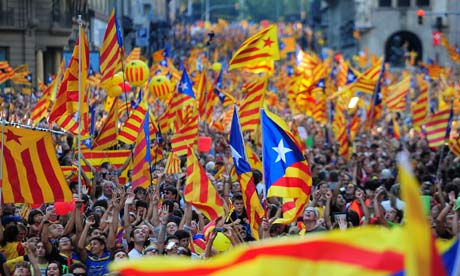
'Catalonia: a new European state' was the slogan for the march. But statehood remains a long way off, the EU warns. Photograph: Lluis Gene/AFP/Getty Images
Barcelona was a sea of red and yellow Catalan flags as more than 1.5 million people brought the city to a standstill on Tuesday at a mass rally called to demand independence for the Spanish region.
The planned route was already filled with demonstrators before the march began, in what marked a watershed for the hitherto marginal independence movement.
At least one train and more than 1,000 coaches had been chartered to bring supporters to the march.
Long-standing resentment about what Catalans see as their unfairly high contribution to central government has been inflamed by Spain's economic woes. Polls published on Tuesday show support for independence running at 46.4%, twice as high as in 2008, when thefinancial crisis began.
The upsurge in support for secession has caught Catalonia's nationalist CiU government on the hop. CiU, which has governed Catalonia for 25 of the 33 years since democracy was restored, has never aspired to independence, preferring to wring more autonomy out of minority governments in Madrid.
Artur Mas, the Catalan president, initially said he had no intention of joining the march but later said he would attend in a personal capacity. Carme Forcadell, a spokeswoman for the group behind the march, said: "Anyone who attends should understand that they will be considered pro-independence."
Catalan calls for independence have increased sharply since the financial crisis exploded in 2008, hitting Spain particularly hard
Speaking on television on the eve of the rally, Mariano Rajoy, the Spanish prime minister, dismissed the march, saying: "This isn't a moment for big gestures like this. What we need to do is create jobs."
Carles Brugueras, a documentary film-maker said he was not a nationalist but favoured independence from a strictly economic perspective. "For a long time, Catalonia has been generating a lot of resources for Spain but the fiscal balance has been very unfair," he said.
Laura Nuñez, a law student and also a new convert to independence, said she believed it would boost the Catalan economy. "We're economically the most powerful part of Spain, because of industry and tourism, and we contribute more than other Spanish regions," she said. "We shouldn't be subject to this internal discrimination."
The slogan for the march was "Catalonia: a new European state". But aEuropean Union spokesman in Brussels pointed out that, were Catalonia to secede from Spain, it would have to leave the EU and could rejoin only if it met the economic criteria and if other member states voted unanimously in favour of its membership.
Whether Catalonia would be viable as an independent state is an open question. Much of Catalonia's wealth comes from tourism, but there are major industries in the region, as well as a significant multinational presence. Whether these firms would want to remain in a small state that was not part of Spain is unclear.
If the region continues to pursue independence, boycotts could follow, analysts warn. There was a damaging cava boycott in 2005, when Catalonia refused to back Madrid's bid for the 2012 Olympics.
The economist Xavier Cuadras warned: "A large-scale boycott could cause a 40% drop in exports of consumer goods to Spain, and a sustained boycott could cost Catalonia 4% of its GDP." Spain accounts for 54% of the region's exports.
In sport, Catalans make much of the fact that half the victorious Spanish football team are Catalans. But it is doubtful whether many of those players would play for a small country that was unlikely to win anything at an international level. The same goes for the mighty Barcelona football club: if Catalonia were independent, it would be reduced to playing in a semi-professional league.
And not all Catalans are pro-independence. Some 40% of Catalans are Spanish immigrants – or the children of those immigrants – who fled poverty in rural Spain after the civil war and retain strong family and emotional ties with Spain. Then there are a further 1 million people (14% of the population) who are from other EU states, Latin America, Morocco, Pakistan and China. Very few of these, were they given the chance to vote, would back independence.
There is considerable antipathy in Spain towards the Catalans, who are widely perceived as rich, spoilt, constantly complaining and forever playing the victim. Catalans are, understandably, hurt by this. "The rise in the pro-independence movement is directly related to the Spanish state's inability to include Catalonia," said Miquel Berga, professor of English literature at the Universitat Pompeu Fabra. "It seems to me that only a profound change in constitutional arrangements can address the prevailing sense of dissatisfaction."
Joan Fumaz, a chef, said: "If we were independent, we wouldn't have to go on justifying ourselves. I'm Catalan. It would be nice not to have to explain that to people all the time."
and...
http://www.guardian.co.uk/business/2012/sep/12/eurozone-crisis-
german-court-bailout-fund
Here's some early reaction to the Court ruling:
Sony Kapoor, director of the Re-Define think tank, says the Constitutional Court has preserved the 'status quo' in Germany, by ruling that the Bundestag must give its approval to any extensions to the ESM.

The Open Europe think tank suggests the ruling may mean the Bundestag must consider the ESM again:

Matthias Kumm of Berlin's Humboldt University told Reuters that the Court ruling is broadly in line with expectations:
It means that Germany will now be able to move forward and ratify the ESM, providing an additional clarifying interpretation of the conditions under which Germany can assume responsibility.So in effect this means that the ESM can enter into force.
At present, the ESM has €700bn of firepower at its disposal. That would not be enough to fund a full bailout of both Spain and Italy, for example.
Channel 4's economics editor, Faisal Islam, predicts drama in the Bundestag next year:

DETAILS OF THE COURT RULING
By rejecting the complaint, Germany's Constitutional Court has given the green light for Germany's president to sign the €700bn European Stability Mechanism into German law.
That takes away the danger of the bailout fund being blocked.
But there are also some key conditions:
1) The court has rules that German liability to the ESM must not exceed €190bn without asking the Bundestag for approval.
2) Both houses of the German Parliament must be kept informed about how the funds within the ESM are deployed.
Updated at 09:21 BST
( Seeing what the Troika has done for Greece and Portugal , no wonder Rajoy absolutely will not agree to conditionality - until he is dragged kicking and screaming to the mat... )
THE TROIKANAUTS: How familiarity breeds contempt
The Troika is still hard at work breeding extremism via barmy wish-lists and unpayable taxes
Like some State-sponsored IVF treatment for enabling the birth of hard Left and Right Parties, the Troika continues its triumphant tour through the ClubMed region.
I pointed out last week how the Greek neo-nazi Party Golden Dawn has gone from under 0.3% of the vote to being bigger than Pasok. Yesterday it was the Greek Communist Party’s turn to express their admiration for the neocon hit-squad
Waving the standard banners and anti-austerity slogans, Greek Communist Party (KKE) trade unionists took over the Labour Ministry’s facade in Athens, effectively locking the Troika out from a meeting between Yiannis Vroutsis and the Troika scheduled for 1:00 p.m.
But the conference did eventually take place, and this is what emerged as the Troikanaut wish-list:
- possible rise in the retirement age from 65 to 67 years old.
- a decreased notice time for lay-off from 6 down to 3 months
- reduction in lay-off compensation by 50%
- deecreasing employers’ contributions to social security funds/increasing those of employees
- Increase of working week from 5 to 6
- Lowering the already lowered minimum wage again from 586 to 500 euro.
A similar shooting-script is under discussion in Portugal, from where two separate emails came to The Slog’s attention yesterday:“Did you hear about the latest austerity measures in Portugal? Workers who now pay 11% of their income for Social Security will have to pay 18%. that’s over 63% more…if this measure is approved, my wage will go back to the values of 10 years ago. I will not be able to meet my financial commitments”.and“For those who work for others (the ones that can’t flee with their money off-shores) an increase from 11 to 18 percent in the contribution to social security; for corporations a decrease from 23.75 to 18 percent in the same contribution. What was the “motive” for these measures? To tackle unemployment! What crap! All companies will do with this money is take it into their bank accounts!”****and....
http://www.telegraph.co.uk/finance/debt-crisis-live/9537151/Debt-crisis-live.html
11.11 Spanish prime minister Mariano Rajoy has again insisted that he will monitor the nation's borrowing costs before deciding whether to seek a full-scale rescue. Addressing parliament this morning, he said:
I still don't know the conditions nor whether it is necessary for Spain to request it [...] We will see how the risk premium develops and the financing differentials ahead.
Spanish Prime Minister Mariano Rajoy answers a question during a parliamentary session in Madrid on Wednesday (Photo: Reuters).
Meanwhile, deputy economy minister Fernando Jimenez Latorre told reporters that there was no urgency over Spain's decision because the country could now issue debt in “more comfortable” conditions. He added:
The important thing is that when whatever assistance that is needed is requested that it should be well received in the markets.
10.21 Spanish and Italian borrowing costs may have fallen this morning, but those countries shouldn't pop open the champagne bottles just yet.
Guntram Wolff, deputy director at European think tank Bruegel, argues that Karlsruhe may still require changes in the ESM treaty that could "significantly delay" its implementation:
The German constitutional court has, as was widely expected, given a "yes-but" answer to the ESM treaty. The "But" refers to Article 8(5), sentence 1 "The liability of each ESM Member shall be limited, in all circumstances, to its portion of the authorised capital stock at its issue price." The crucial point here is the reference to the "issue price".
[...] The second "but" refers to Article 32 (5), Article 34 and Article 35 (1). The court demands here that the two chamber of the German parliament (Bundestag und Bundesrat) need to be fully informed. In the reading of the court, the three articles could be read in a way that this full information of the parliament is restricted.
[...] The Karlsruhe judges now demand the that these two objections are removed in a "völkerrechtlich bindend" way, meaning in a way that it binding in international law. My first reaction would be that this probably cannot be done by just agreeing in the German implementation law that the conditions are met. It may require changes in the ESM treaty or a new side treaty to the ESM. So my suspicion is that it will significnatly delay the implementation of the ESM.
10.13 The court's job isn't over, however. Following a request by German MP Peter Gauweiler, its next job is to examine whether the ECB's new bond buying programme (OMT) means part of German sovereignty is transferred to the ECB.
09.43 Germany's borrowing costs shot up following the announcement. Benchmark 10-year bond yields spiked to 1.6265pc.
09.40 If you're so inclined, you can read the ruling in full here:
09.32 Bruno Waterfield sends his initial thoughts:
The 190 billion cap on Germany's liabilities in the ESM bailout fund will be a major political obstacle.
In the last last two years of euro crisis, there has been only one certainty that the bill for propping up the euro always gets bigger.
In fact the current size of the ESM - 500bn - now seems almost quaintly, naively tiny as the EU contemplate direct bank bailouts in Spain and bond purchases to shore up Italy, the eurozone's third largest economy.
An increase in firepower will now become a major political event in Germany.
09.26 Freudian slip? Mr Vosskuhle mistakenly says that plantiff complaints were justified, but quickly corrects himself. They were NOT justified, he says. Laughter is heard, and even Mr Vosskuhle smiles.
09.22 Germany does have the right to raise its ESM share in the future, but any moves must be approved by both houses.
09.18 The court says both houses of Parliament must be informed of ESM decisions.
09.16 The main condition is that the German government must set a cap for Germany's ESM liability - at €190bn.
BREAKING
09.15 The eurozone's permanent bail-out fund HAS BEEN ratified - with conditions.......
09.12 Germany's constitutional court is about to deliver its ESM verdict.Andreas Vosskuhle, President of Germany's Constitutional Court has been reading out a list of complaints and complainants for the last 13 minutes. While we wait, here's what Mr Vosskuhle looks like when he's not wearing his red robes:
08.59 The "roadmap" to a full banking union was obtained by Bruno Waterfield yesterday. You can read it here:
08.55 The European Commission outlines its proposals for new powers for the ECB here, and has compiled a separate list of FAQs (there are 22 of them) on the new proposals here.
08.42 Back to the serious stuff.
Mr Barroso says closer integration is about creating "a federation of nation states, not a super state." There are a few audible groans from the audience.
Union is about countries being better equipped to control their own fate, he says, and is designed to work with member states, not against them.
"In these times of anxiety it will be a mistake to leave Europe's fate to popularists and nationalists," he says.
Creating this federation of nation states will ultimately require a new treaty. We are all aware of how difficult treaty changes have become, but a deep and genuine union can only be completed with changes to the treaties.
08.32 The Commission will publish an economic blueprint this autumn which will outline possible treaty changes, says Mr Barroso.
08.30 Next, he announces measures that will be a "stepping stone to a banking union". "The crisis has shown when things went wrong it was the taxpayers who has to pick up the bill," he says. "Mere coordination is no longer adequate".
He says that the single supervisory mechanism outlined today will restore confidence in the supervision of banks in the euro area.
Supervision must be everywhere, because problems can arise anywhere.
08.28 Mr Barroso turns to Greece. He says he "truly believe[s] that we have a chance this autumn to reach turning point". He says that Greecemust banish all doubts about its commitment to reform, while other states must banish all doubts about their willingness to support Greece.
On the ECB, he suggests that OMTs are within the bank's mandate, and the bank "has not only the right, but the duty to restore the integrity of monetary policy."
"All actors should respect the ECB's independence," he adds.
08.23 Mr Barroso sees a "social emergency" in some parts of Europe. He wants to implement a "youth guarantee scheme" which will to facilitate training. He also wants to implement measures that will fight tax fraud and evasion, which could yield billions of euros.
08.21 He says that today's speech is about presenting a "decisive deal" for Europe. He stresses that the Eu needs to support countries via innovation and investment growth.
08.19 He says the weaker countries should leave no doubts about their willingness to reform, while stronger countries must leave no doubt about the EU sense of solidarity.
"We are in this together and we must resolve this together," he says.
08.16 He adds:
08.13 Mr Barroso says that some European countries can no longer steer the course of events on their own - some audience members clap.
Europe needs more integration, he says. Part of that means "accepting we are all in the same boat" [and] embracing the interdependence of countries' existence. He says:
When you are in a boat in the middle of a storm, absolute loyalty is the minimum you expect of the crew members.
08.12 Mr Barroso says Europe continues to be in crisis. Not just a financial crisis, but an economic crisis and a political crisis - a crisis of confidence.
The eurozone's current structure is "not up to the job" he says. It has been a "painful" and difficult effort, and citizens feel their way of life is at risk, he adds.
"Europe needs a new direction, and this direction cannot be based on old ideas," he says.
07.45 Then, at 10am BST, eight men and women donned in red robes will deliver a closely watched ruling on the legality of the eurozone's permanent bail-out fund - the European Stability Mechanism (ESM).
Under current provisions, Germany would be the €700bn (£560bn) fund's biggest creditor, with liabilities of up to €190bn.
07.35 Jose Manuel Barroso, the president of the European Commission, will deliver his "state of the union" address in Strasbourg this morning, where he is expected to outline plans for an EU-wide banking union.
But as our Brussels correspondent Bruno Waterfield reports, the proposals could see British lenders shut down or forced into taxpayer-funded bail-outs against the wishes of the UK government:
A panel of European officials would be given sweeping new powers to police the financial sector across the continent but also in the City of London.
They would be given "full decision making powers" to impose EU law and to arbitrate disputes between Britain and the eurozone over the risks posed by British banks, according to the proposals being tabled on Wednesday at the European Commission. Decisions taken by the powerful body would be automatically binding unless Britain was able to win the unlikely backing of a majority and overturn them.
Rulings by the panel could create huge costs for the British government and banks if they were ordered to bail out a struggling institution, contribute to cross-border bail-out funds, or allow the EU to rule over breaches of European law.
and Greece girds for more strikes.....
| |||

|

