http://www.bloomberg.com/video/knight-faces-capital-gap-monday-o-shaughnessy-says-E7QItVYHSKurGF3Ou20Xew.html?cmpid=yhoo
( Capital gap of 400 - 500 million due on Monday to close Goldman trade... )
and will they have to sell asets at firesale prices such as their FX platform...
http://seekingalpha.com/article/778181-will-knight-capital-be-forced-to-sell-hotspot-fx?source=yahoo
After losing $440 million and seeing its shares close at $2.58/share on Thursday, down 75% over the last two trading days, Knight Capital Group (KCG) has been reportedly seeking additional funding sources to shore up its capital. To do this, Knight will need to sell assets or succumb to selling a huge chunk of its company as bargain basement prices. One asset that is sure to find suitors is Hotspot FX, the company's Forex ECN trading network.
Demand for institutional Forex products remains strong, as seen by therecent acquisition of FXAll for $625 million by Thompson Reuters (TRI) and a smaller deal of FXCM buying Lucid Markets in June for $176 million. While only a third of the size of FXAll in terms of daily FX volumes, Hotspot's $30 billion/day in trading on its network accounts for 9.4% of all publicly reported Forex trading. Based on the valuation FXAll received, a Hotspot FX sale could go for north of $200 million. This compares with the $77.5 million price tag Knight paid for Hotspot six years ago.
The potential of a Hotspot sale was also highlighted yesterday in theWSJ's Deal Journal. The report sifted through potential Knight assets that could be sold and Hotspot was at the top of the list of non-equity units, based on the ECN's fast growth in grabbing market share.
Another reason why Hotspot could be attractive to buyers is the unit's culture. Although owned by Knight, Hotspot has always been run as a separate unit with a culture based on providing institutional FX trading, rather than being simply the Forex division of Knight (Personal note: my experiences with Hotspot employees was that when I mentioned Knight Capital and their achievements, it was ignored. Reminded me of Michael Lewis's Liars Poker and "Equities in Dallas" was purgatory for the bond players.) As such, a buyer would find Hotspot easier to integrate than if it were a more involved unit within its parent group.
Who would be a possible suitor?
Although not often mentioned among financial M&A deals Bloomberg could be a good fit for Hotspot. The business media giant already manages its agency trading platform Tradebook. Buying Hotspot FX would be allow them to gain a greater footprint among Forex traders and give them access to selling Bloomberg's trading analytics and algo products to Hotspot's clients.
Another broker that would seemingly need to mentioned in any talk of a Forex acquisition is Japanese broker Monex. Monex has been an aggressive purchaser, buying both Tradestation and IBFX last year. A Monex/Hotspot hook up could also offer synergy advantages as one of Hotspot's weaknesses has been the drop of trading volumes during the Asian session. While spreads on Hotspot's ECN remained fairly tight during the Asian period, combining with Monex would be expected to increase liquidity from Asia onto the ECN.
Among investment banks, Goldman Sachs (GS) has been involved with several Forex related purchases over the last few years. While these deals haven't been successes for the firm, it has shown their interest in the space. With Hotspot, they could view the ECN as an established profit center that they could integrate into their REDI trading platform.
Among long shots, futures trading exchanges could see the potential of adding Hotspot's network and technology. With the steady increase of Forex futures trading volume, adding the ability to trade spot side by side could be a selling point to traders. While technology wise, the exchanges would probably interested in Hotspot, being regulated entities makes them long shots, as they may not be able to act fast enough to get a deal done to satisfy Knight's immediate funding needs.
and....
http://www.forbes.com/sites/steveschaefer/2012/08/03/stay-of-execut
Update, 5 p.m.: Knight survived another day and shares spiked 57% to $4.05, but the firm now heads into an uncertain weekend seeking a cash infusion or transaction to shore up its capital base. For more, read “There’s Hope for Knight Capital” from Forbes’ Halah Touryalai.
Update, 2:45 p.m.: TD Ameritrade, one of several counterparties that had suspended doing business with Knight Capital in the wake of its trading fiasco, announced Friday afternoon that it has resumed routing client trades to the firm.
“After considerable review and discussion, we are resuming our order routing relationship with Knight,” CEO Fred Tomczyk said. Shares of Knight, already showing big gains on the day after losing 75% of their value over the last two sessions, were up 61.2% at $4.16 with just over an hour to the bell.
The bottom-fishers who picked up Knight Capital shares anywhere near their $2.27 low Thursday were cheering Friday, as the stock popped nearly 25% on a report that the firm secured a credit line that should let it survive into the weekend.
Knight has been pushed to the brink this week aftertaking a $440 million loss due to erroneous orders created by new trading software that caused erratic trading in dozens of NYSE-listed stocks Wednesday. That loss, more than four times Knight’s annual profits, raised concerns that the firm might not survive to the weekend.
Those fears were given something of a respite Friday though, after the Wall Street Journal reported that Knight has been telling Wall Street brokers it secured a credit line that will allow it to operate somewhat normally. From the WSJ:
Knight representatives said they could handle as much order flow as the desks wanted to send, said people familiar with the conversations. That marked a departure from requests from Knight on Thursday that some customers dial back on the volume of trades channeled to Knight. Such a request to route elsewhere typically reflects a cash-strapped brokerage’s desire to keep downward pressure on its capital demands, as the need for a capital cushion rises with trading volume.
A Knight spokesperson did not immediately respond to Forbes’ request for comment on its current condition.
Shares of the firm, which plunged 75% over the last two days, jumped24% to $3.20 Friday morning. Knight CEO Tom Joyce, who was a vocal critic of Nasdaq when the exchange botched the debut of Facebook shares in May, told Bloomberg TV the situation is similar but not the same. “We’re very proud of the fact that we escalated it directly to our clients and got them out of harm’s way,” he said.
As for the concerns average investors may have about the market being a rigged game, Joyce admitted situations like his firm’s trading error contribute to the perception, but said investors were not harmed. “If you get involved in the day to take minutia and not invest for the long term, this will give you a headache, no question about it,” he told Bloomberg. “We’re not happy that we added to that pile.”
and.....
http://www.bloomberg.com/news/2012-08-03/knight-survives-another-day-with-short-term-financing.html?cmpid=yhoo
Knight Capital Group Inc. (KCG), stung by a software malfunction that triggered a $440 million trading loss, survived another day as it secured a funding lifeline and more customers resumed routing orders to the market maker.
The firm told brokers it has money for today after it received short-term financing, according to a person familiar with the matter who requested anonymity because the conversations were private. TD Ameritrade Holding Corp. and Scottrade Inc., which sent trades elsewhere for execution after Knight’s software bug on Aug. 1 roiled markets, said they were routing orders to the firm again.Knight’s stock surged 57 percent to $4.05 in New Yorktrading today after tumbling 75 percent in the previous two sessions.
As the company opened its books to potential saviors, people with knowledge of the matter said KKR & Co., TPG Capital and Silver Lake were among buyout firms that had an initial interest -- while one said chances of a private-equity deal are small. The market maker has until Aug. 6 to complete a transaction in which Goldman Sachs Group Inc. will take over trades that saddled Knight with a $440 million loss, a person familiar with the matter said. U.S. stock trades settle three sessions after they are made.
“I seriously doubt they will go out of business,” Kenneth Pasternak, who co-founded Knight in 1995, said in a phone interview from his Ridgefield Park, New Jersey, private equity firm Kabr Real Estate Investment. “I just hope they can maintain the innovation. My fear is they will be bought by some big bank and become consumed by the CYA behavior and lose their edge.”
Books Open
Kara Fitzsimmons, a Knight spokeswoman, didn’t return a call and e-mail requesting a comment today. The short-term financing was reported earlier by the Wall Street Journal.David Wells, a spokesman for New York-based Goldman Sachs, said he couldn’t comment.
Knight opened its books to private-equity firms and at least one securities-industry rival, said two people with knowledge of the matter. It’s working with Sandler O’Neill & Partners LP as advisers in the rescue talks, said one of the people, who spoke on condition of anonymity because the discussions are private.
The trading fault, which caused stocks to move as much as 151 percent, left the firm with a “large error position,” Knight Chief Executive Officer Thomas Joyce told Bloomberg Television yesterday.
‘Capable People’
“We’re talking to a lot of capable people, people who are in touch with situations like this,” Joyce said yesterday. “This was an anomaly, not one we’re proud of.” Joyce declined to elaborate on the discussions during the interview, saying “you might imagine during the day-to-day activity, it’s kind of hard to comment.”
Scottrade spokesman Whitney Ellis said the online retail brokerage began routing orders back to Knight earlier today. TD Ameritrade Holding said it will resume routing client trades to Knight after testing its systems.
“After considerable review and discussion, we are resuming our order routing relationship with Knight,” said Fred Tomczyk, president and chief executive officer at TD Ameritrade, in a statement. “Knight is one of many order routing destinations for us and has long been a good and trusted partner.”
John Woerth, of Vanguard Group Inc., said in an e-mail that the company continued to avoid routing brokerage orders through Knight. Fidelity Investments, the second-largest mutual-fund company, is routing orders away from Knight, according to a person familiar with the matter, who asked not to be identified because the information is private.
‘Biggest Risk’
“Knight may or may not have the ability to withstand this on a balance sheet basis, but their biggest risk is if people decide not to do business with them,” Keith Wirtz, who oversees $14.7 billion as chief investment officer for Fifth Third Asset Management in Cincinnati, said in a telephone interview. Fifth Third is a client of Knight’s. “In my 30-plus years experience, your confidence with a counterparty like a Knight is only as strong as their skills as well as their balance sheet.”
About 23 percent of Vanguard’s market orders in NYSE-listed securities were routed to Knight last quarter, according to a filing. The figure was 41 percent at Scottrade, 38 percent at Fidelity’s National Financial Services LLC unit and 9 percent at TD Ameritrade.
Fitch Ratings said in a statement that it does not expect any major counterparties of Knight to suffer large losses even in a bankruptcy scenario since “numerous institutions” have already switched to other market makers. The issue still may lead to a structural change in the business, the ratings firm said.
‘Unforseeable Risks’
“The events of the last two days again pose risks for equity trading volume as many investors become more concerned about seemingly unforeseeable risks related to trading technology problems and the broader market impact of high- frequency trading systems that periodically break down,” Fitch said in the statement.
The number of exchange-listed securities changing hands on average each day fell 11 percent to 6.12 billion in July from a year ago, according to data compiled by Bloomberg.
Knight’s $440 million loss compares with net income of $115.2 million in 2011 and is more than the company’s market value of $253 million at the close yesterday, data compiled by Bloomberg show. The company was worth as much as $4.8 billion in 2000 and valued at more than $1 billion before yesterday, according to data compiled by Bloomberg.
‘Exhaust’ Cash
The loss represents about 40 percent of Knight’s book value and would “exhaust” the firm’s cash, according to CLSA Credit Agricole Securities. Knight had $365 million of cash as of the end of June, with about $70 million in its revolving credit line, Robert Rutschow, a New York-based analyst with CLSA, wrote in a report yesterday.
Knight’s market-making unit executed a daily average of $19.5 billion worth of equities in June, according to its website. The unit traded 711 million exchange-listed shares a day in June, according to data compiled by the company and Bloomberg.
The NYSE reviewed trading in 140 stocks from Molycorp Inc. to AT&T Inc. as the market’s Aug. 1 open was disrupted. Trades that occurred during the height of the volatility were canceled in six securities, where prices swung at least 30 percent in the first 45 minutes. Trades in all of the other stocks were allowed to stand.
‘Technology Breaks’
“Technology breaks,” Joyce told Bloomberg TV yesterday. “It ain’t good. We don’t look forward to it.” He added that the problem is mainly one for his firm, and “we did not harm individual investors, we got them out of the way.”
The software malfunction was the latest black eye for the computer infrastructure of an equity market still haunted by the May 2010 market crash, the botched initial public offering of Facebook Inc. (FB) and failed IPO of Bats Global Markets Inc.
The Securities and Exchange Commission has been monitoring the situation, spokesman Kevin Callahan said in an e-mail yesterday. George Smaragdis, spokesman for the Financial Industry Regulatory Authority, said Finra has examiners on site and is working with Knight and other regulars to review the impact of the incident.
The error has fueled scrutiny that may reshape an industry spread across about 50 trading venues. The head of the New York Stock Exchange said the firm’s crisis is a “call to action” to fix a market that’s grown too complex to explain to regulators.
“The structure that has evolved over the last decade in the U.S. has led to inexorable fragmentation, really an emphasis on speed, a feeling that if something is faster than by definition it’s better,” NYSE Euronext (NYX) Chief Executive Officer Duncan Niederauersaid during a conference call today after the company reported earnings. “We are understanding that speed is not always better.”
and.....
Who would be a possible suitor?
Although not often mentioned among financial M&A deals Bloomberg could be a good fit for Hotspot. The business media giant already manages its agency trading platform Tradebook. Buying Hotspot FX would be allow them to gain a greater footprint among Forex traders and give them access to selling Bloomberg's trading analytics and algo products to Hotspot's clients.
Another broker that would seemingly need to mentioned in any talk of a Forex acquisition is Japanese broker Monex. Monex has been an aggressive purchaser, buying both Tradestation and IBFX last year. A Monex/Hotspot hook up could also offer synergy advantages as one of Hotspot's weaknesses has been the drop of trading volumes during the Asian session. While spreads on Hotspot's ECN remained fairly tight during the Asian period, combining with Monex would be expected to increase liquidity from Asia onto the ECN.
Among investment banks, Goldman Sachs (GS) has been involved with several Forex related purchases over the last few years. While these deals haven't been successes for the firm, it has shown their interest in the space. With Hotspot, they could view the ECN as an established profit center that they could integrate into their REDI trading platform.
Among long shots, futures trading exchanges could see the potential of adding Hotspot's network and technology. With the steady increase of Forex futures trading volume, adding the ability to trade spot side by side could be a selling point to traders. While technology wise, the exchanges would probably interested in Hotspot, being regulated entities makes them long shots, as they may not be able to act fast enough to get a deal done to satisfy Knight's immediate funding needs.
and....
http://www.forbes.com/sites/steveschaefer/2012/08/03/stay-of-execut
Update, 5 p.m.: Knight survived another day and shares spiked 57% to $4.05, but the firm now heads into an uncertain weekend seeking a cash infusion or transaction to shore up its capital base. For more, read “There’s Hope for Knight Capital” from Forbes’ Halah Touryalai.
Update, 2:45 p.m.: TD Ameritrade, one of several counterparties that had suspended doing business with Knight Capital in the wake of its trading fiasco, announced Friday afternoon that it has resumed routing client trades to the firm.
“After considerable review and discussion, we are resuming our order routing relationship with Knight,” CEO Fred Tomczyk said. Shares of Knight, already showing big gains on the day after losing 75% of their value over the last two sessions, were up 61.2% at $4.16 with just over an hour to the bell.
The bottom-fishers who picked up Knight Capital shares anywhere near their $2.27 low Thursday were cheering Friday, as the stock popped nearly 25% on a report that the firm secured a credit line that should let it survive into the weekend.
Knight has been pushed to the brink this week aftertaking a $440 million loss due to erroneous orders created by new trading software that caused erratic trading in dozens of NYSE-listed stocks Wednesday. That loss, more than four times Knight’s annual profits, raised concerns that the firm might not survive to the weekend.
Those fears were given something of a respite Friday though, after the Wall Street Journal reported that Knight has been telling Wall Street brokers it secured a credit line that will allow it to operate somewhat normally. From the WSJ:
and.....Knight representatives said they could handle as much order flow as the desks wanted to send, said people familiar with the conversations. That marked a departure from requests from Knight on Thursday that some customers dial back on the volume of trades channeled to Knight. Such a request to route elsewhere typically reflects a cash-strapped brokerage’s desire to keep downward pressure on its capital demands, as the need for a capital cushion rises with trading volume.
A Knight spokesperson did not immediately respond to Forbes’ request for comment on its current condition.Shares of the firm, which plunged 75% over the last two days, jumped24% to $3.20 Friday morning. Knight CEO Tom Joyce, who was a vocal critic of Nasdaq when the exchange botched the debut of Facebook shares in May, told Bloomberg TV the situation is similar but not the same. “We’re very proud of the fact that we escalated it directly to our clients and got them out of harm’s way,” he said.As for the concerns average investors may have about the market being a rigged game, Joyce admitted situations like his firm’s trading error contribute to the perception, but said investors were not harmed. “If you get involved in the day to take minutia and not invest for the long term, this will give you a headache, no question about it,” he told Bloomberg. “We’re not happy that we added to that pile.”
http://www.bloomberg.com/news/2012-08-03/knight-survives-another-day-with-short-term-financing.html?cmpid=yhoo
Knight Capital Group Inc. (KCG), stung by a software malfunction that triggered a $440 million trading loss, survived another day as it secured a funding lifeline and more customers resumed routing orders to the market maker.
The firm told brokers it has money for today after it received short-term financing, according to a person familiar with the matter who requested anonymity because the conversations were private. TD Ameritrade Holding Corp. and Scottrade Inc., which sent trades elsewhere for execution after Knight’s software bug on Aug. 1 roiled markets, said they were routing orders to the firm again.Knight’s stock surged 57 percent to $4.05 in New Yorktrading today after tumbling 75 percent in the previous two sessions.
As the company opened its books to potential saviors, people with knowledge of the matter said KKR & Co., TPG Capital and Silver Lake were among buyout firms that had an initial interest -- while one said chances of a private-equity deal are small. The market maker has until Aug. 6 to complete a transaction in which Goldman Sachs Group Inc. will take over trades that saddled Knight with a $440 million loss, a person familiar with the matter said. U.S. stock trades settle three sessions after they are made.
“I seriously doubt they will go out of business,” Kenneth Pasternak, who co-founded Knight in 1995, said in a phone interview from his Ridgefield Park, New Jersey, private equity firm Kabr Real Estate Investment. “I just hope they can maintain the innovation. My fear is they will be bought by some big bank and become consumed by the CYA behavior and lose their edge.”
Books Open
Kara Fitzsimmons, a Knight spokeswoman, didn’t return a call and e-mail requesting a comment today. The short-term financing was reported earlier by the Wall Street Journal.David Wells, a spokesman for New York-based Goldman Sachs, said he couldn’t comment.
Knight opened its books to private-equity firms and at least one securities-industry rival, said two people with knowledge of the matter. It’s working with Sandler O’Neill & Partners LP as advisers in the rescue talks, said one of the people, who spoke on condition of anonymity because the discussions are private.
The trading fault, which caused stocks to move as much as 151 percent, left the firm with a “large error position,” Knight Chief Executive Officer Thomas Joyce told Bloomberg Television yesterday.
‘Capable People’
“We’re talking to a lot of capable people, people who are in touch with situations like this,” Joyce said yesterday. “This was an anomaly, not one we’re proud of.” Joyce declined to elaborate on the discussions during the interview, saying “you might imagine during the day-to-day activity, it’s kind of hard to comment.”
Scottrade spokesman Whitney Ellis said the online retail brokerage began routing orders back to Knight earlier today. TD Ameritrade Holding said it will resume routing client trades to Knight after testing its systems.
“After considerable review and discussion, we are resuming our order routing relationship with Knight,” said Fred Tomczyk, president and chief executive officer at TD Ameritrade, in a statement. “Knight is one of many order routing destinations for us and has long been a good and trusted partner.”
John Woerth, of Vanguard Group Inc., said in an e-mail that the company continued to avoid routing brokerage orders through Knight. Fidelity Investments, the second-largest mutual-fund company, is routing orders away from Knight, according to a person familiar with the matter, who asked not to be identified because the information is private.
‘Biggest Risk’
“Knight may or may not have the ability to withstand this on a balance sheet basis, but their biggest risk is if people decide not to do business with them,” Keith Wirtz, who oversees $14.7 billion as chief investment officer for Fifth Third Asset Management in Cincinnati, said in a telephone interview. Fifth Third is a client of Knight’s. “In my 30-plus years experience, your confidence with a counterparty like a Knight is only as strong as their skills as well as their balance sheet.”
About 23 percent of Vanguard’s market orders in NYSE-listed securities were routed to Knight last quarter, according to a filing. The figure was 41 percent at Scottrade, 38 percent at Fidelity’s National Financial Services LLC unit and 9 percent at TD Ameritrade.
Fitch Ratings said in a statement that it does not expect any major counterparties of Knight to suffer large losses even in a bankruptcy scenario since “numerous institutions” have already switched to other market makers. The issue still may lead to a structural change in the business, the ratings firm said.
‘Unforseeable Risks’
“The events of the last two days again pose risks for equity trading volume as many investors become more concerned about seemingly unforeseeable risks related to trading technology problems and the broader market impact of high- frequency trading systems that periodically break down,” Fitch said in the statement.
The number of exchange-listed securities changing hands on average each day fell 11 percent to 6.12 billion in July from a year ago, according to data compiled by Bloomberg.
Knight’s $440 million loss compares with net income of $115.2 million in 2011 and is more than the company’s market value of $253 million at the close yesterday, data compiled by Bloomberg show. The company was worth as much as $4.8 billion in 2000 and valued at more than $1 billion before yesterday, according to data compiled by Bloomberg.
‘Exhaust’ Cash
The loss represents about 40 percent of Knight’s book value and would “exhaust” the firm’s cash, according to CLSA Credit Agricole Securities. Knight had $365 million of cash as of the end of June, with about $70 million in its revolving credit line, Robert Rutschow, a New York-based analyst with CLSA, wrote in a report yesterday.
Knight’s market-making unit executed a daily average of $19.5 billion worth of equities in June, according to its website. The unit traded 711 million exchange-listed shares a day in June, according to data compiled by the company and Bloomberg.
The NYSE reviewed trading in 140 stocks from Molycorp Inc. to AT&T Inc. as the market’s Aug. 1 open was disrupted. Trades that occurred during the height of the volatility were canceled in six securities, where prices swung at least 30 percent in the first 45 minutes. Trades in all of the other stocks were allowed to stand.
‘Technology Breaks’
“Technology breaks,” Joyce told Bloomberg TV yesterday. “It ain’t good. We don’t look forward to it.” He added that the problem is mainly one for his firm, and “we did not harm individual investors, we got them out of the way.”
The software malfunction was the latest black eye for the computer infrastructure of an equity market still haunted by the May 2010 market crash, the botched initial public offering of Facebook Inc. (FB) and failed IPO of Bats Global Markets Inc.
The Securities and Exchange Commission has been monitoring the situation, spokesman Kevin Callahan said in an e-mail yesterday. George Smaragdis, spokesman for the Financial Industry Regulatory Authority, said Finra has examiners on site and is working with Knight and other regulars to review the impact of the incident.
The error has fueled scrutiny that may reshape an industry spread across about 50 trading venues. The head of the New York Stock Exchange said the firm’s crisis is a “call to action” to fix a market that’s grown too complex to explain to regulators.
“The structure that has evolved over the last decade in the U.S. has led to inexorable fragmentation, really an emphasis on speed, a feeling that if something is faster than by definition it’s better,” NYSE Euronext (NYX) Chief Executive Officer Duncan Niederauersaid during a conference call today after the company reported earnings. “We are understanding that speed is not always better.”
and.....
http://www.businessinsider.com/traders-knight-capitals-clients-have-completely-abandoned-them-2012-8
Knight Capital's clients have completely flown the coop after a software error in the company's trading software caused the company to stomach $440 million in losses, according to three different traders consulted by Business Insider.
Wall Street institutions large and small no longer feel comfortable using the market making firm to execute their trades in the wake of the snafu, essentially cutting of its business.
An equities trader explained that Knight was the "last place" he would go to execute a trade. Others expressed befuddlement and the firm's inability to rectify the trading error for a full 45 minutes.
Wall Streeters' abandonment of the firm bodes ill for the company's ability to recoup losses. In May, the company had a daily trading volume of about $21 billion.
and...
http://blogs.wsj.com/deals/2012/08/02/what-a-knight-buyer-would-get/
( market making unit is worth what with business pulled by numerous major players , what value could you place on the institutional trading and dark pool units also tainted by association at this point ? And does anyone trust any of Knight's platforms even a currency after this week ? Besides , why pay retail prices when one could be patient and just scoop up what you want in bankruptcy court with the protections of bankruptcy to eliminate exposure to liabilities presently unknown ?
By Telis Demos
Knight says it’s looking for strategic alternatives. What might be the appeal to buyers, in whole or in part?
“There are certainly valuable pieces to [Knight’s] franchise,” wrote Chris Allen of Evercore in a note this morning. He says that despite the technology problems, the crown jewel is Knight’s retail market-making, or “wholesale,” business, which produced around $250 million in annual pre-tax profit between 2009 and 2011.
That unit takes the other side of trades placed at retail brokerages, and makes money by trading out of those positions at a profit. The business has formidable competitors, such as Citadel and units of UBS and Citigroup, but is attractive enough that banks such as Goldman Sachs and Credit Suisse have for some time been trying to establish themselves in it.
Because Knight has been in the business since the 1990s, Knight has by far the most physical data linkages to broker-dealers, who feed retail trading orders into its system, around 700 to 800, says Christopher Nagy, former head of order routing at TD Ameritrade and now an industry consultant. It would be dauntingly expensive for a new entrant in the business to replicate so many physical connections.
Another unit that analysts say has strong value, and could be sold separately, is Knight’s currencies trading platform, HotSpot FX. HotSpot is an electronic communications network, or ECN, that competes with the likes of EBS, which is owned by Icap, and Reuters, the dominant venues for trading currencies. HotSpot, which Knight acquired in 2006 for $77.5 million, has grown its market share sharply, an average of 50% a year since 2010, by allowing retail and other non-bank competitors onto the platform.
One other distinct asset is Knight’s 19.9% stake in Direct Edge, the electronic stock exchange it originally founded. (They are still based in the same building in Jersey City, N.J.) One industry veteran estimates the stake is worth $70 million to $90 million.
Beyond that, it’s unclear what could fetch real interest. Knight has an institutional trading unit and “dark pool,” which matches trades anonymously between buyers and sellers. It also acts as a designated market maker, or DMM, on the New York Stock Exchange floor. But those are businesses with many, and much bigger, competitors. One person familiar with DMM businesses adds that a sale of that unit would be very complicated, in part because the NYSE would likely have to approve it, and because it carries a steep capital requirement, in the neighborhood of $30 million to $60 million.
Knight also has a group of proprietary traders who use algorithms to make money only for the firm. Knight does not break out its “prop” results, but the unit is said to be good, and sizable, and it is legally separate from market-making. However, it might be difficult to extract or sell as a standalone, said the industry veteran. The market-making and prop units operate under the same broker-dealer license, and likely share some software and other technological infrastructure.
A group of Knight’s fixed-income businesses, such as BondPoint, which matches small trades of corporate bonds between retail and institutional customers, and a reverse-mortgages lending and trading unit, Urban Financial Group, acquired in 2010, are still in their early stages and not significant profit generators.
Matthew Heinz, analyst at Stifel Nicolaus, estimated Thursday that the market-making unit is worth about 50% of its annual revenues as a standalone unit, or $280 million. He assigns zero value to the institutional businesses. He says the most valuable single piece is the unit that includes HotSpot FX and Knight’s other electronic execution services: $540 million assuming a nine times multiple of its estimated 2012 earnings.
Beyond that, it’s unclear what could fetch real interest. Knight has an institutional trading unit and “dark pool,” which matches trades anonymously between buyers and sellers. It also acts as a designated market maker, or DMM, on the New York Stock Exchange floor. But those are businesses with many, and much bigger, competitors. One person familiar with DMM businesses adds that a sale of that unit would be very complicated, in part because the NYSE would likely have to approve it, and because it carries a steep capital requirement, in the neighborhood of $30 million to $60 million.
Knight also has a group of proprietary traders who use algorithms to make money only for the firm. Knight does not break out its “prop” results, but the unit is said to be good, and sizable, and it is legally separate from market-making. However, it might be difficult to extract or sell as a standalone, said the industry veteran. The market-making and prop units operate under the same broker-dealer license, and likely share some software and other technological infrastructure.
A group of Knight’s fixed-income businesses, such as BondPoint, which matches small trades of corporate bonds between retail and institutional customers, and a reverse-mortgages lending and trading unit, Urban Financial Group, acquired in 2010, are still in their early stages and not significant profit generators.
Matthew Heinz, analyst at Stifel Nicolaus, estimated Thursday that the market-making unit is worth about 50% of its annual revenues as a standalone unit, or $280 million. He assigns zero value to the institutional businesses. He says the most valuable single piece is the unit that includes HotSpot FX and Knight’s other electronic execution services: $540 million assuming a nine times multiple of its estimated 2012 earnings.
http://barnhardt.biz/
KNIGHT CAPITAL GOING DOWN LIKE THE TITANIC
POSTED BY ANN BARNHARDT - AUGUST 2, AD 2012 1:42 PM MST
The Knight Capital computer algorithm abortion yesterday is even worse than originally thought. The losses are being quoted now at $440 million. Egan Jones just downgraded Knight to junk CCC with this warning:
Tough math - KCG probably needs $600M of equity capital but its market cap is only $300M and therefore probably can only raise $80M to $90M using normal rules of thumb. A sale of the firm would take 90 days under good conditions and therefore only an equity or quasi-equity investment makes sense. However, with weakness in the markets, there is likely to be few likely buyers. In a good year KCG earns $115M and therefore the $440M loss is debilitating. (Watch for the secondary losses related the loss of client confidence.) Net revs for the June quarter declined by 13% YoY. The Market-Making segment revenues were down 21% with pre-tax income down 84% from $39.2M to $5.9M due to trading losses related to the Facebook IPO. June quarter oper inc was down from $29.5M to $5.4M. We are downgrading.
So Penson collapses and within a matter of weeks the firm that bought Penson collapses. MF Global. PFG Best. Who will be next?
And there are STILL people who are so stupid and so stuck in a normalcy bias / Stockholm Syndrome that they are emailing me asking how to open an account with me, or if I could recommend a good stock or futures broker. Heck, I had some sleazoid call me last week who - get this - said he started reading me back in November, was my number one fan, had listened to every interview I had done since, and wanted to know if I'd be interested in brokering and/or investing in a commodity pool that he was putting together to do call writing.
What does one even say to that level of cognitive dissonance?
Let me phrase this as bluntly as I can to hopefully nip any further inquiries in the bud:
DO NOT call me asking for a broker referral. The markets are dead and collapsing, and only a complete moron would expose money to the markets, either futures or stocks, at this point.
If you are one of those truly stupid people who is still trading stocks or futures and you get your money stolen, DO NOT CALL OR EMAIL ME whining about it. You're not going to get ANY sympathy. Since MF Global, the situation has been crystal, crystal clear. If you haven't totally exited the financial markets, then you are simply stupid, and there are consequences for being stupid.
Girls who go to frat parties dressed like prostitutes and then drink until they pass out get raped.
Tough math - KCG probably needs $600M of equity capital but its market cap is only $300M and therefore probably can only raise $80M to $90M using normal rules of thumb. A sale of the firm would take 90 days under good conditions and therefore only an equity or quasi-equity investment makes sense. However, with weakness in the markets, there is likely to be few likely buyers. In a good year KCG earns $115M and therefore the $440M loss is debilitating. (Watch for the secondary losses related the loss of client confidence.) Net revs for the June quarter declined by 13% YoY. The Market-Making segment revenues were down 21% with pre-tax income down 84% from $39.2M to $5.9M due to trading losses related to the Facebook IPO. June quarter oper inc was down from $29.5M to $5.4M. We are downgrading.
So Penson collapses and within a matter of weeks the firm that bought Penson collapses. MF Global. PFG Best. Who will be next?
And there are STILL people who are so stupid and so stuck in a normalcy bias / Stockholm Syndrome that they are emailing me asking how to open an account with me, or if I could recommend a good stock or futures broker. Heck, I had some sleazoid call me last week who - get this - said he started reading me back in November, was my number one fan, had listened to every interview I had done since, and wanted to know if I'd be interested in brokering and/or investing in a commodity pool that he was putting together to do call writing.
What does one even say to that level of cognitive dissonance?
Let me phrase this as bluntly as I can to hopefully nip any further inquiries in the bud:
DO NOT call me asking for a broker referral. The markets are dead and collapsing, and only a complete moron would expose money to the markets, either futures or stocks, at this point.
If you are one of those truly stupid people who is still trading stocks or futures and you get your money stolen, DO NOT CALL OR EMAIL ME whining about it. You're not going to get ANY sympathy. Since MF Global, the situation has been crystal, crystal clear. If you haven't totally exited the financial markets, then you are simply stupid, and there are consequences for being stupid.
Girls who go to frat parties dressed like prostitutes and then drink until they pass out get raped.
People who have money exposed to the collapsing, lawless, fascist financial markets get their money stolen.
Same thing.
DO NOT call me asking to open an account. This goes especially for people who claim to have been reading me since my Going Galt letter was published at ZeroHedge, was read on the air by both Limbaugh and Beck, and the subsequent Puplava and Schiff audio interviews, all of which totaled up to tens of millions of listeners. If you have been reading me since I went viral by SHUTTING MY FIRM DOWN, why, why, WHY would you email me asking to OPEN AN ACCOUNT? What exactly do you think "shutting down" and "ceasing operations" means? In all of those interviews when I have vociferously called for a total financial market strike, when I have repeatedly warned people to get their money COMPLETELY out of the markets, what do you think that meant? If you are so stupid that you don't understand what GET THE HELL OUT means, then you should not now and not ever be trading in any markets. There is a baseline intelligence requirement, and being able to understand one's native language spoken simply and clearly is that baseline.
If you are still, for whatever completely unfathomable and inexplicable reason, in the financial markets, get the hell out now, especially if you have an account that clears through Knight.
Oh, and for those of you who survive to the other side of this collapse and war and are charged with the rebuilding, all computerized trading, high-frequency trading and algorithm trading MUST be made illegal. In fact, I would recommend going completely old school back to open outcry markets. Orders can be entered and routed to the floor electronically, but must be executed BY HUMAN BEINGS.
Same thing.
DO NOT call me asking to open an account. This goes especially for people who claim to have been reading me since my Going Galt letter was published at ZeroHedge, was read on the air by both Limbaugh and Beck, and the subsequent Puplava and Schiff audio interviews, all of which totaled up to tens of millions of listeners. If you have been reading me since I went viral by SHUTTING MY FIRM DOWN, why, why, WHY would you email me asking to OPEN AN ACCOUNT? What exactly do you think "shutting down" and "ceasing operations" means? In all of those interviews when I have vociferously called for a total financial market strike, when I have repeatedly warned people to get their money COMPLETELY out of the markets, what do you think that meant? If you are so stupid that you don't understand what GET THE HELL OUT means, then you should not now and not ever be trading in any markets. There is a baseline intelligence requirement, and being able to understand one's native language spoken simply and clearly is that baseline.
If you are still, for whatever completely unfathomable and inexplicable reason, in the financial markets, get the hell out now, especially if you have an account that clears through Knight.
Oh, and for those of you who survive to the other side of this collapse and war and are charged with the rebuilding, all computerized trading, high-frequency trading and algorithm trading MUST be made illegal. In fact, I would recommend going completely old school back to open outcry markets. Orders can be entered and routed to the floor electronically, but must be executed BY HUMAN BEINGS.
http://www.zerohedge.com/news/knight-considering-bankruptcy-looking-363-asset-sale
Knight Considering Bankruptcy, Looking At 363 Asset Sale
 Submitted by Tyler Durden on 08/02/2012 16:19 -0400
- VIRTU OUT OF BIDDING FOR KNIGHT CAPITAL
- KNIGHT’S JOYCE CONSIDERING BANKRUPTCY REORGANIZATION
- KNIGHT LOOKING AT ‘363’ REORGANIZATION TO SELL ASSETS
- KNIGHT LOOKING TO EMERGE AS VIABLE COMPANY
363 Asset sale? This is what we said earlier when we reported on the rumors of a sale to Virtu: "Will it happen? Maybe. Although we doubt it - why pay for equity value when one can pick up the functioning assets in a Chapter 363 asset sale which also sticks the creditors with all the crappy assets?" Sure enough. Sadly, what this means for the company 1,500 employees is that about 80% them will be out of a job due to an algo gone wild. And to then we have been warning about the impact of HFT for the past 3 years.
Perhaps now that people's livelihoods are about to destroyed even the porn-addicts at the SEC will finally take this matter seriously.
- VIRTU OUT OF BIDDING FOR KNIGHT CAPITAL
- KNIGHT’S JOYCE CONSIDERING BANKRUPTCY REORGANIZATION
- KNIGHT LOOKING AT ‘363’ REORGANIZATION TO SELL ASSETS
- KNIGHT LOOKING TO EMERGE AS VIABLE COMPANY
363 Asset sale? This is what we said earlier when we reported on the rumors of a sale to Virtu: "Will it happen? Maybe. Although we doubt it - why pay for equity value when one can pick up the functioning assets in a Chapter 363 asset sale which also sticks the creditors with all the crappy assets?" Sure enough. Sadly, what this means for the company 1,500 employees is that about 80% them will be out of a job due to an algo gone wild. And to then we have been warning about the impact of HFT for the past 3 years.
Perhaps now that people's livelihoods are about to destroyed even the porn-addicts at the SEC will finally take this matter seriously.
and......
http://www.zerohedge.com/news/will-penson-cash-vaporize-gentle-good-knight
Will Penson Cash Vaporize Gentle Into That Good Knight?
Submitted by Tyler Durden on 08/02/2012 15:22 -0400
First MFG; then PFG; and next KCG? A little over two months ago Knight Capital, the well-respected brokerage house, purchased a 'floundering' futures brokerage - Penson Financial Services. The de minimus $5mm that Knight paid on May 31st for the firms meant(implicitly) that the $411mm of customer funds became 'useful'. With various firms pulling lines and the math underlying Egan-Jones downgrade, it is natural that an investor would be anxious to ensure that all their hard-earned deposited segregated accounts are, well, still segregated. Have no fear though, as Bloomberg reports, CME, which regulates Knight's futures business, is "monitoring the situation". An advocacy lawyer for MFG/PFG clients noted: "Those at Penson should be a little worried;" and so while KCG "actively pursues its strategic financing alternatives to strengthen its capital base" - read D.I.P. plans - one can't help but wonder whether all that shiny customer cashola is burning a hole in their capital-deficient pockets. It would seem at $2.27 per share, a few others are wondering that also.
P.S. While the rogue algo that took Knight down to Chinatown may have been switched off, it appears its ever-ready competitors forgot to turn theirs off - as NANEX provides (once again) clear evidence of the wondrous market-making/eating algos feasting on the carcas of freshly damaged capital to the tune of 1000s of trades per millisecond occurring...

First MFG; then PFG; and next KCG? A little over two months ago Knight Capital, the well-respected brokerage house, purchased a 'floundering' futures brokerage - Penson Financial Services. The de minimus $5mm that Knight paid on May 31st for the firms meant(implicitly) that the $411mm of customer funds became 'useful'. With various firms pulling lines and the math underlying Egan-Jones downgrade, it is natural that an investor would be anxious to ensure that all their hard-earned deposited segregated accounts are, well, still segregated. Have no fear though, as Bloomberg reports, CME, which regulates Knight's futures business, is "monitoring the situation". An advocacy lawyer for MFG/PFG clients noted: "Those at Penson should be a little worried;" and so while KCG "actively pursues its strategic financing alternatives to strengthen its capital base" - read D.I.P. plans - one can't help but wonder whether all that shiny customer cashola is burning a hole in their capital-deficient pockets. It would seem at $2.27 per share, a few others are wondering that also.
P.S. While the rogue algo that took Knight down to Chinatown may have been switched off, it appears its ever-ready competitors forgot to turn theirs off - as NANEX provides (once again) clear evidence of the wondrous market-making/eating algos feasting on the carcas of freshly damaged capital to the tune of 1000s of trades per millisecond occurring...

and.....
http://www.reuters.com/article/2012/08/02/knightcapital-loss-idUSL2E8J27QE20120802?feedType=RSS&feedName=marketsNews&rpc=43
* Knight shares plunge as CEO says firm seeking financing
* TD Ameritrade, Fidelity routing orders to other market makers
* Knight attributes trading glitch to software problems
* SEC considering if new market measures needed
By Edward Krudy and Jed Horowitz and John McCrank
NEW YORK, Aug 2 (Reuters) - Knight Capital Group Inc fought for survival on Thursday after a $440 million trading loss caused by a software glitch wiped out much of its capital, forcing Knight to seek new funding as its shares plunged almost 80 percent in two days.
Many of the company's biggest customers, including TD Ameritrade, the No. 1 U.S. retail brokerage by trading volume, and fund giants Vanguard and Fidelity Investments, stopped routing orders through Knight. One of the biggest fears is that the company will collapse, landing trading partners with losses.
"They have about 48 hours to shore up confidence," said James Koutoulas, head of an advocacy group for former customers of failed brokerages MF Global and Peregrine Financial.
Knight said it is "actively pursuing its strategic and financing alternatives," raising the likelihood the firm will be sold or face bankruptcy because of the loss and subsequent damage to business.
As one of the leading market makers in U.S. stocks, Knight is among the firms that are critical to smooth, orderly trading. Market makers match orders from buyers and sellers and often provide liquidity by stepping into the market themselves.
The speed at which Knight has unraveled has been particularly unnerving for investors and markets. It resulted from problems with the firm's trading software that sent bogus, rapid-fire trades into the market for 45 minutes on Wednesday and left Knight with big losses on numerous stocks it bought at inflated prices.
Knight is in talks with Silver Lake Partners-backed trading firm Virtu Financial LLC about a possible deal, according to The Wall Street Journal. Knight has approached JPMorgan Chase & Co for financing, according to a report on Fox Business Network. A spokesman for JPMorgan declined to comment. Spokeswomen for both Knight and Silver Lake also declined comment.
Knight's $440 million trading loss has reignited debate over whether technology has elevated risk in trading to unacceptable levels.
The U.S. Securities and Exchange Commission on Thursday said it would consider whether new measures might be necessary to safeguard markets.
"We continue to closely review the events surrounding yesterday's trading and discuss those events with other regulators as well as Knight Capital Group," said SEC spokesman John Nester.
"We also are considering what, if any, additional steps may be necessary, beyond the post-Flash Crash measures that limited the impact of yesterday's trading," Nester said.
Advocates of trading systems that can pump thousands of shares across Wall Street in milliseconds say the fault lies not in the systems but in the lack of controls at individual firms. Knight blamed its technology breakdown on new software that routed a flood of erroneous orders to the New York Stock Exchange on Wednesday, but offered no explanation as to why traders didn't immediately intervene to arrest the obvious errors.
DISASTERS SEEN INEVITABLE
Trading veterans say the sprawl of trading venues in the United States coupled with the constant tinkering with software codes and systems upgrades have led to such complexity that disasters are bound to occur. Since March, a series of embarrassing technology issues, including the botched Facebook trading debut after its IPO and the failed public offering of BATS Global Markets have rocked markets and shaken the confidence of investors.
"You've got 13 exchanges, 50 dark pools, brokers that internalize client orders at their own desks and thousands of algorithms pumping orders in milliseconds," said Larry Tabb, founder of Tabb Group, a financial consulting firm. "The structure just may be too complicated to work."
But some experts fear that a regulatory and populist backlash - let alone protests from competitors - will reverse advances that benefit investors.
"I'm very worried people will take a look and say there is something fundamentally wrong with the market, and there isn't," said Maureen O'Hara, a finance professor at Cornell University who sat on an advisory panel that explored reforms after the U.S. stock market collapsed inexplicably in a few minutes in the 2010 "Flash Crash."
USING OTHER MARKET MAKERS
Several large retail brokerages said they had not resumed trading with Knight, instead routing orders to other market makers. TD Ameritrade, which usually routes about 4.5 percent of its orders through Knight, is currently not sending orders through the firm, said Joe Kinahan, its chief derivatives strategist.
He said as long as Knight remains in good standing with the exchanges, TD Ameritrade will resume sending orders through it.
Mutual fund group Vanguard Group, which typically routes about a quarter of its NYSE andNasdaq trades through Knight, was sending orders elsewhere. Scottrade, E*Trade, TD Ameritrade, Pershing LLC, a subsidiary of BNY Mellon , Invesco and Fidelity were all shifting orders elsewhere.
In 2011 Knight was the No. 1 market marker in retail U.S. equity shares traded in NYSE and NASDAQ stocks. Knight's daily market-making volume was $19.5 billion in June, down 12 percent from a year ago as overall equity trading volumes have declined.
There were questions about how the firm's possible failure could affect the network of 800 smaller brokerages that rely on it to process orders, said Chris Nagy, a market structure consultant. "Although they have very small amounts of order flow, in aggregate, (they) represent a significant amount of volume," he said.
Longview Capital Management, LLC, a Wilmington, Delaware-based registered investment adviser with $200 million in assets under management, is holding off from trading with Knight until "it gets its act together and tell us where they stand," said Christian Wagner, chief executive and chief investment officer of the firm.
Exchange-traded fund issuers, for which Knight is the lead market maker, have been calling competitors to make sure they can step in if Knight does not execute trades in their funds, according to two people familiar with the situation.
AdvisorShares, an ETF provider with $670 million in assets, said officials from Knight called him Thursday morning and addressed his concerns about some of AdvisorShares' ETFs that were trading at wider spreads than they would normally. That can happen when market makers are not fulfilling trades.
ATTENTION FROM REGULATORS
The Financial Industry Regulatory Authority, the industry's self-regulator, said it has examiners at Knight and was working with the firm and other regulators to review the impact from the technology issues. It said Knight was currently in compliance with capital requirements.
While securities regulators are looking into what went wrong on the trading side, the focus in thefutures industry is on the estimated $411 million in customer funds that were part of Knight's purchase in May of floundering futures brokerage Penson Financial Services.
Confidence in the futures industry's ability to safeguard customer funds has been shaken after the collapse of futures brokerages MF Global and PFGBest in the past year was followed by accusations that they improperly raided customer accounts.
WORKING IN THE DARK
From even before the opening bell on Wednesday, traders across the market noticed something wrong, saying they saw heavy "indicated" volume for stocks that normally trade infrequently.
As soon as the market opened, an unusually high flow of orders in more than 140 stocks came in, causing shares to move rapidly. Knight later attributed the moves to software problems that caused little-traded shares like China Cord Blood to rise sharply, with some gaining more than 100 percent within seconds.
According to floor traders, Knight staff working on the NYSE's floor were in the dark as well. According to sources, algorithmic trading of this type is separate from regular trading at the company's Jersey City, New Jersey, headquarters.
"The guys are down here on the floor so they were just as caught off guard because they were actually suffering some of the consequences of the failure of their own technology," said Ken Polcari, managing director at ICAP Equities in New York, who trades on the floor of the exchange.
As the crisis unfolded, traders at Knight were fielding numerous calls and talking with officials in the firm's technology department, who confirmed that the problems were originating with Knight's software, and not with the NYSE.
It took 45 minutes to resolve the problems, again pointing to the inability of individuals to contend with out-of-control computer-based trading.
Knight's shares closed down 63 percent at $2.58 a share in NYSE trading on Thursday. In after-market trading the stock hit another all-time low, falling to $2.10.
The firm's survival may rest in the hands of Knight Capital CEO Tom Joyce, who told Bloomberg Television on Thursday the firm had "excess capital right now," and said the goal was to keep Knight in business.
When Joyce arrived in mid-2002 after the dot-com bust had devastated the U.S. stock market, the market-maker was struggling because of low trading volumes and high payouts made to attract business from discount brokers.
Joyce, whose laid-back demeanor distinguishes him from many more volatile executives in the trading business, spent 15 years at Merrill Lynch & Co., and has considerable contacts on Wall Street if a rescue deal is possible.
"Whenever you have a company that lost roughly half of its tangible book value in five minutes, everything is on the table," said Kenneth Pasternak, who co-founded Knight in 1995 and served as its chief executive until he retired in 2002. "All he has to do it is pick up the phone."
Joyce has seen his considerable stake in his firm almost wiped out in a matter of hours. As of April 2, Joyce owned more than 1.2 million shares of Knight Capital, with a market value of nearly $16 million - a stake now worth less than $3 million.
"Unless Tommy Joyce can do some really massive damage control and calm the markets and let everyone rest assured they are OK and they are not going out of business they've got some rocky days in front of them," Polcari at ICAP said.
The speed at which Knight has unraveled has been particularly unnerving for investors and markets. It resulted from problems with the firm's trading software that sent bogus, rapid-fire trades into the market for 45 minutes on Wednesday and left Knight with big losses on numerous stocks it bought at inflated prices.
Knight is in talks with Silver Lake Partners-backed trading firm Virtu Financial LLC about a possible deal, according to The Wall Street Journal. Knight has approached JPMorgan Chase & Co for financing, according to a report on Fox Business Network. A spokesman for JPMorgan declined to comment. Spokeswomen for both Knight and Silver Lake also declined comment.
Knight's $440 million trading loss has reignited debate over whether technology has elevated risk in trading to unacceptable levels.
The U.S. Securities and Exchange Commission on Thursday said it would consider whether new measures might be necessary to safeguard markets.
"We continue to closely review the events surrounding yesterday's trading and discuss those events with other regulators as well as Knight Capital Group," said SEC spokesman John Nester.
"We also are considering what, if any, additional steps may be necessary, beyond the post-Flash Crash measures that limited the impact of yesterday's trading," Nester said.
Advocates of trading systems that can pump thousands of shares across Wall Street in milliseconds say the fault lies not in the systems but in the lack of controls at individual firms. Knight blamed its technology breakdown on new software that routed a flood of erroneous orders to the New York Stock Exchange on Wednesday, but offered no explanation as to why traders didn't immediately intervene to arrest the obvious errors.
DISASTERS SEEN INEVITABLE
Trading veterans say the sprawl of trading venues in the United States coupled with the constant tinkering with software codes and systems upgrades have led to such complexity that disasters are bound to occur. Since March, a series of embarrassing technology issues, including the botched Facebook trading debut after its IPO and the failed public offering of BATS Global Markets have rocked markets and shaken the confidence of investors.
"You've got 13 exchanges, 50 dark pools, brokers that internalize client orders at their own desks and thousands of algorithms pumping orders in milliseconds," said Larry Tabb, founder of Tabb Group, a financial consulting firm. "The structure just may be too complicated to work."
But some experts fear that a regulatory and populist backlash - let alone protests from competitors - will reverse advances that benefit investors.
"I'm very worried people will take a look and say there is something fundamentally wrong with the market, and there isn't," said Maureen O'Hara, a finance professor at Cornell University who sat on an advisory panel that explored reforms after the U.S. stock market collapsed inexplicably in a few minutes in the 2010 "Flash Crash."
USING OTHER MARKET MAKERS
Several large retail brokerages said they had not resumed trading with Knight, instead routing orders to other market makers. TD Ameritrade, which usually routes about 4.5 percent of its orders through Knight, is currently not sending orders through the firm, said Joe Kinahan, its chief derivatives strategist.
He said as long as Knight remains in good standing with the exchanges, TD Ameritrade will resume sending orders through it.
Mutual fund group Vanguard Group, which typically routes about a quarter of its NYSE andNasdaq trades through Knight, was sending orders elsewhere. Scottrade, E*Trade, TD Ameritrade, Pershing LLC, a subsidiary of BNY Mellon , Invesco and Fidelity were all shifting orders elsewhere.
In 2011 Knight was the No. 1 market marker in retail U.S. equity shares traded in NYSE and NASDAQ stocks. Knight's daily market-making volume was $19.5 billion in June, down 12 percent from a year ago as overall equity trading volumes have declined.
There were questions about how the firm's possible failure could affect the network of 800 smaller brokerages that rely on it to process orders, said Chris Nagy, a market structure consultant. "Although they have very small amounts of order flow, in aggregate, (they) represent a significant amount of volume," he said.
Longview Capital Management, LLC, a Wilmington, Delaware-based registered investment adviser with $200 million in assets under management, is holding off from trading with Knight until "it gets its act together and tell us where they stand," said Christian Wagner, chief executive and chief investment officer of the firm.
Exchange-traded fund issuers, for which Knight is the lead market maker, have been calling competitors to make sure they can step in if Knight does not execute trades in their funds, according to two people familiar with the situation.
AdvisorShares, an ETF provider with $670 million in assets, said officials from Knight called him Thursday morning and addressed his concerns about some of AdvisorShares' ETFs that were trading at wider spreads than they would normally. That can happen when market makers are not fulfilling trades.
ATTENTION FROM REGULATORS
The Financial Industry Regulatory Authority, the industry's self-regulator, said it has examiners at Knight and was working with the firm and other regulators to review the impact from the technology issues. It said Knight was currently in compliance with capital requirements.
While securities regulators are looking into what went wrong on the trading side, the focus in thefutures industry is on the estimated $411 million in customer funds that were part of Knight's purchase in May of floundering futures brokerage Penson Financial Services.
Confidence in the futures industry's ability to safeguard customer funds has been shaken after the collapse of futures brokerages MF Global and PFGBest in the past year was followed by accusations that they improperly raided customer accounts.
WORKING IN THE DARK
From even before the opening bell on Wednesday, traders across the market noticed something wrong, saying they saw heavy "indicated" volume for stocks that normally trade infrequently.
As soon as the market opened, an unusually high flow of orders in more than 140 stocks came in, causing shares to move rapidly. Knight later attributed the moves to software problems that caused little-traded shares like China Cord Blood to rise sharply, with some gaining more than 100 percent within seconds.
According to floor traders, Knight staff working on the NYSE's floor were in the dark as well. According to sources, algorithmic trading of this type is separate from regular trading at the company's Jersey City, New Jersey, headquarters.
"The guys are down here on the floor so they were just as caught off guard because they were actually suffering some of the consequences of the failure of their own technology," said Ken Polcari, managing director at ICAP Equities in New York, who trades on the floor of the exchange.
As the crisis unfolded, traders at Knight were fielding numerous calls and talking with officials in the firm's technology department, who confirmed that the problems were originating with Knight's software, and not with the NYSE.
It took 45 minutes to resolve the problems, again pointing to the inability of individuals to contend with out-of-control computer-based trading.
Knight's shares closed down 63 percent at $2.58 a share in NYSE trading on Thursday. In after-market trading the stock hit another all-time low, falling to $2.10.
The firm's survival may rest in the hands of Knight Capital CEO Tom Joyce, who told Bloomberg Television on Thursday the firm had "excess capital right now," and said the goal was to keep Knight in business.
When Joyce arrived in mid-2002 after the dot-com bust had devastated the U.S. stock market, the market-maker was struggling because of low trading volumes and high payouts made to attract business from discount brokers.
Joyce, whose laid-back demeanor distinguishes him from many more volatile executives in the trading business, spent 15 years at Merrill Lynch & Co., and has considerable contacts on Wall Street if a rescue deal is possible.
"Whenever you have a company that lost roughly half of its tangible book value in five minutes, everything is on the table," said Kenneth Pasternak, who co-founded Knight in 1995 and served as its chief executive until he retired in 2002. "All he has to do it is pick up the phone."
Joyce has seen his considerable stake in his firm almost wiped out in a matter of hours. As of April 2, Joyce owned more than 1.2 million shares of Knight Capital, with a market value of nearly $16 million - a stake now worth less than $3 million.
"Unless Tommy Joyce can do some really massive damage control and calm the markets and let everyone rest assured they are OK and they are not going out of business they've got some rocky days in front of them," Polcari at ICAP said.
and.....
http://blogs.wsj.com/marketbeat/2012/08/02/knight-capital-trading-error-cost-firm-440-million/?mod=yahoo_hs
pre-market now at 2.93 and dropping like a rock....
Knight Capital just disclosed a pretax loss of $440 million due to yesterday’s trading error. Shares are down 42% at $4.02 in premarket trading, on top of yesterday’s 33% slide.
Here’s the press release:
PRESS RELEASE: Knight Capital Group Provides Update Regarding August 1st Disruption To Routing In NYSE-listed Securities
JERSEY CITY, N.J., Aug. 2, 2012 /PRNewswire/ — Knight Capital Group, Inc. (NYSE Euronext: KCG) today provided an update on the August 1, 2012 disruption to routing in NYSE-listed securities.
As previously disclosed, Knight experienced a technology issue at the open of trading at the NYSE yesterday, August 1st. This issue was related to Knight’s installation of trading software and resulted in Knight sending numerous erroneous orders in NYSE-listed securities into the market. This software has been removed from the company’s systems.
Clients were not negatively affected by the erroneous orders, and the software issue was limited to the routing of certain listed stocks to NYSE.
Knight has traded out of its entire erroneous trade position, which has resulted in a realized pre-tax loss of approximately $440 million. Although the company’s capital base has been severely impacted, the company’s broker/dealer subsidiaries are in full compliance with their net capital requirements. Knight will continue its trading and market making activities at the commencement of trading today. The company is actively pursuing its strategic and financing alternatives to strengthen its capital base.
Knight Capital just disclosed a pretax loss of $440 million due to yesterday’s trading error. Shares are down 42% at $4.02 in premarket trading, on top of yesterday’s 33% slide.
Here’s the press release:
PRESS RELEASE: Knight Capital Group Provides Update Regarding August 1st Disruption To Routing In NYSE-listed SecuritiesJERSEY CITY, N.J., Aug. 2, 2012 /PRNewswire/ — Knight Capital Group, Inc. (NYSE Euronext: KCG) today provided an update on the August 1, 2012 disruption to routing in NYSE-listed securities.As previously disclosed, Knight experienced a technology issue at the open of trading at the NYSE yesterday, August 1st. This issue was related to Knight’s installation of trading software and resulted in Knight sending numerous erroneous orders in NYSE-listed securities into the market. This software has been removed from the company’s systems.Clients were not negatively affected by the erroneous orders, and the software issue was limited to the routing of certain listed stocks to NYSE.Knight has traded out of its entire erroneous trade position, which has resulted in a realized pre-tax loss of approximately $440 million. Although the company’s capital base has been severely impacted, the company’s broker/dealer subsidiaries are in full compliance with their net capital requirements. Knight will continue its trading and market making activities at the commencement of trading today. The company is actively pursuing its strategic and financing alternatives to strengthen its capital base.
Knight Capital Group, Inc. (KCG)
-NYSE
6.94 Aug 1, 4:05PM EDT|Pre-Market: 4.23  2.71 (39.05%) 8:18AM EDT - Nasdaq Real Time Price
2.71 (39.05%) 8:18AM EDT - Nasdaq Real Time Price( the quote for Pre-market today - actually hit 4.11 today. 440 million loss and seeking capital solutions ! )
and.....
http://www.theflyonthewall.com/permalinks/entry.php/KCGid1681365/KCG-Knight-Capital-drops--to--after-announcing-M-loss-on-trades
| ||||||||||||

http://www.zerohedge.com/news/what-happens-when-hft-algo-goes-totally-berserk-and-serves-knight-capital-bill
This Is What Happens When An HFT Algo Goes Totally Berserk And Serves Knight Capital With The Bill
We all know something went horribly wrong in various NYSE-traded stocks today between 9:30 am and 10:15 am. So wrong in fact that the NYSE had to step in and cancel numerous trades in 6 symbols. However it did not DK millions of other trades in 134 other symbols, the vast majority of which we assume traded errantly due to the market making of Knight Capital (as admittedby the company), which today saw its biggest drop ever since going public on volume about 60 times greater than its average. We also all know that one should buy low and sell high. At least that is what human traders are taught, and that is what they attempt. Because if one consistently does the opposite, one will simply run out of money. Well, the opposite is precisely what the berserk algo in Knight's Market Making group may have done if Nanex, which has done a forensic analysis of one of the trades in question, is correct. In other words, instead of at least attempting to provide liquidity via limit trades, Knight's algorithm acted as a market order... gone horribly wrong. As the third chart below shows what the algo did with furious repetition and steadfast consistency was to buy at the offer, and sell at the bid, in other words buy high and sell low. Over and over and over and over. As Nanex laconically notes, "In the case of EXC, that means losing about 15 cents on every pair of trades. Do that 40 times a second, 2400 times a minute, and you now have a system that's very efficient at burning money." Which also means that by not DK'ing several hundred million prints, the NYSE may have just thrown Knight under the bus, because the market maker is suddenly on the hook for tens if not hundreds of millions in inverse market making profits.
Here we will assume that readers are sufficiently familiar with market structure to know that market makers only participate in the market in order to collect liquidity rebates, i.e., to be the limit on the bid which is hit, or the offer which is lifted. What Knight did was effectively the opposite, and it also collected the opposite of a rebate: i.e., it paid someone else for no reason at all... well technically to withdraw liquidity. However liquidity that led to creation of losses not profits.
Naturally, when the entire logic of trading was perverted courtesy of Knight's busted algo, everything went Bizarro Day, and stocks went higher, because they went higher, and the higher they went, the greater the incentive for the algo to keep pushing the stock higher. This explains not only the volume surge, but also the shocking price moves in some stocks such as China Cord Bloodwhich exploded several hundred percent higher before someone had to finally step in. And what is most notable is that because there were neither fat finger trades, nor busted algos that took out the entire bid or offer stack in one trade, thus triggering circuit breakers, but a slow methodical bleed, there was no reason under the current SEC order cancellation methodology to bail out Knight and its berserk algorithm.
Simply said: today may be the single worst day in Knight's market making history. And sadly, as the NYSE already notedminutes before the market close, the decision to not cancel any more trades is "not subject to appeal."
From Nanex:
What really happened, or how to lose a ton of money, fast.
What follows should strike you as crazy. If it doesn't, read it again, because it is.
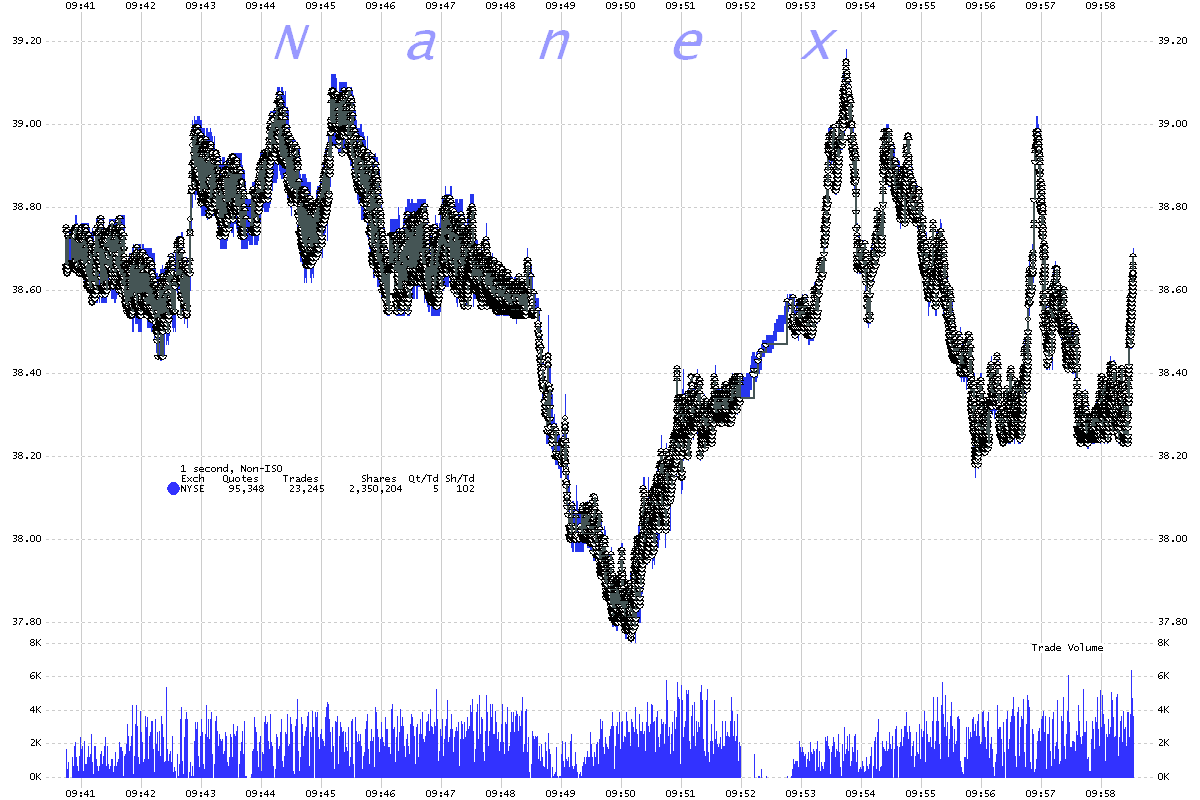
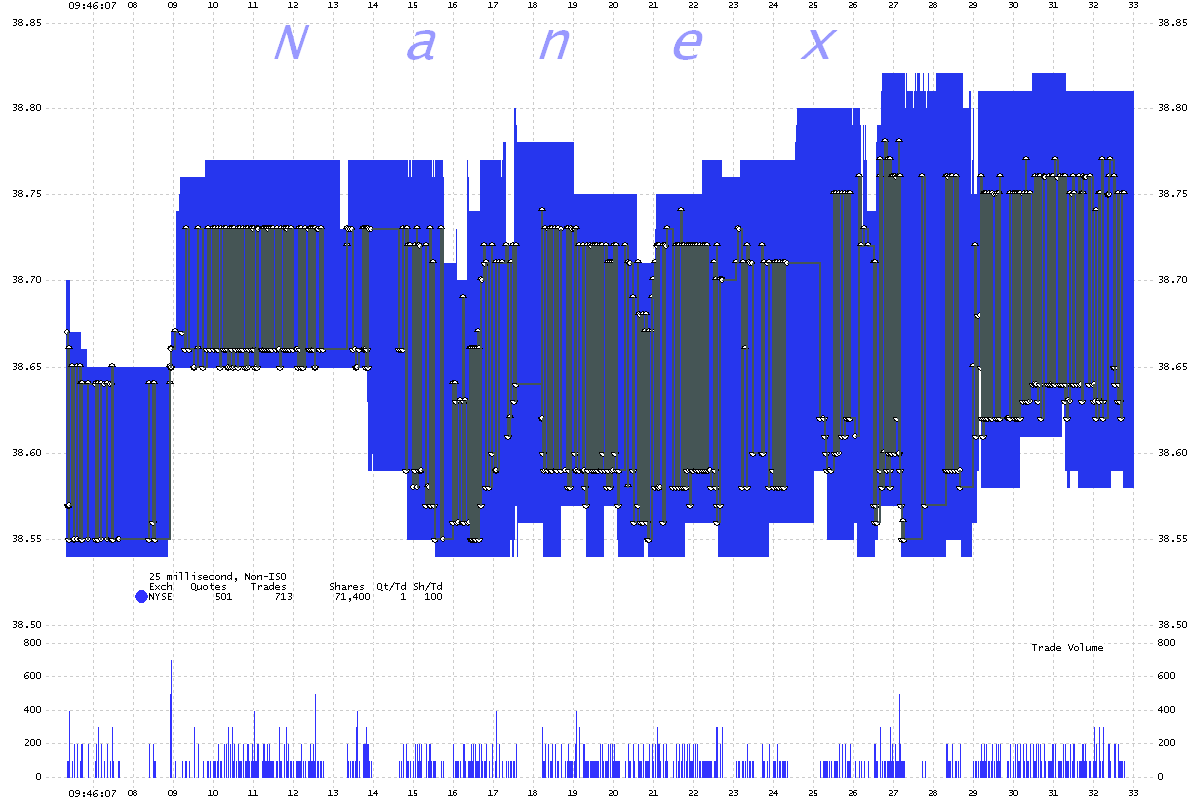
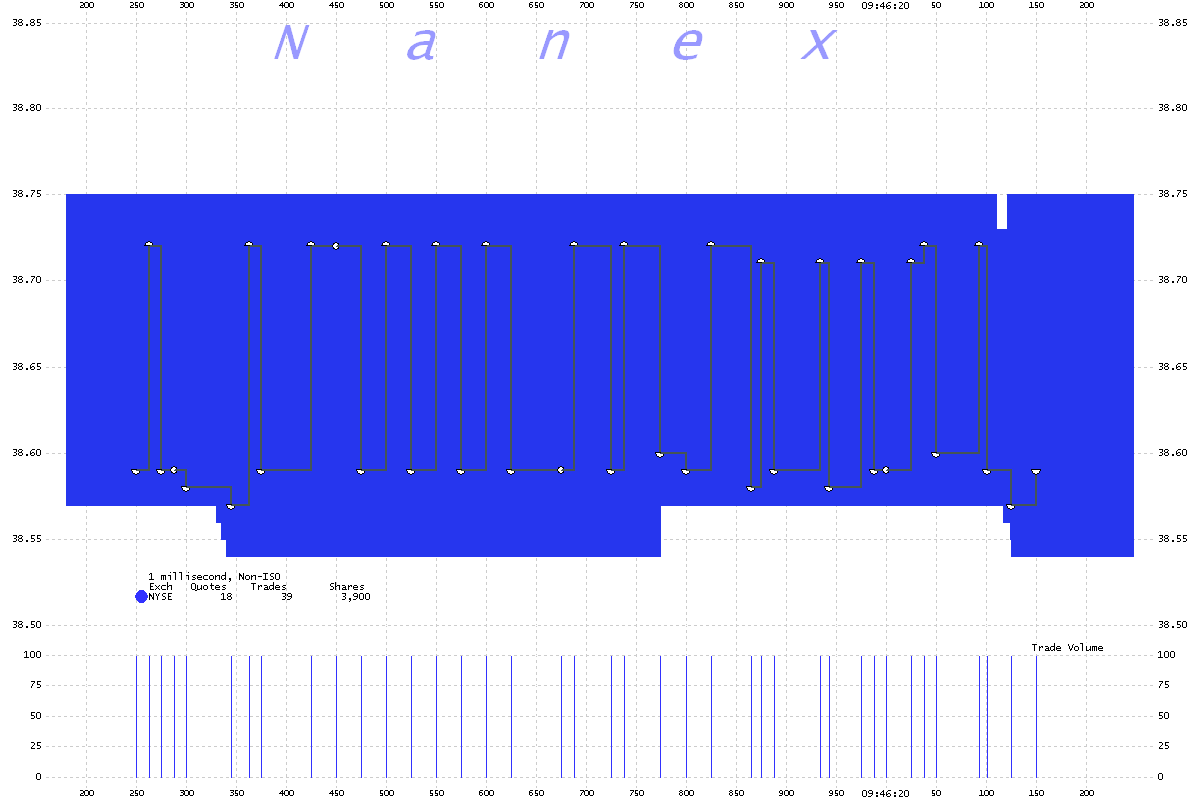
The following 3 charts plot non-ISO trades (regular trade condition) reported from NYSE in the stock of Exelon Corporation (symbol EXC). By plotting and connecting only regular trades from NYSE we get a clearer picture of the nature (some might say horror) of this event.
1. EXC One second interval chart. Circles are trades, the blue coloring is the NYSE bid and ask which is mostly covered by gray lines that connect the trades.
2. Zoom of above chart showing about 27 seconds of data. Now the gray lines connecting trades are more clearly visible. NYSE's bid/ask is the blue shaded area (the bid price is the bottom of the shading, and the ask is the top).
3. Zooming in to a 1 millisecond interval chart, we can see one second of data which shows 39 trades.
Note how the trade executions ping pong from bid to ask. As if someone is buying at the offer, then 10 ms later selling at the bid, and so forth. It turns out, the gray shading you see in the first chart of EXC is from this alternating between buying and selling. That's right, almost all these trades alternate between buying at the offer and selling at the bid, which means losing the difference in price. In the case of EXC, that means losing about 15 cents on every pair of trades. Do that 40 times a second, 2400 times a minute, and you now have a system that's very efficient at burning money.
and.........
http://www.zerohedge.com/news/nyse-cancel-trades-beyond-30-band-opening-price-various-stocks-knight-foot-bill-balance
NYSE To Cancel Trades Beyond 30% Band From Opening Price In Various Stocks, Knight To Foot Bill For Balance?
Update: NYSE has completed its review of the impaired stocks. Those are the only 6 stocks which will see trade cancellations:
15:54 ET 01 Aug 2012MARKET: NYSE, NYSE Amex CATEGORY: Market Operations Update
The NYSE and NYSE MKT in association with all relevant regulatory authorities have concluded the review of this morning's CEE filing. The six symbols listed below will be the only symbols with cancelled trades; no additional symbols will be considered for review.This decision is not subject to appeal.Symbols:WZE at or above $4.68
CO at or above $3.22
UTG RT at or below $0.0497
EJ at or below $3.36ARC at or above $5.71
KWK at or above $5.91
Just as the only response by the SEC and various exchanges to the May 2010 flash crash was to cancel all trades beyond a 20% band of the prevailing NBBO before the Flash Crash (in the process destroying any confidence that market crash perpetrators would be truly punished by forcing them to incur the full damage resulting from the consequences of their stupidity), so the NYSE has determined to unilaterally cancel all trades, initially in six stocks, but probably in all of the attached 140 symbols, in a move that will teach the offenders absolutely nothing, and will punish only those who took advantage of a broken market to incur one-time profits courtesy of a broken market structure. However, what it will also do, is likely make Knight directly liable for any losses incurred by traders from the opening price through the 30% breakage threshold. In other words, with Knight losing about $300 million in market cap today, investors are speculating that the net loss to the firm will be just that as it has to foot the bill. Considering the volume and breadth of the impaired universe, this will likely be very big underestimation of just what the final bill will be to Knight. And isn't it ironic that Knight itself was until recently complaining about how much money it itself lost on the FaceBook IPO as a market maker...
From the NYSE:
CEE Review Determination for multiple symbols14:57 ET 01 Aug 2012The NYSE and NYSE MKT have determined to cancel all trades in the following six symbols associated with this morning's CEE for multiple securities. Trades executed 30% or more above or below the NYSE/NYSE MKT opening price today between 09:30:00 a.m. and 10:15:00 a.m. ET will be busted.
This situation is still under review by all relevant regulatory authorities.Symbols:WZE at or above $4.68
CO at or above $3.22
UTG RT at or below $0.0497
EJ at or below $3.36
ARC at or above $5.71
KWK at or above $5.91
And then the NYSE gave out this update as well:
Update: CEE Review Determination for multiple symbols15:11 ET 01 Aug 2012MARKET: NYSE, NYSE Amex CATEGORY: Market Operations Update
The NYSE and NYSE MKT encourage all member firms to keep their Common Customer Gateway (CCG) lines up and available after 4 p.m. ET today as some of the trade cancellations referenced in the prior message may not flow back until after 4 p.m. ET.In addition, all associated tape prints will be removed from the Consolidated Tape after 4 p.m. ET


No comments:
Post a Comment