http://www.guardian.co.uk/world/2012/jul/11/spanish-coal-miners-protest-madrid
Spanish coal miners bring message of defiance to Madrid
As Mariano Rajoy announces new austerity measures, capital welcomes miners fighting huge cuts in subsidies
 Email
Email- Giles Tremlett in MadridThey came with helmets on their heads and the worried look of men with no future on their faces. But the Spanish coalminers who marched through Madrid on Wednesday were clear that they would not give up on their life-or-death struggle for the future of their collieries."We'll keep going and, if nothing happens, the fight will just get harder," said Jórge Exposito, a miner from Mieres, northern Spain, as fireworks crackled and twitchy riot police stood by with shields and guns loaded with rubber bullets.A tense standoff saw occasional police charges, rubber bullets, and demonstrators hurling objects at police. At least 76 people were injured in clashes along Madrid's central Castellana Boulevard, but the march eventually ended with nothing more violent than a rousing singsong.The miners had brought with them the dust of Castile, the sun-baked central region of Spain that 200 of them had walked through on their 250 mile (400km), three-week march to reach the capital. Many had wept when they were greeted by crowds of supporters in Madrid.Thousands more came in buses that made on the long trip from the northern regions of Asturias and Leon or the collieries of eastern Aragon and southern Puertollano.The industry minister, José Manuel Soria, declined to meet the protesters and the ministry itself was protected with temporary fencing.The miners had arrived in the hope that the centre-right government of Mariano Rajoy could be persuaded to return to a programme of subsidies to mining companies that has been dramatically chopped by 60% this year.Instead, the prime minister devoted the morning to announcing a further austerity package to save the government €65bn (£51bn) over the next two and a half years."All we are asking for is that they stick to the agreement," said Isidro Castro, a former miner from the northern region of Leon. "That is not so difficult. If the mining companies don't get their subsidies this year there will be nothing to negotiate next year as they will have to close."Celestino Duran, a miner from the Sant Lucía de Gordón coalfield, said: "Now they can see the support that we have, then may be they will change."If the mine closes then the whole community will disappear. We saw that happen in the neighbouring colliery at Cistierna. They closed it and a community of 2,000 people now has just 150 inhabitants."With Spanish unemployment at 24%, few miners think they will find jobs elsewhere. "I have two children. They are already taking away grants for school and university," said Duran. "If there are no jobs in the mine, what future will they have?"Angelita Arias, from Santa LucÌa de Gordon, said: "The trouble is that everyone depends on the mine, and if it closes then the town dies. My daughter used to work for the regional television station, but she was laid off. Now she has opened a bar, but, if the mine closes, she will have to close that, too."Tens of thousands of people turned out on Tuesday night to greet the miners who, with their helmet lanterns ablaze, strode into the city's central Puerta del Sol, famous as the centre of Spain's indignado protest movement.Many see the miners as in the vanguard of the fight against austerity measures which were made still more drastic on Wednesday and threaten to deepen a double-dip recession.But the government argues that Spain's coalmines are making losses and EU rules do not allow it to subsidise them for much longer."We think they should keep the mines running because who knows what might happen to the supplies from other countries?" said Exposito. "If they suddenly dry up, for whatever reason, Spain will need its own stock of coal."Mining is all we know. My wife, for example, is the daughter, granddaughter, sister, sister-in-law and wife of miners."But the chances that their children would also be miners are slim. "The future is as black as coal," he admitted.and.....
Spain's prime minister has fallen hostage to his own austerity discourse
Mariano Rajoy's measures aren't working, yet he has so much invested in appeasing Brussels that he can't change course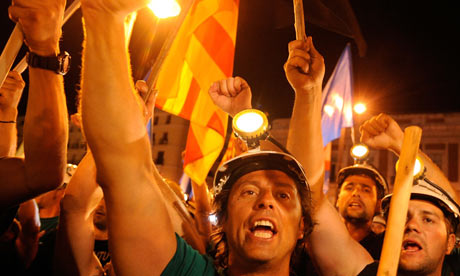 Spanish miners marched in Madrid on 11 July to protest at cuts removing subsidies from their industry. Photograph: Denis Doyle/Getty
Spanish Easter Fridays are famous for their collective display of painful religious emotions. But lately it is as if every Friday has become an Easter Friday in Spain: it's usually on Fridays that the government meets and announces new austerity measures. More than just policy announcements, these briefings resemble litanies: one Friday we learned that we had to partially pay for prescription drugs (which means paying twice, since we already fund them with our taxes); the next Friday we were told that in order to have free legal aid we had to pay for it (quite a contradiction in terms).Recently the pace of announcements has changed. Now they can come any day of the week. On Wednesday prime minister Mariano Rajoy took to the stage in parliament and unveiled a series of austerity measures which dwarf anything Spain has seen before. The list is long: carers of spinal patients and others who cannot fend for themselves will see their wages slashed; unemployment benefits will be cut by 50%. And this in a country in which there are 1.5m households in which everyone is out of work. Even job centre advisers have been fired in droves. The irony doesn't get any darker than that. Cuts in social services, cuts in salaries, cuts in holidays – you could call it death by a thousand cuts.What is really puzzling is how little attention is being paid to the fact that these measures aren't working. Politics has become such exercise in public relations and damage control, such an industry of euphemisms and mixed messages, that even when our leaders are clearly wrong they may not even know it. Have they not realised that since the start of the labour market reforms, unemployment has been going up, rather than down? Can't they see that cuts in ministerial budgets worth up to 30% are bringing the economy – typically dependent on public expenditure – to a halt? More to the point, if all this pain is inflicted in the name of deficit reduction, shouldn't the fact that the deficit has not been substantially reduced be considered a sign of failure?And yet Rajoy insists that, by showing us ready to sacrifice everything we have, we can win the hearts and minds of the markets (that's assuming they ever had the former and have not lost the latter). But in this case the markets could be right. They may not like high government deficits, but low growth rates are not their cup of tea either. And forecasts say Spain will not grow this year or next year. It doesn't matter whether we reduce our deficit; if we don't have growth, investors will only lend us money at unsustainable rates, which is what is happening.The truth is that Rajoy has fallen hostage to his own discourse. He has invested so much of his political capital in the idea that austerity cures all ills that it has now become impossible for him to change course. By trying to play teacher's pet to Brussels and Berlin he has also helped set the trap he is now in. That's the problem with over-emphasising that there's "only one way out": at the end you're left with that one way only. And it may not lead outside.Yet sitting confidently on top of an absolute majority in parliament, Rajoy seems tempted to confuse the exercise of power with the exercise of might. That would be a mistake, as demonstrated on Wednesday. That day, while the prime minister was repeating his tired demand for more sacrifices, striking miners marched through the streets of Madrid, cheered by thousands of people who wanted to show them solidarity – not because they support their specific demands but because at least they are defiant, and they've walked for 400 miles to Madrid to make their case. With their hard hats decorated with the names of their loved ones, theirs is a sacrifice more people understand than the sacrifices demanded by the government.and some of the photos and video from the day ....http://ccaa.elpais.com/ccaa/2012/07/11/madrid/1341991064_892508.html VIDEO: DE LA RUA / L. ALMODÓVAR / C. POP | PHOTO: PEREZ BERNARDO
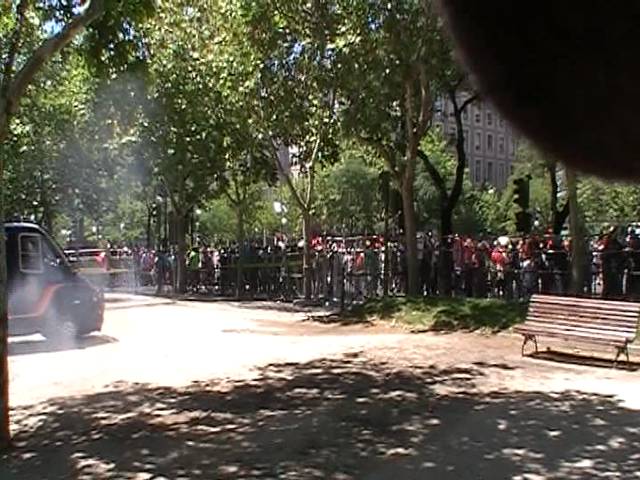 Recording of the protest spread by Interior.
"Balls of rubber against asphalt stones"
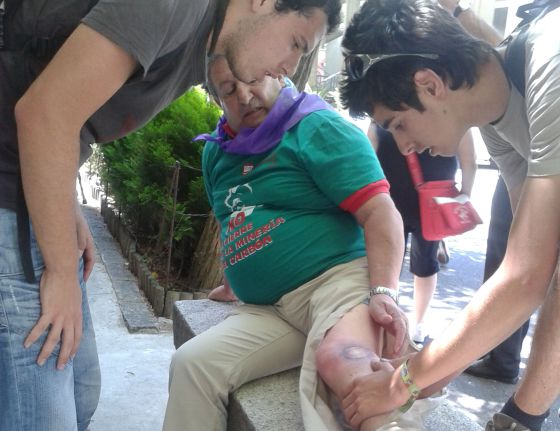 A retired miner Gijón shows his wounds. / MHAfter the shooting of the riot police at the first charge of the demonstration against industry, Alicia cried inconsolably on the shoulder of his father, who ran with her arms away from the tumult. This girl, aged seven, he accompanied his father, mining, demonstration and not taking off at any point in your group, from Leon."It has caught the load without that we done anything and I started running with the child."These two protesters were not the only ones who loads them caught off guard as they walked along La Castellana. A retiree of the mine, from Gijon, has not escaped the flash of a rubber ball in his fibula (pictured) and had to be moved by a couple of guys to the ambulance. Patricia, wife of a miner and neighboring Bierzo (Leon) has assisted the police charges on the esplanade at the Bernabeu, where were stationed a dozen protesters coaches."We were eating quietly when they began to appear several police vans. Then we started to shout and some have thrown a few bottles, which has given rise to the charge, "he explains. "The war has consisted of the following: rubber bullets against the few stones of the pavement. Imagine the result, "said Herman, a miner of Langreo.
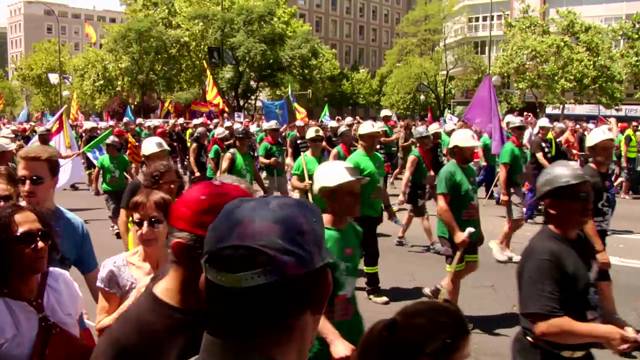 VIDEO: Á. THE RUA / L. ALMODÓVAR / C. POPhttp://www.telegraph.co.uk/finance/financialcrisis/9392230/Spains-day-of-pain-in-pictures.html



No comments:
Post a Comment