http://harveyorgan.blogspot.com/2012/07/rioting-on-streets-of-madrid-and.html
Here is the latest on the Greek funding situation. It seems that Europe will cover the upcoming 3.4 billion euro redemption and other international investors have bought 1 billion euros worth of bonds so they have so wiggle room until the first of August:
\
(courtesy dow Jones)
Greek cash reserves to last for at least a month: Dow Jones, citing comments from two government officials on Tuesday, reported that Greece has enough cash reserves to meet the government's operating needs until at least early August and possibly longer. Recall that there has been widespread speculation that Athens could run out of money as early as this month. The article attributed the breathing room to further spending restraint, a €1B cash injection from international creditors and most importantly, indications that the Eurozone would cover an upcoming €3.1B bond redemption. It added that the T-bill auction program and money that could be tapped from the country's bank recapitalization fund suggest that the government may have sufficient funds to cover its outlays until September, when it hopes to receive a €31B payout from its creditors.
Here is the latest on the Greek funding situation. It seems that Europe will cover the upcoming 3.4 billion euro redemption and other international investors have bought 1 billion euros worth of bonds so they have so wiggle room until the first of August:
\
(courtesy dow Jones)
Greek cash reserves to last for at least a month: Dow Jones, citing comments from two government officials on Tuesday, reported that Greece has enough cash reserves to meet the government's operating needs until at least early August and possibly longer. Recall that there has been widespread speculation that Athens could run out of money as early as this month. The article attributed the breathing room to further spending restraint, a €1B cash injection from international creditors and most importantly, indications that the Eurozone would cover an upcoming €3.1B bond redemption. It added that the T-bill auction program and money that could be tapped from the country's bank recapitalization fund suggest that the government may have sufficient funds to cover its outlays until September, when it hopes to receive a €31B payout from its creditors.
Coalition leaders agree to bring forward bailout renegotiation
  Fotis Kouvelis is seen leaving the Maximos Mansion following a meeting with coalition partners Antonis Samaras and Evangelos Venizelos. Fotis Kouvelis is seen leaving the Maximos Mansion following a meeting with coalition partners Antonis Samaras and Evangelos Venizelos. |
Sources told Kathimerini that there was agreement between Prime Minister Antonis Samaras, PASOK leader Evangelos Venizelos and Democratic Left chief Fotis Kouvelis. Rather than leave the issue of renegotiating the loan agreement, or memorandum, until September, the three leaders concurred that Greece had to adopt a more proactive stance. As a result, it is likely that Finance Minister Yannis Stournaras will be asked to bring up the issue at a Eurogroup meeting, which is due to take place towards the end of July.
However, the task of renegotiating the terms will not be left up just to Stournaras. Samaras, Venizelos and Kouvelis are likely to form the key negotiating team but officials at other levels will also be involved.
The meeting was called after PASOK leader Evangelos Venizelos appeared concerned that the government was giving the impression it was not making any effort to renegotiate the terms of Greece’s bailout, particularly after Finance Minister Yannis Stournaras’s appearance at the Eurogroup meeting in Brussels on Monday.
“It is very important that we convey to the Greek people that we will do all we can to improve the terms of the support program,” said Venizelos after the talks at Maximos Mansion.
“The starting point for the review is the extension of the fiscal adjustment period. We have to convince our partners that the recession is much deeper than the one forecast so we need to spread the fiscal adjustment over a longer period so it is easier on citizens and growth.”
| |
|
and....
Tsipras accuses coalition of surrendering to lenders over bailout terms
Speaking to state-run NET TV, Tsipras said that the government had failed to take advantage of the window of opportunity opened at the European Union leaders’ summit on June 28, when Italy and Spain refused to sign the growth pact unless there was agreement on bank recapitalization via the European Stability Mechanism. “We would have fought the battle at the summit, where the government was absent,” said Tsipras. “When Spain and Italy use their veto, it is inconceivable for Greece, which has been brought to its knees over the past 2.5 years, not to say a word.” Tsipras said that the pre-election positions of the three parties in the coalition had proved a myth and that they never carried through with their pledges to renegotiate. He accused the government of having a “clear lack of feeling for patriotic responsibility.” He added that at Monday’s Eurogroup meeting, Finance Minister Yannis Stournaras had simply said what his German counterpart, Wolfgang Schaeuble, wanted to hear: that Greece was “not asking for anything.” Tsipras insisted that Greece has to take on the Europeans over the terms of its bailout, even if this risks the eurozone’s collapse. “If the dilemma that is being put to the Greek side is collapse of its economy, society and ensuing social chaos or the collapse of the whole of Europe, we would choose the second,” he said. “This is not blackmail, it is the need for a country and people who have reached the end of their tether to survive.” Tsipras added that he opposed plans to privatize the Public Power Corporation but was in favor of ending special benefits for some public servants. He accused Prime Minister Antonis Samaras of being a hypocrite for attacking SYRIZA as a defender of unfair privileges in the civil service. Tsipras suggested that as culture minister in 2009, Samaras had provided jobs at the Acropolis Museum for people from his birthplace. “If we were to go to the museum and you checked the IDs of the employees, I bet you would not find anyone who is not from Messenia,” he said. “Those who created clientelistic state cannot now wag their finger at us.”
|


and..
http://www.zerohedge.com/news/night-european-opera
A Night At The European Opera

Submitted by Mark Grant, author of Out of the Box
A Night At The Opera
Some days it seems like an eternity. Other days it passes in the glimpse of a blinking eye. Most days it ekes out like a sore oozing infection and so the tragedy of Europe continues and lengthens and stretches as moments come and pass and as many await the defining moment where some kind of curtain descends and ends the Act or perhaps the play. This has been the way of it for the past two years but the muddling has become bumbling and the depth of the sorrow deepens and the possibility of escape is now all but impossible.
“One can't judge Wagner's opera Lohengrin after a first hearing, and I certainly don't intend to hear it a second time.”-Gioachino Rossini
The amount of capital being used and the ability of anyone to pay for what now must be paid or, if not, what cannot be paid is now like an anchor firmly strapped to the neck of the beast and the stumbling increases with the weight. Promises of a 120% debt to GDP ratio for Greece, grand visions of firewalls meant to protect the Continent and fervent and constant reassurances that this firewall would protect both Spain and Italy at a minimum now decry hopes and prayers that, in time, proved to be lies and deceptions. The debt to GDP ratios for Europe, never real but a manipulated formula for disaster are proving to be just that as contingent liabilities become present tense liabilities and as double and triple counted assets remain what they always were; pledges to fund that were never funded but now the promissory notes are coming due.
Promised pension cuts in Portugal were just declared unconstitutional and promised funding for the ESM may be declared unconstitutional by the German Constitutional court. Pleas for immediacy on an ESM decision were just rejected in Germany and it is likely ninety days before a ruling is declared. In the meantime the one Stabilization Fund in existence is a scant $65 billion from its outer limit and the refusal by Berlin to cough up more money resonates down the court hallways of Brussels. The echoes are becoming louder, hallower and the effects on the markets less pronounced. Believers are streaming from congregation and the remaining parishioners are quickly losing faith that the prophecies will come to pass. It is rather like a secular religion disappearing as the people once wooed by the words of the Evangelical Minister are not credible enough any longer to provide the hope for an entrance to Heaven or to deter them from turning towards Hell. Europe has entered Purgatory at the end of a long road to perdition and those willing to tithe to support the scheme are declining so that the offering plates passed around, once full, now only have enough to fill a small saucer and the church improvements can no longer be funded.
“Nor do I hear in my imagination the parts successively, I hear them all at once.”-Wolfgang Amadeus Mozart
It is the ring of the auction house; “Going, Going Gone” as the final bang of the auctioneer’s gavel is about to fall. It is the awful sound of the woosh of the guillotine manned by the Lord High Executioner that will fall upon ears and eyes wide open. It will be the final night of a failed play and the melodrama of the Operatic tragedy that will be documented in history books and perhaps recorded in some literary masterpiece that is yet to be written.
The economic conditions in Europe are deteriorating with an alarming speed and the affects, coming to the United States in this quarter, will be worse for the balance of the year. It is to be recession there, recession here and some measly cup of porridge for all. Those expecting Prime Rib for dinner are about to be disappointed as it will be gruel and the Petrus wine of last year will be Annie Greensprings poured from a plastic box.
“As to the play itself, I will only add that it is offensive in its morals, corrupt in its teaching, and revolting in its brutality, and yet everyone who admires acting is bound to see it.”-Cecile Howard writing about La Tosca
and not so surprising news from Greece....
Coalition heads to meet FinMin amid rift rumors [UPDATE]
PASOK chief Venizelos rebuffs reports of 'undermining' Stournaras
Officially the goal of the meeting is for Stournaras to brief the three leaders on Monday's Eurogroup summit of eurozone finance ministers and Tuesday's gathering of European Union finance ministers. But according to reports, rifts have appeared within the fragile coalition over the stance adopted by Stournaras in Brussels. Venizelos, a former finance minister himself, has reportedly criticized Stournaras for failing to broach the issue of Greece's demand to extend Greece's deadline for fiscal adjustment. Stournaras had said that this issue could not be broached until Greece has managed to get its economic reform program back on track. The minister, and the coalition leaders, were on Wednesday expected to discuss the implementation of some 3 billion euros in measures that Greece agreed to in March but which have yet to be enforced. It is thought that Venizelos may ask his coalition partners for the issue to be raised at the next Eurogroup meeting, scheduled for July 20. In a written statement issued by PASOK's offices on Wednesday, Venizelos rebuffed reports in Kathimerini and Skai accusing him of 'undermining' Stournaras, noting that PASOK's position -- and the common position of the coalition -- was to seek the renegotiation of certain terms of the country's debt deal with creditors, including the extension of its fiscal adjustment period. Those who interpret the fact that he sought a meeting with Stournaras and the other coalition leaders after the former's talks in Brussels as an attempt to 'undermine' the minister 'have no grasp of the political, economic and social reality in Greece nor about the formation of alliances in Europe at this time,' he said. and from athens news.....
| ||||||||||||||||||


and.....
http://www.zerohedge.com/news/bunga-back-berlusconi-run-2013
Bunga Is Back: Berlusconi To Run In 2013
Back in November 2011, when Silvio was forced out of his PM position with a combination of plunging Italian bonds and strong globalist pressure in an attempt to restore confidence in the Italian economy and administration, and was replaced with a Goldman-affiliated technocrat, we said that it is only a matter of time before Monti fails in his task of turning the Italian economy around, and revisionist power vacuum forces put Silvio right back in his throne. Sure enough, Corriere writes that the man whoe made the term Bunga Bunga legendary may run for premier next year. Specifically, the ex-prime minister may seek top job in a “ticket” together with his party’s current leader Angelino Alfano, quoting him as saying that this is "A choice that I didn’t want to make." Berlusconi’s PDL party could garner 30% of vote in next election if the ex-premier seeks top job, Corriere says, without elaborating. Of course, what guaranteed that he would run was his statement last year that he would not run in the next election, making this outcome a foregone conclusion. And the funny thing is that he just may win.
From Corriere:
He has spent the last few weeks to study the surveys, to analyze the scenarios for the vote in 2013, listening to the PDL leaders, entrepreneurs and international representatives. But ultimately the decision is made: be standing for re-election as premier.The role of noble father does not heat his constituents who ask a more direct engagement, the engagement she had ruled at the time of the investiture of Angelino Alfano as secretary of the PDL. The latest polls, arrived on his desk, some data have shown that, according to Knight, one can not ignore.Three scenarios submitted to respondents: a PDL without Berlusconi would not reach 10% of the votes and the nomination of the premiership Alfano, Berlusconi in the field as party chairman, would lead to a result around 18%. If, however, Berlusconi was still in the running for the presidency of the Council, in a ticket with Alfano and a team of young executives, the polls would arrive, according to surveys, including a 30%. A result that might not be enough to win the leadership of the country but would give the Knight and his party a decisive role in the next term, especially if you come to a coalition government called upon to continue the path of fiscal consolidation and exit from economic crisis.
The two summer months serve to prepare the new descent into the field ("a choice that I wanted to do but to which I have been pushing the polls, hundreds of letters and messages of the people of the moderates"). Berlusconi to give up vacation at Villa Certosa in Sardinia and will remain in Arcore just to get to September with all the papers ready: a new name to the party (which will recall the origins of Forza Italy), a team of forty to promote the new political adventure, consultations with international leaders with whom he maintained relations, the identification of candidates capable of winning votes in the territory.
Berlusconi is concerned for a PDL in the grip of "personalism," a nomenclature which is growing too interested in the defense of their share of power. You see more and more disillusioned moderate voters who take refuge in abstaining or even swell the ranks of grillismo.
Certainly will not be easy. There is first of all to preserve the relationship with Alfano, Berlusconi believes that the "very good" and why he wants to maintain a leading role. It is to dismantle the machinery of the primary would be meaningless if the founder of the party for re-election. Then weigh the processes are still open, especially on the Ruby case, even if the Knight is convinced, after the last hearings, that "things will go well."And finally there is to develop an economic program that "optimism returns to a country gripped by a crisis of confidence." A difficult game, inside and outside the party, on the edge of the impossible almost twenty years after first taking the field
and.....
http://www.zerohedge.com/contributed/2012-07-10/german-constitutional-court-against-euro-hysteria
The German Constitutional Court Rules Against Euro Hysteria

Wolf Richter www.testosteronepit.com
Chancellor Angela Merkel did the right thing. She left Germany. And Germany is in turmoil. The bailout policies she and her government had pushed through and that parliament had passed just after the EU summit ran into discord, accusations, and threats. Everybody was applying pressure. And the Federal Constitutional Court would have to decide. On Tuesday, it began its hearings on the permanent European Stability Mechanism (ESM) and on the fiscal union pact. A high-urgency, top-priority, super-rush hearing, restricted to oral arguments to speed things along. Very unusual for the Court. A sign it was taking the time pressures seriously.
Plaintiffs had swarmed the Court from all sides: the Left, conservative Peter Gauweiler (CSU), former Minister of Justice Herta Däubler-Gmelin (SPD) with the association More Democracy, representing now over 23,000 citizens, and the Association of Tax Payers. They claimed that the Bundestag, in passing the laws, had transferred critical parliamentary rights—controlling the national budget—to other organizations, thereby curtailing the rights of voters to participate democratically in budget decisions. [Read.... The “European Monster State"].
Andreas Voßkuhle, President of the Constitutional Court, opened the session with a stunner: time. It would be impossible to examine all the issues and rule on the constitutionality of the laws in the time expected due to their complexity. Instead, the Court would decide by the end of July whether or not to grant an injunction that would prevent President Joachim Gauck from signing the laws. Then it would take another three months to rule on the constitutionality of the laws.
Yet the ESM was supposed to be operational by July 1. It had been ballyhooed as theinsurmountable firewall that would keep contagion at bay. It was supposed to save the Eurozone, and by extension, the economy of the world.
So Merkel did the right thing: instead of pressuring the eight justices in Karlsruhe by showing up and threatening the end of the world if they dared to stop the ESM and the fiscal union pact, she flew to Indonesia—which wants to buy 100 used Leopard tanks from Germany. A trade that made some people nervous. But at the press conference following the meeting between Merkel and President Susilo Bambang Yudhoyono, heclarified: “We will never use tanks and helicopters against our people.” It had a calming effect and confirmed that a deal was being made. Business is business. And Merkel met IMF Managing Director Christine Lagarde at the hotel. A surprise meeting: “She asked me if we should meet for a beer,” Lagarde explained later. So there they were, the two bailout women, relaxing over a beer or two.
Outside the court room, it was a veritable slugfest. Bundestag President Norbert Lammert (CDU) warned of “hefty consequences” not only for Germany but also for the entire European system of treaties, if the court stopped or delayed the ESM. “It would be politically and economically fatal,” said Helmut Brandt, CDU delegate. “Every judge knows what this is about,” said Christian Ahrendt (FDP). President Gauck had a change of heart and was “happy” that the court was looking at the laws; instead of supporting Merkel, he showed a preference for the plaintiffs’ position. And European parliament delegate Alexander Graf Lambsdorff (FDP)complained that the justices were not always “sufficiently familiar” with all the processes in Europe and occasionally arrived at “erroneous judgments.”
Then there were those who lashed out against those who’d lashed out against the Court: “The Law in Europe has been continually stepped on during the euro crisis,” warned Frank Schäffler (FDP). “That doesn’t have to be repeated in Germany in that the Constitutional Court is maligned.” CSU legal expert Thomas Silberhorn toldBild, “The highest German court doesn’t need anyone’s political advice but everyone’s respect for its independence and dignity.” Horst Seehofer, head of the CSU and Minister-President of Bavaria, resentedwhat was said over the last few days in public; it was “unappetizing,” he said, “certain that the justices would correctly evaluate things.”
Inside the court room, experts had five minutes each to present their case orally. Finance Minster Wolfgang Schäuble warnedthat stopping the ESM could lead to “considerable economic upheaval with unpredictable consequences for Germany,” similar to the crisis of 2009. Doubts on Germany’s ability or willingness to preserve the stability of the Eurozone could aggravate “crisis symptoms” and could lead to “more forceful speculation” that some nations would exit the Eurozone. And it “could lead to significant insecurity in the markets.”
He tried to push the court into making a quick decision not only on the injunction but also on the constitutionality of the laws. But Voßkuhle slapped down his efforts. The court was familiar with the misinterpretation by the foreign media if the injunction were granted, he said. “We’re all seeing the headline: Euro Bailout Stopped by Germany.’” And just before lunch, he toldthe government: “Please think if the ESM might become like a systemically important bank to be fed with ever more money to save the Eurozone.”
Bundesbank President Jens Weidmann spenthis five minutes in the afternoon dialing down the drama. Estimating the consequences of stopping the ESM was “highly speculative,” he said, and part of the delay of the ESM was “already priced in” by the financial markets. Further, the EFSF would suffice for the immediate needs of Spain and Cyprus, he said.
On the other hand, the ESM wasn’t a panacea anyway, he said, and a “quick ratification wouldn’t guarantee that the crisis didn’t get worse.” State guarantees were only credible if markets believed that payment obligations would be fulfilled. And the fiscal union pact was “not sufficient” to guarantee that there would be a “solid foundation for the monetary union.”
So calm down, everyone, he seemed to say. Even if the Court ruled for the laws in no time, it wouldn’t solve the Eurozone debt crisis. And if it ruled against the laws, it wouldn’t be such a big deal.
After eight hours of discussions, it was clear: the court wasn’t eager to decide. The decision might be condemned by politicians and entail crashes cascading around the world. Even a mere injunction could be interpreted as a decision to scuttle the European bailout policies. Hence, the court’s play for time: it would allow euro hysteria to settle down, and markets could get comfortable with all possible outcomes. So the court’s first decision—more time—was its first major response in an era of euro chaos, hectic summits, frantic bailouts, failed mechanisms, and hasty treaties.
Germany and France exist in two different universes, apparently: France, safely ensconced in a Eurozone without bailouts and with nary a debt crisis on the horizon, debates its social model. Germany sees a Eurozone ravaged by a debt crisis with mind-boggling bailout costs and risks that stir up a furor on all sides, and everything is getting questioned, even the euro itself. Read.... France, Germany, And "The Reintroduction of the D-Mark."
And to sprinkle some humor into that dogged Eurozone drama, here is “Merkel at Wimbledon 2012,” a funny video by down-under comedians Clarke & Dawe.
and....
http://www.nakedcapitalism.com/2012/07/eurozone-screws-spains-citizens.html
WEDNESDAY, JULY 11, 2012
Eurozone Screws Spain’s Citizens
Yves here. Delusional Economics discussed earlier how hapless Spanish depositors, who’d been sold bank equity products as deposit equivalents, were at risk of being crammed down en masse. That move appears to be proceeding as planned. NC readers confirmed his earlier take, that this abuse of unsophisticated savers was likely to have serious social and political repercussions.
By Delusional Economics, who is horrified at the state of economic commentary in Australia and is determined to cleanse the daily flow of vested interests propaganda to produce a balanced counterpoint. Cross posted from MacroBusiness.
A draft Memorandum of understanding for the Spanish bank bailout became available overnight (available below). Much of the document makes sense in terms of assessing, monitoring and implementing corrective action on the banks. Specifically there is mention of using Special Purpose Vehicles to remove non-performing assets from banks balance sheets:
Segregation of impaired assets: Asset Management Company21. Problematic assets of aided banks should be quickly removed from the banks’ balance sheets. This applies, in particular, for loans related to Real EstateDevelopment (RED) and foreclosed assets. In principle, it will also apply to other assets if and when there are signs of strong deterioration in their quality. The principle underpinning the separation of impaired assets is that they will be transferred to an external AMC. Transfers will take place at the real (long-term) economic value (REV) of the assets. The REV will be established on the basis of a thorough asset quality review process, drawing on the individual valuations used in the Stress Test. The respective losses must be crystallized in the banks at the moment of the separation. The Spanish authorities, in consultation with the European Commission, the ECB and the IMF, will prepare a comprehensive blueprint and legislative framework for the establishment and functioning of this asset separation scheme by end-August 2012. The Spanish authorities will adopt the necessary legislation in the autumn with a view to assuring that the AMC will be fully operational by November 2012.

There are, however, some very important sections of the document which need highlighting.
Back in April I wrote a post in which I mentioned that Spanish banks were getting “creative” in order to maintain their capital ratios against the backdrop of the failing Spanish economy. One things that stuck out was this:
The key in a banking crisis is to keep the confidence of depositors. But while many countries relied on capital injections and government guarantees, Spanish banks have added a unique twist of effectively turning some depositors into equity holders. That puts customers on the front line.Some banks started by persuading depositors to switch from low, interest-bearing accounts into preference shares, which paid a fixed, higher interest rate. The benefit for the banks was that these securities counted as core capital under banking rules. UBS says Spanish banks issued €32 billion ($42.7 billion) of such instruments from 2007 to 2010.But as the crisis deepened, these instruments became illiquid, trading at deep discounts. At the same time, they ceased to count as core capital under new rules known as Basel III. So banks have encouraged investors to convert preference shares into either common stock or mandatory convertible notes, which pay a high initial yield before later converting into stock.
And here is what I said about it:
Liability to asset conversion. Very clever, and fair enough unless you are an existing shareholder. I just hope those depositors understand the risks of what they have just done.
As it turns out these depositors had no idea what they were in for. From today’s MoU:
The restructuring plans of viable banks requiring public support will detail the actions to minimise the cost on taxpayers. Banks receiving State aid will contribute to the cost of restructuring as much as possible with their own resources. Actions include the sale of participations and non-core assets, run off of non-core activities, bans on dividend payments, bans on the discretionary remuneration of hybrid capital instruments and bans on non-organic growth. Banks and their shareholders will take losses before State aid measures are granted and ensure loss absorption of equity and hybrid capital instruments to the full extent possible.
So it would appear that under the guidelines of the MoU many Spanish citizens are about to take a huge bath. But that may not be the only issue for them. Lower down in the document is this:
VI. Public finances, macroeconomic imbalances and financial sector reform29. There is a close relationship between macroeconomic imbalances, public finances and financial sector soundness. Hence, progress made with respect to the implementation of the commitments under the Excessive Deficit Procedure, and with regard to structural reforms, with a view to correcting any macroeconomic imbalances as identified within the framework of the European semester, will be regularly and closely monitored in parallel with the formal review process as envisioned in this MoU.
30. According to the revised EDP recommendation,Spain is committed to correct the present excessive deficit situation by 2014. In particular, Spain should ensure the attainment of intermediate headline deficit targets of [x]% of GDP for 2012, [x]% of GDP for 2013 and [x]% of GDP for 2014. Spanish authorities should present by end-July a multi-annual budgetary plan for 2013-14, which fully specifies the structural measures that are necessary to achieve the correction of the excessive deficit. Provisions of the Budgetary Stability Law regarding transparency and control of budget execution should be fully implemented. Spain is also requested to establish an independent fiscal institution to provide analysis, advice and monitor fiscal policy.
31. Regarding structural reforms, the Spanish authorities are committed to implement the country-specific recommendations in the context of the European Semester. These reforms aim at correcting macroeconomic imbalances, as identified in the in-depth review under the Macroeconomic Imbalance Procedure (MIP). In particular, these recommendations invite Spain to:
1) introduce a taxation system consistent with the fiscal consolidation efforts and more supportive to growth,
2) ensure less tax-induced bias towards indebtedness and home- ownership,3) implement the labour market reforms,4) take additional measures to increase the effectiveness of active labour market policies,5) take additional measures to open up professional services, reduce delays in obtaining business licences, and eliminate barriers to doing business,6) complete the electricity and gas interconnections with neighbouring countries, and address the electricity tariff deficit in a comprehensive way.VII. Programme Modalities32. Spain would require an EFSF loan, covering estimated capital requirements with an additional safety margin, estimated as summing up to EUR 100 billion in total. The programme duration is 18 months. FROB, acting as agent of the Spanish government, will channel the funds to the financial institutions concerned. Modalities of the programme will be determined in the FFA. The funds will be disbursed in several tranches ahead of the planned recapitalisation dates, pursuant to the roadmap included in Section IV. These disbursements can be made either in cash or in the form of standard EFSF notes.
VIII. Programme monitoring33. The European Commission, in liaison with the ECB and EBA, will verify at regular intervals that the policy conditions attached to the financial assistance are fulfilled, through missions and regular reporting by the Spanish authorities, on a quarterly basis. Monitoring of the FROB activities in the context of the programme will take place regularly. The Spanish authorities will request technical assistance from the IMF to support the implementation and monitoring of the financial assistance with regular reporting.So as far as I can tell this MoU is very much a framework for a standard European bailout package. The funding is through a sovereign entity, the FROB. Also, as the Guardian reports, the funding is contingent on Spain implementing its existing fiscal obligations under European treaties including additional recommended action. In addition there appears to be a Troika of sorts, including the ECB and the IMF.The EU summit statement stipulated that it was “imperative to break the vicious circle between banks and sovereigns” but I can see little in this particular document to suggest that this is happening. As we know there has been a vague promise of transferring liability over to the ESM which would supposedly disconnect the Spanish sovereign from the funding pipeline but this is dependent on an agreement and implementation of an ECB controlled banking supervisor. In fact at this stage it isn’t even certain the ESM will come about because it is yet to be ratified by national governments and the German Constitutional Court is yet to pass judgement.That being the case, this MoU looks like a terrible outcome for the Spanish public. Not only are many billions of Euros of their assets about to be bailed into banks, but it appears that they will still be holding the can after the fact.
http://www.guardian.co.uk/business/2012/jul/11/eurozone-crisis-spain-austerity-bailout
The European commission has welcomed Spain's austerity measures, calling them an "important step".
I presume they mean forwards – although Megan Roubini, for one, fears it could go the other way (see 10.24am).
The EC also said it was "working on the principle that private sector distribution" of the losses in Spain's banks will be needed, but that depositors and senior bondholders will not be involved.
So, as feared last night, this means that tens of thousands of citizens who hold preferred shares and subordinated bonds will be hit - and perhaps wiped out.
There's a good explainer about this issue here on FT Alphaville this morning (as usual!). It flags up the argument that while governments have a duty to protect depositors, that does not – and should not – include investors. A fair point, except that many small investors believe they were missold the products.All this is unlikely to go down well in the markets. In the eight years that Italy was governed by the chirpy billionaire, its economy barely grew at all. And his reluctance to introduce structural reform was the chief reason why he was ousted from power last November.
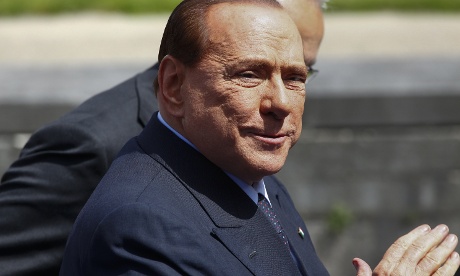 Silvio Berlusconi, last week.
I wrote yesterday that Mario Monti's departure was seen as a political risk, as his appointment as technocratic PM last November had helped to calm the crisis.
Duncan Weldon, the TUC's senior policy officer, called me up on this - pointing out that political risk could be just another name for 'democracy'. It's a fair point - for all his (alleged) sins, Berlusconi was elected.
Duncan's also an economist, and fears that Spain's latest austerity plan is a "crazy" idea during such a steep recession:

Updated at 11:34 BST
Here are some photos from Madrid, as the protests by Spanish miners gets underway (see 10.43am for more details)
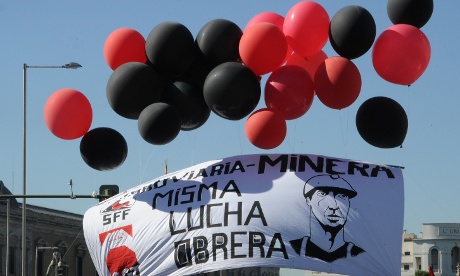
Spanish coal miners hold ballons and a banner reading "Miner's struggle = worker's struggle" during a demonstration today.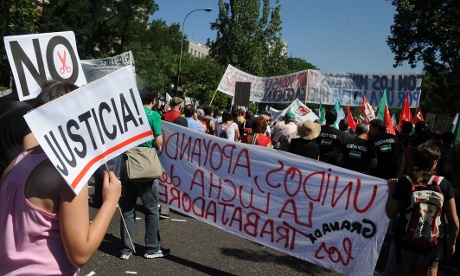 Spanish coal miners demonstrate in Madrid, on July 11, 2012.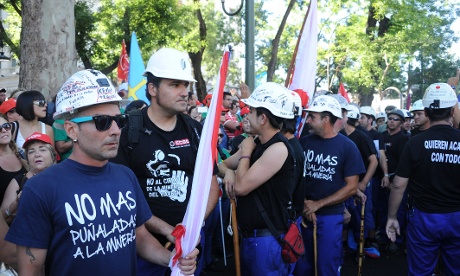
Spanish coal miners demonstrate in Madrid, on July 11, 2012.
Spanish coal miners gatherering.
Updated at 11:16 BST
Spain's miners are taking their protests against the government to the heart of Madrid today.
More than 8,000 have been on strike since the end of May, and many have walked from their homes to the Spanish capital. Unions are hoping to get a turnout of at least 25,000 when they demonstrate outside government buildings later.
This video, based on exclusive interviews with some of the men, explains that they fear their livelihoods are at risk.
The miners have become a symbol of public anger against Spain's austerity plans. The government, though, insists is must cut back on the subsidies it gives to the mining industry.
Updated at 11:05 BST
Experts are warning that Mariano Rajoy's new austerity package will drive the Spanish economy deeper into recession, but some argue he has little choice while Spain needs international help.
Megan Greene of Roubini Global Economics said Spain will be pulled into an "austerity/recessionary' spiral:


Updated at 11:46 BST
Meanwhile, there are reports from Italy that Silvio Berlusconi has decided to make a bid to become prime minister again, when Mario Monti steps aside next year.
Good news for the media, but for Italy?....
John Hooper reports from Rome:
Corriere della Sera is carrying a story this morning that Silvio Berlusconi has made up his to run again for prime minister in the Italian general election that has to be held by next spring. Polls he has commissioned reportedly show his party could not get more than 18 per cent of the vote without him, but that its share of the poll would soar to 30 per cent if he did stand.
The TV mogul was said to have cancelled his holidays to prepare for the re-launch of his party in the autumn. And, Corriere said, he was planning to present a 'shadow cabinet' composed entirely of people under 50.
That might make it more appealing to younger voters. It might also distract attention from the fact that Berlusconi will be 81 years old when the next legislature comes to an end.
The report was published on the day after the media tycoon's successor, Mario Monti, said equally definitely he would not run. Thirty per cent of the vote might not get Berlusconi's party a majority of seats, but, if not, it would certainly hold the balance in the next parliament.
Updated at 10:05 BST
Here's more details, and reaction, from Giles Tremlett in Madrid:
Mariano Rajoy's announcement this morning of €65bn euros of cuts and tax hikes over the next two and a half years may prove a key moment in his career as prime minister – with a similar barrage of measures two years ago marking the beginning of the end for his socialist predecessor, José Luis Rodríguez Zapatero.Rajoy has reminded parliament that he came to power eight months ago promising tax cuts and that he has now delivered hikes (having also raised income tax and business tax earlier this year)."I am applying exceptional measures to exceptional circumstances," he said, pointing to the unsustainable 7% interest rates being demanded by the markets. He also warned several times in his speech that an end to Spain's problems would not come quickly – in other words Spain is in for a long period of economic difficulties (something the 24% of unemployed already know) as it struggles to find exit recession and save its banks.
Rajoy has just announced a major U-turn on sales tax, which will rise by three percentage points.
From Madrid, our correspondent Giles Tremlett reports:
Spanish prime minister Mariano Rajoy has just announced a three point hike in sales tax, from 18% to 21%.
Speaking in parliament, he says this policy U-turn will help Spain meet its obligations to Europe and bring down the deficit.
The measures have provoked angry reactions from opposition politicians in the Spanish parliament, who recall his energetic opposition to VAT hikes in the past.
Ministers have previously claimed that a VAT hike would damage consumer spending and send the economy even further into recession.
Rajoy's announcement - the key points
Here's a round-up of the main measures announced by Mariano Rajoy this morning, as the price of the bailout of Spain's banking sector.
• Reform of public administration, cutting €3.5bn
• A "drastic reduction" in the number of local public companies, and a reduction in the number at national level
• "Corrective mechanisms" for retional spending, and a new liquidity mechanism to help fund Spain's regions
• Civil servants benefits will be cut, and senior workers will lose the Christmas bonus. Further cuts at ministries are planned.
• Funding for unions and political parties will fall by 20%
• A review of unemployment benefits
• VAT will rise to 21%, from 18%. Property tax breaks will be eliminated, and 'indirect taxes' on energy will be raised
• Income tax will be cut
• State assets including airports and railways will be sold off


No comments:
Post a Comment