http://www.telegraph.co.uk/finance/newsbysector/banksandfinance/9436539/HSBC-to-set-aside-600m-to-cover-mis-selling-and-money-laundering-scandals.html
( possible 1 billion in provisions and this does not include inevitable Libor Gate hits ... )

6:57PM BST 29 Jul 2012
 2 Comments
On Monday, the bank is set to make a new provision for payment protection insurance mis-selling of as much as £300m, as well as putting aside about £200m to compensate small business customers mis-sold complex interest rate derivatives.
In addition to the mis-selling claims, HSBC is also likely to make an initial $200m (£127m) provision against costs related to failings in its US business in relation to money laundering that follows a damning Congressional report earlier this month. It is expected to be the first financial hit the bank could take over the money-laundering scandal amid speculation that it could be forced to pay out as much as $1bn.
Stuart Gulliver, chief executive of HSBC, also apologised to shareholders for the bank’s conduct over the money laundering, which has already led to the resignation of its chief compliance officer, David Bagley. In a memo released to coincide with the US hearings earlier this month, Mr Gulliver admitted to staff that the bank had failed to spot what he described as “unacceptable behaviour”.
The Senate inquiry found that HSBC accepted more than $15bn in cash between 2006 and 2009, much of it thought to be connected to drug gangs and terrorists, from Mexico, Russia and other countries. The bank had allowed funds to be shifted to and from its branches in North America without properly monitoring transactions.
HSBC is also likely to face questions over the potential impact of Libor-related claims. While the bank is not being investigated over the claims of Libor rigging, which has seen Barclays fined £290m, it could still face separate legal claims from investors who claim they have been left out of pocket as a result of the alleged manipulation of the world’s key borrowing rate.
The provisions will dent HSBC’s reputation but have less effect on the bank’s first-half financial performance, which will be disclosed on Monday. Consensus estimates indicate the bank is in line to make a pre-tax profit of £12.6bn, up from £10.4bn in the first six months of last year.
HSBC has previously put aside £745m to pay PPI compensation claims. However, confirmation that it has made a £200m provision for interest rate swap mis-selling would be a first indication from the bank of its view on the potential costs of this latest scandal.
Last week, Barclays made a £450m provision for swap mis-selling. Barclays and HSBC, along with nine other banks, including Lloyds and Royal Bank of Scotland, last month agreed with the Financial Services Authority to compensate SME customers mis-sold swaps.
The FSA scheme followed a review by the regulator of the controversial products that was prompted by an investigation by The Telegraph that uncovered evidence of potential mis-selling.
RBS will announce its first half results on Friday and is currently not expected to make a provision for swap mis-selling. However, if HSBC makes an estimate of the cost, it will put pressure on the taxpayer-backed lender to give investors guidance on the issue.
* * *
http://www.guardian.co.uk/business/2012/jul/29/rbs-libor-scandal-stephen-hester?CMP=twt_fd
RBS faces huge fine over Libor scandal, says Stephen Hester
Chief executive of RBS speaks out on rate-rigging scandal and technology meltdown
 Email
Email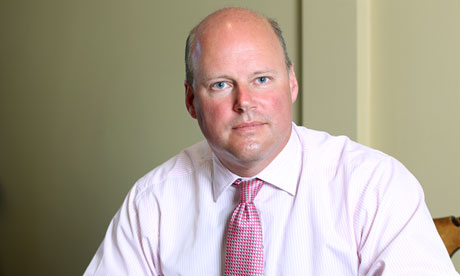
RBS chief Stephen Hester says Libor will put the bank under the spotlight again. Photograph: Graeme Robertson
The boss of the Royal Bank of Scotland is warning the bank faces a further hit to its reputation – and a huge fine – from the Libor scandal, which has engulfed Barclays and caused a fresh wave of anger against bankers.
While the £290m fine slapped on Barclays has helped to distract from the computer meltdown at RBS, which prevented up to 13m customers accessing their accounts for up to a month, Stephen Hester, RBS's chief executive, said the rate-rigging scandal was bad for the entire industry.
"RBS is one of the banks tied up in Libor. We'll have our day in that particular spotlight as well," Hester said in an interview with the Guardian. He did not know the size of the RBS fine but said that the investigation by the Financial Services Authority was "in process".
Hester is preparing to represent first-half figures – showing another loss – on Friday, when the bank's exposure to interest rate swap mis-selling will also be a focus. RBS is said to have paid £25m to just one businessman who was mis-sold products intended to protect against interest rate rises.
On Sunday, HSBC will publish profits for the first half of the year, ahead of a yet be disclosed multimillion-pound penalty for money laundering and other offences through its US arm.
Hester said: "Even though when all the Libor [fines] are out most of it is going to be around the wrongdoings of a handful of people at a number of banks. Those wrongdoings taint a whole industry beyond the handful of people and that makes it a huge problem."
The chief executive has already waived his bonus for 2012 following the furore surrounding the £1m he was to be handed for 2011 before the political outcry forced him to hand it back. The reaction to the bonus in January "caught everyone on the hop", he said.
"Let's set aside if it was fair or not, in this case I thought we ... had fallen down on the job."
He declined to express any sympathy for Bob Diamond, the boss of Barclays who was forced out by regulators in the wake of the Libor scandal. "Everyone has to live with the prospect of professional mortality. Chief executive jobs bring with them job insecurity ... I've always accepted that part of it is that I will not exit in a way and timing of my choice."
Hester admitted the bailed-out bank might have been able to avoid its computer crisis if more had been spent on upgrading existing systems rather than on developing new systems.
He wants the bank to focus on "putting customers first", which is hard to accept perhaps for those at RBS, NatWest and Ulster caught up in the computer meltdown, some of whom incurred problems again last week.
"An element of banks became detached from society around it, an element was for traders making money for themselves or the banks, and customers [were] the means of making money. We have to be sure that banks do it the other way around."
He added: "RBS has seen a big mushrooming in spending on technology. With hindsight maybe a bit more of that increase in spend should have been in the core taken-for-granted systems that work every day. Some of our focus was on the new things people want," Hester said.
He is reluctant to pre-judge an ongoing investigation, but stresses that any warnings about impending computer disaster had not reached board level.
Hester has 18 months left to go of his "clean up" operation of a bank that made record £24bn losses in 2008, after which many banking sources believe he will leave RBS.
The clean up will move a step closer to completion later this year when he expects the bank to exit the asset protection scheme, set up to insure some £300bn of the bank's most toxic assets.
But, even then, any attempts to sell off some 90bn shares will take time. "The process of the taxpayer getting its money is going to be longer and slower than we hoped in the past because the economy is recovering slower and the regulatory picture has changed. But I believe it will happen ... even if it is a lot more slower than we thought."
Despite all the talk earlier in the year that Qatar was being lined up to step in to invest in RBS, Hester said the bank was inextricably linked to the economy, which will need to grow before the shares start to rise.
Taxpayers are currently losing more than half the £45bn invested in the shares during the bailout although Hester has indicated that the first sale of the shares could take place at a loss.
and......
http://www.businessinsider.com/libor-barclays-ubs-rbs-2012-7?utm_source=pulsenews&utm_medium=referral&utm_campaign=Feed:+businessinsider+(Business+Insider)
(Reuters) - New details from court documents and sources close to the Libor scandal investigation suggest that groups of traders working at three major European banks were heavily involved in rigging global benchmark interest rates.
Some of those traders, including one who used to work at Barclays Plc in New York, still have senior positions on Wall Street trading desks.
Until now, most of the attention has involved traders at Barclays, which last month reached a $453 million settlement with U.S. and UK authorities for its role in the manipulation of rates. Now, it is becoming clear that traders from at least two other banks - UK-based Royal Bank of Scotland Group Plc and Switzerland's UBS AG - played a central role.
Between them, the three banks employed more than a dozen traders who sought to influence rates in either dollar, euro or yen rates. Some of the traders who are being probed have worked for several banks under scrutiny, raising the possibility that the rate fixing became more ingrained as traders changed jobs.
The documents reviewed by Reuters in analyzing the traders' involvement included court filings by Canadian regulators who have been investigating potential antitrust issues; settlement documents with Barclays filed by the U.S. Department of Justice and the U.S. Commodity Futures Trading Commission in Washington and by the Financial Services Authority in the U.K.; and a private employment lawsuit filed by a former RBS trader in Singapore's High Court.
The scandal, which began to come to light in 2008, has become a time bomb for regulators and a big focus for politicians on both sides of the Atlantic. At issue is the manipulation between at least 2005 and 2009 of rates that are used to determine the cost of trillions of dollars of borrowings, including everything from home loans to credit card rates.
One former Barclays employee under scrutiny, Reuters has learned, is Jay V. Merchant, according to people familiar with the situation. Merchant, who oversaw the U.S. dollar swaps trading desk at Barclays in New York, worked for the bank from March 2006 to October 2009, according to employment records maintained by the U.S. Financial Industry Regulatory Authority (FINRA).
Merchant currently holds a similar position at UBS, where he works out of the Swiss bank's offices in Stamford, Connecticut, according to FINRA. He did not return requests for comment.
People familiar with the investigation said authorities are looking at whether some individuals on Merchant's trading desk tried to influence the rate on Libor by communicating with other traders in London to get a higher return on certain swaps the desk was trading. His specific role is unclear.
The Department of Justice declined to comment.
Merchant's attorney, John Kenney of Hoguet Newman Regal & Kenney, did not respond to requests seeking comment.
A UBS spokeswoman said that the bank has "no reason to believe Mr. Merchant has engaged in any improper conduct at UBS." The spokeswoman, who noted that Merchant is on a two-week vacation, declined to comment on the broader investigation.
Barclays declined to comment. In a statement, an RBS spokeswoman said the bank is cooperating with the investigation.
SPREAD FROM BARCLAYS
Earlier this week, Reuters reported that federal prosecutors in Washington have begun reaching out to lawyers for some of the individuals under scrutiny as they get closer to bringing possible criminal charges.
The dollar and euro rate-rigging appears to have begun in earnest in early 2005 in the dollar market, according to the documents reviewed by Reuters. By August of that year, Barclays traders were reaching out to traders at other big global banks to manipulate their rates to make them favorable to Barclays' trading positions.
Soon, the trading had crossed to the euro rate markets, according to the settlement documents filed in the Barclays investigation. And by 2007, traders at RBS and UBS were seeking to influence the yen rate market, according to documents filed in 2011 in Singapore's High Court and in Canada's Ontario Superior Court.
Traders at Barclays are believed to have participated in manipulating the rate for the dollar and the rate for the euro known as Euribor, according to documents filed in the Barclays settlement last month.
RBS and UBS traders are a focus of the global investigation because of their alleged involvement in seeking to influence yen-denominated rates.
Two RBS traders in London, Brent Davies and Will Hall, are alleged to have agreed to help a trader at UBS, Thomas Hayes, to manipulate yen Libor, according to court documents filed by the Canadian Competition Bureau.
UBS is cooperating with Canadian and U.S. authorities, according to people familiar with the situation.
Hayes worked at UBS from 2006 to 2009. He later moved to Citigroup where he remained until 2010, after which he left the bank. Hayes, Davies and Hall could not be reached for comment.
The documents reveal that Hayes also contacted traders at other banks in London to get them to manipulate yen rates. They include Peter O'Leary at HSBC Holdings Plc, Guillaume Adolph at Deutsche, and Paul Glands at JPMorgan. A second UBS employee sought to get a Citigroup trader, who formerly had worked at UBS, to influence rates.
None of these traders could be reached for comment.
CONDONED
In addition, a former trader at RBS, Tan Chi Min, said in a wrongful termination lawsuit filed in the Singapore High Court in 2011 that he was forced out for "improperly seeking to influence" the setting of Libor. Tan, who ran a trading desk at RBS, said in the suit that improper rate-rigging was known by some at the bank and condoned.
Tan denied trying to manipulate Libor, and alleged in the 2011 court filing, and one in March this year, that about a half dozen other RBS traders openly tried to request specific rates.
Tan's attorney, N. Sreenivasan, declined to comment because the court case is ongoing.
Beyond traders at the three European banks, authorities are still probing the role of others.
For example, traders at JPMorgan Chase & Co also interacted with some of the traders under scrutiny who worked for Barclays and RBS, according to a person familiar with the situation and court documents filed in Singapore.
Similarly, Deutsche Bank AG also had several employees whose trading is under scrutiny by authorities, according to people familiar with the situation and court documents filed in Canada.
and........
http://www.huffingtonpost.com/mark-gongloff/libor-fraud-timothy-geithner_b_1710225.html
Tim Geithner claims he learned of Libor manipulation when the rest of us commoners did, in 2008. New evidence keeps coming out suggesting he should have known much, much earlier.
The latest example -- which puts the earliest time-stamp on Libor manipulation we've seen yet -- is a Financial Times op-ed by former Morgan Stanley trader Douglas Keenan. He claims that Libor, a key short-term bank lending rate that affects mortgages and other interest rates throughout the economy, was being jerked around for fun and profit as long ago as 1991.
Let that sink in for just a minute: Libor was being manipulated 17 years before the financial crisis and Geithner's babe-in-the-woods discovery of it, according to Keenan. Geithner wasn't in charge of the New York Fed at the time, but if this was widespread knowledge years before his arrival, it makes you wonder how he could not have heard about it for so long.
Now here's another Keenan allegation that will blow your mind. He notes that the guy running Morgan Stanley's rate-trading desk back then was none other than Bob Diamond. Yes, the same Bob Diamond that ended up becoming Barclays CEO, only to step down because his bank manipulated Libor like most people change socks.
Keenan doesn't say he has any evidence that Diamond was some sort of Libor-manipulatin' Ninja back in 1991. But Keenan does say that it was widespread knowledge even then that banks lied habitually about Libor.
He found this out when, in his early days on the trading desk, he noticed that Libor fixings -- set by a panel of banks, who declare, on a hilarious honor system, what their borrowing costs are -- were noticeably different from what financial markets predicted they should be:
Futures contracts on three-month Libor were -- and are -- traded on the London International Financial Futures Exchange (Liffe, now part of NYSE Euronext). There was a standard contract for the month of September. That contract had its rate settled on the third Wednesday of the month, at 11 o'clock.
In 1991, I had live trading screens that showed the Libor rates. In September of that year, on the third Wednesday, at 11 o'clock, I watched those screens to see where the futures contract should settle. Shortly afterwards, Liffe announced the contract settlement rate. Its rate was different from what had been shown on my screens, by a few hundredths of a per cent.
That few hundredths of a percentage point doesn't sound like a very big deal, but it adds up, day after day after day, on hundreds of trillions of dollars' worth of loans and derivatives contracts. Keenan says it was costing him money on his trades, and he complained to Liffe about it, getting nowhere.
Then he complained about it to his new buddies on the trading desk, who all laughed and laughed at him (emphasis mine):
I talked with some of my more experienced colleagues about this. They told me banks misreported the Libor rates in a way that would generally bring them profits. I had been unaware of that, as I was relatively new to financial trading. My naivety seemed to be humorous to my colleagues.
Imagine how hilarious Tim Geithner's naivete must seem to them! He had, after all, been in charge of the New York Federal Reserve since 2003. That organization runs point in the financial markets for the Fed and thus has intimate knowledge of and involvement in interest rates, including Libor. New York Fed officials talk all the time to people in the market. Somewhere along the way you might think they'd have heard about Libor manipulation.
In fact, they definitely heard about it at least once, in 1998, from Fed analyst Jeremy Berkowitz, who wrote a paper raising alarms about the accuracy of Libor and the ease with which it could be manipulated. Anecdotes in his paper dated back to 1996.
As Business Insider's Simone Foxman wrote, the report "suggests that the Fed was already ... concerned about the effects of inaccurate reporting by banks about their lending practices ten years before the financial crisis. Further, acknowledgments that a very small contingent of banks potentially could manipulate rates suggests that the Fed may very well have seen this coming."
And yet somehow Geithner only found out about Libor manipulation in 2008, a decade later.
This is an extraordinary missed opportunity, if it's true. Although it's hard to imagine what Geithner would have done about Libor manipulation had he learned earlier, considering his "actions" after his late discovery of it. He apparently didn't tell British regulators that the New York Fed had direct evidence that Barclays had admitted to not submitting an "honest" Libor. He didn't raise alarm bells in the market about the possibility that Libor was not accurate. He didn't tell U.S. banks to cool it with the Libor fraud.
What's more, he allowed Libor to be used in loans to banks under the Term Asset-Backed Securities Loan Facility and to American International Group, rubber-stamping Libor's legitimacy and potentially costing taxpayers millions, if not billions, of dollars.
Geithner's response raises questions about just how cozy he and other regulators have been with the banks they're supposed to be regulating -- and makes it even harder to believe his claim of utter cluelessness about Libor manipulation before 2008.

