http://www.guardian.co.uk/business/2012/jun/19/eurozone-crisis-live-greece-poised-to-form-coalition

http://ftalphaville.ft.com/blog/2012/06/19/1051371/exclusive-to-all-newspapers-efsfesm-bond-buying/
 Submitted by Tyler Durden on 06/19/2012 14:33 -0400
Eurozone crisis: Italy next in line for a bailout?
The options are running out for Mario Monti as Italy's deep-seated economic problems continue to restrict growth
 Email
Email
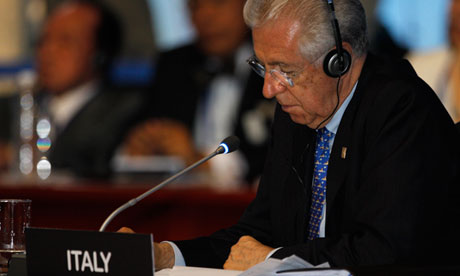
Italian prime minister Mario Monti at the G20 summit in Mexico. Italy's economy is stagnating as the eurozone crisis deepens. Photograph: Andres Leighton/AP
As the spotlight of investors' attention swings from Greece to Spain, the mood in Italy has been one of increasingly nervous apprehension.
The euro debt crisis, as the financial daily Il Sole 24 Ore noted last week, has come to resemble Agatha Christie's novel Ten Little Indians. And Italians are only too aware that, with the possible exception of the Cypriots, they are next in line after the Spanish.
"We're in a better position than the Spanish inasmuch as our banks do not have the same exposure to bad property loans," said Pietro Reichlin, professor of economics at the Luiss University in Rome. But, he added, the balance sheets of Italian banks – like those of so many in the eurozone – are also heavy with government bonds whose prices have been steadily eroded as the yield on Italian sovereign debt has risen.
This yield has been on an upward trend since March. Though Italian bond yields are now significantly lower than their Spanish equivalents – more than 1.2 percentage points – the benchmark rate on Tuesday was still uncomfortably high at around 5.8%.
This reflected a number of overlapping concerns. The biggest being that Italy's economy has become incapable of sustained, significant growth.
It has been at a virtual standstill since the start of the 2000s. In the first quarter of 2012, it shrank 1.4% year on year and last month, the OECD forecast that between 2012 and 2017 Italy's GDP would grow by an average of only 0.5% per annum, the lowest rate among more than 40 countries for which it made forecasts.
Since coming to office last November, Mario Monti and his non-party ministers have worked hard to improve the situation. They have increased the retirement age and passed a bill to cut red tape.
Last week, the cabinet finally approved a package of measures intended to boost growth. But it turned out to be not only much-delayed but much-reduced. There were some fiscal incentives for companies hiring new employees, tax breaks for home improvements and a measure to boost offshore drilling.
But it was scarcely a bill that would transform the economy and highlighted the fact that the government's has little room for manoeuvre. Committed to eliminating the budget deficit by the end of next year, it just does not have the cash to fund, for example, big new infrastructure projects like an eternally proposed (and eternally postponed) bridge over the Straits of Messina.
What the crisis has highlighted, moreover, is that Italy's growth potential is to a worrying degree restricted by deep-seated problems that have more to do with society than the economy. They include widespread corruption, an educational system that is turning out fewer graduates than almost any in Europe, courts that fail to offer investors judicial security and a deeply-ingrained view that women should not return to work after they become mothers.
Without growth, however, Italy will be in no position to start paying down its vast public debt, which is expected to top €2 trillion (£1.6 trillion) this year. As Reichlin notes, a stagnant economy also adds to the pressure on banks by increasing the danger of default by companies to which they have lent.
The danger of political instability is a separate problem. Monti's government currently enjoys the backing of both Italy's main parties, the Freedom People (PdL), founded by Silvio Berlusconi, and the centre-left Democratic Party (PD).
But they ceded power on the implicit understanding that Monti and his ministers would impose the sort of reforms that they have shown themselves incapable of passing for more than a decade. As that has become increasingly clear to voters, support for mainstream politicians has fallen drastically, allowing the Five Star Movement, founded by a comedian, Beppe Grillo, to become the country's third-biggest – or, according to some polls, second-biggest – party.
Monti's mandate runs out next spring. What happens after that is anybody's guess.
and......
http://www.guardian.co.uk/business/2012/jun/19/eurozone-leaders-greek-bailout-terms
Eurozone leaders prepare for Greek negotiations over bailout terms
Finance ministers will discuss whether to reward Greece for choosing a pro-bailout government
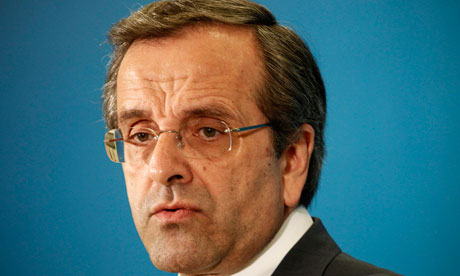
Antonis Samaras and his colleagues would like to see a softening of the terms of Greece’s rescue package. Photograph: Alkis Konstantinidis/EPA
Greece's politicians appeared to be close to announcing the formation of a government as Europe's leaders geared up for tough negotiations with the new prime minister, Antonis Samaras, about rewriting the conditions of its bailout.
Eurozone finance ministers will meet in Luxembourg on Thursday, amid rumours that Angela Merkel is about to give the green light for the eurozone bailout fund, the European Financial Stability Facility, to wade into financial markets and buy up the bonds of troubled governments.
But even if such a dramatic extension of the EFSF's role helps to calm financial markets and buy time for crisis-hit Spain, ministers will be forced to grapple urgently with the question of whether to reward Greece for choosing a pro-bailout government.
Samaras and his colleagues have made clear that although they are keen to remain within the single currency they would like to see a softening of some of the rules attached to Greece's rescue package. However, Amadeu Altafaj, spokesman for Olli Rehn, said: "No one is talking about a new memorandum of understanding" with Greece.
As politicians in Athens were thrashing out the final details of a coalition with talks due to resume today, the markets continued to focus on Spain, where the fiscal crisis appeared to be worsening.
Madrid was forced to deny reports it would delay announcing the results of an independent audit of its financial institutions until September, amid fears that the troubled banking sector may require more capital than the €100bn (£81bn) offered to Spain by its European partners.
An initial health-check of the banks will be published on Thursday, and an economy ministry spokesman told the Reuters news agency last night the detailed audit was on schedule and would be released on July 31. But the earlier report of a delay added to concerns about the damage sustained by Spanish banks amid the deteriorating economic outlook.
The Spanish prime minister, Mariano Rajoy, was reported to have failed to persuade his fellow leaders at the G20 summit to allow him to exclude the €100bn bank rescue fund from Spain's national debt.
"Connecting banking risk and sovereign risk has become very damaging," Rajoy told leaders at the meeting in Mexico, according to Spanish reporters who accompanied him. Including the new loan would increase Spain's national debt by up to 15%.
At a disastrous bond auction on Tuesday Spain was forced to pay more than 5% to borrow €2.4bn for just 12 months, in another signal that investors are losing confidence in Madrid's ability to service its debts.
Analysts are increasingly speculating that the government will be forced to accept a full-blown bailout in the coming months. "It is inevitable," said Harvinder Sian, of RBS. "The market has made its statement. There has to be a change in the way the Europeans are attacking the crisis." There was also evidence on Tuesday that growing anxiety about the impact of the turmoil in the eurozone economy had spread even to some of its strongest members. Confidence among Germany's investors and economists has plunged at its fastest rate since October 1998, before the launch of the single currency, according to the ZEW economic institute.
European leaders appeared to be responding to the pressure for more radical action as they considered allowing the EFSF to act as a buyer of last resort for government bonds – a radical extension of its remit.
However, investors are likely to be concerned about whether the EFSF, which will soon be replaced by a permanent successor, the European Stability Mechanism, will have sufficient resources to lean against the markets.
Bond yields in countries including Denmark and Germany have turned negative in recent days, signalling that investors are effectively willing to pay safe haven governments to hold on to their money, rather than risk lending it out to troubled countries such as Italy or Spain.
The European parliament on Tuesday pressed ahead with the task of re-regulating the financial sector, recommending reforms to credit ratings agencies including allowing them to be sued by investors under civil law if they made mistakes.
"The debt crisis in the eurozone has shown that credit rating agencies have gained too much influence, to the point of being able to influence the political agenda. In response we have strengthened rules on sovereign debt ratings and conflicts of interest," said Leonardo Domenici, the Italian MEP steering the reform through parliament.
and......
http://www.guardian.co.uk/business/nils-pratley-on-finance/2012/jun/18/markets-eurozone-bluff-spain
Markets call eurozone's bluff on Spain
The Spanish banking bailout, announced amid triumphalism in Madrid only nine days ago, seems like another age
Traders at the Madrid stock exchange. The only sure-fire remedy for Spain is a direct sovereign bailout. Photograph: Andrea Comas/Reuters
Can the euro crisis be contained until the euro leaders summit in Brussels on 28-29 June? On current form, it'll be a close-run thing.
The Greek relief rally lasted an hour on Monday. Worse, Spain's borrowing costs hit another euro-era high – the yield on 10-year bonds reached 7.2%. The Spanish banking bailout, announced amid triumphalism in Madrid only nine days ago, seems like another age.
There were at least three problems with it. First, it destroyed the notion that Spain's saving grace was its relatively low debt-to-GDP ratio: the €100bn, or whatever the final figure turns out to be, goes directly onto the government's books since the bailout is not, as Rajoy had wished, a direct injection of funds into the Spanish banking system. Second, investors in Spanish bonds feared being relegated down the pecking order of creditors if the loans directed via Madrid to the banks carry preferred status. Third, investors made the straightforward calculation that a country that cannot raise money at attractive rates to fund its banks cannot raise affordable capital full stop.
At 7.2%, the cat is out of the bag. Spain can tolerate such rates for a while (there will be an auction of short-dated debt on Tuesday and another later in the week) but the only sure-fire remedy is a direct sovereign bailout. That's the reality the eurozone leaders may have to confront in Brussels at the end of this month.
To take Spain out of the bond market for three years might cost €400bn or so (since there's about €200bn of debt that matures in that period), which is roughly the level of eurozone members' commitments to the European Stability Mechanism. But there's a world of difference between a commitment to write a cheque and the act of writing it. Indeed, deploying the ESM would almost exhaust the fund that was meant to stand as a deterrent against market attacks. In other words, the markets are calling the politicians' bluff. Spain, not Greece, is the trigger for the crisis to be solved – or not.
and then after the stream of bailout articles - here comes the rumor de jour ....
http://www.guardian.co.uk/business/2012/jun/19/germany-eurozone-bailout-countries-debt
Germany set to allow eurozone bailout fund to buy troubled countries' debt
Angela Merkel poised to remove opposition to direct lending by rescue fund in move seen as step towards sharing debt burden
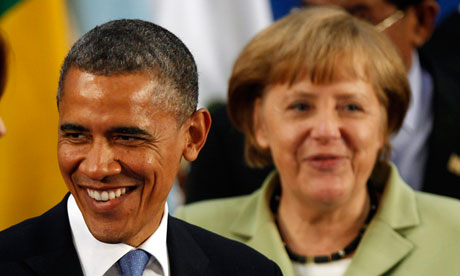
Barack Obama and Angela Merkel at the G20 summit in Los Cabos. Photograph: Ulises Ruiz Basurto/EPA
Angela Merkel is poised to allow the eurozone's €750bn (£605bn) bailout fund to buy up the bonds of crisis-hit governments in a desperate effort to drive down borrowing costs for Spain and Italy and prevent the single currency from imploding.
Germany has long opposed allowing the eurozone's rescue fund, the European Financial Stability Facility, to lend directly to troubled eurozone countries, fearing that Berlin would end up paying the bill, and the beneficiaries would escape the strict conditions imposed on Greece, Portugal and Ireland.
But Merkel has come under intense pressure as financial markets have pushed up borrowing costs for Spain to levels that many analysts see as unsustainable.
Analysts are likely to see the decision as the first step towards sharing the burden of troubled countries' debts across the single currency's 17 members, though it falls short of the "eurobonds" proposed by the European commission president, José Manuel Barroso.
A spokeswoman for Merkel said: "Nothing has been decided yet."
The proposal was discussed on the margins of the two-day G20 summit in Los Cabos, Mexico, which has been dominated by the depressing impact of the eurozone crisis on the world economy.
G20 officials believe an announcement could be made by the leaders of the eurozone in the next few days, but stressed they remained unclear as to timing and precise content.
It would be the first time the EU bailout funds have been used directly to purchase Spanish debt. It is understood the money would come from both the €500m European Stability Mechanism and its predecessor, the €250m European Financial Stability Facility. Britain does not contribute to either fund.
Last week, EU leaders had agreed a line of credit to Spanish banks through the Spanish government, a move that failed to reduce Spanish bond yields.
The ECB purchased €210bn of mainly Greek bonds in 2010, but its involvement was stopped partly because of German opposition. This would be the first time the two bailout funds were used in this way.
The funds had been set up to bail out peripheral countries such as Ireland and Portugal, and there will be concern whether the funds have sufficient firepower to help large economies.
The German agreement to sanction the move was relayed at a meeting between Barack Obama and Merkel on Monday. The move initially prompted the US president to agree to cancel a further meeting of the eurozone leaders scheduled for late on Monday night.
François Hollande, the French president, said the meeting between the eurozone and Obama had been rescheduled for this morning to brief the Americans on "mechanisms that allow us to fight speculation". The private discussions at the G20 have focused repeatedly on the eurozone crisis, and leaders recognise that one summit is not going to fix the crisis.
British ministers were pleased the G20 communique is specific on its commitments to try to find a mechanism to address unsustainable bonds costs.
Ministers have been struck that within the eurozone there is a realisation that even with the Spanish banks' recapitalisation and a Greek election endorsing its previous bailout agreement, more needs to be done to address unsustainable bond yields.
There were renewed signs that the fiscal crisis was intensifying on Tuesday after the Spanish government announced it would delay spelling out the full results of the independent audit of its crisis-hit banks until September.
Madrid was granted a €100bn bailout from its European partners earlier this month to shore up its financial sector. But news that the full extent of the shortfall of the banks will not be known until the autumn underlined the sense of chaos.
There was speculation that the full total required could end up being far more than €100bn. Madrid was forced to pay a record 5.07% at a debt auction on Tuesday morning to borrow €2.4bn for just 12 months, prompting analysts to say Spain is edging perilously close to needing a full-blown rescue.
"The decidedly elevated bond yield levels leave a question mark firmly in place as regards the sustainability of Spain's public finances while doing nothing to temper speculation as to how long the country might hold out before looking for a more comprehensive bailout," said Richard McGuire of Rabobank.
British government sources were stressing that any steps taken to help on Spanish bond yields were not a substitute for longer-term reforms such as European banking union, fiscal integration and even political union.
The chancellor, George Osborne, hinted at the possible deal saying the eurozone was inching towards solutions. He said: "I think there are signs that the eurozone are moving towards richer countries standing behind their banks and standing behind the weaker countries.
"There is no doubt that they [the eurozone] realise that individual measures taken in individual countries – like recapitalising Spanish banks and getting a Greek government that is in favour of staying in the euro – are not by themselves enough" The G20 communique due to be issued later mentions "steps towards greater fiscal and economic integration that lead to sustainable borrowing costs".
British officials are pleased that the lengthy passage on the eurozone makes specific forward-looking references to improving the functioning of financial markets and breaking the feedback loop between sovereigns and banks. It also speaks of the need for a more integrated financial architecture encompassing banking supervision and recapitalisation and deposit insurance.
• This article was amended on 19 June 2012. The original version wrongly stated that Madrid had to pay 5.7% at a debt auction to borrow €2.4bn for 12 months, rather than 5.07%.
but the grand rumor actually is nothing more than projection of powers that the EFSF / ESM already have - since November of 2011 - then why hasn't this been rolled out .....
Exclusive to all newspapers, EFSF/ESM bond-buying
Reporter: Um, I’ve filed some copy from Los Cabos
Panicked Night News Editor: Well, what’s the news!?!?!
Angela Merkel is poised to allow the eurozone’s €750bn bailout fund to buy up the bonds of crisis-hit governments in a desperate effort to drive down borrowing costs for Spain and Italy and prevent the single currency from imploding.
G20 officials believe an announcement could be made by the leaders of the eurozone in the next few days, but stressed they remained unclear as to timing and precise content…Goodness. They should maybe write this idea down somewhere.Oh. They did. (ESM Treaty still not ratified, incidentally)You could say this is the problem with eurozone tardiness on doing what they’ve already committed to…Somewhat more equivocal reporting from the FT on Tuesday, and interesting on how bond-buying came back on the agenda:According to officials briefed on G20 discussions, Mario Monti, the Italian prime minister, raised the possibility of using the EFSF to purchase peripheral bonds on the open market during a formal session on Monday night, where German chancellor Angela Merkel had been non-committal.However, officials said Ms Merkel had subsequent conversations on the sidelines of the summit which led interlocutors to believe “she may be willing to do more”, said one European official. The official cautioned, however, that Ms Merkel had not yet committed to any course of action.Germany’s acceptance of the draft, committing the eurozone to take steps to ensure “sustainable borrowing costs”, suggests it has accepted the principle of action, G20 sources said.A senior German official said nothing had been decided.At least it’s all written down if they do decide!Update: In fairness… though Germany already allows bond-buying by either the EFSF or the ESM, it might be news if it announced at the G20 that it would support activating the measures.Let’s take the existing (ahem) guidelines for the EFSF intervention on the secondary market as the most relevant way bond-buying could be carried out, given the ESM ratification issues):Conditionality for secondary market intervention relates to the issue of what are the financial market conditions under which the tool should be applied to ensure its effective use. The Heads of State and Government indicated that it should be done on the basis of ECB analysis and following a decision by mutual agreement from Member States.The procedure is initiated by a request from a Member State to the President of the Eurogroup for access to the Secondary Market Purchase Programme.So every eurozone government has to agree to do it, and activation follows the government whose bonds are in trouble making a request. The request involves a quid pro quo of a country agreeing to monitoring of economic reforms:Countries benefiting from such interventions outside a macro-economic adjustment programme would have to comply with ex-ante eligibility conditions as defined in the context of the European fiscal and macro-economic surveillance framework and take corrective action.Technically this memorandum of understanding could be signed quickly under the guidelines. How the recipient government would welcome conditionality – let’s say after the government in question already made a song and dance of not having to be humilated in accepting eurozone loans – is another matter.


but then the rumor de jour turned out to be groundless as Germany still says Nein......
http://www.zerohedge.com/news/grauniad-rejected-germany-denies-all-rumors
Grauniad Rejected - Germany Denies All Rumors
Nobody could have possibly foreseen that the Guardian was literally pulling BS out of its ass:
- GERMAN GOVERNMENT OFFICIAL SAYS THERE WAS NO DISCUSSION TO BUY BONDS OF CRISIS HIT MEMBERS AT THE G-20 MEETING - RTRS
Have fun with this lunatic, patently fake news driven shitshow that the "market" has become. We are out.
Previously:

Turns out it doesn't.
From Reuters:
Germany says did not discuss EU bond buying plan at G20 summit
There was no discussion at a G20 summit in Mexico this week about using Europe's rescue funds to buy up the bonds of stricken members of the euro zone, a German government official said.
British media reports on Tuesday said German Chancellor Angela Merkel was poised to use Europe's dual bailout funds, known as the EFSF and ESM, to buy up the debt of countries like Italy and Spain and had discussed the plans at the summit.
"Secondary market bond purchases are one of many instruments available to the EFSF and ESM," a German government official told Reuters, speaking on condition of anonymity.
But he added: "There was no discussion here in Los Cabos about any concrete intitiatives" related to such purchases.


No comments:
Post a Comment