http://ransquawk.com/headlines/227489
ECB's Nowotny says disquieting that only four countries have ratified the ESM bailout fund so far
http://www.zerohedge.com/news/biderman-vs-spiderman-towels
Biderman Vs. Spiderman (Towels)

Despite the failure of the generous offer of Spiderman towels from the recently 'stress-test'-proof-but-now-busted Bankia, today's market suggests there is still hope. The public estimate of loan losses for Spanish banks stands around EUR225 billion (EUR 125bn known and an additional EUR100bn estimated) which, as Charles Biderman of TrimTabs notes "is so big as to be practically unsolvable" as he details the total and utter lack of trust of Spain and Spanish banks that is spreading not just across Europe but around the world. The installation of six of the largest global consulting firms (and the IMF) to begin audits of the Spanish banks, as Reuters reports today, should tell everyone (especially those who bid them up 7-10% today) just how terrible the situation is. Biderman begins to go ultrasonic as he expects real losses for Spain to be in excess of EUR300 billion and this is just Spain! Who knows how big the losses are for the rest of Europe? He does not believe Germany, or anyone else, will put up the EUR300 billion for Spain (or a trillion for the rest of Europe) and sees at best a 50% chance that the entire Euro banking system will go down leaving a much smaller Euro-zone behind (and a 25% chance of a non-panic mode restructuring).
http://www.telegraph.co.uk/finance/financialcrisis/9313558/Spain-says-no-EU-bail-out-before-bank-audits.html
Mr De Guindos said in Brussels: "I have absolutely not discussed any intervention in Spain's banks today."
Markets in Europe rose strongly on Wednesday on talk that German and Spanish governments are nearing a compromise on how to provide the Spanish banking sector with funds via the eurozone's EFSF rescue fund if needed.
Spain's Ibex jumped 2.9pc and shares in Germany, France, Italy and Britain rose between 1.4pc and 2pc.
Under existing agreements, the EFSF can't be used to directly recapitalise banks. It was created in 2010 to provide financial assistance to countries unable to access capital markets. Ireland, Portugal and Greece have all received EFSF loans.
A German opposition leader said a decision to use the EU bail-out fund to help Spanish banks should be taken within days, although there is clarity about what form should this take and what it will cost Spain.
and.....
http://www.guardian.co.uk/business/2012/jun/06/spain-euro-finished-fiscal-union
Spain calls for new tax pact to save euro
Madrid calls for Europe-wide plan but resists 'humiliation' of national bailout
 Email
Email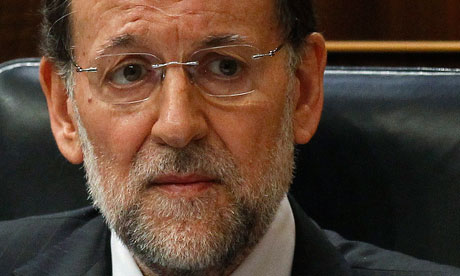
Spain's prime minister, Mariano Rajoy, is pleading for a direct eurozone rescue of the country's banks to avoid the humiliation of requesting a national bailout. Photograph: Andrea Comas/Reuters
Spain is warning that Europe's single currency will unravel unless its leaders decide within weeks to centralise budget and tax policies in the eurozone and agree on a strategy to pool responsibility for failing banks.
As Spain's prime minister, Mariano Rajoy, came under mounting international pressure to accept the eurozone's fourth national bailout in two years, the government in Madrid angrily rejected the demands, insisting that it did not need rescuing. With fears of a euro meltdown having rapidly shifted from Greece to Spain, Rajoy is pleading for a direct eurozone rescue of his country's banks, to avoid the humiliation attached to requesting a national bailout.
Sources familiar with the Spanish government's thinking said its negotiating position was that the fundamental quandary facing the eurozone was not Spain, but a European failure of leadership in persuading the financial markets that the euro would be defended at all costs.
A Brussels summit at the end of the month would have to remedy that by agreeing to establish a eurozone banking and fiscal union – major federalising steps certain to be fought over. Without that commitment, Spain fears the single currency would be finished in months.
The Spanish government believes that the eurozone's fourth-biggest economy is too big to rescue and that the consequences of abandoning Spain to the markets without a pledge of major European reform could be so ferocious that the single currency would not survive.
The current rules governing eurozone bailouts stipulate that a government has to request help and that the money may only be channelled via governments – increasing the national debt burden.
But Spain is stalling until key euro group meetings, the G20 summit and the Greek election later this month. Some analysts believe that if Spain is finally forced to request a full-scale EU/IMF bailout it is likely to come around 20 June.
Sources in Brussels confirmed that a rescue plan was being hatched for Spain – but it could be limited to desperately-needed banking aid, rather than a full national bailout.
Luis de Guindos, the Spanish finance minister, said his government would wait until the results of an independent audit of Spanish banks was completed later this month before pondering its options.
The IMF is to deliver its verdict on the condition of the Spanish banks on Monday, followed a week later by the Spanish audit. "From that basis, the Spanish government will decide what measures must be taken to recapitalise banks," said De Guindos. Madrid was joined by Washington and London in calling on the eurozone, principally Angela Merkel, the German chancellor, to deliver a persuasive new plan quickly for saving the euro. They fear the crisis might inflict immense damage on the US and UK economies.
A big move towards reform could immediately ease market pressure on Spain's borrowing costs, though the European Central Bank might still have to supply some funding while details of the new union were thrashed out.
Sources familiar with the Spanish government's thinking believe the country's banking crisis could be fixed much more cheaply than the €50bn bill currently estimated by analysts. In Brussels the signs are that a deal is being considered that would be more palatable for Rajoy by explicitly linking the rescue money to the banking problem and not to his government's stewardship of Spain's finances.
As the ECB left eurozone interest rates unchanged at 1%, ignoring calls for a slight reduction, its head, Mario Draghi, dismissed the criticism from Washington and London – but he also urged eurozone leaders get their act together.
Berlin is pushing the fiscal union, but on its own terms. It wants to force common rules and targets but avoid any early commitment to sharing liability for the debt or bank savings of individual countries. David Cameron is to go to Berlin on Thursday to try to push Merkel into a more protective stance on the euro, which would entail German pledges to underwrite struggling countries' debt. Following a telephone conversation with Barack Obama, the British prime minister will tell Merkel the US and the UK are insisting on "an immediate plan" on the euro, Downing Street said. The prime minister will tell Merkel the eurozone has no more than weeks to act to shore up the single currency.
Cameron's spokeswoman said the pair "agreed on the need for an immediate plan to tackle the crisis and to restore market confidence". Cameron's regular interventions from the sidelines of the euro crisis irritate Berlin and Brussels and Merkel is unlikely to be swayed, although Germany is showing some signs of greater flexibility. The White House, fearing the impact of a European disaster on Barack Obama's re-election campaign, is becoming more trenchant in its criticism of the eurozone and its demands of the Germans.
In Brussels, the signs are that the sides were inching towards a deal that would be made more palatable for Rajoy by explicitly linking the rescue money solely to the banking problem - and not to his government's stewardship of Spain's public finances.
German politicians dropped any pretence that they were not pressing Rajoy to ask for a bailout, but said the rescue could come without very tight strings attached. "I do think that Spain has to come under the rescue shield," said Volker Kauder, the parliamentary leader of Merkel's Christian Democrats in Berlin. "Not because of the country, but because of the banks."
Tristan Cooper, sovereign credit analyst at Fidelity Worldwide Investment said: "The willingness to support Spain is there. The difficulty is designing a method that can satisfy Germany and the market. Although sick banks are Spain's most acute ailment, there are more chronic ones. These include the highest unemployment and the third widest fiscal deficit in Europe in a deep recession.
Markets would react positively to an adequate bank recap solution. A structural change in investor sentiment requires the prospect of a sustainable economic recovery and a credible plan for achieving it."
The expectation is that any decisions will be delayed until after the Greek election on 17 June. Eurozone finance ministers are to meet on 21 June. The next day Rajoy is due in Rome for a summit with the leaders of Germany, France, and Italy before the Brussels summit a week later.
If the result of this risky round of brinkmanship and bargaining is an agreed "road-map" towards the medium-term aim of a eurozone federation, the Spanish hope the heat will be off, pressure from the financial markets will subside, their borrowing costs will sink and recapitalising their banking sector will become more feasible.
and.....
http://www.zerohedge.com/news/another-spanish-bailout-plan-taking-shape
Another Spanish Bailout Plan Taking Shape As Germany Folds
- European Central Bank
- Eurozone
- Germany
- Greece
- Gross Domestic Product
- International Monetary Fund
- Ireland
- Portugal
- Reuters
- Sovereigns
With all proposed Spanish bank bailout plans so far either shot down, or found to be inadequate, the question always has boiled down to whether Germany, which as we have noted in the past is the true lender of last resort in Europe, not the ECB, will agree to the trade off of preserving the Eurozone, i.e. temporarily ending the latest Spanish risk flare out, in exchange for the risk of political disgrace domestically, where more and more people are against sweeping European bail outs, due to soaring "contingent liabilities" which increasingly more people on the street are realizing are all too real (see: TARGET2). On the other hand, a direct bank bailout request for Spain using traditional European channels, which would fund the government, would result in a deterioration in the Spanish sovereign leverage, and make the country even riskier, thereby putting more pressure on the banks, and so in a toxic loop. It now seems that this dilemma may have been resolved, at least on paper. As Reuters reports, "A deal is in the works that would allow Spain to recapitalize its stricken banks with aid from its European partners but avoid the embarrassment of having to adopt new economic reforms imposed from the outside, German officials say. While Berlin remains firm in its rejection of Spain's calls for Europe's rescue funds to lend directly to its banks, the officials said that if Madrid put in a formal aid request, funds could flow without it submitting to the kind of strict reform program agreed for Greece, Portugal and Ireland."
Whether this is merely more posturing out of Germany to telegraph it is willing to step in, without actually doing it will likely soon be tested. When that happens, expect a backlash: "Merkel has also sent the message that she is open to Europe-wide supervision of the banking sector, albeit as a "medium-term" goal, one element of a proposed "banking union" to break the vicious circle of interdependence between Europe's financial institutions and its sovereigns. But she must tread carefully. Some of her political allies and leading conservative newspapers have come out strongly against other aspects of a banking reform, including the idea of a Europe-wide deposit guarantee scheme." Yet as we showed yesterday, Germany may not have an option: the cost of a Eurozone collapse, at least in the short term, will surely be greater than kicking the can one incremental time. Which is why sovereign spreads in Europe have tightened substantially on this latest news. That, and of course, the latest Hilsenrath rumor that the Fed is about to CTRL-P, has sent risk soaring despite the latest ECB disappointment from this morning.
More from Reuters:
Spain would only have to agree to new conditions tied to the reform of its banking sector.Berlin is also exploring the possibility of funneling aid to Spain's bank rescue fund FROB to reinforce the message that it is the country's banks and not its public finances which are at the root of its problems.The evolving German stance on aid for Spain is the latest evidence that Chancellor Angela Merkel is adopting a more flexible approach to solving the euro zone's deepening debt crisis.With an IMF report on Spain's banks looming next week, officials say all the pieces are in place to move within days on an aid deal for Madrid. A package is expected by early next month at the latest, after an external audit of the banking system.
"One could imagine that conditionality would be focused mainly on the banks, because Spain has already tackled the other reforms," a senior German government official said on condition of anonymity because of the sensitivity of the situation."These packages are not aimed to punish, just to ensure that the necessary reforms are being implemented."Spain's Economy Minister Luis de Guindos reiterated on Wednesday that his country had no immediate plans to request a bailout and was awaiting the external audit in late June.Berlin is certainly shifting positions. Last week, it signaled it supported granting Spain an extra year to cut its deficit to the EU's 3 percent of gross domestic product threshold, having previously held fast to the notion that austerity drives should not be diluted.
In other words, Germany is about to onboard even more contingent liabilities, in the form of directly subsidizing the Spanish bailout fund, in what amounts to the latest stealth bailout of an insolvent banking sector. And at this point why not: the sunk costs are so huge that a EMU collapse would disintegrate Germany - may as well perpetuate the illusion that somehow any of this debt will be paid back.
Multiple sources said the German finance ministry was exploring the possibility of channeling EU aid directly to Spain's Fund for Orderly Bank Restructuring (FROB), but that this would only work under the ESM, which is due to come into force next month."Nobody wants the EFSF for Spain. It's too restrictive," a second senior official said, pointing to the added flexibility contained in Article 19 of the bloc's permanent rescue mechanism.
That article states explicitly that the board of governors of the ESM are allowed to make changes to the financial assistance instruments laid out in the facility's statutes.A senior French official who has been in contact with the Germans said negotiations were heating up and that there was a broad consensus now among member states on using the EFSF or ESM to help Spanish banks."The Europeans want to cut the link between the banks and the sovereign. That's what is being discussed. There are plans to do that in the long run (through a banking union) but the idea is also to apply that to Spain," the official said.
So for the time being, this is the latest page in the neverending European script of infinite bailout permutations. We expect some informal refutation, which will make things worse, which will merely press the inevitable bailout outcome even more, until one day there is simply no more German money lying around available to preserve the broken European dream, and the illusion that "Europe is fine."


No comments:
Post a Comment