http://news.antiwar.com/2012/06/21/iran-detects-massive-cyber-attack-after-failed-moscow-talks/
 “Based on obtained information, America and the Zionist regime along with the MI6 planned an operation to launch a massive cyber attack against Iran’s facilities following the meeting between Iran and the P5+1 in Moscow,” said Iran’s Intelligence Minister Heydar Moslehi.
 Clinton’s argument, such as it is, came just days after the end of the latest round of negotiations with Iran, following Israeli demands for the USto be more “explicit” in its threats to attack Iran.
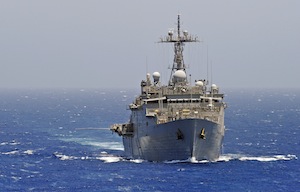 The Pentagon reported the warship was to be used for “support missions in areas where ground based access is not available,” and while it is being presented as a hedge against a hypothetical mining effort by Iran it could conceivably be used to launch attacks from offshore anywhere in the region.
Iran Detects ‘Massive Cyber Attack’ After Failed Moscow Talks
The US continues its aggressive postures towards Iran, despite claiming to be on a diplomatic course
by John Glaser, June 21, 2012
Iranian officials say they have detected a planned “massive cyber attack” against its nuclear facilities from the US, Britain, and Israel just days after talks with world powers failed to reach a settlement on Iran’s nuclear program.
 “Based on obtained information, America and the Zionist regime along with the MI6 planned an operation to launch a massive cyber attack against Iran’s facilities following the meeting between Iran and the P5+1 in Moscow,” said Iran’s Intelligence Minister Heydar Moslehi.
The US has been involved in the development and implementation of two previous cyber attacks against Iran’s nuclear facilities. The first was called Stuxnet, which had begun under the George W. Bush administration and continued under Obama, and the second was called Flame.
Washington has hypocritically maintained that offensive cyber attacks constitute an act of war, except when they do it.
The third round of talks between the P5+1 and Iran ended this week in Moscow without resolution, primarily because of US intransigence in refusing to grant Iran its right under international law to develop peaceful nuclear energy and in refusing to ease the sweeping economic sanctions in return for Iranian concessions on uranium enrichment.
In principle, the talks and the Western aggression against Iran are illegitimate. There is a consensus in the US intelligence community that Iran is not developing nuclear weapons and has demonstrated no intention to do so.
Still, the so-called diplomacy with Iran has been “predicated on intimidation, illegal threats of military action, unilateral ‘crippling’ sanctions, sabotage, and extrajudicial killings of Iran’s brightest minds,” writes Reza Nasri at PBS Frontline’s Tehran Bureau. These postures have spoiled the chance to resolve this issue promptly and respectfully.
After the failed talks in 2009 and 2010, wherein Obama ended up rejecting the very deal he demanded the Iranians accept, as Harvard professor Stephen Walt has written, the Iranian leadership “has good grounds for viewing Obama as inherently untrustworthy.” Former CIA analyst Paul Pillar has concurred, arguing that Iran has “ample reason” to believe, “ultimately the main Western interest is in regime change.”
Tehran has repeatedly said that if the West recognizes its right to a civilian nuclear program, talks can succeed. They have also suggested that concession from the West, like easing illegitimate economic warfare, could result in reciprocation like ending 20 percent uranium enrichment.
“If the other side agrees to recognize Iran’s (nuclear) rights based on international regulations, Iran is ready to negotiate anything,” Ali Akbar Velayati, an adviser to Iran’s Supreme Leader Ayatollah Ali Khamenei reiterated on Thursday.
Since the peaceful nature of Iran’s current nuclear program is so widely accepted, the only real gripe people have is that Tehran is slightly too opaque on the issue (this, despite all declared enrichment sites being subject to international inspections and having 24-hour video surveillance). Any opaqueness Iran has demonstrated, along with its emphasis on being “nuclear capable,” is merely a defensive posture from a regime that fears US or Israeli aggression.
But there is a simple solution to this which would vastly decrease the geopolitical tensions in the region, yet is seen as out of the question by the US. If Israel, Iran’s main adversary and not a NPT signatory, agreed to dismantling its vast stockpiles of nuclear weapons and to a deal enforcing a nuclear weapons-free zone in the Middle East – a deal Iran has repeatedly proposed – Iran’s defensive posture would probably expire, along with the whole dispute about its nuclear program.
and......
http://news.antiwar.com/2012/06/21/clinton-iran-wants-to-be-attacked/
Clinton: Iran Wants to Be Attacked
Warns Not 'Stopping' Iran Could Lead to 'Unforeseen Consequences'
by Jason Ditz, June 21, 2012
Speaking today in an interview with Charlie Rose, Secretary of State Hillary Clinton claimed that Iran secretly really wants to be attacked by the US because it “would unify the Iranian public and legitimize the Islamic regime.”
Clinton’s argument, such as it is, came just days after the end of the latest round of negotiations with Iran, following Israeli demands for the USto be more “explicit” in its threats to attack Iran.
Interestingly enough, Clinton’s belief that Iran “wants” the attack and that it would benefit them did not stop her from continuing on in detail about the importance of “stopping” Iran within the next year or so, by diplomacy or with an attack.
Indeed, Clinton seemed to warn against the idea of not attacking Iran, cautioning that a war would be “not only about Iran” but about avoiding “unforeseen consequences” that could erupt from the lack of a new US war.
and.....
http://news.antiwar.com/2012/06/21/us-special-forces-floating-base-heading-through-suez-to-persian-gulf/
US Special Forces ‘Floating Base’ Heading Through Suez to Persian Gulf
Ship Will Allow Small Scale Deployments From Offshore Anywhere in the Region
by Jason Ditz, June 21, 2012
The USS Ponce, an amphibious transport ship newly refitted as a “floating base” forUS special forces to launch attacks, is heading through the Suez Canal on Friday on its way into the Persian Gulf.
The Pentagon reported the warship was to be used for “support missions in areas where ground based access is not available,” and while it is being presented as a hedge against a hypothetical mining effort by Iran it could conceivably be used to launch attacks from offshore anywhere in the region.
CENTCOM has been keen to see the USS Ponce deployed to the region, saying that the ship is uniquely suited to operating in the region, where the US doesn’t necessarily have a base in every single country from which to operate.
The ship won’t actually have any combat forces on board when it arrives in Bahrain, expected to be about two weeks from now. Officials have not said when the combat troops will be deployed.


No comments:
Post a Comment