http://www.guardian.co.uk/world/2012/jun/02/western-banks-colombian-cocaine-trade
 Susanne Posel, Contributor
Activist Post
In the rainforest of south-east Cameroon 80% of the meat eaten is “bushmeat”. The indigenous people consume a diet of gorilla, chimpanzee or monkey.
It is estimated that an excess of 30,000 gorillas are killed in Cameroon each year for their meat.
The habits of tribes like those in Cameroon are now being blamed for the transmission of viruses like the human immunodeficiency virus (HIV) which is purported by mainstream scientists to have originated in chimpanzees.
Babila Tafon of the Ape Action Africa (AAA) a primate sanctuary claims to have found a new virus in the apes arriving at the AAA. It is a simian “foamy” virus, closely related to HIV. Tafon explains: “A recent survey confirmed this is now in humans, especially in some of those who are hunters and cutting up the apes in the south-east of the country.”
Following the storyline of “HIV came out of Africa” researchers at the Wilford Hall United States Air Force Medical Center and San Antonio Military Medical Center, have concluded that people of African descent are more likely to have a genetic trait that makes them “more susceptible” to contracting the HIV virus.
Matthew Dolan, co-author of the study suggests:
In 60% of African-Americans and 90% of Africans, a genetic trait was identified that made HIV 40% more prevalent than in Caucasians.
These researchers did not consult Wangari Maathai, a Kenyan ecologist and Nobel Peace Prize winner, who says that HIV was created deliberately in a laboratory as a biological weapon.
Maathai stated at a press conference after receipt of the Nobel Peace Prize that:
Dr. Alan Cantwell, MD agrees with Matthai’s summation of the origins of HIV.Cantwell explains:
In the 1970s, at Fort Detrick in Maryland, Richard Nixon joined the NCI with the military’s biological warfare unit.
Cantwell asserts:
However, a vaccine trial conducted by rival drug corporation Merck, the HIV Vaccine Trial Network and the National Institute of Allergy and Infectious Diseases claimed that 24 of 741 volunteers who got the vaccine in one segment of the experiment later became infected with HIV, which causes AIDS. In a comparison group of volunteers who got the placebo, 21 of 762 participants also became infected.
Propaganda articles in mainstream media are pro-HIV vaccine. They claim that “the World Health Organization (WHO) and UNAIDS combined existing research and evidence to develop aStrategic Investment Framework (SIF) for HIV/AIDS that showed that by increasing smart and focused investments now we can turn the tide against this disease and can realistically start talking about the end of AIDS.”
Nothing could be further from the truth.
In recent months Africa has been victim to:
Western banks 'reaping billions from Colombian cocaine trade'
While cocaine production ravages countries in Central America, consumers in the US and Europe are helping developed economies grow rich from the profits, a study claims
 Email
Email
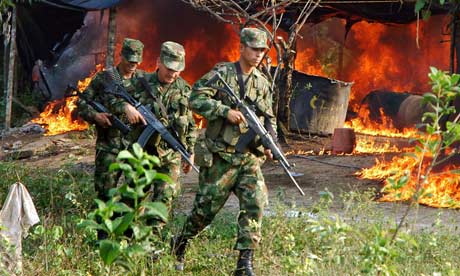
Soldiers torch a cocaine processing laboratory near the city of Cucuta, in northern Colombia, as part of the country's war on drugs. Photograph: AFP/Getty Images
The vast profits made from drug production and trafficking are overwhelmingly reaped in rich "consuming" countries – principally across Europe and in the US – rather than war-torn "producing" nations such asColombia and Mexico, new research has revealed. And its authors claim that financial regulators in the west are reluctant to go after western banks in pursuit of the massive amount of drug money being laundered through their systems.
The most far-reaching and detailed analysis to date of the drug economy in any country – in this case, Colombia – shows that 2.6% of the total street value of cocaine produced remains within the country, while a staggering 97.4% of profits are reaped by criminal syndicates, and laundered by banks, in first-world consuming countries.
"The story of who makes the money from Colombian cocaine is a metaphor for the disproportionate burden placed in every way on 'producing' nations like Colombia as a result of the prohibition of drugs," said one of the authors of the study, Alejandro Gaviria, launching its English edition last week.
"Colombian society has suffered to almost no economic advantage from the drugs trade, while huge profits are made by criminal distribution networks in consuming countries, and recycled by banks which operate with nothing like the restrictions that Colombia's own banking system is subject to."
His co-author, Daniel Mejía, added: "The whole system operated by authorities in the consuming nations is based around going after the small guy, the weakest link in the chain, and never the big business or financial systems where the big money is."
The work, by the two economists at University of the Andes in Bogotá, is part of an initiative by the Colombian government to overhaul global drugs policy and focus on money laundering by the big banks in America and Europe, as well as social prevention of drug taking and consideration of options for de-criminalising some or all drugs.
The economists surveyed an entire range of economic, social and political facets of the drug wars that have ravaged Colombia. The conflict has now shifted, with deadly consequences, to Mexico and it is feared will spread imminently to central America. But the most shocking conclusion relates to what the authors call "the microeconomics of cocaine production" in their country.
Gaviria and Mejía estimate that the lowest possible street value (at $100 per gram, about £65) of "net cocaine, after interdiction" produced in Colombia during the year studied (2008) amounts to $300bn. But of that only $7.8bn remained in the country.
"It is a minuscule proportion of GDP," said Mejía, "which can impact disastrously on society and political life, but not on the Colombian economy. The economy for Colombian cocaine is outside Colombia."
Mejía told the Observer: "The way I try to put it is this: prohibition is a transfer of the cost of the drug problem from the consuming to the producing countries."
"If countries like Colombia benefitted economically from the drug trade, there would be a certain sense in it all," said Gaviria. "Instead, we have paid the highest price for someone else's profits – Colombia until recently, and now Mexico.
"I put it to Americans like this – suppose all cocaine consumption in the US disappeared and went to Canada. Would Americans be happy to see the homicide rates in Seattle skyrocket in order to prevent the cocaine and the money going to Canada? That way they start to understand for a moment the cost to Colombia and Mexico."
and once you get past the morality issue , open to mind as to how far some might go to achieve and endpoint
http://www.activistpost.com/2012/06/how-hiv-virus-became-us-governments.html
Monday, June 4, 2012
How HIV Became the US Government’s Most Successful Bio-Weapon
Activist Post
In the rainforest of south-east Cameroon 80% of the meat eaten is “bushmeat”. The indigenous people consume a diet of gorilla, chimpanzee or monkey.
It is estimated that an excess of 30,000 gorillas are killed in Cameroon each year for their meat.
The habits of tribes like those in Cameroon are now being blamed for the transmission of viruses like the human immunodeficiency virus (HIV) which is purported by mainstream scientists to have originated in chimpanzees.
Babila Tafon of the Ape Action Africa (AAA) a primate sanctuary claims to have found a new virus in the apes arriving at the AAA. It is a simian “foamy” virus, closely related to HIV. Tafon explains: “A recent survey confirmed this is now in humans, especially in some of those who are hunters and cutting up the apes in the south-east of the country.”
Transfer of viruses from ape to human occur when the primate bites or scratches, however, some assert that eating primate meat (although cooked) is a transferable way for the new virus to reach humans.Professor Dominique Baudon, the director of the Cameroon Centre, blames the practice of eating bushmeat for the transfer of simian immunodeficiency virus (SIV) which then trans-mutated into HIV in humans.
Matthew Dolan, co-author of the study suggests:
The benefit that the Africans got from a mutation that gave them some resistance to malaria has, statistically at least, rendered them some increased susceptibility to HIV.The question researchers asked was: how do some people exposed to HIV contract the virus while others do not?
The study analyzed more than 1,200 US military service men and women infected with HIV to answer questions about the genetic aspects of the disease.
In 60% of African-Americans and 90% of Africans, a genetic trait was identified that made HIV 40% more prevalent than in Caucasians.
These researchers did not consult Wangari Maathai, a Kenyan ecologist and Nobel Peace Prize winner, who says that HIV was created deliberately in a laboratory as a biological weapon.
Maathai stated at a press conference after receipt of the Nobel Peace Prize that:
Some say that AIDS came from the monkeys, and I doubt that because we have been living with monkeys (since) time immemorial, others say it was a curse from God, but I say it cannot be that.Maathai maintains that HIV was created by,
agents to wipe out other people . . . In fact [the HIV virus] was created by a scientist for biological warfare. Why has there been so much secrecy about AIDS? When you ask where did the virus come from, it raises a lot of flags. That makes me suspicious.She asserts that HIV was created for the purposes of population control in Africa.
Dr. Alan Cantwell, MD agrees with Matthai’s summation of the origins of HIV.Cantwell explains:
After the smallpox vaccine story hit the front-page of The London Times, the story was subsequently killed and never appeared again in any of the world major media. The smallpox eradication vaccine program sponsored by the World Health Organization was responsible for unleashing AIDS in Africa. About 100 million Africans living in central Africa were inoculated by the WHO. The vaccine was held responsible for awakening a ‘dormant’ AIDS virus on the continent. I am sure the ‘big business’ of vaccine makers had something to do with censoring the story. Also the Times story provided another explanation for the outbreak in Africa other than the widely-accepted ‘monkey in the African jungle’ theory of HIV/AIDS.Cantwell believes that primates were injected with various cancer-causing and immunosuppressive viruses, as part of primate animal cancer research conducted by the National Cancer Institute (NCI).
In the 1970s, at Fort Detrick in Maryland, Richard Nixon joined the NCI with the military’s biological warfare unit.
Cantwell asserts:
There is NO PROOF that AIDS, which first appeared EXCLUSIVELY in young (primarily white) gay men in Manhattan, came from Africa. This is yet another myth about AIDS. How could a supposed black heterosexual African epidemic transform itself into an EXCLUSIVELY WHITE YOUNG GAY MENS’ DISEASE IN MANHATTAN? In my opinion this is biologically impossible. Furthermore, there was no ‘incubation period’ for HIV in America. As soon as the government-sponsored gay hepatitis B experiment (1978-1981) ended in Manhattan in 1981 the epidemic became official. The first cases of AIDS in gay men appeared in Manhattan in 1979, soon after the gay experiment began in Manhattan, New York City.
Dr. Robert Strecker has explained in his books that Africans were infected with HIV during the smallpox vaccine distribution; as laid out by WHO in a memorandum from 1972.
Prior to 1979, there were no reported cases of HIV/AIDS in Africa, according to Luc Montagnier, a French Pasteur scientist. By calculating Montagnier’s isolation of the first HIV case in Paris, France, the first cases of HIV must have begun in the fall of 1982.
While AIDS are first announced in 1981, there were yet no reported cases proving that there was an African epidemic.
Those populations in underdeveloped nations like Africa succumb to the disease much quicker. Because of the lack of access to medical care, up to 40% of the population is estimated to be killed off.
Experiments conducted by Myron Max Essex at Harvard explained that prior to the HIV outbreak in Africa scientists had foreknowledge that retroviruses cause immunosuppression, by studying feline leukemia viruses.
Robert Gallo, who participated in this research, later admitted that HIV was a government created bio-weapon.
According to an annual volume of the Special Cancer Virus Program , human experimentation with cancer-causing and immunosuppressive viruses was essential. With the “gay plague” and “gay cancer’, such experiments were no longer necessary. The deaths of thousands of gay men proved with these viruses caused cancer, immunosuppression, and were sexually-transmissible between people.
Just as the human radiation experiments administered radioactive elements to unsuspicious Americans, so the HIV virus was unleashed onto the unsuspecting African people receiving a smallpox vaccine.
Last month the first human study conducted for clinical trials commenced with the hopes from the pharmaceutical industry that Vacc-C5, the “HIV vaccine”, would prove successful.Oslo University hospital hosted the study of Bionor Pharma ASA’s Vacc-C5 believed to slow down or stop induction of immune hyper-activation. This vaccine attacks the virus’s ability to produce, therefore making it the perfect candidate to be a preventive vaccine; administered to everyone eventually.
While AIDS are first announced in 1981, there were yet no reported cases proving that there was an African epidemic.
Those populations in underdeveloped nations like Africa succumb to the disease much quicker. Because of the lack of access to medical care, up to 40% of the population is estimated to be killed off.
Experiments conducted by Myron Max Essex at Harvard explained that prior to the HIV outbreak in Africa scientists had foreknowledge that retroviruses cause immunosuppression, by studying feline leukemia viruses.
Robert Gallo, who participated in this research, later admitted that HIV was a government created bio-weapon.
According to an annual volume of the Special Cancer Virus Program , human experimentation with cancer-causing and immunosuppressive viruses was essential. With the “gay plague” and “gay cancer’, such experiments were no longer necessary. The deaths of thousands of gay men proved with these viruses caused cancer, immunosuppression, and were sexually-transmissible between people.
Just as the human radiation experiments administered radioactive elements to unsuspicious Americans, so the HIV virus was unleashed onto the unsuspecting African people receiving a smallpox vaccine.
Last month the first human study conducted for clinical trials commenced with the hopes from the pharmaceutical industry that Vacc-C5, the “HIV vaccine”, would prove successful.Oslo University hospital hosted the study of Bionor Pharma ASA’s Vacc-C5 believed to slow down or stop induction of immune hyper-activation. This vaccine attacks the virus’s ability to produce, therefore making it the perfect candidate to be a preventive vaccine; administered to everyone eventually.
However, a vaccine trial conducted by rival drug corporation Merck, the HIV Vaccine Trial Network and the National Institute of Allergy and Infectious Diseases claimed that 24 of 741 volunteers who got the vaccine in one segment of the experiment later became infected with HIV, which causes AIDS. In a comparison group of volunteers who got the placebo, 21 of 762 participants also became infected.
Propaganda articles in mainstream media are pro-HIV vaccine. They claim that “the World Health Organization (WHO) and UNAIDS combined existing research and evidence to develop aStrategic Investment Framework (SIF) for HIV/AIDS that showed that by increasing smart and focused investments now we can turn the tide against this disease and can realistically start talking about the end of AIDS.”
Nothing could be further from the truth.
In recent months Africa has been victim to:
- The ravaging by AFRICOM under Obama’s orders to search out and capture Joseph Kony; a minimal threat who has been missing since 2007.
- The securitization of their natural resources by corporate and government interests.
- They are witnessing the UN’s forcible land grab operations under the guise of preserving the land. The UN has aligned with private corporations to make use of the land without Africa’s consent.
- Researchers for the British Geological Survey (BGS) and the University of London sponsored by the British government have located underground aquifers of water in Africa that are 100 times the amount found on the surface of the continent. They intend to securitize these supplies.
- Obama’s creation of the New Alliance for Food and Nutrition Security (NAFNS) that is a $3 billion plan to securitize Africa’s food supply by giving African land to private corporations (like Coca-Cola and Nestle) to make agricultural use and nationalize the food production and disbursement.
While the purpose of the vaccine to “cure” HIV will no doubt be preventative; meaning everyone will be expected to get the immunization, the threat of large amounts of the world’s populations becoming infected with HIV will become a reality in the near future.and.......http://www.japantimes.co.jp/text/nn20120604a6.htmlPlutonium reprocessing plan raises alarm amid shutdown
Critics wonder why MOX plan is running when reactors are idle
APLast year's tsunami crisis left Japan's nuclear aspirations in doubt and its reactors idled, rendering its huge stockpile of plutonium useless. So, the nuclear industry's plan to produce even more this year has raised a red flag.Nuclear industry officials say they hope to start producing half a ton of toxic plutonium within months, in addition to the more than 35 tons Japan already has stored around the world. That is even though all the reactors that might use it are either inoperable or offline while the government rethinks its gung-ho nuclear energy policy after the crisis at Tokyo Electric Power Co.'s Fukushima No. 1 plant."It's crazy," said Princeton University professor Frank von Hippel, a leading authority on nonproliferation issues and a former assistant director for national security in the White House Office of Science and Technology. "There is absolutely no reason to do that."Japan's nuclear industry produces plutonium — which is strictly regulated globally because it also is used for nuclear weapons — by reprocessing some of its spent, uranium-based fuel in a procedure that it hopes will help decrease the amount of radioactive waste that would otherwise require long-term storage.The industry wants to step up its reprocessing output to build up reserves in anticipation of when it has a network of reactors that run on MOX, a next-generation mixed-oxide fuel that makes use of plutonium gleaned from other sources — such as old fuel or discarded warheads — and can be reused in a self-contained cycle — but that much-delayed day is still far off.Japanese officials argue that, once those plans are in place, the reactors will draw down the stockpile and use up most of it by 2030."There is no excess plutonium in this country," said Koichi Imafuku, an official at the Agency for Natural Resources and Energy. "It's not just lying around without purpose."In the meantime, the post-Fukushima review of nuclear policy is pitting a growing number of critics who want to turn away from plutonium altogether against an entrenched nuclear industry, or "village," that continues to forge ahead with it.Other countries, including the United States, have scaled back the separation of plutonium because it is a proliferation concern and more expensive than the alternatives, including long-term storage of spent fuel.Fuel reprocessing remains unreliable, and it is questionable whether it is a viable way of reducing the massive number of spent fuel rods, said Takeo Kikkawa, a Hitotsubashi University professor specializing in energy issues."Japan should abandon the program altogether," said Hideyuki Ban, codirector of the respected antinuclear Citizens' Nuclear Information Center. "Then we can also contribute to the global effort for nuclear nonproliferation."Von Hippel stressed that only two other countries reprocess on a large scale: France and Britain, and Britain has decided to give it up. Japan's civilian-use plutonium stockpile is already the fifth-largest in the world and has enough plutonium to make about 5,000 simple nuclear warheads, although it does not manufacture them.Because of the inherent dangers of plutonium stockpiles, government regulations require industry representatives to announce by March 31 how much plutonium they intend to produce in the year ahead and explain how they will use it.But, for the second year in a row, the industry has failed to do so. Instead, it blames the government for failing to come up with a long-term nuclear policy after Fukushima and says it nevertheless wants to make more plutonium if it can get a reprocessing plant up and running by October.Kimitake Yoshida, a spokesman for the Federation of Electric Power Companies, said the plutonium would be converted into MOX — a mixture of plutonium and uranium — which can be loaded back into reactors and reused in a cycle. But technical glitches, cost overruns and local opposition have kept Japan from actually putting the moving parts of that plan into action.In the meantime, Japan's plutonium stockpile — most of which is stored in France and Britain — has swelled despite Tokyo's promise to international regulators not to produce a plutonium surplus.Its plutonium holdings have increased fivefold from about 7 tons in 1993 to 37 tons at the end of 2010. Japan initially said the stockpile would shrink rapidly in the early 2000s as its fuel cycle kicked in, but that has not happened.Critics argue that since no additional spent fuel is being created, and there are questions about how the plutonium will be used, this is not a good time start producing more. They also say it makes no sense for Japan to minimize its plutonium glut by calling it a "stockpile" rather than a "surplus.""It's a simple accounting trick," said Edwin Lyman, a physicist with the Union of Concerned Scientists. "It's laughable. And it sends the wrong signal all around the world."Officials stress that, like other plutonium-holding nations, Japan files a yearly report detailing its stockpile with the International Atomic Energy Agency. But it has repeatedly failed to live up to its own schedules for how the plutonium, which is highly toxic when inhaled, will be used.From 2006 until 2009, the nuclear industry said the MOX will be used in 16 to 18 conventional reactors "in or after" 2010. In fact, only two reactors used MOX that year. By the time of the earthquake and tsunami last year, the number was still just three — including one at the Fukushima plant.In response to the delays, the industry has simply dated its plans further off into the future. It is now shooting for the end of fiscal 2015."There really is a credibility problem here," said Princeton's von Hippel, who also is a member of the independent International Panel on Fissile Materials."They keep making up these schedules which are never realized," von Hippel said. "I think the ship is sinking beneath them."
.


No comments:
Post a Comment