Dempsey: Atrocities in Syria Make Military Intervention More Likely
UN envoy Kofi Annan is back in Syria to try to broker a ceasefire and a peace deal in the country teetering on the edge of civil war
by John Glaser, May 28, 2012
The chairman of the United States Joint Chiefs of Staff warned that continued atrocities in Syria could make military intervention more likely, as the United Nations envoy Kofi Annan restarted negotiations in the capital, Damascus.
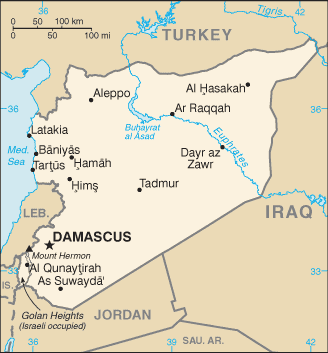 In response to the massacre of over 100 people in the Houla area of central Syria, Gen. Martin E. Dempsey, the chairman of the Joint Chiefs of Staff, called said the “horrific” and “atrocious” act could prompt a military intervention, but warned such a policy may cause more havoc.
“There is always a military option, but that military option should always be wielded carefully,” General Dempsey said. “Because one thing we’ve learned about war, I have learned personally about war, is that it has a dynamic all its own — it takes on a life of its own.” Nonetheless, he said, “it may come to a point with Syria because of the atrocities.”
UN envoy Kofi Annan, now back in Damascus, is trying to revive his failed peace plan. “I urge the government to take bold steps to signal that it is serious in its intention to resolve this crisis peacefully, and for everyone involved to help create the right context for a credible political process,” Mr. Annan said on Monday.
Annan explicitly stated that moving towards a ceasefire and a just political process is the responsibility of not just the Assad government but of the opposition fighters too.
Washington has already begun providing lethal and non-lethal aid to the Syrian opposition, even as they contemplate additional support to those rebels they determine are not allied with al-Qaeda-linked militants. But the al-Qaeda elements running throughout the disparate rebel militias are impossible to pinpoint and even those not aligned with al-Qaeda have been shown to have committed serious atrocities.
George Washington University professor and Middle East expert Marc Lynch has argued that “arming the Syrian opposition, would likely spread the violence and increase the numbers of Syrian dead without increasing the likelihood of regime collapse.” Also, as we saw in Libya, “fighting groups will rise in political power, while those who have advocated nonviolence or who advance political strategies will be marginalized.”
A big part of why the Annan peace plan has failed is because foreign powers continue to intervene in Syria for their own benefit. Russia and Iran continue to arm the Assad government, just as the U.S. and its allies in Europe and the Persian Gulf arm and aid the insurgent militias. The aid emboldens both sides and hinders any viable peace.
and....
Pakistan Cancels High-Level CIA Talks
New ISI Chief Won't Visit CIA as Relations Continue to Sour
by Jason Ditz, May 28, 2012
With tensions continuing to soar between the US and Pakistan, the Inter-Services Intelligence (ISI) agency has announced that it is canceling high-level talks with the CIA’s leadership, scheduled for later this week.
 The cancellation is being presented as a result of “pressing commitments” for Lt. Gen. Islam, but Pakistan officials concede that it is actually retaliation for last week’s Senate action cutting aid.
The cut was actually fairly small, just $33 million out of the $1 billion+ aid package, but was announced explicitly to spite Pakistan for jailing Dr. Shakil Afridi on treason charges. Dr. Afridi was running a phony vaccination campaign on behalf of the CIA to collect children’s DNA to scan for possible relatives of terrorists.
This is just one of a series of open issues between the US and Pakistan, however, with the US still refusing to apologize for attacking Pakistani military bases in November, and continuing to launch drone strikes on a regular basis despite formal requests by the Pakistani government to stop. The US has also accused Pakistan of “price gouging” by refusing to reopen the border to occupied Afghanistan without a pledge of higher payments for shipments.
and....
US Drones Attacking North Waziristan at Growing Rate
16 Killed in Three Strikes Over Weekend
by Jason Ditz, May 28, 2012
Despite ongoing negotiations with the Pakistani government aimed at reopening the border to Afghanistan, the rate of the US drone strikes against North Waziristan Agency seem to be increasing, not decreasing.
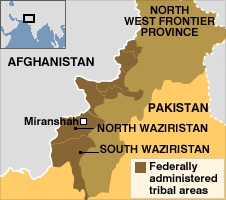 Today, drones followed up the late-night attack on Hasso Khel, which destroyed a house and killed seven unidentified people, with another attack in Datta Khel, which killed five more bringing the toll to 12 in the last 24 hours, and 16 over the weekend.
The victims of today’s attack were not clear either, as it attacked a seemingly random vehicle and charred the bodies beyond recognition. Officials have termed all 16 slain, including the four bakery customers killed Saturday, “suspects” based purely on the fact that they got hit with the missiles.
Pakistan’s parliament has repeatedly demanded that the US end its drone campaign, and has summoned US envoys over the failure to do so. President Obama has ruled out ever ending the strikes, insisting that they are vital to his ongoing wars.
and....
http://www.foxbusiness.com/news/2012/05/28/shell-to-exit-libyan-oil-gas-blocks/
LONDON – Royal Dutch Shell PLC (RDSA, RDSB, RDSA.LN, RDSB.LN) Monday said it was exiting its Libyan exploration blocks amid insecurity and harsh contracts, the first such move since Gadhafi's overthrow.
The Anglo-Dutch giant insisted it was still interested in the country, which holds Africa's largest oil reserves.
But the move casts a cloud on Libya's oil recovery as Shell had originally planned sizable investments in the blocks.
Shell "intends to suspend and abandon drilled wells and stop exploration in [its] Libyan licenses," a company spokesman said, confirming an internal email seen by Dow Jones Newswires.
Libya's oil production has fast recovered since the toppling of strongman Moammar Gadhafi last year. But foreign companies complain of tough contracts and of persistent insecurity.
The deals, which the new government says it won't change, had already led to the exit of several companies under the old regime. Others, like Germany's Wintershall AG, have warned the terms could impede decisions on new investments.
The Shell spokesman said exploration "results [prior to the war] have been disappointing and further exploration cannot be economically justified," he said.
In 2004, Shell signed preliminary deals with Gadhafi's regime potentially worth billions of dollars of investments, from exploration to a possible liquefied natural gas plant.
After interrupting its operations when the civil war started in early 2011, Shell had previously said it was studying a return to Libya.
But insecurity, including frequent attacks on oil officials, contributed to its decision to abandon the exploration blocks, according to people familiar with the matter.
British oil giant BP PLC (BP, BP.LN), which signed a $900 million exploration deal in 2009, has yet to resume operations in part due to insecurity, while other companies have kept the return of expatriates to a minimum. However, a BP spokesman said it still intends to return to Libya. In an internal email, Shell Libya said "severance packages will be offered to all staff."
But the email said it "will actively continue to engage with the [National Oil Co.] and Libyan authorities to explore other business opportunities.
"This is not a country exit, and a Shell Representative Office will remain in Libya," it added.


No comments:
Post a Comment