http://www.guardian.co.uk/world/2012/may/24/police-urge-greeks-money-bank
http://www.athensnews.gr/portal/11/55693
Police urge Greeks to keep money in bank
Scale of withdrawals from Greek banks has led to speculation that eurozone-wide guarantee is need to maintain confidence
 Email
Email
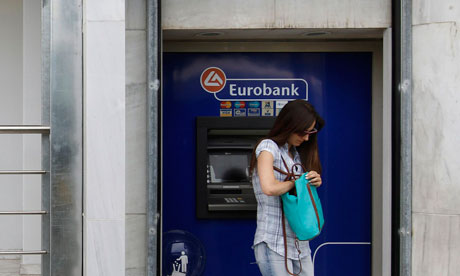
A woman withdraws money from a bank in Athens. Photograph: John Kolesidis/Reuters
Police are urging Greeks to keep their money in bank accounts rather than putting it at risk of theft, amid further uncertainty about whether the austerity-struck country will remain in the eurozone.
Greece's banks are likely to be shored up on Friday or Monday with €18bn (£14bn) of bailout funds they have been due to receive for weeks but which were held up by political uncertainty caused by inconclusive elections. Greece goes to the polls again on June 17, further stoking fears about its future within the euro.
The scale of withdrawals from Greek banks – almost 25% of deposits have been taken out in the past two years – and fears that other countries may suffer mass withdrawals has led to speculation that a eurozone-wide guarantee is needed to maintain confidence in the banking system.
Greece's national police spokesman, Thanassis Kokkalakis, told Reuters: "Many people have withdrawn their money from the banks fearing a financial crash, and they either carry it on them, find a hideout at home or in storage rooms.
"We urge people to trust the banking system, leave their money there, or at least in a safe place, not hide it at home, where they must anyway take the basic security measures."
The injection of fresh funds into the Greek banks is expected to allow the European Central Bank to start dealing with those unnamed institutions to which it stopped providing direct funding because they did not have enough capital.
Deposits in other eurozone countries are holding up, with those in Spain and Italy down only 3% and 2% respectively.
The Spanish government is propping up its banks, putting €9bn into Bankia, the fourth largest bank, and bringing in independent valuators – including US management consultants Oliver Wyman – for the property loans sitting inside Spain's banks. Spain already had a restructuring fund for its banks – known as FROB – which will provide the resources for the recapitalisation of Bankia.
Savings across the EU – including in Britain – are guaranteed up to €100,000 by national banking systems, which should prevent the need for any deposits to be withdrawn. There are suggestions that this burden should be shared across the eurozone.
Simon Ward, chief executive at global investment management group Henderson, pointed out that sharing out the bill might prove politically difficult.
"Germany would end up bearing the risk and I don't think that's politically acceptable," he said.
The ECB, Ward said, could do more to restore confidence in the stalling eurozone economies by embarking on quantitative easing. "We need to move to full QE that would stabilise the economies … boost confidence and slow the deposit flight. But we might not have time for that."
and.....
- and....
- http://hat4uk.wordpress.com/2012/05/24/euroblown-greece-how-we-all-paid-e220bn-to-get-precisely-nowhere-10-2/
EUROBLOWN. Greece: how we all paid €220bn to get deeper in debt
How to spend €220bn and wind up €20bn worse off
 Another little dose of Greek reality. In Crete as of yesterday afternoon, prescriptions have been refused at all pharmacies unless customers pay the full price. It’s obvious really: if you raid the hospital bank accounts to pay off the bondholders, the hospitals don’t pay the pharmacies, and so the chemist charges full wack. I think under Friedmanite economics that would be called the market deciding.We can be fairly certain that this development will spread across the rest of Greece; and that the only ones unaffected by it will be senior bureaucrats and politicians. But before this starts to sound like me going all Left and fluffy, perhaps now that the Greeks are having their faces ground into the mire, it’s time to return to the recurrent Slog theme, viz debt forgiveness.
All this month we have heard over and over again the sterile debate between stimulation and austerity. The simple truth is that, without debt forgiveness now, it’s too late to do either of those things. Frufru Lagarde insists that George Osborne is running out of time to start Plan B, but it was too late from Plan A let alone B:in November 2011 the Draper was forecasting 2.75% average growth from 2011-14. To say that looks sick is a bit like saying Stalin looks dead. Osborne sold us silly growth rates as the only answer to what the Slog and thousands of other sites were saying: your predecessors missed the boat, chum.Trust me, there ain’t no Plan C. Only debt forgiveness will stop the insanity.I’m talking financial, mathematical insanity by the way, not bleeding heart Miliband bollocks. Merkel suffers from the same problem as Lagarde: she can’t add up. Join me now on a brief trip back through time.When Greece first announced it was in trouble, in May 2010 the other Eurozone countries, and the IMF, agreed to a rescue package which involved giving Greece an immediate €45 billion in bail-out loans, with more funds to follow, totaling €110 billion. This was to help it with a total debt of €270 billion. Had the EU negotiated then with the IIF and others – and used the bailout to forgive the debt still left after negotiation – Greece would’ve been solvent immediately.But bankers don’t like that kind of solution. Bankers don’t accept any responsibility for their actions. Much more to the point, they don’t like the sort of fairness that might create a precedent.Instead, there was much moralising from Berlin, and the Greek debt shot up to €350bn by the end of 2011. It did this for two reasons: first, bond markets had no faith in the Berlin-am-Brussels solution, so the cost of Athenian borrowing sky-rocketed; and second, Berlin and the IMF insisted on a f*ckwitted austerity programme that dramatically reduced Greece’s ability to repay.
The bailout in March this year reduced the debt to €240bn, mightily pissed off the bond markets, and thereby laid the groundwork for bond spikes to rise in Italy, Spain and France. With debt forgiveness, Greece’s debt would’ve been zero ten months before that. The net cost to the EU taxpayer is (just on Greece alone) in the region of €220bn.Think about this: EU taxpayers have shelled out 89% of the remaining debt, and the sum total result is that they have, um, a 100% debt unpaid. For the Greeks themselves (see below) the cost has been even worse.Under the terms of the 2012 Brussels Accord, Greece is doomed to sink deeper into debt even if the economy picks up….which it isn’t doing: every month, it contracts further.Such is the cost of Brussels inaction and Teutonic Holier than Thou neurosis. Greek estimates – and Stephanie Flanders of all people – seem able to roughly agree on one point: this entire exercise has cost Athens 6-7 times the original value of the bonds issued.
Merkel and Schäuble continue to insist that it had to be done that way pour encourager les autres like Ireland, Spain, Portugal and Italy. Bollocks. The same austerity + bond spiking is now ensuring that these lemmings too are throwing themselves off a cliff. Synchronised suicide, EU style.Geithner, of course, is an idiot of roughly similar size to all the European players. He insists that borrowing yet more from the same folks who lent us the stuff in the first place produces leveraging, the financial equivalent of cold fusion meets Italian particles travelling faster than light. And this has allowed the Fuhrerin in Berlin to seize on the idiocy and say “Borrowing more never solved anything”. Correct: but trying to repay a loan that’s mathematically impossible to repay simply makes things worse.Austerity, borrowing still more, and central-planning stimulus are and always will be a waste of time is situations like this, where things have already gone too far. The only solution is debt forgiveness, followed by much stricter rules on (a) EU sovereign borrowing and (b) multinational bank lending.“AAAaaarg!” yell the neo-liberal economists, wielding their crucifixes, “Regulation! Unclean! Out foul spot! Quick, find me an exorcist!”When the whole world loses its marbles, this is what we get. But the thing about rules is really akin to the old joke about anarchist communes: if nobody obeys the rules, then the answer is rules, rules, and still more rules. Doh.In the meantime, I’ve no idea why I’m proffering this advice to those who have mislaid their marbles, because my first, second and third preference would be for all of them to suffocate beneath a dung mountain of their own making.So I’ll end with this piece of advice: Vote Merkel, and kill the EU.and...

http://www.athensnews.gr/portal/11/55693
| EU leaders urge country to stick to austerity course | ||||||||||||||||
| ||||||||||||||||

Attending his first and only EU summit, the prime minister said that the consequences of the recession and unemployment are testing the fortitude of citizens, who need to be given some hope that there is a way out of the crisis.
Panagiotis Pikrammenos said that a growth strategy was essential for the country and spoke in favour of eurobonds and the injection of 6.5 billion euros into the market.
He also told his counterparts that the inconclusive outcome of the May 6 election reflected the unease and anguish of citizens for the future.
At the summit, European Union leaders, advised by senior officials to prepare contingency plans in case Greece decides to quit the single currency, urged the country to stay the course on austerity and complete the reforms demanded under its bailout programme.
After nearly six hours of talks held during an informal dinner, leaders said they were committed to Greece remaining in the eurozone, but it had to stick to its side of the bargain too, a commitment that will mean a heavy cost for Greeks.
"We want Greece to stay in the euro, but we insist that Greece sticks to commitments that it has agreed to," German Chancellor Angela Merkel told reporters after a Wednesday evening summit in Brussels dragged long into the night.
Three officials told Reuters the instruction to have plans in place for a Greek exit was agreed on Monday during a teleconference of the Eurogroup Working Group (EWG) - experts who work for eurozone finance ministers.
The Greek finance ministry denied there was any such agreement but Belgian Finance Minister Steven Vanackere, said: "All the contingency plans (for Greece) come back to the same thing: to be responsible as a government is to foresee even what you hope to avoid."
Two other senior EU officials confirmed the call and its contents, saying contingency planning was only sensible.
In its monthly report, Germany's Bundesbank said the situation in Greece was "extremely worrying" and it was jeopardizing any further financial aid by threatening not to implement reforms agreed as part of its two bailouts.
It said a euro exit would pose "considerable but manageable" challenges for its European partners, raising pressure on Athens to stick with its painful economic reforms.
Greek officials have said that without outside funds, the country will run out of money within two months and there remains the threat that if it crashes out of the eurozone, other member states could be brought down too.
A document seen by Reuters detailed the potential costs to individual member states of a Greek exit and said that if it came about, an "amiable divorce" should be sought with the EU and IMF possibly giving up to 50 billion euros to ease its path.
Although EU leaders' minds will have been focused by that prospect, disagreements have flared over a plan for mutual eurozone bond issuance and other measures to alleviate two years of debt turmoil, such as giving countries like Spain an extra year to make the spending cuts demanded of them.
"The idea is to put energy into the growth motor. All the member countries don't necessarily share my ideas. But a certain number expressed themselves in the same direction," new French President Francois Hollande told reporters.
For the first time in more than two years of crisis summits, the leaders of France and Germany did not huddle beforehand to agree positions, marking a significant shift in the axis which has traditionally driven European policymaking.
Instead, Hollande met Spanish Prime Minister Mariano Rajoy in Paris to discuss policy, before the pair travelled to Brussels by train.
Despite fears Greeks could open the departure door if they vote for anti-bailout parties at a June 17 election, Spain, where the economy is in recession and the banking system in need of restructuring is at the front line of the crisis.
After meeting Hollande, Rajoy said he had no intention of seeking outside aid for Spain's banks, which are laden with bad debts from a property boom that bust and still has some way to go before it touches bottom.
But his government said its rescue of problem lender Bankia would cost at least 9 billion euros and it is also seeking ways to help its highly indebted regions meet huge refinancing bills.
Shifting sands
Socialist Hollande's election victory has significantly changed the terms of the debate in Europe, with his call for greater emphasis on growth rather than debt-cutting now a rallying cry for other leaders.
That has set up a showdown with conservative Merkel, whose primary objective is budget austerity and structural reform.
At his first EU summit, Hollande chose to make a stand on euro bonds - issuing common eurozone debt - despite consistent German opposition to the idea. "I was not alone in defending euro bonds," he said.
Merkel showed no sign of dropping her objections to the proposal, which she has said can only be discussed once there is much closer fiscal union in Europe. "There were differences in the exchange about euro bonds," she said bluntly.
The Netherlands, Finland and some smaller eurozone member states support her.
No major decisions were made at Wednesday's summit, which was intended to promote ideas on jobs and growth ahead of another meeting at the end of June.
But debate was intense, not just over euro bonds but over how to rescue banks and whether to give more time to struggling eurozone countries to meet their budget deficit goals.
"We haven't come together to confront each other ... but we have to say what we think - what are the right instruments, the right methods, the right steps, the right initiatives to raise growth," Hollande said.
The leaders discussed broad measures to stem the fallout from a winding up or restructuring of bad banks, EU officials said, with the European Central Bank pressing for the bloc to stand behind its struggling lenders but with Merkel's approval seen as far from guaranteed.
At the heart of the discussion are proposals from the European Commission for a legal framework to wind up or reorganise insolvent banks so as to avoid a repeat of the multi-trillion-euro taxpayer bailouts during the financial crisis.
Another suggestion is for the eurozone's rescue funds to be allowed to recapitalise banks directly, rather than having to lend to countries for on-lending to the banks. But that is another idea with which Germany is uncomfortable.
Having rallied on Tuesday, European stocks dropped 2.2 percent as investors priced in a lack of dramatic policy action. The euro tumbled against the dollar to its lowest since August 2010 and Spanish and Italian borrowing costs climbed.
A German two-year debt auction gave a stark illustration of how money is dashing for safe havens. Investors snapped up the 4.5 billion euros of paper on offer even though it came with a zero coupon - offering no return at all.
Search for growth
With the eurozone registering no growth in the first quarter and threatening to slip back into recession, policymakers touted three ideas to provide stimulus:
-'Project bonds' backed by the EU budget to finance infrastructure projects alongside private sector investment.
- Doubling the paid-in capital of the European Investment Bank, the EU's co-financing arm, to a little over 20 billion euros.
-Redirecting structural funds which tend to flow to poorer countries, to other areas where they might reap more immediate growth rewards.
Even if all three proposals were to be activated quickly, economists say they will not provide a sufficient shot in the arm to the eurozone and the wider EU economy. (Reuters/Athens News)
but is the austerity program worth the costs .......
http://www.athensnews.gr/portal/1/55771
| ||||||||||||||||


No comments:
Post a Comment