Karzai: US Must Pay at Least $2 Billion Per Year to Stay
US Says They'll Spend That Much, But Don't Want It in Writing
by Jason Ditz, April 17, 2012
In a speech today, Afghan President Hamid Karzai discussed the ongoing negotiation with the US over continuing its military presence through 2024, saying that he wants the “partnership agreement” to include a pledge from the US to give the Afghan government a minimum of $2 billion a year to pay for its own military.
 The US has been negotiating on the pact since last summer, and the agreement to allow the Afghan government total control over night raids (which US officials say they won’t abide by anyhow) was seen as a major breakthrough in pushing the deal through the Afghan parliament.
US officials have said that they will almost certainly provide far more than the $2 billion demanded annually, saying they will probably pay closer to $4 billion. They objected to putting it in writing, however, saying the partnership agreement was never meant to cover every aspect of US involvement in Afghanistan.
Recently the spiraling costs of propping up the Afghan military have become a subject of discussion among NATO member nations, who after years of annually pledging to make the Afghan military bigger now find themselves on the hook to pay for virtually the entire behemoth themselves.
and......
Taliban offensive shakes faith
By Jim Lobe
WASHINGTON - Sunday's well-orchestrated - if unsuccessful - attacks by Taliban forces on Kabul and three provincial capitals in eastern Afghanistan could further shake ebbing public confidence in the United States and its allies that their strategy for securing Afghanistan is working.
Billed as the opening of the Taliban's spring offensive, the attacks also raise new questions about the timing and pace of the planned US withdrawal from the country, as well as the fate of a longer-term strategic agreement that is currently being negotiated between Kabul and Washington.
Just a week before the attacks, an ABC News/Washington Post poll showed that public support for the war in Afghanistan had plunged to an all-time low, with only 30% of respondents saying that they believed the conflict was worth fighting, this 11 years after the Taliban were ousted by the US-led invasion of late 2001. It was the first poll in which a majority of self-identifiedRepublicans agreed with that proposition.
Moreover, 62% of respondents said they believed that most Afghans opposed what the US was trying to do there.
Tuesday's announcement by Australian Prime Minister Julia Gillard that Australia would accelerate its planned withdrawal from Afghanistan strikes yet another blow at Washington's hopes of retaining help from its Western allies through the end of 2014, the deadline that the North Atlantic Treaty Organization (NATO) agreed last year for the final departure of all NATO combat troops.
Citing improvements - despite Sunday's attacks - in the security situation in Afghanistan, Gillard pledged to have sent most of her country's 1,550 troops in Afghanistan home by the end of 2013.
That timetable was similar to the one adopted in January by President Nicolas Sarkozy for the withdrawal of almost 4,000 French troops after four French soldiers were shot and killed by an Afghan recruit in one of the worst of a growing number of incidents of what has become known as "Green on Blue" attacks. Until then, Paris, along with the rest of NATO, had pledged to stay through the end of 2014.
Whether others will also speed up their own withdrawal plans is likely to be the subject of much corridor talk later this week when NATO defense ministers meet in Brussels and again at next month's NATO summit in Chicago where US President Barack Obama is expected to press his fellow leaders to commit as many troops as possible until the end of 2014 and as many advisers and as much money as possible beyond that date.
Obama himself has pledged to withdraw some 22,000 of the remaining 90,000 US combat troops in Afghanistan by the end of September. But how quickly to withdraw the remaining 68,000 troops between then and the end of 2014 remains a source of heated debate both within the administration and between Republicans and Democrats in congress. Backed by most Democratic lawmakers, Vice President Joe Biden and Obama's National Security Advisor Tom Donilon reportedly favor a relatively quick pace that would reduce US troop levels to about 40,000 by mid-2013. But military commanders, supported by most Republicans despite the new poll findings, have pressed for a halt to further withdrawals after this fall through the "fighting season" in 2013.
The US "will need significant combat power through the end of 2013," said General John Allen, the US and NATO commander in Afghanistan, recently.
Sunday's attacks are certain to feed this debate, as have other recent debacles, including the accidental burning by US soldiers of copies of the Koran outside Bagram air base and the murderous nighttime rampage of one disturbed US soldier who killed 16 civilians, including nine children, near Kandahar.
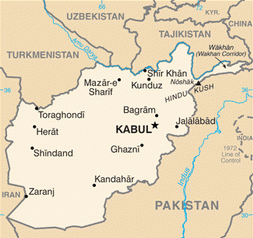
The attacks, which most analysts have said bore the hallmarks of the Taliban's Pakistan-based Haqqani faction, included three discrete assaults in Kabul, and two in Jalalabad, one in Gardez, and another in Pul-e-Alam in the eastern part of the country where the US has tried to build up its forces over the last several months.
Altogether, only 39 Taliban fighters - almost all of whom were eventually killed - took part in the attacks, but, as noted by officials here, each assault must have required help from dozens of others who provided intelligence, weapons and ammunition, logistics, and other forms of support in order for such a complex operation to be carried out.
In Kabul, considered the safest city in the country, the attacks brought normal life and commerce to a halt for as much as 18 hours.
While the Afghan army and police bore the brunt of the fighting - 11 servicemen were killed - the battle in Kabul was brought to an end only after several US helicopter gunships repeatedly strafed construction sites occupied by the insurgents.
It was the most fighting that has taken place in the capital since 2001. The US Embassy and a NATO base there came under attack last September, but the fighting then was much less protracted and intense.
While there is little question that the size and scope of Sunday's attacks caught Afghan government, US and NATO officials by complete surprise, demonstrating what Afghan President Hamid Karzai's office called "an intelligence failure for us and especially for NATO", officials and analysts were divided about their implications for the debate in the US.
Allen and those who oppose a rapid withdrawal expressed satisfaction with the response and performance of the Afghan government forces.
"No one is under-estimating the seriousness of today's attacks," General John Allen, the NATO commander in Afghanistan, said in a statement. "Each attack was meant to send a message: that legitimate governance and Afghan sovereignty are in peril. The [Afghan security forces] response itself is proof enough of that folly."
Max Boot, a prominent neo-conservative military analyst, argued in Commentary's Contentions blog that the attack was actually a sign of weakness on the part of the Taliban, noting that "the insurgents had to stage their attacks from abandoned buildings, which suggests they do not have too much support in the capital."
But others said the attacks marked a show of strength on the part of the insurgency and pointed to the reliance by the Afghan security forces on US and Western advisers who accompanied them in the course of the day, as well as the apparent necessity of engaging US gunships in the battle, at least toward the end of the fighting.
"While this wasn't the [1968] Tet offensive [by the Vietcong in Vietnam], if they can pull off something like this in what is supposed to be the safest part of Afghanistan - and attack three other cities at the same time - it's not very encouraging," one administration official told Inter Press Service. "And it isn't going to help boost public support for the war."
and the War is going great but......
While there is little question that the size and scope of Sunday's attacks caught Afghan government, US and NATO officials by complete surprise, demonstrating what Afghan President Hamid Karzai's office called "an intelligence failure for us and especially for NATO", officials and analysts were divided about their implications for the debate in the US.
Allen and those who oppose a rapid withdrawal expressed satisfaction with the response and performance of the Afghan government forces.
"No one is under-estimating the seriousness of today's attacks," General John Allen, the NATO commander in Afghanistan, said in a statement. "Each attack was meant to send a message: that legitimate governance and Afghan sovereignty are in peril. The [Afghan security forces] response itself is proof enough of that folly."
Max Boot, a prominent neo-conservative military analyst, argued in Commentary's Contentions blog that the attack was actually a sign of weakness on the part of the Taliban, noting that "the insurgents had to stage their attacks from abandoned buildings, which suggests they do not have too much support in the capital."
But others said the attacks marked a show of strength on the part of the insurgency and pointed to the reliance by the Afghan security forces on US and Western advisers who accompanied them in the course of the day, as well as the apparent necessity of engaging US gunships in the battle, at least toward the end of the fighting.
"While this wasn't the [1968] Tet offensive [by the Vietcong in Vietnam], if they can pull off something like this in what is supposed to be the safest part of Afghanistan - and attack three other cities at the same time - it's not very encouraging," one administration official told Inter Press Service. "And it isn't going to help boost public support for the war."
and the War is going great but......
http://news.antiwar.com/2012/04/17/nato-talks-major-us-offensive-in-afghan-capital/
NATO Talks Major US Offensive in Afghan Capital
Publicly Cheering About War, But Privately Officials Concerned About Dwindling Security
by Jason Ditz, April 17, 2012
In public, NATO officials are not only satisfied with the 11th year of progress of the Afghan War; they’re downright thrilled. Gen. John Allen reiterated today that he is “enormously proud” of how the Afghan military reacted to an entirely unpredicted city-wide attack on Kabul, which led to 18 hours of gunfire targeting every major site in the city.
Privately, however, the subject of the upcoming “jumbo meeting” of NATO foreign and defense ministers is expected to center around the ever-worsening security conditions nationwide and the inability to predict even major coordinated attacks.Even the public claims of “no strategy changes” don’t seem to be holding up, as the US is reportedly preparing to launch a massive offensive against Kabul, apparently aimed at “shoring up the defenses” in the city.
This latest spring offensive follows in the old formula for the war, with major offensives announced to target whichever part of the country is currently the most under siege. That more than ten years of activity haven’t secured any of the other targets in a meaningful way appears lost on them.
and...
Iraqis Accuse Maliki of Dictatorship After Arrest of Top Election Official
No matter how bad Prime Minister Maliki's drive to authoritarianism gets, he continues to receive Washington's support
by John Glaser, April 17, 2012
Iraqi leaders from across the political spectrum are accusing Prime Minister Nouri al-Maliki of seeking to rig the country’s electoral system after he arrested the official in charge of administering elections.
 Maliki, increasingly denounced by Iraqi voices of all stripes as a ruthless dictator, seems to have taken to arresting anybody he disagrees with, including his own vice president, Tariq al-Hashemi.
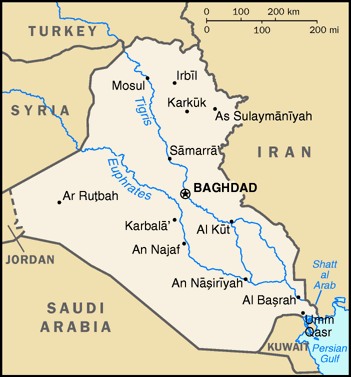
Now, the top elections official, Faraj al-Haidari, and another election commissioner, Kareem al-Tamimi, are jailed inside the Salhayah police station in Baghdad on charges of corruption, despite a court ruling in their favor two months ago.
The arrest of Haidari “is undemocratic and illegal,” said Muaid al-Tayab, a member of parliament. “We call it political revenge.”
Maliki had previously clashed with Haidari after the 2010 elections resulted in the prime minister’s party losing out to the Iraqiya bloc, a clash that led to months of impasse as Maliki contested the initial outcome. As the head of the Independent High Electoral Commission (IHEC), Haidari rejected Maliki’s petition to have thousands of votes for Iraqiya thrown out.
Maliki now seems to be teaching Haidari a lesson: never oversee an election that provides Maliki with less votes than others.
“The person who gave the specific order for this arrest, he is brother Nouri al-Maliki,” said a written statement issued by the cleric Moqtada al-Sadr. “This arrest should be done under the law, not under dictatorship.”
Khaled al-Alwani, a senior member of parliament in the Iraqiya bloc, accused Maliki and his backers of trying to target and marginalize his political opponents, and secure an unrivaled dictatorship. “They will push out Haidari by any means necessary,” Alwani said.
The Obama administration has kept largely quiet about Maliki’s behavior, aside from about $2 billion in annual aid and tens of billions in military assistance to support this drive to authoritarianism. While this keeps the halls of power in Washington and the oil corporations happy, even the best case scenarios are damning for Iraqi citizens as well as the geopolitics of the region.
“Maliki is heading towards an incredibly destructive dictatorship, and it looks to me as though the Obama administration is waving him across the finishing line,” said Toby Dodge, an Iraq expert at the London School of Economics. “Meanwhile, the most likely outcomes, which are either dictatorship or civil war, would be catastrophic because Iraq sits between Iran and Syria.”
and.......
Libya may reshuffle government in next few weeks-spokesman
By Hadeel Al Shalchi
TRIPOLI, April 17 (Reuters) - Libya's ruling National Transitional Council is reviewing the work of some of the government's ministers and may choose to replace them, an NTC spokesman said on Tuesday.
Mohammed al-Harizy declined to say which ministers were under review or whether the prime minister was among them, but said there could be a reshuffle in the next few weeks.
"There is a discussion over the performance of some of the ministers in the government and a possibility that some ministers will be changed," he told Reuters on Tuesday. "But no decision has been made."
If it went ahead, it would be the second reshuffle of Libya's interim government since its creation.
Last November, Prime Minister Abdurrahim al-Keib was brought in to deal with the tricky task of managing the transition from civil war to democracy. He chose a new cabinet which began to integrate former rebel fighters into a new national army and to build new government institutions from scratch.
But the NTC has been looking into the activity of ministries, including the health ministry run by Fatima al-Hamroush, which has been hit by scandal.
On April 7, the NTC was forced to halt a ministry of health scheme to pay compensation to people who fought in last year's uprising against Muammar Gaddafi because the programme turned out to be corrupt.
The ministry had spent 1.8 billion Libyan dinars ($1.4 billion) in less than three months, the NTC discovered, and some of the money had been doled out to people who were dead or who had never even fought in the uprising.
Earlier this year, the same ministry also had to cancel another programme meant to provide free overseas medical care for the uprising's wounded after it turned out to be riddled with fraud too.
In that case, the government discovered it was picking up the airfares, medical and hotel bills of people who had simply obtained faked documents saying they were wounded. (Editing by Andrew Osborn)


No comments:
Post a Comment