http://news.antiwar.com/2012/04/26/kurdish-president-raises-secession-option/
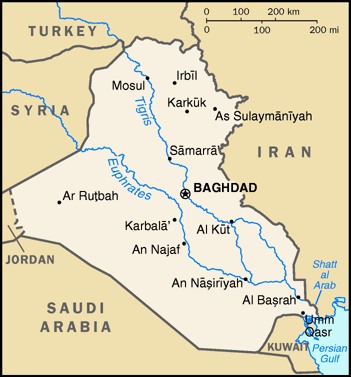 As always, the center of the dispute is Prime Minister Nouri al-Maliki, whose ongoing centralization of power and efforts to have opposition figures arrested as “terrorists” have many fearing a growing dictatorship. Of that possibility Barzani said “they have to decide if they are willing to accept to live under a dictatorial regime or not,” adding that a secessionist vote could come as soon as September.
Kurdish President Raises ‘Secession’ Option
Sadr in Kurdistan for Talks as Barzani Warns Against Authoritarian Rule
by Jason Ditz, April 26, 2012
The ongoing political dispute in Iraq looks to be coming to a head, with Shi’ite cleric Moqtada al-Sadr in Kurdistan for crisis talks and Kurdistan Regional Government (KRG) President Massud Barzani openly talking about secession.
As always, the center of the dispute is Prime Minister Nouri al-Maliki, whose ongoing centralization of power and efforts to have opposition figures arrested as “terrorists” have many fearing a growing dictatorship. Of that possibility Barzani said “they have to decide if they are willing to accept to live under a dictatorial regime or not,” adding that a secessionist vote could come as soon as September.
Sadr, the head of the Iraqi National Alliance faction,pushed for everyone to consider Iraqi unity a primary concern, while warning that Maliki had to appoint security and defense ministers instead of just keeping those jobs for himself.
For the Kurds, a secession sooner rather than later might be the safer choice, as Barzani and other officials have expressed concern that the central government’s military might, once the US delivers its F-16 warplanes, would be sufficient to crush any secessionist movement.
and.....
http://www.independent.co.uk/news/world/asia/anything-you-can-do-pakistan-follows-india-with-its-own-missile-test-7679184.html
A week after India successfully tested a long-range missile, Pakistan yesterday said it had also fired an upgraded nuclear-capable device in a reminder of the ongoing arms race that has gripped Asia.
Officials in Pakistan said they had completed a positive trial of the Shaheen-1A, an intermediate range missile that is capable of reaching targets across India. Officials said the missile came down in the Indian Ocean.
The test came a week after India trialled the so-called "game-changing" Agni-V, which, for the first time, would allow it to target many of China's major cities. While officials said the weapon was not "target-specific", analysts said it had been designed to counter a perceived threat from Beijing.
Talat Masood, a former army general based in Islamabad, said: "As you are aware, [India and Pakistan] have both been pursuing these nuclear and missile programmes for some time and will do so for some time to come. India has reached the point where it can target most of China. Pakistan also wants to develop its longer range weapons and increase its inventory."
Asked whether the timing of the Pakistan's launch was coincidental, he added: "It could have been coincidence. [But] it may have been a way of saying to the world, 'We have a missile programme too'."
The launch came as campaigners in the US warned in a study that a billion people around the world could starve to death if India and Pakistan were involved in a nuclear exchange, saying that even a "limited" war would cause deadly major climate disruptions.
The study, produced by the International Physicians for the Prevention of Nuclear War, said corn production in the US would decline by 10 per cent for a decade and soybean production would similarly drop by about 10 per cent. Rice production in China would fall by 21 per cent in the first four years.
"It is not just the arsenals of the US and Russia that pose a threat to the whole world," the report's author Dr Ira Helfand, told the Agence France-Presse. "Even these smaller arsenals pose an existential threat to our civilisation, if not to our species."
The South Asian neighbours, neither of whom are signatories to the nuclear non-proliferation treaty, have gone to war three times since 1947. In 2002, some analysts believed they were on the brink of another conflict. They regularly conduct missile tests and inform each other in advance.
While Pakistan's nuclear arsenal is believed to be the fastest growing in the world, neither its tests nor those of India receive the sort of condemnation heaped on North Korea for carrying out similar trials.
Asia has steadily become the focus of a multi-billion dollar arms race. Last month, the International Institute for Strategic Studies in London said arms spending by Asian nations will this year for the first time overtake that of European countries, where economic woes have forced a slowdown. It added that beyond India, China and Pakistan, Australia, Indonesia, Japan, Malaysia, Singapore, South Korea, Thailand and Vietnam were also spending heavily.
and.....
http://www.cbsnews.com/8301-202_162-57422446/4-us-troops-killed-in-separate-afghan-incidents/
(AP) KABUL, Afghanistan - An Afghan soldier fatally shot an American service member and a local interpreter in southern Afghanistan, officials said Thursday, the latest in a string of attacks against U.S. and other foreign forces by their Afghan partners.
In the east, meanwhile, three U.S. service members were killed in a bomb attack, according to NATO and a U.S. official. The official confirmed the nationalities on condition of anonymity because the information had not yet been publicly released. Further details were not immediately available.
In the insider attack in southern Kandahar province, an Afghan soldier opened fire with a machine gun from atop a building, killing a U.S. soldier and an Afghan interpreter and wounding three other coalition service members before he was gunned down, a senior U.S. defense official said. The official spoke on condition of anonymity because he was not authorized to release details.
The U.S. military officially confirmed only that a man wearing an Afghan army uniform turned his gun on coalition service members late Wednesday, killing one. The incident was under investigation, the military said.
Since the beginning of the year, there have been at least 16 such attacks against American and other international troops. The U.S.-led coalition is trying to mentor and strengthen Afghan security forces so they can lead the fight against the Taliban, and foreign troops can go home by the end of 2014. That mission, however, requires a measure of trust that has been repeatedly undermined by the deaths of coalition troops at the hands of their Afghan partners.
In one of the highest-profile attacks, a man working as a driver at the Afghan Interior Ministry shot dead two U.S. military advisers at close range in March. That incident alone led the U.S. military to temporarily pull all its advisers out of Afghan ministries.
U.S.-Afghan ties have also been under strain following Quran burnings at a U.S. base and the killing spree allegedly by an American soldier in the south in recent months. Relations appeared to be shifting back on track, with Washington and Kabul agreeing to a long-awaited deal earlier this week on a strategic pact to govern the U.S. presence in Afghanistan till 2024.
NATO: Man in Afghan uniform kills coalition troop
Losing the media war in Afghanistan
Losing the media war in Afghanistan
The U.S. military chooses its language carefully in describing insider shootings because of the possibility that assailants may be insurgents disguised in Afghan army uniforms and not actual members of the Afghan security forces. Such uniforms are easily available in markets in Afghanistan, and the Taliban have used them to mount previous attacks on international or Afghan military installations.
Since 2007, more than 80 NATO service members have been killed by Afghan security forces, according to an Associated Press tally, which is based on Pentagon figures released in February. More than 75 percent of the attacks have occurred in the past two years.
Also Thursday, three Afghan women were killed in the crossfire of a battle in the east. A mortar fired during the fighting in Wardak province hit a house, killing the women inside, said Shahidullah Shahid, a spokesman for the provincial governor
The battle began when Taliban fighters ambushed a NATO convoy, Shahid said. Both sides used heavy weapons, but it was not immediately clear who fired the mortar, he said.
NATO forces spokesman Capt. Justin Brockhoff said reports indicate it was a joint Afghan and international patrol that came under fire. He said they were looking into reports that "civilian casualties may have been caused by the engagement."
Last year was the deadliest on record for civilians in the Afghan war, with 3,021 killed, according to the United Nations. Taliban-affiliated militants were responsible for more than three-quarters of those deaths.
and.....
http://news.yahoo.com/syria-blames-terrorist-bomb-factory-hama-blast-111128321.html
BEIRUT (Reuters) - The Syrian government and rebels traded blame on Thursday for a huge explosion which killed 16 people in the city of Hama, as a two-week-old U.N.-backed ceasefire looked increasingly fragile.
U.N. Secretary-General Ban Ki-moon accused Damascus of breaking its pledge to withdraw heavy weapons and troops from towns, saying he was "gravely alarmed by reports of continued violence and killing in Syria."
Syria blamed "terrorist" bomb-makers for Wednesday's blast. Information Minister Adnan Mahmoud also accused rebel militiamen of repeated violations of the ceasefire and said Damascus was "reserving the right to respond to any violation or attack", state news agency SANA reported.
The British-based Syrian Observatory for Human Rights said the cause of the explosion was unclear, but also gave a death toll of 16. The Local Coordination Committees, a grassroots opposition group, said more than 50 people had been killed by what it said was a military rocket.
The blast in Hama, a centre of unrest against President Bashar al-Assad, has added to doubts about a ceasefire brokered by U.N.-Arab League envoy Kofi Annan, who, like Ban, says Assad has not ordered troops and tanks back to barracks as promised.
But outside powers are deeply divided on how to shore up the ceasefire, which has led to only a small reduction in violence in the 13-month-old uprising, during which the United Nations estimates Syrian forces have killed 9,000 people.
France, leading Western calls for tougher action against Assad, says it is planning to push next month for a "Chapter 7" Security Council resolution if Assad's forces do not pull back.
Chapter 7 of the U.N. charter allows the Security Council to authorize actions ranging from diplomatic and economic sanctions to military intervention. In the case of Syria, Western powers have said they intend to push for an arms embargo and sanctions if Damascus fails to comply with the Annan plan.
Russia and China have made clear that they would veto any attempt to authorize Libya-style military action in Syria and have resisted the idea of sanctions. The Western powers on the Security Council have signaled that there is no appetite in the West for authorizing the use of force against Syria.
U.S. Ambassador to the United Nations Susan Rice reiterated on Thursday that Assad's government has not lived up to its commitment to halt the fighting and elaborated on the kind of "Chapter 7" action Washington is considering.
"We have talked about the importance of this council being prepared to consider sanctions in the event that the Assad regime continues to violate every commitment it makes," Rice told reporters in New York.
The Arab League issued a statement calling on the Security Council to take immediate action to protect civilians but cut a reference from an earlier draft that would have recommended "Chapter 7" action by the 15-nation body.
Russia - which won a strong foothold in the Middle East through its close ties with Assad's government - suggested, however, that it was more inclined to share at least some of Damascus' description of the current fighting [ID:nL6E8FQ9VM].
"We call upon the Syrian side to carry out in full its obligations," Russian Foreign Ministry spokesman Alexander Lukashevich told a weekly briefing. "Nonetheless ... there is another side in Syria, opposition groups, which have in essence shifted to tactics of terror on a regional scale."
MONITORS TRICKLING IN
The ceasefire appears to be breaking down across Syria.
An activist said seven civilians and two rebel militiamen were killed in fighting in the eastern city of Deir al-Zor, while a resident of Zamalka on the outskirts of Damascus reported intense gun-battles.
"There have been heavy clashes today, really heavy over the past couple hours," the man said. "I couldn't get close enough to see. There are checkpoints everywhere."
SANA said a school headmaster was blown up in a booby-trapped car in the northern city of Aleppo and an "armed terrorist group" shot dead four members of the same family in Erbin near Damascus.
It also said two members of the security forces were killed in Deir al-Zor.
"Armed terrorist groups have escalated the crimes of killing, massacres, explosions, kidnappings and assassinations against civilians and law-enforcement members," Information Minister Mahmoud said in a statement reported on SANA.
In all, Damascus says 2,600 of its personnel have been killed in the fighting.
U.N. monitors charged with policing the ceasefire are trickling in, and two are now based permanently in Hama, where many thousands of people were killed when Assad's late father, Hafez al-Assad, crushed an armed Islamist uprising 30 years ago. Two observers are also staying in the battered city of Homs.
Activists have been dismayed at the pace of the observer deployment. A senior U.N. official said this week it would take a month to put the first 100 monitors on the ground, though the world body is working to speed up the pace of deployment.
The main reasons for the slow pace are national bureaucracies in approving and freeing up officers to join the U.N. force, called UNSMIS; the need to train them before deploying; and bureaucracy on the part of Damascus in issuing visas. Syria has already refused to allow one officer to join UNSMIS because of his nationality, U.N. officials say.
Only 15 are in place so far out of an envisaged full-strength team of 300 to be led by Norwegian General Robert Mood.
SANA said four monitors from Russia, Syria's most powerful ally, were on their way.
Syria says it has completed withdrawing tanks and troops from populated areas in line with Annan's peace plan, but the former U.N. chief said on Tuesday Damascus had failed to meet all its commitments and the situation remained "unacceptable".
His team said they had satellite photographs confirming their views.
The United Nations is drawing up a major humanitarian effort for more than a million people affected by the conflict. A report seen by Reuters on Thursday said sewage networks had been damaged and water contaminated, setting the stage for outbreaks of water-borne diseases such as cholera.
(Additional reporting by Oliver Holmes in Beirut, Stephanie Nebehay in Geneva, Louis Charbonneau and Michelle Nichols at the United Nations, Yasmine Saleh and Ayman Samir in Cairo; editing by Myra MacDonald and Mohammad Zargham)


No comments:
Post a Comment