http://news.antiwar.com/2012/04/25/foreign-oil-corporations-vie-for-libya-oil-as-new-government-takes-shape/
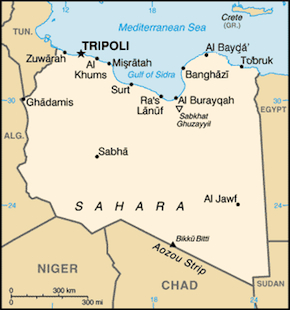 Corporations from around the world displayed their expertise in exploration, production, refining and services at a four-day conference in the war-torn country, called Oil & Gas Libya 2012. The interim Libyan government has said decisions on such issues of business contracts for exploration and production will begin after June elections for a national assembly.
http://www.aljazeera.com/news/africa/2012/04/2012425134112668493.html
Foreign Oil Corporations Vie for Libyan Oil as New Government Takes Shape
New contracts and production will begin after June elections on a national assembly
by John Glaser, April 25, 2012
Foreign oil companies are vying for a piece in Libyan oil as the new government begins to take shape according to the industry’s interests which recognize Libya as possessing Africa’s largest crude oil reserves.
Corporations from around the world displayed their expertise in exploration, production, refining and services at a four-day conference in the war-torn country, called Oil & Gas Libya 2012. The interim Libyan government has said decisions on such issues of business contracts for exploration and production will begin after June elections for a national assembly.
Meanwhile, persistant instability in the country resulting from continued fighting among armed tribal factions and no true government to speak of is making oil corporations anxious.
“(We need) a stable environment … security. We also need answers to questions about what will be the role of IOCs (international oil companies) in the future,” said Jean-Daniel Blasco of France’s Total. ”What will be the relationship between the ministry and National Oil Corporation? When will the next exploration rounds be issued? … will EPSA 4 remain the model for future exploration? These are the main questions.”
The intense lobbying and focus on the oil sector has “given more power to the oil ministry and carved up the responsibilities of the state’s National Oil Corporation,”reports Reuters. The close connection between these business interests, the government of the domestic nation, and the foreign policies of more powerful Western nations is likely to develop in a similar fashion that it has throughout the region.
and note the NTC just passed a law banning religious parties - i.e. the Muslim Brotherhood's Freedom and Development Party....
| Libya bans religious parties from politics | |
National Transitional Council issues law banning parties based on religion, drawing concern from Islamic organisations.
Last Modified: 25 Apr 2012 17:01
| |

Libya is gearing up for the country's first post-Gaddafi general elections to choose a 200-member assembly [Reuters]
| |
| Libya's ruling National Transitional Council (NTC) has issued a new law that bans parties that are based on religious principles, the council spokesman said.
The law, which was passed on Wednesday, comes two months ahead of the country's first general elections to choose a 200-member assembly tasked with writing a new constitution and forming a government.
The surprise move was immediately denounced by Islam-oriented parties that are preparing to compete in the June elections. NTC spokesman Mohamed al-Hareizi said the provision, included in a law which governs the formation of political parties, was designed to preserve "national unity". "Parties shouldn't be based on ethnic or religious ideologies," he said. "We don't want the government to be divided by these ideological differences." He did not make clear how this would affect a political party formed in March by Libya's Muslim Brotherhood and other religious groups. The new party was expected to make a strong showing in the election, the first since last year's overthrow of Muammar Gaddafi in a NATO-backed popular uprising. 'Not democracy' "This is not democracy," said Mohamed Gaira, spokesman for the Freedom and Development party founded by the Muslim Brotherhood earlier this year. "We don't understand this law ... It could mean nothing, or it could mean that none of us can participate in the election,'' he added. "We are a nationalist party and Islam is our religion. This law is unacceptable and only suits liberals." Mohamed Sawan, the head of the Freedom and Development Party, said the NTC needed to make it clearer what it meant by banning religious parties. He said this would cause controversy in conservative Libya, whose population of six million is made up almost entirely of Sunni Muslims. "This kind of clause is only useful in countries where there exists many religions, not in Libya where most people are religious Muslims," Sawan told Reuters. "This law needs to be reviewed by the NTC and if it's not changed, we would have to protest it." Libya's NTC has already indicated that the country will be run in accordance with sharia, though the exact place of Islamic law in the legal system will be settled only once a new constitution is written after elections.
|


http://www.reuters.com/article/2012/04/25/libya-oil-idUSL6E8FKHB320120425
TRIPOLI, April 25 (Reuters) - Libya's first post-war oil and gas exhibition attracted dozens of foreign companies to Tripoli this week, avid to win new business and hopeful that questions about contracts and security will ultimately be resolved in their favour.
After a virtual shutdown last year, Libyan oil output has climbed to near pre-war levels of 1.6 million barrels per day since the conflict that ousted Muammar Gaddafi ended, but concerns remain over security and how the North African country's new rulers will treat foreign companies.
Libya needs foreign investment and expertise to increase oil and gas production. But uncertainty about existing contracts and about the terms of any new deals will persist until a clearer landscape emerges after June elections for a national assembly.
"(We need) a stable environment ... security. We also need answers to questions about what will be the role of IOCs (international oil companies) in the future," Jean-Daniel Blasco, vice president North Africa for exploration and production at France's Total, told a conference that ran alongside the exhibition.
"What will be the relationship between the ministry and National Oil Corporation? When will the next exploration rounds be issued? ... will EPSA 4 remain the model for future exploration? These are the main questions," he said, referring to Libya's last exploration and production sharing agreement programme.
The interim government has set up a committee to look into corruption allegations in the Gaddafi regime. Its determinations could lead to the reworking of lucrative deals in the OPEC member, which has Africa's largest crude oil reserves.
Meanwhile, a shake-up of the sector has given more power to the oil ministry and carved up the responsibilities of the state's National Oil Corporation (NOC).
"We are cooperating with the committee, we gave them all the information we have," Oil Minister Abdulrahman Ben Yazza told Reuters. "We hope they will finish their work soon and give out all the information needed."
When asked about the next potential offering of blocks or contracts, he said: "We are studying this matter and we will (talk) about this soon."
INCREASING FUTURE PRODUCTION
The government has reiterated there will be no new deals until after the polls and that it is too early to say what future contracts would look like. In the meantime, businesses are ensuring they make themselves well known on the ground.
Companies from around the world exhibited their expertise in exploration, production, refining and services at the four-day Oil & Gas Libya 2012, which runs until Thursday. Among them were Total, Repsol, Wintershall and Statoil , already among the biggest firms already operating in Libya.
Repsol expects to reach its pre-war Libyan output of 340,000 bpd by summer. It hopes for a rise to up to 380,000 bpd in coming years, Nemesio Fernadez-Cuesta, upstream director, said.
"A lot of Libyan people know they need the international oil companies for financing, added technology, and we don't foresee any major problems," he told Reuters. "This process (regime change) can generate some difficulties, but we think we will be able to deal with them."
Unlike in Iraq, the scale of the damage in Libya was limited, although oil officials have cited the need for maintenance and upgrades after fields were hastily shut down. That means potential business for the numerous European and Middle Eastern engineers, consultants and others at the exhibition.
"We hope to re-establish a lot of contacts with Libyan clients, existing and new," Erik Huber, of Dutch engineering and environmental consultancy Royal Haskoning, said. "We trust that there will be a lot of investment in the Libyan oil industry."
But behind the public statements of optimism, worries are evident. Protesters in Benghazi closed off the office of NOC subsidiary the Arabian Gulf Oil Co on Monday and Tuesday, and their demands included the ouster of Gaddafi-era officials.
"The problem is that some people want a clean cut from before (the Gaddafi-era), but some are needed for their expertise. Getting through change is key," a European oil executive said. "We just have to be patient for now."
Security also remains one of the biggest concerns of foreign companies returning to Libya. The numbers of expatriate workers still have yet to return to pre-war levels.
Officials speak of plans to train thousands of former rebel fighters under an umbrella oil installation guard. Groups of fighters have stood guard in the absence of an effective army.
"One of my biggest concerns is that fighting, such as tribal clashes, can easily start," a Libyan worker at a European oil and gas company said. "The situation is still unstable." (Additional reporting by Ali Shuaib, editing by Jane Baird)


No comments:
Post a Comment