| Australia to end Afghan mission in 2013 | |||||||||||||||||||||
Prime minister Julia Gillard announces plans for troops' exit a year before 2014 deadline for international withdrawal. Last Modified: 17 Apr 2012 09:02 | |||||||||||||||||||||
 Most of Australia's forces are stationed in the central province of Uruzgan [GALLO/GETTY] | |||||||||||||||||||||
| Australia has announced that its troops will be withdraw from Afghanistan nearly a year ahead of a previously scheduled 2014 withdrawal date. Julia Gillard, the Australian prime minster, said on Tuesday that most of 1,550 remaining Australian troops in Afghanistan were expected to return home by the end of 2013. That timetable would see the largest force provided by any nation outside of the NATO alliance leave the country a year ahead of the proposed December 2014 withdrawal date for all international forces.
"This is a war with a purpose. This is a war with an end," Gillard said in a speech to the Australian Strategic Policy Institute in Canberra. "We have a strategy, a mission and a timeframe for achieving it." The deaths of Osama bin Laden and many of al Qaeda's senior officials, along with general improvements in security were cited as reasons for the accelerated withdrawal. Gillard has said that she will take the proposed timetable to a NATO summit on Chicago on May 20 where she is also expected to sign a partnership agreement with Afghan President Hamid Karzai. Citing mid-2013 as a milestone period for the international presence in Afghanistan, Gillard also said that she expected the Afghan President Hamid Karzai to make an announcement on transition in Uruzgan and other provinces in the coming months. Al Jazeera's Bernard Smith, reporting live from Kabul, says Gillard is "just pre-empting Hamid Karzai" in his statement about which regions of the nation will be handed over to Afghan security forces. The prime minister said she expected the handover of the central province to Afghan forces to take 12 to 18 months, at which point, the Australian presence in Afghanistan "wll look very different to that which we have today". "We will have completed our training and mentoring mission. ... And the majority of our troops will have returned home", Gillard said.
and.... Karzai Slams NATO Intelligence Failures in Kabul Attacks18-Hour Siege of Capital Comes to an Endby Jason Ditz, April 16, 2012 In the midst of the 18-hour siege of the Afghan capital city of Kabul, during which virtually every heavily defended site in the city was struck at least once, Afghan President Hamid Karzai is calling for an investigation into how such a massive, coordinated attack could be carried out entirely by surprise. 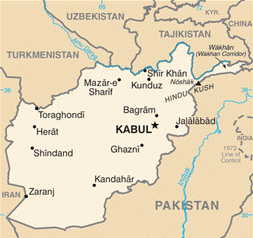 In his statement, Karzai faulted his own intelligence agency, but said that the failure was “especially for NATO,” which of course has a much larger presence in the country. Not only was NATO caught unawares; it was issuing statements about the attack being over in the middle of the fighting. In his statement, Karzai faulted his own intelligence agency, but said that the failure was “especially for NATO,” which of course has a much larger presence in the country. Not only was NATO caught unawares; it was issuing statements about the attack being over in the middle of the fighting.Early on NATO was largely absent from the fighting, leaving the Afghan forces and the guards for the respective embassies on their own. Overnight, however, NATO attack helicopters began strafing the area around the British and German embassies, apparently trying to flush out militants hiding at a nearby construction site. In the end NATO issued largely the same statements that it did when the fighting was still ongoing, praising the Afghan Army for handling the conflict more or less by themselves. Whether 18 hours of combat in the most heavily defended part of the country amounts to “handling” the situation is less apparent, however, and there seems to be serious doubt over security in the capital going forward. Afghan officials say the attack wasn’t even carried out by the Taliban itself, reporting that they arrested a “facilitator” for the strike and he implicated the Haqqani Network, a Pakistani based faction with ties to the Taliban, but which operates more or less independently of it. and..... Another Afghan Soldier Opens Fire on NATO Troops, Killed in Return FireThe attack caps off a weekend of violence in the Taliban's spring offensiveby John Glaser, April 16, 2012 An Afghan soldier was shot dead on Monday after opening fire on NATO troops inside a military base near Kandahar, in the latest in a trend of such attacks highlighting the failure of the training mission in Afghanistan. 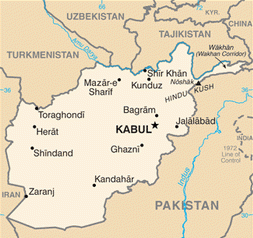 “An army soldier has opened fire on ISAF [International Security Assistance Force] vehicle to kill troops,” General Abdul Hameed Hameed, Afghan army commander for southern Afghanistan, told AFP. “An army soldier has opened fire on ISAF [International Security Assistance Force] vehicle to kill troops,” General Abdul Hameed Hameed, Afghan army commander for southern Afghanistan, told AFP.No NATO troops were killed, although about 17 foreign troops – including at least seven Americans – have been shot dead by Afghan security personnel in the past three and a half months. As opposition to the war in Afghanistan reaches record highs in the U.S., this latest attack comes at the end of a weekend onslaught of insurgent violence, opening the Taliban’s annual spring offensive. Nearly 50 people died from the attacks over the weekend. and finally...... Afghanistan: Is Karzai Peace Plan a No-Go?Is Afghanistan a House of Cards, Just Waiting to Fall?…by Khalil Nouri STAFF WRITER / EDITOR High vantage points - a standard Taliban tactic The wave of coordinated attacks unleashed by the Taliban militants in Afghanistan on Sunday targeting Parliament and eastern cities gives a grim realization that Western backed Afghan President Mr. Karzai’s staked peace deal efforts with the Taliban aren’t working. But the real question is whether the fragile empire that Mr. Hamid Karzai has built will stay seamed together when international troops begin to leave Afghanistan in 2014 – or will it be swept aside by dangerous political fractures opened up by his efforts to negotiate peace with the Taliban? Evidently, Mr. Karzai’s pursuit of peace was, from the outside, driven by political pragmatism, not high principle. From 2006, the Taliban began a relentless assassination campaign targeting traditional tribal leaders in the Kandahar region (Mr. Karzai’s traditional power-base).
Although vote rigged, the 2009 elections made evident that Hamid Karzai had little support among southern Afghanistan’s ethnic Pasthuns. His victory against key rival Abdullah Abdullah was secured because of support from ethnic minorities; those grouped around the warlords akin to Haji Muhammad Mhaqiq, and those loyal to Abdul Rashid Dostum.  Is the finger in the wind an effective policy? In a desperate effort to rebuild his political foundations, Mr. Karzai turned to the networks of Mr. Rabbani’s Jamaiat-e-Islami – the centerpiece of the Islamist movement; which, from the 1970’s dethroned Afghanistan’s traditional elite; and now, the son of slain Rabbani, Salahuddin Rabbani is in the driver seat to weld the fruitless peace process. Mr. Karzai also sought help from Gubuddin Hekmayar’s Hezb-e-Islami, a party which though still ostensibly insurgent, has proxies in the political system. Inside the Kabul palace—as it became clear western forces would draw down in 2014 — figures considered close to Pakistan acquired critical importance; among them, his chief of staff Abdul Karim Khurram. From 2010, Mr. Karzai initiated an ever-more desperate search for peace with the Taliban and alienating large swathes of the opposition. Even though Pakistan proved unwilling, or unable, to rein in Taliban operating from its soil, Mr. Karzai continued to reach out; hoping a deal could be struck.
The recent attacks were a great embarrassment for the Afghan government, despite the allegation that they were directed by the Pakistani intelligence apparatus; which like Mr. Karzai’s usual blame game on others, particularly NATO, was not accepted by the majority in the wake of the incident.  Multiple car bomber attacks - another standard tactic Having recently praised the direction of Special Forces night raids away from US control, the infiltration of fighters equipped with rocket-propelled grenades, suicide vests and machine guns inside Kabul’s secured green zone must obviously count as a major security lapse. In fact, it will be a moment of re-evaluation for representatives of Afghanistan’s ethnic minorities who have been in talks to build a united front ahead of the 2014 elections—hoping to create a broad coalition that could include leaders from the south, like United States-based scholar Ali Ahmad Jalali and even a royalist Hamayoon Shah Asifi. In the last ten years, many more people in Afghanistan have developed deep interests in the need for keeping the peace. There are businessman and contractors with stakes in the system; young people who have invested in their education; even orphanages who already face charity contribution hurdles; and the list goes on for many whose businesses will be disrupted by ongoing war.
|
Tuesday, April 17, 2012
Follow up on the after math of this sunday's earthquake attack in Kabul - not because of the number of casualties , but the symbolism of this attack at this point in time.....


Subscribe to:
Post Comments (Atom)
No comments:
Post a Comment