http://www.cnn.com/2013/02/12/world/meast/turkey-syria-blast/index.html
http://www.debka.com/article/22758/Syrian-jets-bomb-northern-air-base-seized-by-Islamist-led-rebels

and....
http://www.guardian.co.uk/world/2013/feb/11/syrian-minister-meet-opposition-leader
 But just because nothing is happening doesn’t mean the military can’t scaremonger, with Israeli military officials saying that the calm is “deceptive” and that terror attacks from Syrian rebels or regime are “only a matter of time.”
Syrian opposition: Turkish border blast was an assassination attempt
updated 9:46 AM EST, Wed February 13, 2013

STORY HIGHLIGHTS
- An explosion at a Turkish border gate kills at least 14 people
- A Syrian National Council delegation was supposed to be at the gate, a member says
- The group was en route to meet with rebel Free Syrian Army commanders
- It's not clear who committed the attack, the deadliest in Turkey since the Syrian civil war started
Cilvegozu, Turkey (CNN) -- A Syrian opposition group says it was the target of a deadly blast at a Turkish border gate near Syria on Monday that left at least 14 people dead and 28 wounded.
"When the explosion happened, we were supposed to be there. But we were delayed for maybe half an hour," said George Sabra, a leader of the opposition Syrian National Council.
Sabra said he was part of a 13-member group from the council's executive bureau that was traveling from Turkey to Syria on Monday to meet with commanders of the rebel Free Syrian Army."We stopped at a gas station, and some of our group went to a small mosque to pray there for half an hour," Sabra said. "My mother always said to me, 'God bless you.' Maybe this time He responded to her."
Their journey through the Turkish border gate at Cilvegozu was delayed by a prayer.
Their journey through the Turkish border gate at Cilvegozu was delayed by a prayer.
"We stopped at a gas station, and some of our group went to a small mosque to pray there for half an hour," Sabra said. "My mother always said to me, 'God bless you.' Maybe this time He responded to her."
Dozens of other Syrians and Turks at the border crossing were not so fortunate.
On Monday afternoon, Turkish officials said, a minivan drove from the Syrian rebel-controlled side of the border compound and parked next to the first Turkish checkpoint.
Later, that vehicle blew up.
http://www.debka.com/article/22758/Syrian-jets-bomb-northern-air-base-seized-by-Islamist-led-rebels
Syrian jets bomb northern air base seized by Islamist-led rebels
DEBKAfile Special Report February 12, 2013, 10:48 PM (GMT+02:00)
Hangar at the Syrian al-Jarra airfield
Tuesday night, Feb. 12, the Syrian Air Force began bombing the large al-Jarra air base which rebels led by Islamist battalions conquered near the northern city of Aleppo. Bashar Assad has ordered the destruction of the dozens of fighter-bombers on the ground in the captured base. Most are Czech-made L-29 trainer planes which his air force has been using to pound rebel positions in built-up areas of the cities. But still in hangars are also Sukhoi Su-22M bombers and Mig-23 interceptors which too have been pressed into service for striking rebel-held territory.
The loss of the al-Jarra air base is a major blow for Assad’s forces, depriving them of the ability to hunt down and wipe out rebel forces from the air. Now the remnants of his air force are entrusted with somehow destroying their own planes, which are housed in bomb-proof hangars of the captured air facility.
The loss of the al-Jarra air base is a major blow for Assad’s forces, depriving them of the ability to hunt down and wipe out rebel forces from the air. Now the remnants of his air force are entrusted with somehow destroying their own planes, which are housed in bomb-proof hangars of the captured air facility.
As for the rebels celebrating their feat in those hangars, they might have used the air fleet they seized to bomb the presidential palace in Damascus, except that none of them are trained fliers. What they have done is to launch a recruitment campaign in Muslim countries for air crews with experience in flying Russian-made warplanes and helicopters.
Their headhunters are scouring the former Soviet republics and East Europe with large Muslim communities for Muslim pilots who served in the air forces of their own countries. Even those trained fighters, however, never served on advanced Sukhois or Migs, only on light trainers.
In Damascus, DEBKAfile’s military sources report that the 4th Division (which acts as the Republican Guard) managed Tuesday to shore up the defensive lines that the rebels had breached in the eastern sector in the last day or two and throw back their advance into the heart of the capital. The rebels can only shell the Jobar district of central Damascus from outside, but are prevented from breaking through to their ultimate target.
In Damascus, DEBKAfile’s military sources report that the 4th Division (which acts as the Republican Guard) managed Tuesday to shore up the defensive lines that the rebels had breached in the eastern sector in the last day or two and throw back their advance into the heart of the capital. The rebels can only shell the Jobar district of central Damascus from outside, but are prevented from breaking through to their ultimate target.
DEBKAfile’s sources and most Western observers sources fear that as his setbacks in battle pile up, the Syrian ruler is likely to decide that the only way to save his regime is to turn his chemical weapons against the rebel forces.
and....
http://www.guardian.co.uk/world/2013/feb/11/syrian-minister-meet-opposition-leader
Syrian minister offers to meet opposition leader overseas
Ali Haidar raises prospect of free elections in response to surprise change of line by Syrian National Coalition leader
 Email
Email
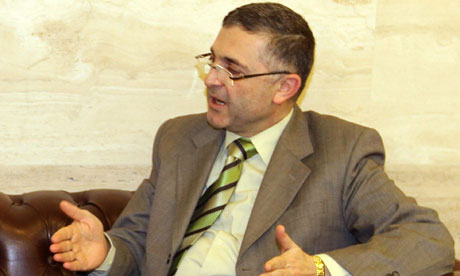
Ali Haidar, Syria's minister for national reconciliation, has a reputation as a softliner in the regime. Photograph: Louai Beshara/AFP/Getty Images
The Syrian government is ready to send a minister abroad for talks with Moaz al-Khatib, leader of the opposition Syrian National Coalition, who recently threw rebel politics into turmoil by coming out in favour of dialogue with the regime.
"I am willing to meet Mr Khatib in any foreign city where I can go in order to discuss preparations for a national dialogue", Ali Haidar, the minister for national reconciliation, told the Guardian. His remarks were the most positive response the Syrian government has yet given to the opposition leader's surprise change of line.
Exiles and their affiliated armed groups have long said they would never talk to the regime unless Bashar al-Assad first left office. Their leader's switch has been severely criticised by some of his colleagues because the coalition's charter states it will not talk to the regime except about its departure.
In explaining the purpose of the national dialogue, Haidar raised the prospect of a genuine contest for a multiparty parliament and for the presidency when Assad's mandate runs out next year.
"The dialogue is a means to provide a mechanism for reaching free parliamentary and presidential elections. This is one of the subjects which will be discussed at the table. Such a thing could be the result of negotiations, but not a precondition," he said. "We reject a dialogue that is just to hand power from one side to another."
Assad offered talks with opposition leaders in a speech last month. But he appeared to rule out any contact with the Syrian National Coalition, which was put together under US, Turkish and Qatari pressure in Doha last summer in an attempt to unite the disparate opposition groups.
"Who do we conduct dialogue with? Those who are carrying extremist thinking and do not believe in anything except blood, killing and terrorism? Should we speak to gangs that receive their orders from abroad to reject dialogue because they believe that dialogue will foil their schemes aimed at weakening Syria?" Assad said.
Khatib's political bombshell came three weeks later, prompting debate in Syrian government circles. They also noted last week's revelations that Barack Obama rejected Pentagon and state department recommendations to arm the opposition. The US has since come out in support of Khatib's initiative, and there is speculation in Damascus that it was co-ordinated in advance with Washington.
Haidar's offer to meet the coalition leader is clearly designed to prevent Khatib's initiative from collapsing under resistance from rebel colleagues. Haidar pointed out that like other regime ministers he was banned from the EU under sanctions, but said Geneva was a possible venue for preliminary talks. "But we insist that the actual national dialogue take place on Syrian soil because it is a matter of Syrian dignity," he added.
He recognised that exiled politicians were concerned about being arrested if they returned to Syria. In announcing his shift toward negotiations, Khatib demanded the government renew the passports of all Syrians who were overseas so they ceased to be stateless. Haidar said the justice ministry had already started taking steps to cancel any proceedings against Syrians overseas.
"The ministry of the interior has agreed to relax its policies and give them all the necessary documents to return and let them in even if they don't have any. I don't want to close the door to any opposition people who have concerns. I personally invite anyone to return and guarantee their safe entry and departure, if that's what they want," Haidar said.
He made it clear the new impetus for negotiations came not just from Khatib's policy switch but from a change in the regional and international climate, as well as because of the military stalemate. "There are hardliners on both sides but 80% on each side now realise that no military victory is possible. I'm in contact by phone with some leaders of the Free Syrian Army and they used to say, 'We'll be in Damascus in a few days' time,' but today they say, 'We've found out that the international community is playing games with us and working for their own interests only so we realise we can't defeat the Syrian army,'" he said.
In spite of the Syrian government's apparent readiness to talk to representatives of the armed opposition, differences remain over the shape of any transition. Russia, the US and several other key players including Britain and France agreed in Geneva in June that one element should be the appointment of a coalition government that could include members of the opposition as well as the present government and would have "full executive powers".
When Lakhdar Brahimi, the special envoy of the UN and the Arab League, saw Assad in December, the issue appeared to be a sticking point. Brahimi later told the UN security council this meant there would be no role for Assad in the transition. His remarks caused anger in Damascus, with the foreign ministry accusing him of being "flagrantly biased" and al-Watan, a pro-government newspaper, calling him "an ageing tourist".
Members of his team who are based in Damascus have been trying to discover whether he can return to Syria. Asked by the Guardian whether the Brahimi mission was dead, Haidar denied it, but accused the envoy of not being straightforward.
"In his discussions here it was Brahimi who said it was a bit early to form a government. His point was that it's not possible because there are so many factions in opposition in exile who are not yet ready to participate. Unfortunately, when he left Syria we heard something else from him," Haidar said. "There were contradictions in his statements which weakened his position of being equidistant from all Syrians. We wouldn't say his mission has completely failed but he has to regain his previous position of equidistance."
Haidar's conciliatory views confirm his reputation as a regime dove. As leader of the Syrian Social Nationalist party, a small opposition party, he was among a group published the Damascus declaration, a manifesto for democratic reform and radical political change, in 2005. Some were jailed and others went into exile. He remained in Damascus and was appointed a minister in 2011. He continues to have differences with the regime and during last year's referendum on a new constitution he appeared three times on state TV calling on voters to reject it.
Under the constitution Assad would be entitled to put himself forward for a new term next year, after two terms in office. Haidar suggested Assad should do so unless the national dialogue resulted in major changes. "Personally I have not discussed this with the president. But the current constitution does not prevent him running. As a Syrian citizen he has the right like any other citizen," he said.
And as the West pulls back , it falls on Israel to step forward ......
Israeli Military Predicts Terror Attacks on Syria Border, Blames Assad
Insists Assad's Criticism of Recent Attacks Fuel 'Anti-Israel Aggression'
by Jason Ditz, February 11, 2013
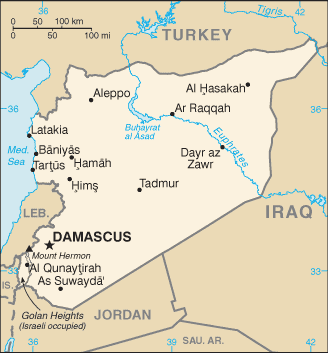
With Syria engaged in an ugly and ever-worsening civil war, the border with Israel and the huge Israeli-built fence several miles into internationally recognized Syrian territory, remains calm.
But just because nothing is happening doesn’t mean the military can’t scaremonger, with Israeli military officials saying that the calm is “deceptive” and that terror attacks from Syrian rebels or regime are “only a matter of time.”
The terror attacks, which again one must be reminded aren’t actually happening, are being preemptively blamed on Syrian President Bashar Assad, and his criticism of recent Israeli air strikes against his country.
The logic is that Assad’s criticism, and his accusation that Israel is backing the rebels with such attacks, is fueling “anti-Israel aggression” that will lead to attacks at some non-specified point in the future by some non-specified combatant force.


No comments:
Post a Comment