http://www.infowars.com/israel-threatens-syria-intervention-over-chemical-weapons/
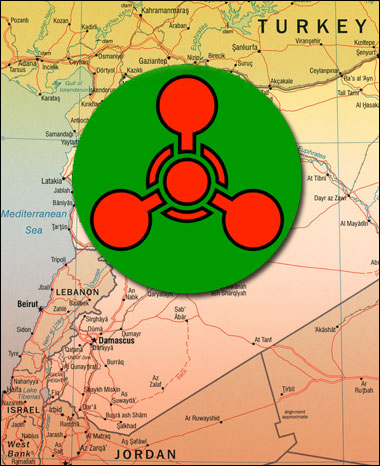 It is reminiscent of the excuse given to invade Iraq in 2003 – Israel will consider the “military option” in Syria to make sure its chemical weapons do not “reach the hands of extremists,” according to the Times of Israel.

http://www.blacklistednews.com/Iran_Launch_Submarine_and_Destroyer_into_Gulf_During_US_Naval_Exercises_/22069/0/0/0/Y/M.html
Charles KennedyOilprice.com
and.....
 Submitted by Tyler Durden on 10/17/2012 15:19 -0400

http://www.defense.gov/news/newsarticle.aspx?id=118239
Israel Threatens Syria Intervention Over Chemical Weapons


Kurt Nimmo
Infowars.com
October 17, 2012
Infowars.com
October 17, 2012
It is reminiscent of the excuse given to invade Iraq in 2003 – Israel will consider the “military option” in Syria to make sure its chemical weapons do not “reach the hands of extremists,” according to the Times of Israel.
“Israel will do everything it takes to ensure Syria’s chemical weapons do not fall into the hands of terrorist organizations – and if such a situation arises, then Israel will weigh a military option,” Netanyahu told a group of European ambassadors in Jerusalem. He said Hezbollah has aided Syrian leader Bashar al-Assad.
In August, rebels supported by the CIA and MI6 and funded by Saudi Arabia and Qatar said they had seizedSyrian weapons “that were converted to carry non-conventional warheads and which can be equipped with chemical or biological warheads.”
The Supreme Military Council of the Syrian rebels called on Arab countries and the international community to immediately intervene in order to protect the lives of the Syrian people “before the regime moves to a new level of crimes, which will have tragic consequences for the entire region.”
Syria admits possessing chemical weapons and al-Assad has said he will only use them if his country is invaded. “All of the stocks of these weapons that the Syrian Arab Republic posses are monitored and guarded by the Syrian army,” Foreign Ministry spokesman Jihad Makdissi said in July. “These weapons are meant to be used only and strictly in the event of external aggression against the Syrian Arab Republic.”
Despite al-Assad’s admission, Syrian Foreign Minister Walid Moallem said the United States is using chemical weapons as an excuse to invade the country.
“The claim that we have chemical weapons is an American invention aimed at pressuring the regime in Damascus. The Americans said the same about Iraq just to have an excuse to invade its territory,” Moallem said in an interview with Syrian media on the sidelines of the UN General Assembly in New York.
Syria’s fears were heightened when the United States sent a specialized military team to Jordan under the pretext of monitoring its chemical weapons. The Italian News Agency reported on October 14 that British troops had joined the Americans in Jordan and French troops may also be operating on the Syrian border “on concerns over Syria’s chemical weapons arsenal.”NATO boss Anders Fogh Rasmussensaid on October 1 that Syria’s chemical weapon stockpiles are a “great concern” and NATO was monitoring the situation closely.
On Wednesday, while speaking at a NATO conference of defense ministers in Brussels, Defense Secretary Leon Panetta said the U.S. is working with Jordan to monitor chemical and biological weapons sites in Syria, according to the Associated Press.
“As we’ve said before, we have been planning for various contingencies, both unilaterally and with our regional partners,” Pentagon press secretary George Little said in a written statement delivered from Paris. “There are various scenarios in which the Assad regime’s reprehensible actions could affect our partners in the region. For this reason and many others, we are always working on our contingency planning, for which we consult with our friends.”
Netanyahu’s comments signal that Israel may get the ball rolling on a Syrian intervention under the guise of protecting Israel from a chemical attack.
“The growing fear is that extremist fighters and other groups may get their hands on Syria’s vast chemical and biological weapons stockpiles if Assad falls. The threat of the weaponry falling into rebel hands has grown as the uprising has intensified in recent months,” the Times of Israel reports.
Israel has threatened to attack Syria’s alleged chemical weapons in the past.
and as for any ceasefire , will the rebels go along - who speaks for the rebels anyway ???

and as for any ceasefire , will the rebels go along - who speaks for the rebels anyway ???
UN Syria envoy calls for regime ceasefire amid doubts over rebels’ unity on issue
Published: 17 October, 2012, 21:55
TRENDS:
Syria unrest
Syria unrest
A handout picture released by the Lebanese photo agency Dalati and Nohra shows United-Nations Envoy to Syria Lakhdar Brahimi speaking during a joint press conference with Prime Minister Najib Mikati at the governmental palace in Beirut on October 17, 2012. (AFP Photo/Dalati & Nohra)
and.......
Russian S-400s relocated near Turkey. Hizballah shifts units, rockets into Syria
DEBKAfile Exclusive Report October 17, 2012, 9:35 PM (GMT+02:00)

Hizballah missile on the move into Syria
Hizballah has begun depleting line of rockets and fighting units it has facing Israel from the Litani River of South Lebanon and moving them to the Syrian front line at Homs to strengthen Assad’s forces, DEBKAfile's military sources reveal. Hizballah’s forward line against Israel is still in place among the southernmost Shiite villages, but a part of their artillery back-up is gone and, for the first time, Hizballah’s ground-to-ground rockets are moving in an eastward direction into Syria. This is a striking reversal of the usual direction taken by Hizballah hardware which, for years, headed from east to west to reach Lebanon from Iran and Syria.
This step attests to the scope, fury and determination of the Syrian army’s current land and air offensive against the rebels.
It also means that Hizballah has no fear of Israeli retaliation for the infiltration of an Iranian stealth drone from Lebanon into its air space on Saturday, Oct. 6 - even after HIzballah leader Hassan Nasrallah promised more unmanned interlopers would intrude on Israel’s skies.
Tuesday, Oct. 16, America’s UN Ambassador Susan Rice told a Security Council meeting on the Middle East that Nasrallah’s fighters were now part of “Assad’s killing machine.” Hizballah’s leaders, she said, continue to plot with Iran new measures “for propping up a murderous and desperate dictator.”
This step attests to the scope, fury and determination of the Syrian army’s current land and air offensive against the rebels.
It also means that Hizballah has no fear of Israeli retaliation for the infiltration of an Iranian stealth drone from Lebanon into its air space on Saturday, Oct. 6 - even after HIzballah leader Hassan Nasrallah promised more unmanned interlopers would intrude on Israel’s skies.
Tuesday, Oct. 16, America’s UN Ambassador Susan Rice told a Security Council meeting on the Middle East that Nasrallah’s fighters were now part of “Assad’s killing machine.” Hizballah’s leaders, she said, continue to plot with Iran new measures “for propping up a murderous and desperate dictator.”
The Assad regime has found succor in another, more powerful quarter: Moscow has announced the deployment starting Wednesday, Oct. 17, of advanced S-400 interceptor missile batteries in Russia's southern military region opposite Turkey.
Russian military spokesman Col. Igor Gorbul described those missiles as “targeting Turkey” against its involvement in NATO’s missile shield program. He emphasized that the S-400s are capable of destroying all types of airplanes, as well as ultra-stratospheric and ballistic missiles.
Russian military spokesman Col. Igor Gorbul described those missiles as “targeting Turkey” against its involvement in NATO’s missile shield program. He emphasized that the S-400s are capable of destroying all types of airplanes, as well as ultra-stratospheric and ballistic missiles.
DEBKAfile's military sources say that, beside the issue of the NATO missile defense system to which Russia is firmly opposed, Moscow is relaying a double warning to Ankara on two additional scores:
One, that any more interceptions of Syria-bound aircraft coming from Russia after the incident of Oct. 10 would bring forth a Russian military response; and two, that Moscow will not tolerate aerial intrusion in the Syrian conflict by Turkey or any other NATO member. This warning was directed specifically against the imposition of a no-fly zone over Syria which Turkey is in the process of enforcing.
Col. Gorbul said the Russian army would finish relocating the S-400 interceptors in their new positions by the end of the year.
Col. Gorbul said the Russian army would finish relocating the S-400 interceptors in their new positions by the end of the year.
( meanwhile chess pieces moving into place , should be set up next week....)
Iran Launch Submarine and Destroyer into Gulf During US Naval Exercises
October 18, 2012Charles KennedyOilprice.com
This week the US, UK, France, and a few Middle Eastern countries are conducting naval exercises in the Gulf of Persia to practice clearing mines that Iran, or other groups may place around the Straits of Hormuz in an attempt to disrupt the movement of oil tankers in the region.
Mohammed Ali Jafari, the commander of the Islamic Revolutionary Guard Corps, said that the “exercise is a defensive exercise and we don't perceive any threats from it. We are not conducting exercises in response.”
Yet this is not the impression that is given.
Just yesterday, according to the official IRNA news agency, upon the direct orders of Supreme Leader Ayatollah Ali Khamenei Iran launched a refitted Tareq-901 submarine and a Sahand destroyer into the Gulf from the port of Bandar Abbas.
At the same time, as stated on Khamenei’s official website, the Supreme Leader was visiting the northern coastal city of Nowshahr to observe naval cadets practice planting mines, rescuing hijacked ships, destroying enemy ships, and rapid deployment via helicopters.
Khamenei addressed his troops, saying that “the armed forces must reach capabilities such that no one can attack the strong fence of the country and the dear people of Iran.”
Israeli Prime Minister Benjamin Netanyahu announced on Sunday that Tehran is now very close to building a nuclear bomb, leading some to fear that Israel may take things into their own hands and strike against Iranian nuclear facilities.
Mohammed Ali Jafari, the commander of the Islamic Revolutionary Guard Corps, said that the “exercise is a defensive exercise and we don't perceive any threats from it. We are not conducting exercises in response.”
Yet this is not the impression that is given.
Just yesterday, according to the official IRNA news agency, upon the direct orders of Supreme Leader Ayatollah Ali Khamenei Iran launched a refitted Tareq-901 submarine and a Sahand destroyer into the Gulf from the port of Bandar Abbas.
At the same time, as stated on Khamenei’s official website, the Supreme Leader was visiting the northern coastal city of Nowshahr to observe naval cadets practice planting mines, rescuing hijacked ships, destroying enemy ships, and rapid deployment via helicopters.
Khamenei addressed his troops, saying that “the armed forces must reach capabilities such that no one can attack the strong fence of the country and the dear people of Iran.”
Israeli Prime Minister Benjamin Netanyahu announced on Sunday that Tehran is now very close to building a nuclear bomb, leading some to fear that Israel may take things into their own hands and strike against Iranian nuclear facilities.
and.....
http://www.zerohedge.com/news/2012-10-17/us-aircraft-carrier-john-stennis-arrives-iran
US Aircraft Carrier John Stennis Arrives By Iran
Ten days ago, when we last tracked the progress of the third US aircraft carrier, CVN-74 Stennis, with destination Arabian Gulf, aka Iran, we reported that it was "within a week of reaching" its destination. Sure enough, as the latest Stratfor naval update confirms, CVN-74 has now reached its destination for which it was commissioned several months prematurely. But before you get your war hats out, note that that other aircraft carrier which is conducting its final voyage, the CVN-65 Enterprise, has decided to take a bit of a break and left the Arabian Gulf area for a scehduled R&R port visit in Naples, Italy. In a week or so, shore leave will be over and CVN will be back to join everyone else, at which point the US will finally have three aircraft carriers just off the Iranian coastline ready to rumble.

News
American Forces Press Service
| |
NEWS ARTICLE
|


No comments:
Post a Comment