http://www.zerohedge.com/news/spain-running-out-cash
 Submitted by Tyler Durden on 09/03/2012 21:29 -0400


http://www.guardian.co.uk/business/2012/sep/03/andalucia-seeks-lifeline-spanish-government
http://ftalphaville.ft.com/blog/2012/09/03/1143931/a-draghi-leak/
( In case you wondered why europe saw a pop this afternoon - and why the euro spiked earlier.... looks like rumor mongering is back)

http://www.zerohedge.com/news/eus-poorest-member-country-smacks-down-euro-bulgaria-refuses-join-eurozone
Submitted by Tyler Durden on 09/03/2012 11:43 -0400

and......
http://www.zerohedge.com/news/carpe-diem-quam-minimum-credula-postero
Submitted by Tyler Durden on 09/03/2012 09:36 -0400
“Once more unto the breach, dear friends, once more...”
-William Shakespeare, Henry V
The Battle Of Frankfurt
Tomorrow the Battle of Frankfurt begins. Make no mistake in your thinking as America ends its holiday weekend; it will be a battle and there will be bodies littering the field of engagement. Spain and the rest have aims, plans, schemes if not hopes and ambitions in direct opposition to Germany and her side. The outcomes prayed for are a demand for money and a resistance to those demands. The pleas of Spain are about to be answered; first from the ECB and then from Germany’s acceptance or rejection of the Draghi plan. The “Game of Muddle” will be ended and real answers to real insistences will be given. Spain has demanded money from the ECB to lower its cost of funding, money from the EU for their banks, no conditions for the receipt of either and they are forcing the issue of what it actually means to be part of the European Union. It all comes down to this; money and how much of it and under what circumstances and whether the nations with capital are willing to hand it to their neighbors and watch their credit ratings, their own cost of funding, their standards of living decline to a mean for all of Europe. It will be war; just not one fought with tanks and rifles.
Tomorrow it begins.
and.....
http://www.presstv.ir/detail/2012/09/03/259623/andalusia-to-seek-spain-govt-rescue/
An Andalusia government spokesman, speaking on condition of anonymity, confirmed on Monday that the indebted Spanish region needs a one-billion-euro ($1.3 billion) advance to provide liquidity, AFP reported.
The request makes it the fourth region after Catalonia, Valencia and Murcia to seek rescue money from a special fund set up by Madrid.
Catalonia has already applied for 5bn euros in financial aid.
http://ftalphaville.ft.com/blog/2012/09/03/1142071/trucks-of-cash-and-empty-new-drachma-accounts/
http://ftalphaville.ft.com/blog/2012/09/03/1142361/eurozone-pmis-from-still-bad-to-worse/


and.....
http://www.telegraph.co.uk/finance/debt-crisis-live/9516331/Debt-crisis-live.html
 The course of the Greek economy is one of decline. In 2012, we are expecting a drop in gross domestic product of 7 percent. This will create unemployment of 24 percent level - 1.2 million people.
I don't think this will be a solution to the problem. We can introduce these mechanisms only when everybody plays by the rules, when everybody has demonstrated that they are doing its homework.
The course of the Greek economy is one of decline. In 2012, we are expecting a drop in gross domestic product of 7 percent. This will create unemployment of 24 percent level - 1.2 million people.
I don't think this will be a solution to the problem. We can introduce these mechanisms only when everybody plays by the rules, when everybody has demonstrated that they are doing its homework.
But if, as expected, the court gives a green light on September 12 to the euro zone's permanent bailout mechanism and a pact on stricter budget discipline, it may add conditions that constrain Berlin's power to pursue further European integration.
We are ready to join when you have resolved your problems and when we can say to our people 'we can now safely join'. You can hardly blame us for not wanting to enter while the eurozone is in a grave crisis.
The ECB has itself said it does not have the potential to supervise the European Union's 6,000 banks in the forseeable future.
and from Greece....
Is Spain Running Out Of Cash?
Some hours ago Spain finally bit the bullet, and after months of waffling had no choice but to hand over €4.5 billion (the first of many such cash rescues) in the form of a bridge loan to insolvent Bankia, which last week reported staggering losses (translation: huge deposit outflows which have made the fudging of its balance sheet impossible). As a reminder, in June Spain formally announced it would request up to €100 billion in bailout cash for its insolvent banking system, which subsequently was determined would come from the bank rescue fund, the Frob, which in turn would be funded with ESM debt which subordinates regular Spanish bonds, promises to the contrary by all politicians (whose job is to lie when it becomes serious) notwithstanding. And while Rajoy has promised that the whole €100 billion will not be used, the truth is that considering the soaring level of nonperforming loans in Spain - the biggest drain of both bank capital and liquidity - it is guaranteed that the final funding need for Spain's banks will be far greater. As a further reminder, Deutsche Bank calculated that when (not if) the recap amount hits €120 billion, Spanish total debt/GDP would soar to 97% in 2014 from an official number of 68.5% in 2011 (luckily the endspiel will come far sooner than that). But all of that is well-known, and what we wanted to focus on instead was the fact that bank bailout notwithstanding, Spain will have no choice but to demand a full blown rescue within a few short months for one simple reason: its cash will run out.
Before we dig deeper, a quick reminder: while everyone focuses on the cash generation by the Spanish sovereign, via the almost daily Bill and Bond auctions, what many forget is that the bulk of the proceeds is merely used to refinance existing debt. The remainder goes to fund the actual national deficit (of which there is plenty to go round), and to be deployed via various less than legitimate channels to keep insolvent financial institutions "solvent" until such time as these can become someone else's problem. Namely Germany's. Until that happens however, Spain is facing crunchtime as it has to fund over €40 billion in debt maturities in the next two months alone.

A secondary problem is that not only is Spain still facing a gaping primary deficit, it also has to pay the interest on its rolling refis which as everyone knows, and Rajoy most certainly, areunsustainable in the 6%+ range, not so much standalone, but certainly when juxtaposed with an economy which is collapsing in nominal terms, and is "growing" at a -0.4% growth rate. In other words, compounding the refi issue, is the fact that ever more of the organic growth from the economy has to be paid out to various state creditors.
Add the fact that the economy itself continues to collapse, with unemployment deteriorating with no bottom in sight, only completes the triangle of terror.
Which brings us to Exhibit A: the chart below shows Spain's National Account monthly cash balance, broken into its two subcomponents: the deposits at the Banco de Espana, and the Treasury Liquidity Tenders (columns 11 and 12; full historical breakdown here). The reason we bring it up is that this is the chart that everyone loves to forget.

The chart shows is that in July the Spanish cash balance dropped to €23 billion after hitting a 2012 high of €54 in March. It has plunged straight line since then, unable to repeat last year's July cash surge (when the number was more than double), and if the recent deposit outflow is any indication, the government will have had to plug many bank holes using fungible cash using any means necessary and possible. In other words, once the next Spanish State Liability update is posted, we wouldn't be surprised to see this number plunge to a new post-Lehman low. Yet what is scariest is that all else equal (and it never is), at the current run rate Spain may well run out of cash by the end of the year even assuming it manages to conclude all its remaining auctions through year's end without a glitch.
What all this really means it that any debate over whether Spain needs a bailout is at this point moot. It also means that absent a direct cash injection into the Spanish sovereign, Rajoy will have no choice, but to demand a bailout. What he does subsequently - whether he stays or he goes - will determine if the Spanish transition from a sovereign state to the latest vassal entity of the Troika and, more importantly, Germany will be peaceful (as much as possible) or rather violent.
http://www.guardian.co.uk/business/2012/sep/03/andalucia-seeks-lifeline-spanish-government
Andalucía seeks €1bn lifeline from Spanish government
Spain's most populous region becomes latest to request financial assistance from Madrid
 Email
Email
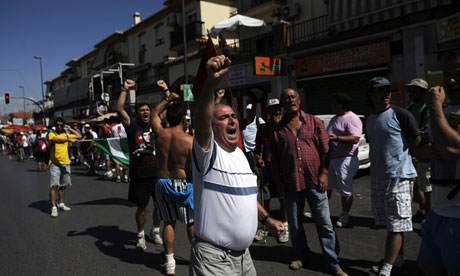
Andalucían trade union activists protest against the Spanish government's handling of the economic crisis and its latest austerity measures. Photograph: Cristina Quicler/AFP/Getty Images
Andalucía, Spain's most populous region, has said it needs a €1bn (£800m) advance to pay its bills.
It comes as Catalonia, the second most populous region, warned that if it does not get rescue money by the end of the month, it will be in serious trouble and must seek a bridging loan.
The Spanish government has yet to make available the €18bn rescue fund to provide liquidity to regional governments that cannot fund themselves. The regions account for 40% of Spanish public spending and the queue of those needing money urgently is getting longer.
Catalonia has asked for €5bn from the rescue fund to cover debt-rollovers and deficit spending this year. Regional finance boss Andrea Mas-Colell has warned it may have to apply yet another round of spending cuts before the end of the year.
The Standard & Poor's credit rating agency downgraded Catalonia's debt to junk status at the weekend. The Catalan government claims it is being picked on, especially as S&P claimed its attempts to change its financing deal with Madrid would add to tensions.
Catalonia's nationalist government wants the region to become like the Basque country and gather taxes itself before sending Madrid its share, rather than the other way around, with central government collecting taxes and then sending Catalonia its part.
Meanwhile Spain's economy minister said on Monday the country's ailing banks will probably not need all the €100bn that has been made available by the country's euro partners.
Luis De Guindos also said that no additional austerity measures would be needed to meet the Spanish government's deficit-reduction target. However, De Guindos said Spain's most troubled bank, Bankia, will get urgent aid and the country's bailout fund, the FROB, said it was injecting €4.5bn into the ailing lender.
Spain's banks have an estimated €184bn in problematic real estate loans and investments following the collapse of the country's property market in 2008. The other 16 eurozone countries have set aside the rescue package to help troubled Spanish lenders.
"In principle, it looks like not all of (the €100bn) will be used," De Guindos told Onda Cero radio.
His comments came ahead of crisis meetings on Thursday when the German chancellor, Angela Merkel, is due to visit Madrid for talks with the Spanish prime minister, Mariano Rajoy, and an announcement is expected from the European Central Bank that it will resume buying distressed government bonds.
Euro crisis managers were briefing MEPs on Monday on resumption of bond buying and according to MEPs present, Mario Draghi, head of the ECB told the parliamentarians that he was planning to buy up three-year bonds – in line with previous statements that the bond-buying would be restricted to short maturity issues and rejecting objections from Germany's Bundesbank that the intervention violated the ECB's statutes as it was tantamount to financing of governments by the ECB. Draghi, according to the sources, said the purchase of three-year bonds did not amount to financing of states.
http://ftalphaville.ft.com/blog/2012/09/03/1143931/a-draghi-leak/
( In case you wondered why europe saw a pop this afternoon - and why the euro spiked earlier.... looks like rumor mongering is back)
A Draghi leak…
…looks like this:
On Monday afternoon, the ECB president was supposed to be holding talks “in camera” with the economic and monetary affairs committee, prior to a full debate amongst MEPs on the EU’s economic future, with commissioner Olli Rehn.
When the debate goes live, you’ll be able to watch it here.
But in the meantime, Draghi is reported to have declared that so long as bond purchases by the ECB are restricted to maturities of three years or less, then the central bank would not be breaching state aid rules.
Who exactly has declared as much was not immediately clear.
Still, good way of keeping everyone awake ahead of Thursday big meeting…
and......
http://www.zerohedge.com/news/eus-poorest-member-country-smacks-down-euro-bulgaria-refuses-join-eurozone
EU's Poorest Member Country Smacks Down Euro As Bulgaria Refuses To Join Eurozone
- Budget Deficit
- Bulgaria
- Capital Markets
- Estonia
- Eurozone
- Greece
- Gross Domestic Product
- Hyperinflation
- International Monetary Fund
- Investor Sentiment
- Ireland
- Italy
- Personal Income
- Portugal
- Reality
- Unemployment
If one needs a shining example of why the days of Europe's artificial currency are numbered, look no further than the EU's poorest country which moments ago said "Ne Mersi" to the Eurozone and the European currency. From the WSJ: "Bulgaria, the European Union's poorest member state and a rare fiscal bright spot for the bloc, has indefinitely frozen long-held plans to adopt the single currency, marking the latest fiscally prudent country to cool its enthusiasm for the embattled currency. Speaking in interviews in Sofia, Prime Minister Boyko Borisov and Finance Minister Simeon Djankov said that the decision to shelve plans to join the currency area, a longtime strategic aim of successive governments in the former communist state, came in response to deteriorating economic conditions and rising uncertainty over the prospects of the bloc, alongside a decisive shift of public opinion in Bulgaria, which is entering its third year of an austerity program. "The momentum has shifted in our thinking and among the public…Right now, I don't see any benefits of entering the euro zone, only costs," Mr. Djankov said. "The public rightly wants to know who would we have to bailout when we join? It's too risky for us and it's also not certain what the rules are and what are they likely to be in one year or two."
When a parasitic technocrat asks to shake your hand, you refuse:

Of course, Bulgaria is right: at this point the only "upside" to new EMU entrants is for the unelected Brussels technocrats, who are now the butt of every possible joke, to demand said countries hand over their middle class' wealth in order to bailout Greece, Portugal, Ireland, Spain, Italy and all the rest of the "wealthy and developed." And since. in trader jargon, by not being "long" the euro, Bulgaria is effectively "short" it, expect to hear some rather disparaging statements emanating out of Europe's insolvent core vis-a-vis the poor nation shortly.
From the WSJ:
Prime Minister Boyko Borisov said concerns had been heightened by growing disputes between policy makers, some of whom back Germany's call to give priority to fiscal discipline over growth, while others want a more expansionary policy."I'm certain that we will definitely see a deepening divide in Europe now because many governments are not prepared to stomach the difficult decisions they have to take. It's like a spoilt child who doesn't want to go to the dentist to fix his bad teeth, even though the operation is needed," Mr. Borisov said. "This moment is critical for the euro zone and for the EU," he added.Mr. Djankov said that Bulgaria's economy should still expand by around 1.5% this year, but warned that the euro zone could face up to five years with "zero growth" if national leaders continue to mull policy responses to the crisis instead of fully backing Germany's call to continue strict fiscal consolidation.On the periphery of the euro zone, but overwhelmingly dependent on the bloc's larger economies for growth, Bulgaria has thus far managed to weather the euro crisis. The economy last year grew by a modest 1.7% and the European Bank for Reconstruction and Development expects that to slow to 1.2% this year. Unemployment has risen to over 12%, but that is around half the levels in Greece and Spain, while Russian investment in the Black Sea resorts is rising rapidly.
In July, when investor sentiment toward the euro zone was less negative, Sofia tapped capital markets, with a heavily oversubscribed five-year €950 million 1.19 billion) Eurobond.But Bulgaria's exposure to the deteriorating health of the euro zone has been compounded in recent months by mounting problems of other economies on its borders.
The paradox is that when Greece finally succumbs to reality, and is forced (or opts) out of Europe and the EMU, the biggest beneficiary will be Bulgaria, as billions in capital are redirected toward it from the "poor" country's southern neighbor, for whom the future is so bleak, rumors of a military coup make the rounds every other day.As to why Bulgaria is slowly becoming the model for Europe, here is a brief extract from a Bloomberg article which explains why taking the pain and sufferening now, and administering true austerity, even if it means total losses of wealth for those who are not prepared for hyperinflation (which Bulgaria had for a long period of time in the 1990s) instead of deferring pain via unrepayable debt, always leads to beneficial consequences:In 1989, the Soviet bloc collapsed. A new Bulgarian democracy was born, but with no money in the state treasury to pay for it. The nation’s savings were insignificant, shops were empty, unemployment was high and infrastructure was rudimentary. Austerity was just a fact of life.
After seven years of delayed reforms, booming private businesses and an almost complete lack of regulation, hyperinflation came to Bulgaria in 1996 and again wiped out the nation’s savings, forcing the closure of a third of the country’s banks. As a result, the lev -- Bulgaria’s currency -- was pegged to the deutsche mark (later to the euro), and the central bank was banned from lending to commercial banks, a precaution that remains in place today. The International Monetary Fund requires that all Bulgarian currency in circulation should be fully matched by foreign-exchange reserves.
The decade of 1989-1999 was harsh, but it turned Bulgaria into a disciplined nation of savers -- even after the country joined the EU in 2007. The banking sector is financed by these savings accounts, which provide a healthy Tier 1 capital- adequacy ratio of 15.8 percent. Credit-card penetration is extremely low -- Bulgarians prefer cash.Being poor is no fun, of course. Public-sector employees are badly paid and retired people struggle to survive with their low pensions. Not a single motorway has been completed to link one end of Bulgaria with another and only parts of the subway in the capital, Sofia, work. This is the price to pay for not spending money that isn’t yours to improve your lot, at the level of the state and of the individual consumer.But today Bulgaria has positive economic growth and the second-lowest state debt in the EU (after Estonia) at 16 percent of gross domestic product. It also has a manageable budget deficit of about 2 percent of GDP, despite levying a flat corporate and personal income tax of just 10 percent. Foreign- exchange reserves amount to 6 percent of GDP. In short, the country has a future.
Greeks, by contrast, have been spending more than they earn for the last 20 years. Once an employee entered the public sector, he couldn’t be laid off; he received 40 days’ vacation per year; and he was paid 14 months out of 12, with guaranteed annual raises. Greeks are richer as a result, but that lifestyle is not sustainable. Debt to GDP is 165 percent and the budget deficit is an unmanageable 9.1 percent.
For more read here.
and......
http://www.zerohedge.com/news/carpe-diem-quam-minimum-credula-postero
Carpe Diem, Quam Minimum Credula Postero
- Borrowing Costs
- Central Banks
- European Central Bank
- European Union
- Eurozone
- France
- Germany
- Greece
- Italy
- Portugal
- ratings
Via Mark J. Grant, author of Out of the Box,
(Latin)
“Seize the day, put no trust in tomorrow.”
Tomorrow, September 4, 2012 will be a defining moment. Mr. Draghi will release to the European Central Banks his plan to save the Continent. The plan will get leaked, no doubt, and the consternation will begin throughout Europe. Today the German Economy Minister went public and announced that he supports Weidmann, the head of the German Central Bank, in his opposition to the European Central Bank's plans to buy debt of Eurozone countries with high borrowing costs, saying that they could not replace economic reforms. I think we may all read this as Frau Merkel’s position as well as Herr Roesler does not speak without approval. The stage is now set for battle.
“A good soldier in an enemy's country should everywhere and at all times be on the alert. It has been one of the rules of my life, and if I have lived to wear grey hairs it is because I have observed it.”
-Sir Arthur Conan Doyle, The Adventures of Gerard
Spain wants the ECB to buy their debt without limit. France, Greece, Portugal, Italy and Cypress are lined up with Spain. The “have nots” are demanding divine intervention; the “haves” are not willing to tithe or to provide the necessary “indulgence” to send Madrid into Heaven. It is not the Barbarians but Martin Luther at the gate and I expect rancor and the spitting of Hell-fire. The Draghi plan, whatever it is going to be, will cause a very serious division of the faithful in Europe and I expect quite a fight. Spain and perhaps Italy are waiting on the plan before lining up for hand-outs and the trouble in Europe keeps escalating. Over the weekend the largest mortgage lender in France had to be bailed out and I expect the cost to be between $40-50 billion. In Spain Bankia had to be rescued and besides the initial payment of $5-6 billion you may expect a $30-40 billion injection required. In Italy the oldest bank in the world, Monte Paschi, turned to the nation to get bailed out in the last few days.The events may be isolated but a pattern is beginning to develop and the amount of money required will send shell-shocks through the national budgets of a number of countries in Europe.
“Seize the day, put no trust in tomorrow.”
Tomorrow, September 4, 2012 will be a defining moment. Mr. Draghi will release to the European Central Banks his plan to save the Continent. The plan will get leaked, no doubt, and the consternation will begin throughout Europe. Today the German Economy Minister went public and announced that he supports Weidmann, the head of the German Central Bank, in his opposition to the European Central Bank's plans to buy debt of Eurozone countries with high borrowing costs, saying that they could not replace economic reforms. I think we may all read this as Frau Merkel’s position as well as Herr Roesler does not speak without approval. The stage is now set for battle.
“A good soldier in an enemy's country should everywhere and at all times be on the alert. It has been one of the rules of my life, and if I have lived to wear grey hairs it is because I have observed it.”
-Sir Arthur Conan Doyle, The Adventures of Gerard
Spain wants the ECB to buy their debt without limit. France, Greece, Portugal, Italy and Cypress are lined up with Spain. The “have nots” are demanding divine intervention; the “haves” are not willing to tithe or to provide the necessary “indulgence” to send Madrid into Heaven. It is not the Barbarians but Martin Luther at the gate and I expect rancor and the spitting of Hell-fire. The Draghi plan, whatever it is going to be, will cause a very serious division of the faithful in Europe and I expect quite a fight. Spain and perhaps Italy are waiting on the plan before lining up for hand-outs and the trouble in Europe keeps escalating. Over the weekend the largest mortgage lender in France had to be bailed out and I expect the cost to be between $40-50 billion. In Spain Bankia had to be rescued and besides the initial payment of $5-6 billion you may expect a $30-40 billion injection required. In Italy the oldest bank in the world, Monte Paschi, turned to the nation to get bailed out in the last few days.The events may be isolated but a pattern is beginning to develop and the amount of money required will send shell-shocks through the national budgets of a number of countries in Europe.
“Once more unto the breach, dear friends, once more...”
-William Shakespeare, Henry V
The Battle Of Frankfurt
Tomorrow the Battle of Frankfurt begins. Make no mistake in your thinking as America ends its holiday weekend; it will be a battle and there will be bodies littering the field of engagement. Spain and the rest have aims, plans, schemes if not hopes and ambitions in direct opposition to Germany and her side. The outcomes prayed for are a demand for money and a resistance to those demands. The pleas of Spain are about to be answered; first from the ECB and then from Germany’s acceptance or rejection of the Draghi plan. The “Game of Muddle” will be ended and real answers to real insistences will be given. Spain has demanded money from the ECB to lower its cost of funding, money from the EU for their banks, no conditions for the receipt of either and they are forcing the issue of what it actually means to be part of the European Union. It all comes down to this; money and how much of it and under what circumstances and whether the nations with capital are willing to hand it to their neighbors and watch their credit ratings, their own cost of funding, their standards of living decline to a mean for all of Europe. It will be war; just not one fought with tanks and rifles.
Tomorrow it begins.
and.....
http://www.presstv.ir/detail/2012/09/03/259623/andalusia-to-seek-spain-govt-rescue/
Spain's southern Andalusia region has announced it will seek a rescue from the central government as the fourth-largest economy in the eurozone is striving to tackle a debt repayment crunch and a bailout threat.
An Andalusia government spokesman, speaking on condition of anonymity, confirmed on Monday that the indebted Spanish region needs a one-billion-euro ($1.3 billion) advance to provide liquidity, AFP reported.
The request makes it the fourth region after Catalonia, Valencia and Murcia to seek rescue money from a special fund set up by Madrid.
Catalonia has already applied for 5bn euros in financial aid.
http://ftalphaville.ft.com/blog/2012/09/03/1142071/trucks-of-cash-and-empty-new-drachma-accounts/
Trucks of cash and empty New Drachma accounts
That’s a couple of the examples of preparations that US companies are making for a Greek eurozone exit, according to the New York Times.
Here’s the trucks:
Bank of America Merrill Lynch has looked into filling trucks with cash and sending them over the Greek border so clients can continue to pay local employees and suppliers in the event money is unavailable.
And the empty accounts:
JPMorgan Chase, though, is taking no chances. It has already created new accounts for a handful of American giants that are reserved for a new drachma in Greece or whatever currency might succeed the euro in other countries.
The particular situation of Grexit occurring on a Friday night, followed by a weekend and then a bank holiday, is worrying others:
and....“In some cases, companies have contingency plans in place, such as having someone take a train to Athens with 50,000 euros to pay employees.”
The story has a few other gems (except for Mastercard and Visa, who just used it to boringly brag about how prepared they are for Grexit).
And predictably, these contingency arrangements include measures that will increase stress on Greece and the other peripheral countries: Juniper Networks says it is moving funds out of eurozone banks more quickly while chemical maker FMC has “begun to avoid keeping any excess cash in Greek, Spanish, or Italian bank accounts” — and is asking for advance payment from some of its Greek customers.
And it is very much in the last 90 days that many of these plans have been formed, according to PwC corporate treasury consultant Peter Frank. Which actually chimes with a comment by the FT’s Gillian Tett in May that among a group of US corporate leaders she met with early that month, the manufacturers were vague about their Grexit planning at the time.
So it has been a Summer of Grexit Planning, of sorts.
http://ftalphaville.ft.com/blog/2012/09/03/1142361/eurozone-pmis-from-still-bad-to-worse/
Eurozone PMIs: from still bad to worse
Let’s start on a positive note on the volley of Markit PMI released Monday.
Spain’s PMI rose during August to 44, versus 42.3 in July…
…meaning business conditions are still deteriorating, with production falling for the sixteenth month in a row.
France also managed a pick up from July’s figure of 43.4 — to 46 for August…
That’s the best showing since April, but weak domestic demand is still stifling new orders.
Germany managed to perk up a little too, with August’s figure coming in at 44.7, against 43 in July…
That’s the best month-on-month performance since January, but August’s data also pointed to falling production for the fifth month in a row.
Italy, however, fell to a 10-month low in August — at 43.6, versus 44.3 in July…
Manufacturing output is now declining at its fastest rate since November last year. Firms are destocking in reaction to lower demand and cutting staff numbers, with employment falling more quickly than at any time in the last three years.
Greece? Well, the PMI built on the gains of June and July to stand at 42.1 in August…
But the country has now languished below 50 for three years. Paul Smith, a senior economist at Markit notes:
Perhaps the biggest takeaway from the latest survey was a sharper reduction in new export orders – the steepest since January 2009. The much needed boost to sector health from external demand sources is showing no sign of materialising as we head towards the final months of 2012.
Ireland held above 50…
Just. A PMI of 50.9 compares with 53.9 in July.
Across the Eurozone as a whole, the Markit manufacturing PMI came in slightly below the earlier flash estimate at 45.1, against July’s 37-mont low of 44.
Not good.
and.....
http://www.telegraph.co.uk/finance/debt-crisis-live/9516331/Debt-crisis-live.html
15.13 Greece's largest labour union has warned today that the country's unemployment rate will reach 29pc next year if the government carries out more planned austerity measures, expected to exceed €11.5bn.
Savvas Rombolis, head of research at the GSEE labor union told theAssociated Press in an interview:
The course of the Greek economy is one of decline. In 2012, we are expecting a drop in gross domestic product of 7 percent. This will create unemployment of 24 percent level - 1.2 million people.
Our estimate is that in 2013, unemployment will be between 28 and 29 percent - more than 1.4 million people. That's because we expect the economy to remain in decline.
14.32 Slovakia's deputy prime minister has spoken out against the ECB embarking on unlimited bond-buying. The central bank is expected to unveil details of a plan enabling it to buy Italian and Spanish government bonds to lower their borrowing costs. But, Miroslav Lajcak said:
I don't think this will be a solution to the problem. We can introduce these mechanisms only when everybody plays by the rules, when everybody has demonstrated that they are doing its homework.
We must not see this mechanism of issuing bonds as a means to share the debts. Those who are playing by the rules must not be paying debts of those who are not.
13.51 Still with Spain, there are reports that the country's indebtedAndalusia region has indicated that it would seek a central government rescue and that it needs a €1bn advance to provide liquidity.
An Andalusia government spokesperson has apparently confirmed the request, which makes it the fourth region after Catalonia, Valencia and Murcia to seek rescue money from a special fund set up by Madrid.
13.47 Spain's Treasury has said today that it will tomorrow issue between €2.5bn to €3.5bn in bonds.
The Treasury plans to sell three bonds, the first issue being a bond maturing April 30, 2014 with a coupon of 3.4pc. It will also sell a bond maturing July 30, 2015 with a 4.0pc coupon. The third bond it will sell has a maturity date of October 31, 2016 and has a coupon of 4.25pc.
12.57 One of the main events happening this month is that Germany's constitutional court is due to rule next week on whether a crucial eurozone financial rescue fund can go ahead.
Reuters writes that the court "holds the fate of the euro in its hands", with a negative ruling, considered improbably by legal experts, casting the currency bloc into turmoil.
But if, as expected, the court gives a green light on September 12 to the euro zone's permanent bailout mechanism and a pact on stricter budget discipline, it may add conditions that constrain Berlin's power to pursue further European integration.
The court based in Karlsruhe in western Germany, one of the country's most trusted institutions, is unlikely to let Chancellor Angela Merkel completely off the hook.
Few experts expect the eight red-robed judges to reject the European Stability Mechanism (ESM)and fiscal pact outright, not least because of the devastating impact on financial markets.
"If they were to surprise us by striking down Germany's participation, I would think it'd be an utter bloodbath in markets," UniCredit global chief economist Erik Nielsen said.
One option, notes Reuters, is that the court's sages could demand more parliamentary consultation before Germany agrees to any further European integration.
11.42 Spanish VAT was raised by three percentage points to 21pc on 1 September. To beat the rise, Spanish customers brought forward their car purchases, with car sales in the country rising in August for the first time in seven months. Car sales rose by 3.4pc, with a total of 48,820 cars sold.
11.03 Poland's foreign minister has suggested that his country is ready and waiting to join the euro - but only once the currency bloc has resolved its problems. He told Frankfurter Allgemeine Zeitung:
We are ready to join when you have resolved your problems and when we can say to our people 'we can now safely join'. You can hardly blame us for not wanting to enter while the eurozone is in a grave crisis.
08.48 Wolfgang Schaeuble has been speaking to German radio. Germany's finance minister rejected a European Commission plan to give the European Central Bank sweeping powers to monitor all eurozone banks, saying it should instead focus on "systemically" important institutions.
The European Union's executive body is due to publish its detailed proposals on banking supervision on September 12. The plan would rob national supervisors of much of their authority, leaving them with routine tasks such as consumer protection. Michael Barnier, internal market commissioner, said last week that he hoped the proposals could be phased in starting next January.
But, Mr Schaeuble expressed scepticism about that timeframe:
The ECB has itself said it does not have the potential to supervise the European Union's 6,000 banks in the forseeable future.
I have doubts that this [banking supervision] can come so fast.
He added that a distinction should be drawn between smaller banks and systemically relevant institutions saying that with the bigger banks, "there is a chance that direct supervision by the ECB could be realised in a forseeable period of time".
08.20 A poll by the Financial Times has found that only a quarter of Germans think Greece should stay in the eurozone or get more help from countries in the currency bloc.
The result highlights the dilemma Angela Merkel faces between keeping her voters happy at home and meeting demands in Europe to agree more time or money for Greece to get is bailout back on track.
While Germans were negative about Greece's prospects, the FT poll showed that respondents in Italy and Spain were far more reluctant to cut Athens loose.
Only 26pc of Germans believed Greece “will ever repay its bailout loans”, compared with 77pc of Italians and 57pc of Spaniards.
There are signs too that the global slowdown is weighing on China, wheremanufacturing activity fell to its lowest level in more than three years in August. The final reading of HSBC's closely-watched purchasing managers' index (PMI), which gauges nationwide manufacturing activity, slid to 47.6 last month from 49.3 in July.
A PMI reading above 50 indicates expansion, while one below 50 points to contraction.
| |||


|
| |||

| |||||||||||||||||||


No comments:
Post a Comment