http://www.nakedcapitalism.com/2012/08/spain-out-of-options.html
And so now, under the watchful eye of the Spanish regulators, depositors in Spanish banks had been converted into equity holders and these same people were about to see their savings eaten up by the first stages of a banking bailout.
Although there are other factors involved, I think this is one of the primary reasons Mariano Rajoy has been so hesitant to move forward with any bailout, and it comes as no surprise that he is now attempting to negotiate a way out for these people:
and......
http://www.telegraph.co.uk/finance/debt-crisis-live/9478336/Debt-crisis-live.html
BEIJING (Reuters) - China's trade outlook for 2012 is worsening, darkened especially by growing problems in Europe, the Commerce Ministry said on Thursday as it revealed the longest run of falling inward investment growth in the economy since the 2008-09 global crisis.
The ministry singled out problems in the European Union - China's biggest overseas market - as the core difficulty for exporters to overcome as it published data showing foreign direct investment (FDI) from the EU fell 2.7 percent year on year to $4.0 billion in the first seven months of 2012.
"Right now, the sharp drop of exports to EU countries is the biggest important factor weighing on China's export growth," Commerce Ministry spokesman Shen Danyang told a news conference held alongside the publication of FDI data.
"With the European debt crisis spreading and the global economy recovering at a slower than expected pace, we expect China's trade situation in the second half will become more severe and we are facing more pressure to meet the annual target for trade growth," Shen added.
China aims to grow total trade by an average of 10 percent in 2012, but shipments have been volatile so far this year.Data published earlier this month showed China's exports to the EU sank 16.2 percent year-on-year in July to 29.4 billion.
July export growth overall virtually stalled, up just 1.0 percent on a year ago versus the consensus estimate in a Reuters poll of an 8.6 percent expansion. Import growth was 4.7 percent year-on-year in July against expectations of 7.2 percent.
Weaker trade and factory output data and persistent global weakness has led some analysts to question whether the economy would slowly rebound in the third quarter, as many market watchers had expected just a few weeks ago.
China's economy expanded at its slowest pace in more than three years in the second quarter, up 7.6 percent on 2011 as demand at home and abroad slackened, confirming a downtrend that has full-year growth on course for its weakest since 1999.
The consensus forecast in the latest Reuters poll is for growth of 8 percent in 2012.
As exporters battle with a global economic slowdown, falling inward investment is doubly worrying for investors as around 200 million jobs in the country are estimated to be oriented towards the external sector and fixed asset investment generates about half of China's economic output.
The Commerce Ministry said China drew $66.7 billion in foreign direct investment (FDI) between January and July, down 3.6 percent on the same period a year earlier. July's inflow alone was $7.6 billion, down 8.7 percent on-year.DECLINING CONFIDENCE
"The trend shows declining confidence of foreign investors in China's outlook, which is negative for sentiment," Dariusz Kowalczyk, senior economist and strategist for ex-Japan Asia at Credit Agricole-CIB in Hong Kong, wrote in a note to clients.
The FDI data follows a raft of other economic indicators for July which revealed undershoots in new bank lending, export, import and industrial output growth, prompting analysts to start slicing GDP forecasts and strengthen their calls for more policy easing from the government.
"Less funds means downside pressure on Chinese capital spending growth, and on GDP growth. This boosts the odds of more stimulus," Kowalczyk said.
China has lowered the level of cash banks must keep as reserves in three steps since the autumn, freeing an estimated 1.2 trillion yuan ($190 billion) for new lending, cut interest rates twice and accelerated spending on key state projects as part of its so-called "fine-tuning" pro-growth policy mix.
But it has failed to arrest a slide in economic activity that has persisted for six straight quarters and government advisers say it could slip into a seventh.
Investment flows into China's lynchpin real estate sector - which directly affects around 40 different business sectors in the world's second largest economy - fell 9.3 percent for the first seven months of 2012 versus 2011, but ministry spokesman Shen sought to downplay the significance."FDI into the property sector is under effective control," he said.
China has been clamping down on speculative investment into the real estate market for more than two years in a bid to bring home prices down to what Premier Wen Jiabao calls "reasonable levels". Housing has soared beyond the reach of many middle-class Chinese citizens in recent years.
Analysts say easing such restrictions would be the fastest way to boost economic activity as investment in the real estate sector was worth 13.6 percent of GDP in the first half of 2012, but it would risk a flare-up in inflationary pressures.
COMPETITION FOR CAPITAL
Besides the year-on-year fall in investment from the EU, the Commerce Ministry also said FDI inflows from Asian countries were also negative on a year-on-year basis.
Investment from the top 10 Asian economies, including Hong Kong, Japan and Singapore, fell 3.8 percent between January and July versus a year ago to $57.3 billion, the ministry said.
Shen attributed the overall drop in FDI this year to a variety of domestic and global factors, including competition for investor attention from India and Brazil, which he said had become the new "hot points" of international direct investment.
Actuaries recalled as alternatives sought ahead of final talks next week
Several government officials were recalled from brief summer holidays Tuesday as the coalition continues to look for ways to complete the 11.5-billion-euro savings package demanded by the troika while limiting the social impact as much as possible.
Labor Minister Yiannis Vroutsis asked members of the government’s actuarial authority to return to Athens to work on alternative scenarios for the pension cuts the three-party alliance will have to approve as part of the package.
As things stand, the government looks set to approve reductions to all pensions above 700 euros per month but to limit the cuts to the lower pensions to just 2 percent. However, given the unpopularity of such cuts, the government wants to explore all the alternatives available.
Coalition talks are due to resume on Monday with the aim of finalizing about 5 billion euros of the 11.5 billion that have yet to be agreed. Prime Minister Antonis Samaras would like to have the measures agreed before Eurogroup chief Jean-Claude Juncker visits Athens on August 22. This meeting will be followed by ones with German Chancellor Angela Merkel and French President Francois Hollande later in the week.
The premier hopes that finalizing the savings will put him in a stronger negotiating position with his eurozone counterparts ahead of the crucial decisions that have to be taken next month. European Energy Commissioner Guenther Oettinger warned that when the eurozone decides in September, based on the troika’s progress report, whether to keep lending Athens money, it should not look upon a potential Greek exit lightly.
“We should not risk such a development without thinking it through thoroughly,” he told German newspaper Bild, adding that it was unnecessary for people to comment on every decision made by the Greek government.
“They have just presented a package of 11.5 billion euros in cuts,” he said. “Now this package will have to be adopted by Parliament and implemented.”
In an editorial for the Wall Street Journal, European Economic and Monetary Affairs Commissioner Olli Rehn suggested that Greece’s efforts over the last two years should not be overlooked.
THURSDAY, AUGUST 16, 2012
Spain Out of Options
Yves here. We’ve flagged in earlier posts how the Spanish banking crisis has the potential to become destabilizing politically, as if Spain
wasn’t already at considerable risk of upheaval. Spanish depositors were pushed to convert their deposits into preference shares, which they were told were just as safe. This was a simple desperation move by the banks to save their own skins, customers be damned, by raising equity from the most unsophisticated source to which they had access. And now that that gambit failed, these shareholders are due to have those investments wiped out unless the Spanish authorities can cut a deal to spare them. Don’t hold your breath.
By Delusional Economics, who is horrified at the state of economic commentary in Australia and is determined to cleanse the daily flow of vested interests propaganda to produce a balanced counterpoint. Cross posted from MacroBusiness
I mentioned back in early July that Spain had a serious political problem brewing because the draft Memorandum of Understanding for the Spanish banking system clearly stated that:
Banks and their shareholders will take losses before State aid measures are granted and ensure loss absorption of equity and hybrid capital instruments to the full extent possible.
From a market perspective this is absolutely the correct thing to do. Equity is a risky business. You take a punt, the banks falls over, your money it gone, fair enough. But in Spain it’s not that simple because of something I commented on in April:
The key in a banking crisis is to keep the confidence of depositors. But while many countries relied on capital injections and government guarantees, Spanish banks have added a unique twist of effectively turning some depositors into equity holders. That puts customers on the front line.Some banks started by persuading depositors to switch from low, interest-bearing accounts into preference shares, which paid a fixed, higher interest rate. The benefit for the banks was that these securities counted as core capital under banking rules. UBS says Spanish banks issued €32 billion ($42.7 billion) of such instruments from 2007 to 2010.But as the crisis deepened, these instruments became illiquid, trading at deep discounts. At the same time, they ceased to count as core capital under new rules known as Basel III. So banks have encouraged investors to convert preference shares into either common stock or mandatory convertible notes, which pay a high initial yield before later converting into stock.
And so now, under the watchful eye of the Spanish regulators, depositors in Spanish banks had been converted into equity holders and these same people were about to see their savings eaten up by the first stages of a banking bailout.
Although there are other factors involved, I think this is one of the primary reasons Mariano Rajoy has been so hesitant to move forward with any bailout, and it comes as no surprise that he is now attempting to negotiate a way out for these people:
The Spanish government is in talks with Brussels to allow tens of thousands of retail clients who bought risky savings products from now nationalized lenders to avoid losing their investments as part of Spain’s bank bailout.Apart from the obvious question of whether they will actually get a deal, the other question is will the banks be in any position to make those payments in the future. As WSJ reports, the banking system looks increasingly flakey as deposits continue to leave the country and the hole is filled by ECB:
In place of inflicting large losses on small savers who purchased savings products linked to preference shares in in the lenders known as cajas, the Spanish government is negotiating a compromise where they will suffer an instant haircut, and then be repaid in full over time by their banks, people familiar with the talks said.
The decision to inflict losses on holders of high interest preference shares and subordinated debt in rescued savings banks has been highly controversial in Spain, with the terms of the country’s bank rescue not distinguishing between professional and retail investors.
Spanish banks borrowed a record amount from the European Central Bank in July, as other sources of funding evaporated further in the weeks following the announcement of a €100 billion ($123 billion) bailout for the country’s financial industry.
Bank of Spain data indicated that net ECB borrowing rose to €375.55 billion from €337.21 billion in June. It was the 10th straight month of increases, highlighting how the country’s lenders are having more and more difficulty financing themselves through private investors.
Spain’s traditional funding sources have been dwindling as the economy sinks deeper into a downturn. During the Spanish construction boom of the past decade, German and other European banks were more than willing to fund the rapid expansion of the Spanish banking system, inflating the country’s credit bubble.
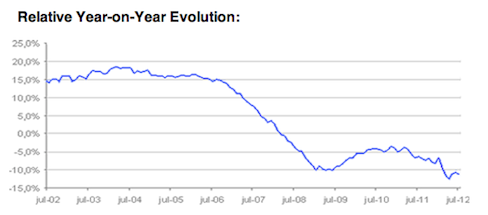
And the latest report from Tinsa makes it very clear that the bubble’s deflation is far from over:
The IMIE General index registered a year-on-year decline of 11.2% in July, pushing the index down to 1577 points. The cumulative decline in house prices since the market peaked in December 2007 is 31%.
…
In terms of the cumulative decline in house prices by region since peak prices, there was a 37.2% fall in July for the “Mediterranean Coast”; followed by 33.5% for “Capitals and Major Cities”, 32.1% for “Metropolitan Areas”, 29.2% for the “Balearic and Canary Islands” and 25.9% for “Other Municipalities”, which comprises the remainder.
Mariano Rajoy is expected to meet Herman Van Rompuy, Angela Merkel, Mario Monti and Finland’s President, Sauli Niinistoe, over the next few weeks in order to discuss his country’s future. It is, however, increasingly obvious that he will have little choice to accept whatever he is given, and I have to question again exactly how long he has left in politics.
and......
http://www.telegraph.co.uk/finance/debt-crisis-live/9478336/Debt-crisis-live.html
08.20 This morning, there are reports that Spain may ask EU authorities to use leftover funds from its €100bn bank bail-out to buy sovereign debt.
Government sources told Spanish daily El Confidencial that the country was already in talks with the European Financial Stability Facility (EFSF) to allow the eurozone's temporary bail-out fund to use any leftover funds to buy sovereign debt in the primary or secondary market.
The ministry of economy estimates that banks will not require more than €60bn to shore up their balance sheets. A separate audit in June by Oliver Wyman and Roland Berger estimated that banks would need €62bn.
The sources told El Confidencial that EFSF bond buying would "maximise the efficiency of financial assistance."
There were rumours yesterday that the government would complete its audit of Spain's financial institutions.
and......
China H2 trade outlook severe, inward investment slows
http://www.chicagotribune.com/business/sns-rt-us-china-economybre87f054-20120815,0,5462438.story
BEIJING (Reuters) - China's trade outlook for 2012 is worsening, darkened especially by growing problems in Europe, the Commerce Ministry said on Thursday as it revealed the longest run of falling inward investment growth in the economy since the 2008-09 global crisis.
The ministry singled out problems in the European Union - China's biggest overseas market - as the core difficulty for exporters to overcome as it published data showing foreign direct investment (FDI) from the EU fell 2.7 percent year on year to $4.0 billion in the first seven months of 2012.
"Right now, the sharp drop of exports to EU countries is the biggest important factor weighing on China's export growth," Commerce Ministry spokesman Shen Danyang told a news conference held alongside the publication of FDI data.
"With the European debt crisis spreading and the global economy recovering at a slower than expected pace, we expect China's trade situation in the second half will become more severe and we are facing more pressure to meet the annual target for trade growth," Shen added.
China aims to grow total trade by an average of 10 percent in 2012, but shipments have been volatile so far this year.Data published earlier this month showed China's exports to the EU sank 16.2 percent year-on-year in July to 29.4 billion.
July export growth overall virtually stalled, up just 1.0 percent on a year ago versus the consensus estimate in a Reuters poll of an 8.6 percent expansion. Import growth was 4.7 percent year-on-year in July against expectations of 7.2 percent.
Weaker trade and factory output data and persistent global weakness has led some analysts to question whether the economy would slowly rebound in the third quarter, as many market watchers had expected just a few weeks ago.
China's economy expanded at its slowest pace in more than three years in the second quarter, up 7.6 percent on 2011 as demand at home and abroad slackened, confirming a downtrend that has full-year growth on course for its weakest since 1999.
The consensus forecast in the latest Reuters poll is for growth of 8 percent in 2012.
As exporters battle with a global economic slowdown, falling inward investment is doubly worrying for investors as around 200 million jobs in the country are estimated to be oriented towards the external sector and fixed asset investment generates about half of China's economic output.
The Commerce Ministry said China drew $66.7 billion in foreign direct investment (FDI) between January and July, down 3.6 percent on the same period a year earlier. July's inflow alone was $7.6 billion, down 8.7 percent on-year.DECLINING CONFIDENCE
"The trend shows declining confidence of foreign investors in China's outlook, which is negative for sentiment," Dariusz Kowalczyk, senior economist and strategist for ex-Japan Asia at Credit Agricole-CIB in Hong Kong, wrote in a note to clients.
The FDI data follows a raft of other economic indicators for July which revealed undershoots in new bank lending, export, import and industrial output growth, prompting analysts to start slicing GDP forecasts and strengthen their calls for more policy easing from the government.
"Less funds means downside pressure on Chinese capital spending growth, and on GDP growth. This boosts the odds of more stimulus," Kowalczyk said.
China has lowered the level of cash banks must keep as reserves in three steps since the autumn, freeing an estimated 1.2 trillion yuan ($190 billion) for new lending, cut interest rates twice and accelerated spending on key state projects as part of its so-called "fine-tuning" pro-growth policy mix.
But it has failed to arrest a slide in economic activity that has persisted for six straight quarters and government advisers say it could slip into a seventh.
Investment flows into China's lynchpin real estate sector - which directly affects around 40 different business sectors in the world's second largest economy - fell 9.3 percent for the first seven months of 2012 versus 2011, but ministry spokesman Shen sought to downplay the significance."FDI into the property sector is under effective control," he said.
China has been clamping down on speculative investment into the real estate market for more than two years in a bid to bring home prices down to what Premier Wen Jiabao calls "reasonable levels". Housing has soared beyond the reach of many middle-class Chinese citizens in recent years.
Analysts say easing such restrictions would be the fastest way to boost economic activity as investment in the real estate sector was worth 13.6 percent of GDP in the first half of 2012, but it would risk a flare-up in inflationary pressures.
COMPETITION FOR CAPITAL
Besides the year-on-year fall in investment from the EU, the Commerce Ministry also said FDI inflows from Asian countries were also negative on a year-on-year basis.
Investment from the top 10 Asian economies, including Hong Kong, Japan and Singapore, fell 3.8 percent between January and July versus a year ago to $57.3 billion, the ministry said.
Shen attributed the overall drop in FDI this year to a variety of domestic and global factors, including competition for investor attention from India and Brazil, which he said had become the new "hot points" of international direct investment.
Domestically, he said tighter land supply and rising labor costs weighed on activity and it would still take some time for domestic consumption to become a main driver of the economy.
China's Communist Party leadership envisages consumers in the 1.3 billion-strong population becoming the engine of economic expansion in a generation to come.
Shen said that the FDI drop was only temporary and that multi-national companies were still confident about China's prospects, despite data showing a 6.4 percent fall in manufacturing FDI and a 3.2 percent drop in service sector inflows in the first seven months of 2012 versus 2011.
Firms in the United States, Germany, Singapore and Japan appear to bear him out.
Year-on-year data for July showed inflows from Germany jumped 27.1 percent to $1 billion, while those from Singapore surged 25 percent to $4.4 billion and commitments from Japan grew 19.1 percent to $4.7 billion. U.S. inflows ticked 1 percent higher to $2 billion.
China drew a record $116 billion in foreign direct investment last year. The Commerce Ministry aims to attract an average of $120 billion in each of the next four years. It is roughly on course to hit the target in 2012.
China's total outbound direct investment from non-financial firms in the first seven months totaled $42.2 billion, up 52.8 percent year on year.
China's Communist Party leadership envisages consumers in the 1.3 billion-strong population becoming the engine of economic expansion in a generation to come.
Shen said that the FDI drop was only temporary and that multi-national companies were still confident about China's prospects, despite data showing a 6.4 percent fall in manufacturing FDI and a 3.2 percent drop in service sector inflows in the first seven months of 2012 versus 2011.
Firms in the United States, Germany, Singapore and Japan appear to bear him out.
Year-on-year data for July showed inflows from Germany jumped 27.1 percent to $1 billion, while those from Singapore surged 25 percent to $4.4 billion and commitments from Japan grew 19.1 percent to $4.7 billion. U.S. inflows ticked 1 percent higher to $2 billion.
China drew a record $116 billion in foreign direct investment last year. The Commerce Ministry aims to attract an average of $120 billion in each of the next four years. It is roughly on course to hit the target in 2012.
China's total outbound direct investment from non-financial firms in the first seven months totaled $42.2 billion, up 52.8 percent year on year.
and.....
Search for cuts intensifies
Actuaries recalled as alternatives sought ahead of final talks next week
 |
Labor Minister Yiannis Vroutsis asked members of the government’s actuarial authority to return to Athens to work on alternative scenarios for the pension cuts the three-party alliance will have to approve as part of the package.
As things stand, the government looks set to approve reductions to all pensions above 700 euros per month but to limit the cuts to the lower pensions to just 2 percent. However, given the unpopularity of such cuts, the government wants to explore all the alternatives available.
Coalition talks are due to resume on Monday with the aim of finalizing about 5 billion euros of the 11.5 billion that have yet to be agreed. Prime Minister Antonis Samaras would like to have the measures agreed before Eurogroup chief Jean-Claude Juncker visits Athens on August 22. This meeting will be followed by ones with German Chancellor Angela Merkel and French President Francois Hollande later in the week.
The premier hopes that finalizing the savings will put him in a stronger negotiating position with his eurozone counterparts ahead of the crucial decisions that have to be taken next month. European Energy Commissioner Guenther Oettinger warned that when the eurozone decides in September, based on the troika’s progress report, whether to keep lending Athens money, it should not look upon a potential Greek exit lightly.
“We should not risk such a development without thinking it through thoroughly,” he told German newspaper Bild, adding that it was unnecessary for people to comment on every decision made by the Greek government.
“They have just presented a package of 11.5 billion euros in cuts,” he said. “Now this package will have to be adopted by Parliament and implemented.”
In an editorial for the Wall Street Journal, European Economic and Monetary Affairs Commissioner Olli Rehn suggested that Greece’s efforts over the last two years should not be overlooked.
| |
|


No comments:
Post a Comment