http://www.guardian.co.uk/world/2012/aug/18/south-african-miners-julius-malema
South African miners' families back Julius Malema's call for nationalisation
Jacob Zuma is criticised as former ANC youth leader says the president sided with mine owner when 34 were killed
 Email
Email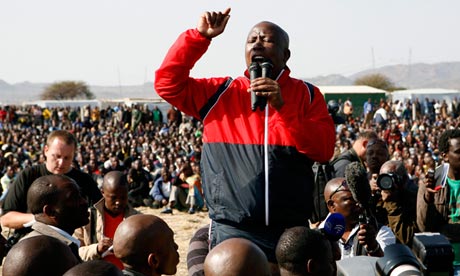
Julius Malema, former leader of the youth wing of the ANC, spoke at a rally outside the Marikana mine to demand nationalisation. Photograph: Themba Hadebe/AP
They were there in their thousands, leaning against tin shacks or sitting in the dusty veld: miners and their wives still looking for answers after a massacre by South African police that left 34 striking workers dead. A red T-shirt worn by a rally organiser seemed to offer one, stating: "Fuck capitalism."
The huge crowd erupted as a charismatic young politician, Julius Malema, took the microphone. He is seen by some as a dangerous demagogue, but to the grieving, angry community at the Lonmin mine in Marikana he came as a messiah offering a radical future.
"The British are owning this mine," he said. "The British are making money out of this mine ... It is not the British who were killed. It is our black brothers. But it is not these brothers who are mourned by the president. Instead he goes to meet capitalists in air-conditioned offices."
Malema was expelled this year as president of the youth wing of the governing African National Congress after falling out with President Jacob Zuma, whom he accuses of failing to challenge "white monopoly capital". He has since been in the political wilderness; once contemptuous of the media, he now courts it. As the Marikana tragedy lays bare discontent over inequalities 18 years after apartheid, he senses his moment.
"President Zuma said to the police they must act with maximum force. He did not say act with restraint. He presided over the murder of our people and therefore he must step down. Not even apartheid government killed so many people ... From today, when you are asked 'Who is your president', you must say 'I don't have a president'."
There were cheers from people whose votes the ANC can no longer take for granted after 18 years in government.
It was the promises of a militant union that stirred violence at Marikana, where the ANC-aligned National Union of Mineworkers has been losing support. Malema hopes this will be mirrored on the national stage, where he accuses the ANC of failing to pursue economic freedom as it did political freedom, leaving millions of black people poor and disenfranchised. He wants mines to be seized from private companies and nationalised. The call appears to be gaining traction in Marikana, where workers are demanding from Lonmin, whose HQ is in London, a wage increase from 4,000 rand (£300) to 12,500 rand a month.
"Lonmin treat us like dogs," said Thembelani Khonto, 24. "When you're underground, it's like you're a slave and they don't know you. But on the surface people who don't do anything in offices are earning more than us."
Siphiwo Gqala, 25, said he sometimes spends up to 14 hours a day underground but does not receive overtime pay. "It's dangerous work," he said. "Sometimes you go down there and a rock falls and you die. Big vehicles can come and kill you." Recalling Thursday's massacre, he said: "I've never seen something like that: people killed like chickens. One of my friends is still missing. I don't know if he's in the hospital or the mortuary."
The impact on the community will be far-reaching, added Gqala, who lives in a shack because house rentals are too high. "Women come here from Eastern Cape with their husbands, who are the breadwinners. If someone has five children, how will they live? I have two young brothers depending on me. What if I die? Who's going to look after them?"
The conditions leave people like Gqala looking for radical solutions. "The mine must be nationalised. We support Julius Malema and the youth league for saying the mines must be nationalised. Now they're starting to shoot us. If we die today, all of us must die: we no longer want to work here."
Two days after the shooting, in which 34 people died and 78 were injured, many families are still waiting to learn the miners' fate. A casualty list has still not been published and there is little information on who is dead, injured or under arrest. Wives have been turned away from local clinics and hospitals.
A 22-year-old woman, who did not wish to be named, had lost a loved one in the shooting. "He was shot in cold blood," she said. "My tears have not dried; I cried all day. I'm worried about things like who's going to feed the kids he left behind. No one is going to give the love to his children like their father."
Elizabeth Makana, 48, a widow whose brother-in-law was wounded, said: "They treat the miners like dogs. The miners take the risk to dig platinum, but the people who sit in offices make the money."
Lonmin defended its treatment of mine workers. A community development brochure published by the company describes extensive health, education, infrastructure and economic projects in the area. Spokesman James Clark said: "We absolutely recognise the hugely positive relationship we have with communities living in the area and doing the best we can for them and their families goes to the heart of our business. It's why we do so much around health and education, but we're not complacent. We do the best we can and try to do better every time."
That will not satisfy Malema and his constituency, however, who argue that the ANC has been too moderate for too long, bending the knee to western corporations. Flashpoints like Marikana expose the fissures in a party that contains capitalists and communists.
Aubrey Matshiqi, a research fellow at the Helen Suzman Foundation, said: "I think the people of Marikana, particularly the miners, see themselves as the manifestation of the gap between mineral wealth and socioeconomic conditions. The death of so many miners has amplified the extent to which Julius Malema's views on mine nationalisation resonate with the people in the area."
He added: "You have the ANC that some people believe has been too pragmatic and sold out and bent over backwards for foreign capital at the expense of the people. Julius Malema suggests that a better life for all would be possible under someone like him. If he is wrong, you will have populism and disappointment that will lead to conflict."
and.....
http://www.news24.com/SouthAfrica/News/Police-miners-families-in-tense-face-off-20120817
The conditions leave people like Gqala looking for radical solutions. "The mine must be nationalised. We support Julius Malema and the youth league for saying the mines must be nationalised. Now they're starting to shoot us. If we die today, all of us must die: we no longer want to work here."
Two days after the shooting, in which 34 people died and 78 were injured, many families are still waiting to learn the miners' fate. A casualty list has still not been published and there is little information on who is dead, injured or under arrest. Wives have been turned away from local clinics and hospitals.
A 22-year-old woman, who did not wish to be named, had lost a loved one in the shooting. "He was shot in cold blood," she said. "My tears have not dried; I cried all day. I'm worried about things like who's going to feed the kids he left behind. No one is going to give the love to his children like their father."
Elizabeth Makana, 48, a widow whose brother-in-law was wounded, said: "They treat the miners like dogs. The miners take the risk to dig platinum, but the people who sit in offices make the money."
Lonmin defended its treatment of mine workers. A community development brochure published by the company describes extensive health, education, infrastructure and economic projects in the area. Spokesman James Clark said: "We absolutely recognise the hugely positive relationship we have with communities living in the area and doing the best we can for them and their families goes to the heart of our business. It's why we do so much around health and education, but we're not complacent. We do the best we can and try to do better every time."
That will not satisfy Malema and his constituency, however, who argue that the ANC has been too moderate for too long, bending the knee to western corporations. Flashpoints like Marikana expose the fissures in a party that contains capitalists and communists.
Aubrey Matshiqi, a research fellow at the Helen Suzman Foundation, said: "I think the people of Marikana, particularly the miners, see themselves as the manifestation of the gap between mineral wealth and socioeconomic conditions. The death of so many miners has amplified the extent to which Julius Malema's views on mine nationalisation resonate with the people in the area."
He added: "You have the ANC that some people believe has been too pragmatic and sold out and bent over backwards for foreign capital at the expense of the people. Julius Malema suggests that a better life for all would be possible under someone like him. If he is wrong, you will have populism and disappointment that will lead to conflict."
and.....
http://www.news24.com/SouthAfrica/News/Police-miners-families-in-tense-face-off-20120817
Police, miners' families in tense face-off
2012-08-17 16:29

Lonmin protest (AP)
These songs were once directed at South Africa's white apartheid government, but these women were singing to denounce their own police who fired on their striking menfolk, leaving 34 dead, the day before.
"The police came here to kill our husbands, our brothers. Here. Our children!" said 42-year-old Nokuselo Mciteni.
Her own husband survived the clash between police and workers in the Lonmin platinum mine staging a weeklong wildcat strike.
Evidence of self-defence
But she said she hadn't seen her neighbour since Thursday, when he joined the hundreds of men protesting on a nearby hillside.Occasionally the women stopped to shout at forensics experts combing through the dusty scene of the deadliest police action since the end of white-minority rule in 1994.
"The police came here to kill our husbands, our brothers. Here. Our children!" said 42-year-old Nokuselo Mciteni.
Her own husband survived the clash between police and workers in the Lonmin platinum mine staging a weeklong wildcat strike.
Evidence of self-defence
But she said she hadn't seen her neighbour since Thursday, when he joined the hundreds of men protesting on a nearby hillside.Occasionally the women stopped to shout at forensics experts combing through the dusty scene of the deadliest police action since the end of white-minority rule in 1994.
Brightly-coloured plastic markers were stuck in the ground, indicating the evidence that police say will prove that they acted in self-defence after armed strikers charged through a cloud of teargas. Police said some workers were firing guns as they advanced.
A police helicopter circled overhead while some 2 000 workers again assembled on a hillside covered in yellowed grass. Some carried metal rods and clubs, wrapping themselves in blankets against the late winter chill.
They denied having guns or charging the police. They said they gathered on the hill because they have nowhere else to go.
"We met at the only place no one can say they own, the only open space," said Zolisa Bodlani, 32.
"We were meeting," said Mozambican migrant worker Luis Macuacua, 35. "Suddenly the police came and chased us away. They made war."
‘We can’t afford to buy food’
Despite the wealth underground, the township the miners call home doesn't even have a road.
Children play in the dust, while communal pit latrines with no running water stand outside the tiny houses, emitting a terrible stench.
"We can't afford to buy food. People working at Lonmin can't send their kids to school," said Jack Khoba, 29, a mine supervisor.
That is why they want their wages of R4 000 tripled - a demand unlikely to be met in an industry that has already been forced to close several mines this year as companies struggle against low platinum prices.
Details on the dead and injured were still hard to come by Friday. Many relatives went to nearby hospitals hoping for news.
Before Thursday, 10 people had already been killed during the weeklong strike as rivalry between unions turned into vicious clashes.
Many people were still too scared or traumatised to talk about Thursday's killings, which made their homes a landmark to equal the more horrific sites of apartheid atrocities.
"I don't want these people to see me talking to you because then they're gonna kill me," one man said. "Just go, because I don't want to die."
‘We can’t afford to buy food’
Despite the wealth underground, the township the miners call home doesn't even have a road.
Children play in the dust, while communal pit latrines with no running water stand outside the tiny houses, emitting a terrible stench.
"We can't afford to buy food. People working at Lonmin can't send their kids to school," said Jack Khoba, 29, a mine supervisor.
That is why they want their wages of R4 000 tripled - a demand unlikely to be met in an industry that has already been forced to close several mines this year as companies struggle against low platinum prices.
Details on the dead and injured were still hard to come by Friday. Many relatives went to nearby hospitals hoping for news.
Before Thursday, 10 people had already been killed during the weeklong strike as rivalry between unions turned into vicious clashes.
Many people were still too scared or traumatised to talk about Thursday's killings, which made their homes a landmark to equal the more horrific sites of apartheid atrocities.
"I don't want these people to see me talking to you because then they're gonna kill me," one man said. "Just go, because I don't want to die."
and......
Zuma, Mthethwa must step down: Malema
29 minutes ago
President Jacob Zuma and Police Minister Nathi Mthethwa must resign following the death of mineworkers at Lonmin's Marikana operations, in the North West, says Julius Malema.
and...
http://www.news24.com/SouthAfrica/News/Fire-killer-cops-Marikana-women-urge-20120817
Rustenburg - The policemen responsible for killing Lonmin miners should be fired, women of their community demanded on Friday.
About 50 of them staged a demonstration near a rocky outcrop at the mine Marikana, North West, to voice their anger.
A total of 34 people were killed and 78 injured in a shoot-out that erupted near the mine on Thursday when police tried to disperse striking miners.
One of the women, Annah Bele, asked why police shot at the miners.
"There have been strikes before but people were never killed. Police themselves have strikes but no one kills them."
A second woman asked: "Where have they learnt these killing techniques?"
Some women demanded that their loved ones be buried by the government and Lonmin."We don't have money so government should pay," said Mmatshepiso Mohlomi who was still unsure of the whereabouts of her relative.
Stood by their men
Nomasomi Baliti said the women stood by their men, who were all employees of the Lonmin platinum mine in Marikana, North West.
"The treatment they have given to our men is just not human," said Baliti.
She said she had not heard from her father since Thursday.
"I don't know whether he is dead or alive."
The women carried placards with messages directed to Lonmin and government. One read: "What sort of government kills its people?" Another stated: "Piega [police commissioner Riah Phiyega], you are celebrating your position by the blood of our families".
The women accused the mine of not properly communicating with them about the whereabouts of their men. Men from the surrounding informal settlement gathered at the outskirts to watch the women.
Earlier, scores of family members stood outside the Andrew Staffer Memorial Hospital in Marikana, hoping to hear news of their relatives.
Many said they had heard of a list with the names of those who were killed, injured, or detained.
From pillar to post
The only source of information came from a hospital official who came out and read the names of some of those admitted inside.
Relatives who heard the names of loved ones were allowed into the hospital.
Said Gcobani Tiya, who was searching for a family member: "They have been sending us from pillar to post. The mine is not communicating with us, but with the media."
President Jacob Zuma was expected to arrive at the mine later in the day.
Phiyega told reporters earlier she took responsibility for giving the officers the order to shoot.
"As commissioner, I gave police the responsibility to execute the task they needed to do."
At the briefing, police showed video footage of how two policemen were killed by a group of protesters. The video showed police officials confronting the group, asking for weapons.
The men told police the weapons would be handed over at the hill, and the two police officers followed them there.
At the hilltop, the incident turned violent and the two officers were killed.
Journalists were also shown aerial photographs of naked miners doing a ritual with a sangoma.
Relatives who heard the names of loved ones were allowed into the hospital.
Said Gcobani Tiya, who was searching for a family member: "They have been sending us from pillar to post. The mine is not communicating with us, but with the media."
President Jacob Zuma was expected to arrive at the mine later in the day.
Phiyega told reporters earlier she took responsibility for giving the officers the order to shoot.
"As commissioner, I gave police the responsibility to execute the task they needed to do."
At the briefing, police showed video footage of how two policemen were killed by a group of protesters. The video showed police officials confronting the group, asking for weapons.
The men told police the weapons would be handed over at the hill, and the two police officers followed them there.
At the hilltop, the incident turned violent and the two officers were killed.
Journalists were also shown aerial photographs of naked miners doing a ritual with a sangoma.
and.....
http://dailymaverick.co.za/article/2012-08-17-beyond-the-chaos-at-marikana-the-search-for-the-real-issues
Beyond the chaos at Marikana: The search for the real issues
 GREG MARINOVICH
  SOUTH AFRICA


- 17 AUGUST 2012 02:00 (SOUTH AFRICA)

Violent clashes between police and striking miners have left between seven and 18 people dead at the last count. But the miners – specifically, the rock drillers – are determined to stay on their outcrop until they are heard. But it’s more than a strike, writes GREG MARINOVICH – it’s becoming a war.
Several thousand men cover the orange outcrop of igneous rock like a single organism, spilling onto the dry thorn-veld below.
They are wrapped in blankets; their spears and fighting sticks protruding menacingly as they chant songs of war.
Ten men have died around this strange geological redoubt; two of them policemen. The violent showdown between these miners and their multinational employer, the platinum giant Lonmin, shows no sign of abating.
The hill is encircled by riot police in more than a dozen armoured Nyalas that surround the hill called Wonderkop. Further down the rutted road, more than a hundred policemen from the tactical unit and a private security firm eat their supper from plastic containers. They are dressed in bulletproof vests and are armed to the teeth.
It looks like war. It is a war. A war of survival, certainly for the miners, and perhaps for the future of Rustenburg’s platinum mines too.

A few of the miners carry indecipherable cardboard signs with their demands. A man emerges from the shuffling, chanting body of men, ostensibly asking for a cigarette. Another joins him and we speak about who they are and what they want. All of Lonmin’s mine employees are out here, one claims. People of all nations and all job descriptions are here. All they want is for the lowest paid miners to get a decent wage. The rock drillers at Lonmin earn R4,000 a month, a scarred man tells me, no matter how long they have worked at the mine. They demand R12,500.
This is a massive increase of over 300%. Not surprisingly, mine management has balked, in addition to the fact that they are locked into a wage agreement that only expires next year. But surely this is the negotiating territory of the union, National Union of Mineworkers (NUM), part of the massive and powerful Cosatu umbrella, which represents them in a closed shop situation. Lonmin needs a good August to meet its annual production figures in a market where the shine has most definitely gone off platinum. But its share price has dropped precipitously on the back of the strike.
Why has it all gone so wrong?
Let’s step back here. The strike was called by the rock drillers. These are the men who work right down at the rock face, who have to work with a 25kg drill that vibrates wildly for the duration of an eight-hour shift. When there is a rock fall, it is generally the drillers who are the victims, who lose fingers or lives. It is the most dangerous job in the business. They regard themselves as men amongst men. It is a sub-culture of machismo.
Throughout the underground mining industry in South Africa, the rock drillers are BaSotho from Lesotho. It is their badge of pride that they do the dirtiest, most difficult job; yet one just two platinum mines, Lonmin and Impala Platinum (Implats), it is AmaMpondo and the related lBmvana (both sub-groups of the Xhosa) who dominate.
This is a massive increase of over 300%. Not surprisingly, mine management has balked, in addition to the fact that they are locked into a wage agreement that only expires next year. But surely this is the negotiating territory of the union, National Union of Mineworkers (NUM), part of the massive and powerful Cosatu umbrella, which represents them in a closed shop situation. Lonmin needs a good August to meet its annual production figures in a market where the shine has most definitely gone off platinum. But its share price has dropped precipitously on the back of the strike.
Why has it all gone so wrong?
Let’s step back here. The strike was called by the rock drillers. These are the men who work right down at the rock face, who have to work with a 25kg drill that vibrates wildly for the duration of an eight-hour shift. When there is a rock fall, it is generally the drillers who are the victims, who lose fingers or lives. It is the most dangerous job in the business. They regard themselves as men amongst men. It is a sub-culture of machismo.
Throughout the underground mining industry in South Africa, the rock drillers are BaSotho from Lesotho. It is their badge of pride that they do the dirtiest, most difficult job; yet one just two platinum mines, Lonmin and Impala Platinum (Implats), it is AmaMpondo and the related lBmvana (both sub-groups of the Xhosa) who dominate.
It is no coincidence that a bitter seventeen-week strike at Implats was also led by the Mpondo/Xhosa drillers. The striking miners I spoke to said that the Implats drillers had also been earning just R4,000 a month, but now they are at R9,500.
Imagine earning R4,000 a month to risk your life deep underground for a metal that powers rich people’s cars and bejewels fingers that have never laboured. The collection of essays “In Praise of Idleness” by Bertrand Russell articulates the logic of our labours: “First of all: what is work? Work is of two kinds: first, altering the position of matter at or near the earth's surface relatively to other such matter; second, telling other people to do so. The first kind is unpleasant and ill paid; the second is pleasant and highly paid.”

A mining insider well acquainted with the platinum sector mused on the situation, on the mindset of the drillers. “Even though I belong to a union, they underrepresent my needs. My concerns are not adequately voiced, and I have no influence. Decisions never seem to benefit me.
Imagine earning R4,000 a month to risk your life deep underground for a metal that powers rich people’s cars and bejewels fingers that have never laboured. The collection of essays “In Praise of Idleness” by Bertrand Russell articulates the logic of our labours: “First of all: what is work? Work is of two kinds: first, altering the position of matter at or near the earth's surface relatively to other such matter; second, telling other people to do so. The first kind is unpleasant and ill paid; the second is pleasant and highly paid.”
A mining insider well acquainted with the platinum sector mused on the situation, on the mindset of the drillers. “Even though I belong to a union, they underrepresent my needs. My concerns are not adequately voiced, and I have no influence. Decisions never seem to benefit me.
“I am constantly violated; and have to work under subjective violence. Despite my strength, I am powerless.”
And so a familiar cycle begins – voices begin to murmur, “If we were not doing this dirty work, would any other the other better paid people in the links of mine labour be able to do theirs? If we stop; it all stops.
“If neither the union nor the employer will listen, we will make them. We will apply objective violence until they are forced to listen to our grievances…”
Hence the strike, and the walkout and the killings and the forceful police reaction that left two of their number dead and another in hospital. The miners are prepared to suffer violence until management is forced to come and talk to them. They will wait at their altar-like outcrop until they feel that they have found their lost power.
So why does the union that represents miners at Lonmin, and before that at Implats, appear not to represent this driller sub-culture?

And so a familiar cycle begins – voices begin to murmur, “If we were not doing this dirty work, would any other the other better paid people in the links of mine labour be able to do theirs? If we stop; it all stops.
“If neither the union nor the employer will listen, we will make them. We will apply objective violence until they are forced to listen to our grievances…”
Hence the strike, and the walkout and the killings and the forceful police reaction that left two of their number dead and another in hospital. The miners are prepared to suffer violence until management is forced to come and talk to them. They will wait at their altar-like outcrop until they feel that they have found their lost power.
So why does the union that represents miners at Lonmin, and before that at Implats, appear not to represent this driller sub-culture?
When the 320,000-strong NUM had its election for General Secretary in 2007, the Platinum sector put forward the NUM stalwart Archie Phalane as its nominee. He would run against Frans Baleni. At the congress, just before the vote, Phalane was told he could not contest the election as he was an employee of the union, and the rules stated that he had to be an elected official*. His supporters cried foul, and conspiracies abounded, but Baleni ran unopposed.
It seems straightforward enough, yet Phalane and his platinum sector supporters were seen to be sympathetic to the cause of ousted president Thabo Mbeki, and Baleni is supportive of current African National Congress leader and President Jacob Zuma. The union was behind Zuma, finish en klaar.
There was a resentment of NUM among their platinum sector members for some years, and so when, in May 2010, a NUM vice president, Piet Mathosa, came to persuade his members at Lonmin that management’s offer was a fair one, even though it fell well short of their demands, they did not respond well. A rock was thrown at him, injuring his eye so badly that he lost it, and spent weeks in hospital.
That could partly explain why NUM president Senzeni Zokwana, who refused to leave the safety of a police armoured vehicle to address the miners, was shouted down when he tried to persuade the Lonmin strikers to return to work. Which is also why the words of the AMCU official were greeted with cheers in the darkness of early evening in the straggly bush below Wonderkop. Or all of those miners were AMCU members already… No-one was saying – with good reason, as rumours of death threats swirled. That the majority of drillers are either foreign (from Lesotho) or rural, poorly educated men whose elected officials are usually smart young men from the district, whom they are slow to trust, has added to the volatile mix.

It seems straightforward enough, yet Phalane and his platinum sector supporters were seen to be sympathetic to the cause of ousted president Thabo Mbeki, and Baleni is supportive of current African National Congress leader and President Jacob Zuma. The union was behind Zuma, finish en klaar.
There was a resentment of NUM among their platinum sector members for some years, and so when, in May 2010, a NUM vice president, Piet Mathosa, came to persuade his members at Lonmin that management’s offer was a fair one, even though it fell well short of their demands, they did not respond well. A rock was thrown at him, injuring his eye so badly that he lost it, and spent weeks in hospital.
That could partly explain why NUM president Senzeni Zokwana, who refused to leave the safety of a police armoured vehicle to address the miners, was shouted down when he tried to persuade the Lonmin strikers to return to work. Which is also why the words of the AMCU official were greeted with cheers in the darkness of early evening in the straggly bush below Wonderkop. Or all of those miners were AMCU members already… No-one was saying – with good reason, as rumours of death threats swirled. That the majority of drillers are either foreign (from Lesotho) or rural, poorly educated men whose elected officials are usually smart young men from the district, whom they are slow to trust, has added to the volatile mix.
When we asked NUM what their version of the situation was, a new story emerged. On Thursday morning, Zokwana and Baleni painted an unflattering picture of both the rock drillers and AMCU. The general secretary confirmed that these men were indeed largely the least educated and literate of the employed workforce in the mines. They tend to come from the Eastern Cape and the mountains of Lesotho because the “township boys” don’t want to do the back-breaking work of rock drilling.
According to Zokwana, these uneducated rock drillers are always vulnerable to scam artists targeting the platinum industry in Limpopo and North West. He said that in some mines their retirement and death benefits as well as provident fund contributions were targeted. In Lonmin’s operations, these guys have taken the guise of a union that promises them R12,500 – which NUM adamantly says is unachievable for a rock driller.
Baleni also said that the AMCU organisers operating at the troubled Marikana mine were all expelled former leaders in NUM.
“NUM exercises discipline. It happens all the time that we expel members who form their own union. After a while, it disappears. The unique thing in this situation is the use of violence,” he said.
It is indeed a complicated business, with the platinum members of NUM having asserted their independence of their union; it was fertile ground for an upstart like AMCU to exploit this weakness, to make promises that they were unlikely to be able to deliver on. A dangerous ploy – the rock drillers seem to answer to nothing but themselves. The hard men of the underworld are determined to stay on the surface in their struggle to earn a living wage.
On Thursday afternoon, when police tried to move the miners off Wonderkop, there were clashes, apparently including shots fired at the police. The tactical unit of the police then retaliated with force which went beyond policing and into the realm of revenge. Journalists say between five and eighteen miners are dead, and many wounded.
According to Zokwana, these uneducated rock drillers are always vulnerable to scam artists targeting the platinum industry in Limpopo and North West. He said that in some mines their retirement and death benefits as well as provident fund contributions were targeted. In Lonmin’s operations, these guys have taken the guise of a union that promises them R12,500 – which NUM adamantly says is unachievable for a rock driller.
Baleni also said that the AMCU organisers operating at the troubled Marikana mine were all expelled former leaders in NUM.
“NUM exercises discipline. It happens all the time that we expel members who form their own union. After a while, it disappears. The unique thing in this situation is the use of violence,” he said.
It is indeed a complicated business, with the platinum members of NUM having asserted their independence of their union; it was fertile ground for an upstart like AMCU to exploit this weakness, to make promises that they were unlikely to be able to deliver on. A dangerous ploy – the rock drillers seem to answer to nothing but themselves. The hard men of the underworld are determined to stay on the surface in their struggle to earn a living wage.
On Thursday afternoon, when police tried to move the miners off Wonderkop, there were clashes, apparently including shots fired at the police. The tactical unit of the police then retaliated with force which went beyond policing and into the realm of revenge. Journalists say between five and eighteen miners are dead, and many wounded.
More blood now stains the outcrop, as another sunset deepens the orange rock to red. DM
Read more:
Read more:
- Battle looms over NUM leadership on IOL
http://www.aljazeera.com/news/africa/2012/08/201281754353971991.html
| Dozens killed in South Africa mine shooting | ||
Police minister confirms at least 30 deaths in crackdown on striking workers in platinum mine in North West province.
Last Modified: 17 Aug 2012 09:52
| ||
| More than 30 people have been killed in a shooting at a mine in South Africa's North West province, the country's police minister says.
Police shot at the workers who were protesting on Thursday afternoon over pay at the Lonmin platinum mine in Marikana, some 100km northwest of Johannesburg.
Asked in an interview, on South Africa's Talk Radio 702 on Friday, whether he could confirm reports of at least 30 deaths, Nathi Mthethwa, the police minister, said "Yes." He later clarified: "I'm talking yesterday only." Mthethwa defended the police, saying officers had come under fire from the miners. In a statement, the South Africa Police Service said the officers were "viciously attacked by the group, using a variety of weapons, including firearms. The police, in order to protect their own lives and in self-defence, were forced to engage the group with force". The Star, a Johannesburg newspaper, reported that 86 others were wounded in the clash. Zweli Mnisi, the police ministry spokesman, said an investigation into the shooting has begun. Political parties and labour unions, including the ruling ANC, called for an independent inquiry. Police investigators and forensic experts meanwhile combed the scene of the shooting, watched by about 100 people on Friday. South African media said that there was no more violence reported in the area overnight. 'Armed' protesters On Thursday, police said some 3,000 striking drill operators armed with machetes and sticks, and some with firearms, ignored orders to disperse. The crowd had charged the line of officers, but it remained unclear what sparked the charge, the spokesman said. Witnesses said a water cannon, stun grenades and tear gas were first used to try and break up the crowd. The shooting happened after police failed to get the striking miners to hand over their weapons. "We had a situation where people who were armed to the teeth, attack and killed others - even police officers," Mnisi said in a statement on Thursday night.
Jacob Zuma, South Africa's president, on Thursday said he was "shocked and dismayed at this senseless violence. We believe there is enough space in our democratic order for any dispute to be resolved through dialogue without any breaches of the law or violence".
"We call upon the labour movement and business to work with government to arrest the situation before it deteriorates any further," Zuma said in a statement, in what appeared to be one of the bloodiest police operations since the end of white-minority rule in 1994 in Africa's biggest economy. South African newspaper, The Sowetan reported on Thursday that police officers earlier said that negotiations with leaders of rival labour union Association of Mineworkers and Construction Union (AMCU) had broken down, leaving no option but to disperse strikers by force. "Today is unfortunately D-day," Dennis Adriao, police spokesman, was quoted as saying on Thursday. While the initial walkout and protest focused on wages, the ensuing violence has been fueled by the struggles between the dominant National Union of Mineworkers (NUM) and the upstart and more radical AMCU. Disputes between the two unions escalated into violence earlier this year at another mine. 'Illegal strike' Lonmin chairman Roger Phillimore issued a statement on Friday saying the deaths were deeply regretted. But he emphasised the mine considers it "clearly a public order rather than a labor relations associated matter". On Thursday, Lonmin said that striking workers would be fired if they did not appear at their shifts on Friday. "The striking [workers] remain armed and away from work,'' it said in a statement. "This is illegal." The unrest at the Lonmin mine began on August 10, as some 3,000 workers walked off the job over pay in what management described as an illegal strike. Those who tried to go to work on Saturday were attacked, management and the NUM said.On Sunday, the rage became deadly as a crowd killed two security guards by setting their car ablaze, authorities said. By Monday, angry mobs killed two other workers and overpowered police, killing two officers, officials said. Officers opened fire that day, killing three others, police said. The protest and ensuing violence, which began a week ago, have killed at least 10 people there, including two police officers. It has also drastically affected production at the mine. |


and.....
http://www.infowars.com/at-least-18-killed-as-s-african-police-open-fire-on-thousands-of-striking-miners-photos/
At least 18 killed as S. African police open fire on thousands of striking miners (Photos)


RT.com
August 16, 2012
August 16, 2012
Warning! Photos below are graphic.
 RT: A miner runs as they were shot at by the police outside a South African mine in Rustenburg, 100 km (62 miles) northwest of Johannesburg, August 16, 2012. (Photo: Reuters)
At least 18 bodies were seen lying bloody and motionless on the ground after local police opened fire on striking miners, a South African news agency reports. Some of the protesters were allegedly armed with machetes and spears.
The incident is believed to have occurred after police, in the process of laying down barricades of barbed wire, were outflanked by a crowd of 3,000 demonstrators.
Nine people had been killed prior to Thursday’s clashes in a spate of protest in the mining town, located northwest of Johannesburg. The platinum mine, owned by Lonmin PLC, has been the focal point of protests over wage disputes since last Friday.
Fighting intensified over the weekend when two police officers were killed. Striking workers and local security guards have also been caught up in the violence.
Some 3,000 police massed in the area on Wednesday, some wearing riot gear and supported by helicopters. Demonstrators were reinforced on Thursday by a group of women pledging to stand by their husbands in their demand for increased wages.
Lonmin announced that the disruption means the company is unlikely to meet its 2012 production targets. Shares in the company have tumbled 6 percent following Thursday’s violence, bringing total losses since the outset of the strike to 13 percent.
Warning! Photos below are graphic.


http://www.guardian.co.uk/world/2012/aug/16/south-african-police-shoot-striking-miners
South African police shoot dead striking miners
Up to 18 people killed at Lonmin platinum mine where strike over pay has escalated into alleged turf war between unions
Police have been accused of a massacre after opening fire on mine workers in one of the deadliest days of protest in South Africa since the end of apartheid.
In scenes that evoked memories of some of the country's darkest days, national television showed pictures of police in helmets and body armour shooting at workers on Thursday amid shouting, panic and clouds of dust at Lonmin's Marikana platinum mine. After three minutes of gunfire, bodies littered the ground in pools of blood. It was claimed as many as 18 people may have been killed.
Newspaper reporter Poloko Tau tweeted from the scene: "Auto guns creacking [sic] and cocked like 100 at a time, scary … warzone down here, 1st shot fired … journalist running, diving and hiding amid shots, water canon spewing water at the strikers … my contact has just been shot dead …"
The deaths came after a week of turmoil at the Marikana mine that hadalready seen 10 people killed, including two police officers and two security guards. Lonmin, the world's third biggest platinum producer, was forced to suspend production at the mine, about 60 miles north-west of Johannesburg, after what it called an illegal strike escalated into an alleged turf war between rival unions.
His voice shaking with anger, the union leader Joseph Mathunjwa accused the Lonmin management of colluding with a rival union to orchestrate what he described as a massacre. Mathunjwa, president of the militant Association of Mineworkers and Construction Union (AMCU), told the eNews channel: "We have to send condolences to those families whose members were brutally murdered by a lack of co-operation from management. We have done our bit. If the management had changed their commitment, surely lives could have been saved."
The official death toll is not yet known. A Reuters cameraman said he saw at least seven bodies after the shooting, while the AMCU estimated 12 deaths. A reporter for the South African Press Association (Sapa) said he counted 18 bodies. An unspecified number suffered injuries.
South Africa's president, Jacob Zuma, condemned the killings but made no reference to the handling of the situation by the police. "We are shocked and dismayed at this senseless violence," he said. "We believe there is enough space in our democratic order for any dispute to be resolved through dialogue without any breaches of the law or violence.
"We call upon the labour movement and business to work with government to arrest the situation before it deteriorates any further. I have instructed law enforcement agencies to do everything possible to bring the situation under control and to bring the perpetrators of violence to book." Zuma added: "We extend our deepest condolences to the families of all who have lost their lives since the beginning of this violent action."
The opposition called for an independent investigation. Helen Zille, leader of the Democratic Alliance, said: "We call on union leaders, the police and everyone else involved to immediately work towards a de-escalation of the conflict. All action must be taken to avoid further bloodshed.
"An urgent independent investigation is required to determine exactly what happened; and who is responsible for this massacre. The families of everyone involved, and indeed the nation, deserve to know how and why this bloodshed occurred."
Roger Phillimore, the chairman of Lonmin, said: "We are treating the developments around police operations this afternoon with the utmost seriousness. The South African Police Service have been in charge of public order and safety on the ground since the violence between competing labour factions erupted over the weekend, claiming the lives of eight of our employees and two police officers.
"It goes without saying that we deeply regret the further loss of life in what is clearly a public order rather than labour relations associated matter."
The violence reportedly flared when police laying out barricades of barbed wire were outflanked by some of an estimated 3,000 miners massed on a rocky outcrop near the mine. Witnesses claimed that some of the miners were armed with pistols and fired first, while also charging the police with machetes and sticks.
The Congress of South African Trade Unions (Cosatu) said: "According to a Sapa report, police tried to disperse striking workers gathered on top of a hill, wielding pangas and chanting war songs. It ended in a three-minute shootout between the two groups, after police fired teargas and then used a water cannon to disperse the strikers, who retaliated by firing live ammunition at the police."
The protests began last week when workers demanded a pay increase to 12,500 rand (£976) a month. The action turned deadly when the AMCU clashed with South Africa's dominant National Union of Mineworkers (NUM).
The NUM rejected the charge of collusion with mine bosses. Spokesperson Lesiba Seshoka said: "We are not surprised by his allegation … It is not true. Everyone can see through these lies."
Seshoka blamed the AMCU – which has been poaching NUM members in platinum mines – for instigating the bloodshed. "These people said today they want to die on the hilltop. They said they will bring their children to die there. That is why we say the ringleaders must be arrested."
There has been growing frustration with the governing African National Congress and its mainstream union allies for moving too slowly to deliver wage increases and public services. Radical and militant voices are making gains in some areas.
Patrick Craven, the national spokesman for Cosatu, which is aligned to the ANC, said it would "convene an urgent meeting of the unions' leaderships to discuss what is emerging as a co-ordinated political strategy to use intimidation and violence, manipulated by disgruntled former union leaders, in a concerted drive to create breakaway 'unions' and divide and weaken the trade union movement".
He added: "Cosatu calls upon all workers to remain vigilant but calm in the face of the most serious challenge to workers' unity and strength for many years."
South Africa is home to four-fifths of the world's known platinum reserves but has been hit by union militancy and a sharp drop in the price of the precious metal this year. At least three people were killed in fighting in January that led to a six-week closure of the world's biggest platinum mine, run by Impala Platinum. Such incidents are seen as tarnishing South Africa's reputation among investors.
This week's violence has forced Lonmin to freeze production at all its South African operations, which account for 12% of global platinum output. The company's London-listed shares plummeted more than 7% on Thursday. A spokesman at Lonmin's head office in London confirmed strikers had been served with an ultimatum to return to work or face dismissal, but denied that might inflame the situation.
"The mine cannot operate without the rock drill operators," he said. "The company tried every avenue it could to negotiate a settlement and we were left with no option."
http://www.aljazeera.com/news/africa/2012/08/2012816141649568598.html
| Police open fire on South African miners | |||
At least 12 protesters reportedly killed when police opened fire on miners at South African mine.
Last Modified: 16 Aug 2012 20:38
| |||
| At least 12 people have been killed when police opened fire on miners staging a protest at a platinum mine in South Africa, according to the Reuters news agency. South African police opened fire and dispersed a crowd of striking miners at the Lonmin mine in the North West province on Thursday after issuing an order to the protesters to lay down their machetes and sticks.The incident, captured by Reuters, drew condemnation from the main opposition party, the Democratic Alliance, social media users and evoked comparisons with apartheid-era brutality. Jacob Zuma, South Africa's president, said he was "shocked and dismayed at this senseless violence. We believe there is enough space in our democratic order for any dispute to be resolved through dialogue without any breaches of the law or violence". "We call upon the labour movement and business to work with government to arrest the situation before it deteriorates any further," Zuma said in a statement, in what appeared to be one of the bloodiest police operations since the end of white-minority rule in 1994 in Africa's biggest economy. Dennis Adrio, a police captain and spokesman for the officers at the mine, declined to immediately comment. South African newspaper, The Sowetan reported on Thursday that police officers had earlier said that negotiation with leaders of the rival union Association of Mineworkers and Construction Union (AMCU) had broken down, leaving no option but to disperse them by force. "Today is unfortunately D-day," police spokesman Dennis Adriao was quoted as saying. Journalists at the scene said several of those shot were laying on the ground and were not moving. Earlier on Thursday, Lonmin said in a statement that striking workers would be fired if they did not appear at their shifts on Friday. "The striking (workers) remain armed and away from work,'' the statement read. "This is illegal.'' 'Illegal strike'
Those who tried to go to work on Saturday were attacked, management and the National Union of Mineworkers (NUM) said. On Sunday, the rage became deadly as a crowd killed two security guards by setting their car ablaze, authorities said.
|


No comments:
Post a Comment