http://www.zerohedge.com/news/math-behind-italys-28000-cash-gold-outlets
( Europe - welcome to the third world... )
The Math Behind Italy's 28,000 "Cash For Gold" Outlets

Via Mike Krieger of Liberty Blitzkrieg blog,
A couple of weeks ago I wrote about how the Portuguese citizenry was being forced to sell its gold in order to eat. It seems that the Italians have now joined this illustrious club. I mean what do you expect when you allow Goldman Sachs to impose technocrat dictator Mario “Three Card” Monti as your political leader? Here are some excerpts from an article in The Globe and Mail:
Times are now so tough that Valerio Novelli, a ticket inspector on Rome’s buses, is planning to sell his old gold teeth.“I can’t get to the end of the month without running up debts,” said Mr. Novelli, 56, who has to support an ex-wife and daughter. “I know I won’t get much, but I need the money.”In a country suffering from economic crisis, buying gold off desperate people has become one of the few boom industries.“Since I was a child I remember that gold was given as a gift on various occasions and people used to say: ‘Put it aside’,” said Ivana Ciabatti, who represents gold– and silversmiths at employers’ lobby Confindustria.“We used to laugh at it, but they turned out to be right. Many families are surviving thanks to this gold.”So people are barely surviving based on the gold passed down from generation to generation, yet the mainstream media here in the U.S. continues to mock gold constantly. Got it. How about this last line from the article:The pawnbrokers, by contrast, can hardly keep up with business. They normally have the gold quickly melted down and sent abroad, making it one of Italy’s fastest growing exports. Official gold sales to Switzerland leaped 65 per cent last year to 120 tonnes, up from 73 tonnes in 2010 and 64 tonnes in 2009.That’s not just gold being exported, that is wealth being exported. China says thanks. At least you protected your bankster class from taking a hit on their bond portfolios.Meanwhile, this whole theme fits in perfectly with an article from The Telegraph yesterday with the fitting title “Unilever Sees ‘Return to Poverty’ in Europe.” That article begins with:Aug. 27 (Telegraph) – Unilever will adopt marketing strategies used in developing countries in order to drive future growth in Europe.Then we find out that Unilever will market to Europeans like they do to Indonesians:“In Indonesia, we sell individual packs of shampoo for 2 to 3 cents and still make decent money,” said Mr Zijderveld. “We know how to do that, but in Europe we have forgotten in the years before the crisis.”Once again, at least the banksters got bailed out at 100 cents on the dollar. No wonder the elites laugh at the sheeple.Read The Globe and Mail article here.Read The Telegraph article here.
http://www.zerohedge.com/news/draghi%E2%80%99s-master-plan-matrix
Draghi’s Master Plan Matrix
Following the dismal failure of Draghi's OpEd this morning (which we assume was a reprint of his much-anticipated - and now cancelled - speech from J-Hole) to jawbone anything but a very brief pop in EURUSD, we thought it useful to aggregate all the great-and-good deeds the ECB elder is considering (and why). Europe remains in a long-term deleveraging phase (as much of the developed world finds itself). This lack-of-demand for credit has crushed the so-called 'money-multiplier in Europe, just as it did in the US (whichwe discussed in detail here as worse than the Depression); as banks have simply stockpiled the vast sums of LTRO/ECB-collateralized funds. This has left him feeling less than his normal omnipotent self and so he is forced to act even more extremely (or talk about acting that way). The following matrix from Morgan Stanley outlines his policy options under various scenarios as we note few (aside from a rate cut) are actionable in the short-term, and even fewer are likely to make any difference to this long-term deleveraging-cycle.
Via Morgan Stanley - European Loans & Deposits Tracker
While we may have avoided a broad credit crunch, the ‘Great Deleveraging’ in Europe seems far from over; history suggests that European banks have a long way to go and the LTRO will slow but not stop the process. European banks will continue to de-globalise, in our view. We think that European banks could deleverage by €1.5-2.5tr over the next 18 months, but history suggests that, over a longer timeframe – say, 5-6 years – this could reach €4.5tr assuming zero deposit growth.

But lending continued to slow in June. A money multiplier at record lows implies that banks are still stockpiling LTRO funds (and as Draghi noted - the transmission mechanism is not working)...

...and so ahead of next Thursday’s ECB meeting, we expect the Governing Council will cut the refi rate by 25bp to 0.5% and the depo rate to -0.25%.
Below, we summarise all the policy options at the disposal of the ECB.

At this stage, we don’t expect another 3Y LTRO, a further widening of the collateral pool nor an immediate commencement of the bond purchase programme announced in August.
http://hat4uk.wordpress.com/2012/08/29/greek-debt-breaking-samaras-unable-to-sell-further-austerity-to-coalition-partners/
GREEK DEBT BREAKING….Samaras unable to sell further austerity to Coalition partners
 Greek PM returns home to political vortex

The Slog understands that today (Wed 29th) Greek PM Antonis Samaras returned to meet with his Coalition partners – PASOK Socialist leader Evangelos Venizelos and Democratic Left leader Fotis Kouvelis – but was unable to get their agreement (or anything near it) to the full €13 billion in cuts for 2013-2014 that the Troika insists must be forthcoming before further bailout aid is handed over.
A point of order here: the ‘aid’ will be placed into an escrow account from which approved bondholder creditors can make withdrawals. Almost none of it will go to propping up the social role of the Greek State.
Greek Finance Minister Yiannis Stournaras admitted that only the “basic scenario” had been scoped out. He tried to fudge the fundamental problem as ”of minor significance”, but the reality is that more wage cuts in senior civil service categories such as the senior admin officers, the military, the judiciary, and orthodox priests are needed; and these are emphatically opposed by New Democracy’s junior Coalition partners.
As The Slog has posted before, the reasons for this refusal are obvious: Evangelos Venizelos, for example, doubled income and property taxes (and taxed the poor for the first time) as Finance Minister in a previous New Democracy-PASOK government. He doesn’t care a fig for social justice: what both junior partners fear is disgruntled civil servants blowing the gaff on where some of their previous misdemeanours are buried.
As for the Troika, it wouldn’t lose a second’s sleep about how corrupt elites have swindled the ordinary Greek citizen: all it wants is the bulging tax pouch with which to slake the bondholders’ thirst.
Meanwhile, we have yet to hear even one mention of pursuing wealthy tax evaders who owe
the Greek government €63 billion…a bill growing at the rate of around €11 billion a year.
the Greek government €63 billion…a bill growing at the rate of around €11 billion a year.
http://www.guardian.co.uk/world/2012/aug/29/spain-regions-central-government-bailout
Spain's regions line up for central government bailout
Eastern Mediterranean regions at front of queue for €18bn bailout to cover deficit spending and refinancing of existing debt
 Email
Email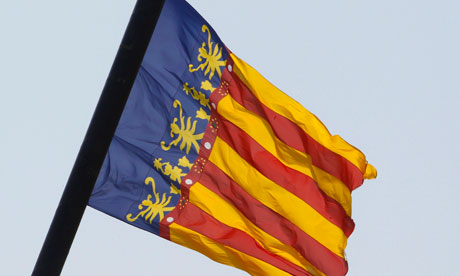
Much of Spain's €18bn regional bailout fund will end up in heavily indebted eastern regions such as Valencia. Photograph: Heino Kalis/Reuters
Spain's regional governments have long made it clear that they cannot make it through the year without the help of a central government bailout.
Much of the €18bn (£14.2bn) on offer will end up on Spain's eastern Mediterranean coast, with Catalonia, Valencia and Murcia at the front of the queue.
They jointly need €9bn to cover deficit spending and the refinancing of existing debt this year. They may need a similar sum to tide them through 2013 and 2014.
But several other regions may follow suit, with Castilla La Mancha – which posted the worst regional deficit of all last year – the most likely to need help.
A political price must be paid. Regions that take bailout money but fail to meet a strict central government deficit target of 1.5% this year can have their finances taken over by the so-called "men in black" – finance ministry officials from Madrid.
That would provoke outrage in Catalonia – a fiercely independent-minded region that already claims it pays too much into Spain's communal tax pot and that the bailout is simply a case of it getting its money back.
and.....
http://www.zerohedge.com/news/dethroned-berlusconi-pushing-early-november-election
Dethroned Berlusconi Pushing For Early November Election
 Just under a year ago, in early November 2011, the ECB specifically made it a very clear prerogative that it would not buy Italian bonds under the SMP program, or in any other way seek to lower Italian bond yields, which promptly soared to all time highs, as long as the intransigent Silbio Berlusconi, then career PM, remained in his position as head of Italy. A few days after Italian bonds soared, Silvio quietly and reluctantly stepped down, paving the way for that other Goldmanite - unelected technocrat Mario Monti to take over the reins. We are now just over two months until the one year anniversary of the historic Berlusconi ouster by a central bank (whose head amusingly wrote an Op-ed in a leftist German publication that his organization is apolitical; just as the Fed is apolitical until Wall Street darling Chuck Schumer tells Bernanke to "get to work Mr. Chairman"), and suddenly Silvio is back in the picture. As Italian daily Repubblica notes, the former PM "fears the repercussions of a conviction in the Ruby process before the vote" currently scheduled for 2013, and as a result Berlusconi would agree to sign off on a plan to reform the electoral law in the next few days on the condition that early elections will be held in November. Whether or not this means that Silvio is seeking to retain his PM throne, or merely to regain prosecutorial immunity from engaging in various questionable activities (mostly of a sexual nature) is unknown, but the fact that the Italian political theater may regain its old tragicomic luster has us smiling at the prospect of what the end of 2012 has to offer, especially since America's own presidential election will culminate at about the same time.
From Repubblica, google translated:
BERLUSCONI asking for votes in November. "We have no choice, 2013 is too far away, prosecutors persecute me, the judges want to condemn me before the election campaign." The acceleration mature within 24 hours.Couple under a blanket of marsh apparent in the negotiations between PDL and PD on the electoral law. Takes shape in the fort of Palazzo Grazioli, where the Knight rushes from Sardinia emergency calling to report her: Alfano, Verdini, Ghedini, Bonaiuti. And here's the twist: you have to hurry, immediately approve the reform.The leader - and the news that the lawyer of former Prime Minister leads to the War Cabinet - looms the very real risk of a conviction at first instance in November and December. The ax of the Ruby process. The curse that haunts him. The nightmare of a campaign to be conducted from January to March, presidential candidate of the Council, with the burden of a judgment fatal to those infamous crimes.Take a short time, the hawks sitting in the living room of Via del Plebiscito, to understand that the only train passes now to avoid catastrophe. Approve the electoral law in a few days, even under the conditions of the opponents of the Democratic Party, provided that the resignation convince Monti and Napolitano to anticipate the vote in November. It is a sudden change of perspective.
and While Silvio plots his comeback in Italy perhaps as soon as this November , cocky Mario Draghi lectures Germany ( while reminding them of their Euro 2012 loss to Italy )
From Jawboning To Fingerboning - Mario Draghi Releases Op-Ed On The Future Of Europe
When jawboning is stuck on max, and mere talking and exortations to just "believe" lead to no incremental benefit for PIIGS bonds and the leve of the Dax, what is a central planner to do? Why start, er, fingerboning, and write extended missive on the future of one doomed utopian vision or another. Sure enough, the former Goldmanite has just released the following Op-ed in German Zeit, titled, "The future of the euro: stability through change", which contains this piece of sheer brilliance: "The ECB is not a political institution. But it is committed to its responsibilities as an institution of the European Union." The European Union which is first and foremost a... political institution.
Full Op-Ed below:
The future of the euro: stability through change
Contribution from Mario Draghi, President of the ECB, Published in "Die Zeit", 29 August 2012
Across Europe, a fundamental debate is taking place about the future of the euro. Many citizens are concerned about where Europe is heading. Yet the solutions presented appear to them unsatisfactory. This is because these solutions offer binary choices: either we must go back to the past, or we must move to a United States of Europe. My answer to the question is: to have a stable euro we do not need to choose between extremes.
The reason this debate is taking place is not the euro as a currency. The objectives of the single currency remain as relevant today as they were when the single currency was agreed. To spread price stability and sustainable growth to all European citizens. To reap the gains of the world’s largest single market and make the historic process of European unification irreversible. To raise Europe’s standing – not only economically but also politically – in a globalised world.
The debate is taking place because the euro area has not yet fully succeeded as a polity. Currencies ultimately depend on the institutions that stand behind them. When the euro was first proposed, there were those who said it would have to be preceded by a long process of political integration. This was because sharing a currency would imply a high degree of joint decision-making. Member countries would be a “Schicksalsgemeinschaft” and would need strong common democratic underpinnings.
But a deliberate choice was made in the 1990s not to give the euro such features. The euro was launched as a “currency without a state” to preserve the sovereignty and diversity of member countries. This informed the so-called “Maastricht setup”, which laid the euro’s institutional foundations. But as recent events have shown, this institutional framework left the euro area insufficiently equipped to ensure sound economic policies and effectively manage crises.
For this reason, the way ahead cannot be a return to the status quo ante. The challenges of having a single monetary policy but loosely coordinated fiscal, economic and financial policies have been clearly revealed by the crisis. As Jean Monnet said, coordination “ is a method which promotes discussion, but it does not lead to a decision.” And strong decisions have to be made to manage the world’s second most important currency.
A new architecture for the euro area is desirable to create sustained prosperity for all euro area countries, and especially for Germany. The root of Germany’s success is its deep integration into the European and world economies. To continue to prosper, Germany needs to remain an anchor of a strong currency, at the centre of a zone of monetary stability and in a dynamic and competitive euro area economy. Only a stronger economic and monetary union can provide this.
Yet this new architecture does not require a political union first. It is clear that monetary union does entail a higher degree of joint decision-making. But economic integration and political integration can develop in parallel. Where necessary, sovereignty in selected economic policy fields can and should be pooled and democratic legitimation deepened.
How far should this go? We do not need a centralisation of all economic policies. Instead, we can answer this question pragmatically: by calmly asking ourselves which are the minimum requirements to complete economic and monetary union. And in doing so, we will find that all the necessary measures are firmly within our reach.
For fiscal policies, we need true oversight over national budgets. The consequences of misguided fiscal policies in a monetary union are too severe to remain self-policed. For broader economic policies, we need to guarantee competitiveness. Countries must be able to generate sustainable growth and high employment without excessive imbalances. The euro area is not a nation-state where persistent cross-regional subsidies have sufficient popular support. Therefore, we cannot afford a situation where some regions run permanently large deficits vis-à-vis others.
For financial policies, there need to be powers at the centre to limit excessive risk-taking by banks and regulatory capture by supervisors. This is the best way to protect euro area taxpayers. There also needs to be a framework for bank resolution that safeguards public finances, as we see in other federations. In the U.S., for example, on average about 90, mostly smaller, banks per year have been resolved since 2008 and this had no impact on the solvency of the sovereign.
Political union can, and shall, develop hand-in-hand with fiscal, economic and financial union. The sharing of powers and of accountability can move in parallel. We should not forget that 60 years of European integration have already created a significant degree of political union. Decisions are made by an EU Council filled by national ministers and by a directly elected European Parliament. The challenge is to further increase the legitimacy of these bodies commensurate with increasing their responsibilities and to seek ways to better anchor European processes at the national level.
A more solid political foundation should allow for agreement on a basic principle: that it is neither sustainable nor legitimate for countries to pursue national policies that can cause economic harm for others. This constraint has to be built into how countries design their economic and social models. The only sustainable model is one that is consistent with the terms of a common currency. Countries have to live within their means. Competition and labour markets have to be reinvigorated. Banks have to conform to the highest regulatory standards and focus on serving the real economy. This is not the end, but the renewal of the European social model.
From the ECB’s perspective, a strong economic union is an essential complement to the single monetary policy. Building this will require a structured process with correct sequencing. Yet citizens can be certain that three elements will remain constant. The ECB will do what is necessary to ensure price stability. It will remain independent. And it will always act within the limits of its mandate.
Yet it should be understood that fulfilling our mandate sometimes requires us to go beyond standard monetary policy tools. When markets are fragmented or influenced by irrational fears, our monetary policy signals do not reach citizens evenly across the euro area. We have to fix such blockages to ensure a single monetary policy and therefore price stability for all euro area citizens. This may at times require exceptional measures. But this is our responsibility as the central bank of the euro area as a whole.
The ECB is not a political institution. But it is committed to its responsibilities as an institution of the European Union. As such, we never lose sight of our mission to guarantee a strong and stable currency. The banknotes that we issue bear the European flag and are a powerful symbol of European identity.
Those who want to go back to the past misunderstand the significance of the euro. Those who claim only a full federation can be sustainable set the bar too high. What we need is a gradual and structured effort to complete EMU. This would finally give the euro the stable foundations it deserves. It would fully achieve the ultimate goals for which the Union and the euro were founded: stability, prosperity and peace. We know this is what the people in Europe, and in Germany, aspire to.
and from The Telegraph liveblog.....
13.57 Mr Monti recently said that the move to grant the ESM a banking licence would "in due course occur". However, Mario Draghi insisted at the last ECB press conference that the ESM would not be a "suitable counterparty that is eligible for central bank financing". The ECB outlines its reasons here.
Mrs Merkel says she agrees with Mario.
Draghi, that is, not Monti.
"It is not compatible," she insists.
13.52 The Italian PM returns the compliment. He says that Germany is an example of how economic policy must be lasting.
There is one thing they still disagree on: granting the European Stability Mechanism (ESM) a banking licence.
Mrs Merkel says that the EU treaty does not allow the eurozone's permanent bail-out fund to have a banking license.
But Mr Monti says that the issue of a licence should be on the table and that the treaty can be modified to deal with the crisis.
Granting the ESM a banking licence would allow it to directly tap ECBfunding.
13.41 I'll return to the American economy in a moment. Angela Merkel is holding a press conference with Mario Monti in Berlin.
The German Chancellor describes Italy's reform efforts as "impressive" and adds that she believes the country's reforms will bear fruit.
She says that the euro area has an ambitious agenda in the coming weeks, but believes that the eurozone has the right tools to bring stability to the area.
12.27 The tiny Spanish region of Murcia will request funds from the same facility in September, according to a local government official.
Although a precise date was not specified, the official repeated that the region would request around €700m from the facility.
11.46 Spain is not in talks with Brussels about implementing further budget cuts, and plans to meet its fiscal targets whether the ECBintervenes or not, according to Spain's economy minister.
Luis de Guindos (below) also told reporters that Catalonia's request of €5bn from a special liquidity fund won’t strain its finances as the request was considered when setting up the €18bn pot, which is part-funded by the Spanish lottery.
10.59 A special summit will be held in November to discuss the controversial topic that is the EU budget, according to reports.
Officials told APF that leaders will gather in November to discuss the "financial perspectives" of the next seven years of the budget. Arguments against ever-rising spending have grown since the financial crisis hit in 2008.
In July, Mark Hoban, the Treasury minister, described the 2.8pc increase for 2013 as an “unhappy compromise” because of a majority voting system that meant Britain was unable to block the deal.
Total EU spending next year will increase by £2.9bn to around £108.7bn. After the complex rebate system is taken into account, British taxpayers will have to fork out around £350m more.
10.09 Italy has just sold six-month debt at much lower rates than at a previous auction in July.
It sold €9bn of six-month T-bills at average yields of 1.585pc, compared with 2.454pc on July 27. Demand was steady, with 1.69 bidders for every bond on offer (v.1.61 in July).
09.55 The Greek stalemate continues. Leaders are meeting this morning for more talks on the €11.5bn savings plan needed to unlock the next tranche of its bail-out.
PM Antonis Samaras has yet to convince his coalition partners to agree to cuts to pensions, pay and benefits for army and police staff which Mr Samaras' conservative party had pledged to protect before being elected in June.
The cuts are being made amid rumours that Greece would have to find an extra €2bn of savings to compensate for revenues lost due to the country's deepening recession.
09.28 Meanwhile, Italian retail sales climbed in June, according to official data.
Sales climbed 0.4pc on a monthly basis - against expectations for a 0.2pc fall, ISTAT said.
09.16 A few bits of data out this morning.
French business confidence edged up this month, although sentiment remains well below the long-run average of 100. Sentiment climbed to 90 from a revised 89 in July, according to national statistics office INSEE.
INSEE said confidence remained "deteriorated":
09.03 Mr Monti has already outlined his message to Mrs Merkel today in an interview with Italian newspaper Il Sole 24 Ore. He warned thatGerman insistence on blocking the ECB from acting to bring down countries' borrowing costs could be an “own goal” because it could lead toGermany's worst nightmare:
Inflation.
He said:
 It would certainly be fair to point out that while the imbalance (between German and Italian borrowing costs) is a serious issue for us [...] it's also a risk for countries that seem to benefit.
The current configuration of spreads has created growth in Germany's M3 money supply, which has resulted in artificially low interest rates, rising bond prices and upward pressure on house prices. This results in a potential inflation risk in Germany, which I don't think corresponds to the desires of the European Central bank nor to the desires of Germany.
and from Greece.....
| Coalition leaders to continue austerity talks | |||||||||||||||||||||||||||||||||||
| |||||||||||||||||||||||||||||||||||

Coalition leaders broadly agree on an austerity package demanded by the troika but have yet to decide on how to soften its impact on low-wage earners and pensioners, government officials and party leaders said on Wednesday.
The leaders of the three government parties met on Wednesday morning to sign off on a new, 11.5bn euro package of cutbacks.
The meeting, which was attended by Prime Minister Antonis Samaras, Pasok leader Evangelos Venizelos and Kouvelis, got underway around 10am and ended just after noon.
The austerity package will be ready next week to be presented to troika inspectors, Finance Minister Yannis Stournaras said.
"There is political agreement on the package," Stournaras said after the leaders' meeting. "The package will be sealed next week and presented to the troika."
He played down the issues holding up the package as "minor, technical" but Pasok and Democratic Left - both under pressure from voters to oppose a new round of austerity - were more cautious on the work left to finalise the package.
The contentious issue of the special salaries paid to the military, police and certain groups of civil servants, as well as pension cuts, is proving a major stumbling block.
Fotis Kouvelis, leader of Democratic Left, said he would reject any wholesale cuts to wages and pensions and that poor citizens on already low salaries must be protected.
"We are trying to avert across-the-board cuts, which I categorically oppose," Kouvelis said after the meeting. "Low-income earners must not bleed any further."
Pasok leader Evangelos Venizelos said the party leaders would continue talks to ensure the cuts were "balanced and just" and did not "destroy the middle class".
The troika is expected to return to Athens on September 5. Their subsequent report on the country's progress in meeting the terms of its bailout will determine whether EU leaders decide in October to continue bailout funding. (Reuters, Athens News/dmcu)
and.....
http://www.athensnews.gr/portal/1/57900
and more Greece news ..... Hey , did they make another remake of the Three Stooges ?
| |||||||||||||||||||||||||||||||||||


No comments:
Post a Comment