http://news.antiwar.com/2012/08/30/five-australian-troops-killed-by-afghan-trainees/
Five Australian Troops Killed by Afghan Trainees
In two separate incidents, five more NATO troops died in so-called insider attacks
by John Glaser, August 30, 2012
Five Australian soldiers have been killed by Afghan trainees in two separate incidents on Wednesday and Thursday, in the latest of such “insider attacks” leaving a bad taste in the mouth of US officials seeking to finish out a lost war for another two years.
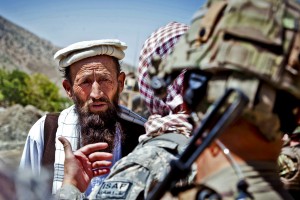 The number of such incidents, termed “green-on-blue” attacks have been increasing steadily as of late, with 35 of them so far this year, ending with 47 NATO members killed, mostly Americans.
The fact that all those killed in the last two incidents were Australian strains an already tense US relationship with Australia over the war in Afghanistan. In April, Australian Prime Minister Julia Gillard announced an early withdrawal to be completed a year before the Obama administration’s so-called withdrawal date at the end of 2014.
Gillard said the loss of the five military personnel the single worst day for her country in war since the Vietnam conflict.
The failure of the US mission in Afghanistan – to build up and train a centralized state and security apparatus – is illustrated clearly in the constant killing of US soldiers by their Afghan counterparts. Much of the security force has been infiltrated by the Taliban or Pakistani agents.
Earlier this month it was reported that the Taliban’s supreme leader Mullah Omar issued a statement bragging about extensive insurgent infiltration in America’s trained security personnel in Afghanistan.
“They are able to (safely) enter bases, offices and intelligence centers of the enemy,” he said. “Then, they easily carry out decisive and coordinated attacks, inflicting heavy losses on the enemy.”
As a former US official told Dexter Filkins of the New Yorker, “several hundred soldiers in the Afghan Army are thought to be agents for the Taliban or for Pakistan.” He said that many insurgents who have infiltrated the Afghan forces and killed US troops “had been planted in the Army by the Taliban or by Inter-Services Intelligence, Pakistan’s main intelligence branch.”
The US mission in Afghanistan has failed miserably. President Obama’s supposed justification for building up Afghan security forces is so they serve as a bulwark against a return to Taliban rule. But the Taliban have seeped deep into those forces the US is spending billions of dollars on training, and the insurgency is as strong as ever.
http://news.antiwar.com/2012/08/29/three-more-nato-troops-killed-by-afghan-trainee/
Three More NATO Troops Killed by Afghan Trainee
The US is literally training their own Taliban enemies to kill American soldiers
by John Glaser, August 29, 2012
Three more NATO troops have been killed by a man in an Afghan army uniform, in the latest of such “insider attacks” leaving a bad taste in the mouth of US officials seeking to finish out a lost war for another two years.
The number of such incidents, termed “green-on-blue” attacks have been increasing steadily as of late, with 34 of them so far this year, ending with 45 NATO members killed, mostly Americans.
The failure of the US mission in Afghanistan – to build up and train a centralized state and security apparatus – is illustrated clearly in the constant killing of US soldiers by their Afghan counterparts. Much of the security force has been infiltrated by the Taliban or Pakistani agents.
Earlier this month it was reported that the Taliban’s supreme leader Mullah Omar issued a statement bragging about extensive insurgent infiltration in America’s trained security personnel in Afghanistan.
“They are able to (safely) enter bases, offices and intelligence centers of the enemy,” he said. “Then, they easily carry out decisive and coordinated attacks, inflicting heavy losses on the enemy.”
As a former US official told Dexter Filkins of the New Yorker, “several hundred soldiers in the Afghan Army are thought to be agents for the Taliban or for Pakistan.” He said that many insurgents who have infiltrated the Afghan forces and killed US troops “had been planted in the Army by the Taliban or by Inter-Services Intelligence, Pakistan’s main intelligence branch.”
The US mission in Afghanistan has failed miserably. President Obama’s supposed justification for building up Afghan security forces is so they serve as a bulwark against a return to Taliban rule. But the Taliban have seeped deep into those forces the US is spending billions of dollars on training, and the insurgency is as strong as ever.
Last 5 posts by John Glaser
- Iranian FM: We Recognize Concerns Over Nuclear Program, 'Ready to Mitigate' - August 29th, 2012
- Romney Campaign Refuses to Endorse Syria No-Fly Zone - August 29th, 2012
- Iraq Executes 21 in a Single Day - August 29th, 2012
- Gaza Woman Critically Injured After Unprovoked Israeli Shooting - August 29th, 2012
- Iraq to Receive First Batch of F-16s in 2014 - August 21st, 2012
and.....
http://www.atimes.com/atimes/China/NH31Ad01.html
Egypt joins China club
By Brendan O'Reilly
President Mohammed Morsi's historic trip to Beijing signifies a new direction for Egyptian foreign policy. The Muslim Brotherhood leader has sent a clear message by selecting China for his first state visit outside the Middle East. By forging closer ties with China, Morsi is warning the US government not to take Egyptian acquiescence for granted.
He has furthermore offered an important opportunity for China to expand its regional influence. It is essential at this juncture to forecast what China expects from the New Egypt in particular, and the greater Middle East in general. Regional and international powers should take note: China's influence and clout will increasingly become a decisive factor in all Middle Eastern struggles.
China's growing engagement with the Middle East is structuredaround a consistent three-pronged focus: opportunity, stability, and sovereignty. China sees post-Mubarak Egypt as a potential partner for promoting these Chinese interests in the region. Beyond this essentially conservative strategy, China is quietly exploring contingency options in the event of open antagonism with the United States.
By Brendan O'Reilly
President Mohammed Morsi's historic trip to Beijing signifies a new direction for Egyptian foreign policy. The Muslim Brotherhood leader has sent a clear message by selecting China for his first state visit outside the Middle East. By forging closer ties with China, Morsi is warning the US government not to take Egyptian acquiescence for granted.
He has furthermore offered an important opportunity for China to expand its regional influence. It is essential at this juncture to forecast what China expects from the New Egypt in particular, and the greater Middle East in general. Regional and international powers should take note: China's influence and clout will increasingly become a decisive factor in all Middle Eastern struggles.
China's growing engagement with the Middle East is structuredaround a consistent three-pronged focus: opportunity, stability, and sovereignty. China sees post-Mubarak Egypt as a potential partner for promoting these Chinese interests in the region. Beyond this essentially conservative strategy, China is quietly exploring contingency options in the event of open antagonism with the United States.
The primary thrust of contemporary Chinese foreign policy - be it in Africa, Asia, South America or the Middle East - is economic opportunity. Beijing is well aware that the ever-growing importance of its economy makes China an indispensable trade partner and source of investment for nations throughout the world.
This economic dynamic is the main focus of Morsi's trip to Beijing. Egypt's economy is hurting badly after the political upheavals that have rocked the country since the overthrow of Hosni Mubarak. China is viewed in Egypt as an indispensable source of emergency funding and investment. Egyptian presidential spokesman Yasser Ali explicitly stated that the main goal of Morsi's trip was to "attract Chinese investment in Egypt". [1]
Minister of Investment Osama Saleh, along with delegation of 80 Egyptian businesspeople, has accompanied Morsi to Beijing. Saleh specifically called for more Chinese money to stimulate the Egyptian economy, saying: "China's current investment volume in Egypt is very small. It should be among the top three." [2]
Currently, the dominant foreign investors in Egypt are Saudi Arabia and the United States. Beyond traditional investments, the latter currently bankrolls the Egyptian government to the tune of about US$2 billion a year - $1.4 billion of which goes to the military. This money comes with strings attached - especially regarding Egyptian policy toward Israel and the Palestinians. Chinese investments could counterbalance US influence and help Morsi steer an independent foreign policy more in line with the expectations of the Egyptian electorate. Furthermore, China sees the relationship with the new Egyptian government as essential to geopolitical stability - the second focus of Chinese policy in the Middle East and elsewhere. The Chinese government wants to avoid destabilizing conflict while consolidating political, economic and military power. China's economy can only consistently grow in a reasonably stable international environment. War is bad for business. This is especially true in the hydrocarbon-rich Middle East.
China is extremely wary of the potential for open conflict between the US-backed de facto alliance among Israel, Turkey and the Arab Gulf states on one side and the "Axis of Resistance" consisting of Iran, Syria and Hezbollah on the other. China is particularly keen on preventing a US or Israeli strike on Iran's nuclear program, and the resulting hazards to Middle Eastern oil exports. Meanwhile, the sectarian undertones of the conflicts in Syria, Iraq and Lebanon contain the destructive seeds of prolonged instability. A middle force is needed to contain the potential firestorm.
By providing funds and political support to Cairo, China can help to promote a stability-focused, independent foreign policy for the Egyptian government. Indeed, President Morsi, before his trip to China, specifically promised a balanced foreign policy: "Egypt is now a civilian country ... with a democratic, constitutional and modern society. International relations between all countries are open and they must be based on the concept of balance. We are hostile to no one but we are to defend our interests." [3]
This message is music to Chinese ears. It should be noted that China maintains close trade and political relations with regional rivals Iran and Saudi Arabia. China would like to see Egypt work the role as an honest broker in the region - maintaining good relations with the US, Saudi Arabia and Israel, while reaching out to Iran, Hezbollah and the Palestinians. It seems that China may have found in Morsi the perfect man for the job. His trip to Iran to attend the Non-Aligned Movement summit after visiting China is yet another symbolic gesture of Egyptian "balance" between the competing camps in the Middle East. With the final thrust of Chinese foreign policy - sovereignty - Beijing faces some important regional disagreements with Morsi. The Chinese government is ideologically and strategically opposed to US-led efforts at regime change. It views the Western policy of militarized "democracy promotion" as self-interested meddling in the internal affairs of other countries disguised as humanitarian intervention. These campaigns constitute an indirect threat to the Chinese government itself. Furthermore, the North Atlantic Treaty Organization military campaign in Libya cost China billions of dollars in contracts with Muammar Gaddafi's regime.
China, along with Russia, has vetoed the possibility of United Nations Security Council-sanctioned military intervention in Syria's civil war. Morsi, on the other hand, has denounced the Syrian government in unambiguous language, saying, "The regime that kills its people must disappear from the scene." [4] He will lobby behind the scenes for a harder line against Syrian President Bashar al-Assad during his trips to Beijing and Tehran.
China's disagreement with Morsi over the Syrian situation could be a political opportunity for both parties. While the Chinese government will continue to be opposed to outside (especially Western) military intervention in the Syrian conflict, it will maintain close ties with the pro-intervention Gulf Cooperation Council. Meanwhile, Morsi's concrete steps to bring about a more balanced Egyptian foreign policy could help alleviate Iran's fears of losing its most important Arab ally. Both the Chinese government and Morsi himself are fairly well positioned to bring relevant regional parties together to try to find a political solution to the crisis while avoiding (or at any rate limiting) outside military intervention.
Middle Kingdom eyes the Middle East
Beyond the important implications of Morsi's China trip for contemporary Chinese policy in the Middle East, there lies a long-term potential for Beijing to assume a much more assertive regional role. As the US continues to pressure China in East Asia, Chinese leaders are quietly and carefully considering global contingencies. The Middle East, with its vast energy resources, central geopolitical position, and strong anti-American sentiment, could be an ideal location for China to challenge America's pre-eminent global role. Indeed, Morsi's state visit to China must have been a calculated message to US leadership: if sufficiently pressured by the United States or enticed by China, Egypt could abandon Washington's camp. During the last Cold War, Egypt shifted from the Soviet to the US sphere when the political leaders perceived such a move as being in their self-interest. As an elected leader, President Morsi must be sensitive to the will of the Egyptian people, and the Egyptian people, for the most part, distrust and fear the US government.
Beyond and above the contemporary Sunni/Shi'ite and Arab/Iranian political divides, there remains a strong anti-American sentiment throughout the greater Middle East. Indeed, while the rulers of Washington's Arab allies publicly bemoan Iranian influence and privately plot against Tehran, a majority of their subjects would welcome Iran's acquisition of nuclear weapons. The 2010 Arab Public Opinion Poll found 57% of respondents to view Iran's achievement of nuclear weaponry as having a positive effect in the region, with only 21% viewing this potential development negatively. [5]
The countries polled were US allies Egypt, Jordan, Morocco, Saudi Arabia and the United Arab Emirates (as well as politically divided Lebanon). Washington suffers from a serious public relations problem when the citizens of US ally states wish for America's arch-regional rival to obtain nuclear weaponry.
Herein lies an important geopolitical opportunity for China stemming from the Arab revolt. If and when Arab governments become more responsive to their people's wills, they will drift away from the US and search for other allies. There were two telling exceptions to this general trend - Libya and Syria, whose rulers were already politically opposed to US regional dominance, and thus found themselves on the wrong end of advanced Western weaponry (explicit in Libya and clandestine, so far, in Syria). Except for these two nations, one can reasonably expect every single Arab government to become less reflexively pro-American the more it democratizes. The Middle East has strong potential for Chinese power projection as long as issues that exacerbate anti-American sentiment - especially the Israeli-Palestinian conflict - remain unresolved. Western media analysts who loudly predicted peril for China's rulers stemming from the example of the Arab revolt ignored two vital trends: the primarily economic nature of the original protests, and the essential peril for US regional dominance that Arab democracy entails.
President Morsi's visit to China serves as a stunning example of drastic transformations in the international system, both in the Middle East and throughout the world. First, if most Arab states become more democratic, they will adopt a foreign policy that is independent of Washington's dictates. Second, China's enormous, no-strings-attached financial resources are increasingly indispensable for nations in economic turmoil. Finally, as the US economy continues to stagnate, traditional US allies will be compelled to look for alternatives sources economic and political support.
For the time being, China can take advantage of these trends to promote a conservative foreign policy focused on economic opportunity, geopolitical stability, and protecting the sovereignty of "rogue states" targeted by Washington. However, as the US government strengthens its military position in Asia, China may adopt a more proactive role to counter US pressure. If Sino-American rivalry escalates into a new cold war, China may find the Middle East awash with oil, and allies.
and cue the use of chemical weapons by Assad forces any day now......
http://english.alarabiya.net/articles/2012/08/29/235025.html
Free Syrian Army discovers cache of large missiles
Wednesday, 29 August 2012
FSA brigades unearthed a cache of large missiles in a military base in the Aftrees areato be used for chemical or biological warfare on civilians. (Al Arabiya)s in

Free Syrian Army brigades have broken into a military base in the Aftrees area that was used by Syrian government forces, the groups claims in an online statement. The resistance fighters say facilities here were used to maintain and modify missiles that have rained on surrounding areas, and also to store artillery and tanks that blast the streets of villages and the outskirts of Damascus.
Amateur footage that could not be independently verified by Al Arabiya shows purported members of the FSA uncovering large stockpiles of powerful missiles.
“Thanks to God, the barracks of Aftrees has been raided by the popular resistance forces, the Eastern Ghouta brigade, in Damascus countryside. The raid on the Aftrees barracks has destroyed tanks. God is great. Breaking into missiles warehouse.”
They say they are surprised to discover modified missiles capable of carrying warheads that harnesses chemical or biological weapons.
“Ten missiles. Oh my God. God is great. A warehouse full of missiles.”
The rebel group documented the operation to show the international community the heavy armaments indiscriminately used by forces loyal to President Bash al-Assad. The Higher Military Council of the FSA stated Assad’s regime is possibly preparing to bombard cities nationwide with such artillery, saying it is likely the regime would resort to using such missiles to stay in power.
In its statement, the resistance group’s military council also pleaded Arab countries and the rest of the international community for immediate intervention to save the civilian lives, before the regime takes another step in its crackdown, implying a disastrous effect on the entire region.
and...
http://english.alarabiya.net/articles/2012/08/29/235029.html
Free Syrian Army find gas masks belonging to regime
Wednesday, 29 August 2012
Gas masks were discovered by the FSA for use by members of the Assad regime in case of chemical warfare. (Al Arabiya)
The Free Syrian Army’s Abu Dujana brigade says it has discovered a stockpile of gas masks to be distributed amongst members of President’s regime in case it unleashes chemical weapons in its ongoing civilian assault.Amateur footage that could not be independently verified by Al Arabiya shows resistance fighters uncovering the large stash in what appears to be a government building in a suburb of Aleppo.
“The use of chemical weapons requires gas masks to protect the Shabbiha and supporters of this criminal regime. As we can see, this is only part of the large amount found in one government building in Deir Hafir. These amounts exist in all government buildings and all Baathist buildings.”


No comments:
Post a Comment