http://www.aljazeera.com/news/middleeast/2012/07/2012724142839340786.html
| Iraqi vice president's trial postponed | |
An Iraqi court refuses to allow president Jalal Talabani testify in vice-president Tariq al-Hashemi's trial.
Last Modified: 24 Jul 2012 17:04
| |

An Iraqi court refused to allow President Jalal Talabani testify in a terror trial against the Sunni vice president [EPA]
| |
The trial of Iraq's fugitive Vice President Tariq al-Hashemi, accused of running death squads, has been postponed after defence requests to call President Jalal Talabani to testify were again denied.
An Iraqi appeals court refused on Tuesday to allow Talabani testify in a terror trial against the nation's Sunni vice president, a case that has deepened the rift between the country's largely sectarian-based political factions.
The latest session in the case against Vice President Tariq al-Hashemi follows the bloodiest day in Iraq in two years.
Monday's attacks killed 115 people and came on the heels of a declaration by al-Qaida's new leader that the movement hopes to reestablish itself in Sunni areas and recreate alliances with Sunni tribes.
Al-Hashemi, one of Iraq's highest-ranking Sunni politicians, is accused of running death squads that targeted Shia officials and pilgrims.
Al-Hashemi, who is in Turkey avoiding trial, has denied the wrongdoing and has said he is the victim of a political vendetta by Shia Prime Minister Nouri al-Maliki.
Attorney Muayad Obeid al-Ezzi, the head of al-Hashemi's defence team, said the Iraq's federal appeals court upheld an earlier decision by the Baghdad's criminal court to not take Talabani's testimony.
In May, al-Hashemi filed a request to have Talabani, an ethnic Kurd, serve as a character witness, along with two other government officials and five Sunni legislators.
Defence lawyers sought to ask if they had any information about al-Hashemi's role in terror attacks. But the three-judge panel rejected the request, saying it would add nothing to the case.
Also in Tuesday's session, the court heard more testimony from five police officers who told the court they found pistol silencers during two separate raids on the homes of al-Hashemi and Ahmed Qahtan, his son-in-law and office manager.
The court also heard from a woman and her son who are Qahtan's neighbours who said they saw policemen taking silencers from the house.
Another witness, one of more than 70 of al-Hashemi's guards now in detention, told the government how he used to drive other guards to plant roadside bombs.
The trial is scheduled to continue on August 14.
Also Tuesday, Iraqi officials raised the death toll from Iraq's deadliest day in more than two years to 115.
Police and hospital officials said that five more people died from injuries sustained in a late-night car bombing Monday near a cafe in a Shia neighborhood in eastern Baghdad.
Initial casualty figures often change in the immediate hours following attacks.
All officials spoke on condition of anonymity because they were not authorised to talk to the media.
and........
Al-Qaeda Infiltrating Syrian Opposition, With US SupportRussia slammed the US for 'justifying terrorism' in Syria
by John Glaser, July 25, 2012
Al-Qaeda militants and other Sunni extremists are becoming a greater and greater part of the conflict in Syria, just as the US officially announced it was abandoning any pretense of a diplomatic approach in favor of toppling the regime through proxy rebel groups.
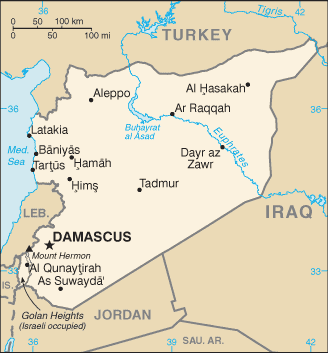 “The evidence is mounting that Syria has become a magnet for Sunni extremists, including those operating under the banner of Al Qaeda,” reports the New York Times. “The presence of jihadists in Syria has accelerated in recent days in part because of a convergence with the sectarian tensions across the country’s long border in Iraq.” “The evidence is mounting that Syria has become a magnet for Sunni extremists, including those operating under the banner of Al Qaeda,” reports the New York Times. “The presence of jihadists in Syria has accelerated in recent days in part because of a convergence with the sectarian tensions across the country’s long border in Iraq.”
According to one US intelligence estimate, as many as a quarter of the 300 rebel groups in Syria may be fighting under the banner of al-Qaeda, says Rep. Mike Rogers (R-MI), chairman of the House Intelligence Committee.
Strangely, the fact that Washington, in cooperation with its allies, is now sendingcommunication gear, military intelligence, and weapons to militias in Syria with considerable – and growing – ties to al-Qaeda has not made the Obama administration blink.
Russia on Wednesday criticized the US for not condemning the July 18 bombing in Damascus, which they called an act of terrorism. ”This is directly justifying terrorism. How can this be understood?” Foreign Minister Sergei Lavrov said.
“In other words, to say it in plain Russian, this means ‘we (the United States) will continue to support such terrorist acts for as long as the UN Security Council has not done what we want’,” Lavrov added.
The CIA is supposedly employing a “vetting process” to avoid having the aid get into the hands of Islamic extremists, but the process is made up of untrustworthy, third-party sources and intelligence officials have recently told the Washington Post and theLos Angeles Times that the truth is that the US doesn’t know who is getting the money and weapons.
Apparently, even arming and strengthening al-Qaeda isn’t enough to disruptWashington’s plan to change the regime in Syria, in order to eliminate Iran’s main ally in the Middle East and to gain an even stronger foothold in the region.
But extremist infiltration of the Syrian opposition carries other problems. The Obama administration runs the risk of helping to bring these extremists to power if and when the Assad regime finally does collapse. Moreover, as happened in Afghanistan after the US proxy war there with the mujihadeens, the potential for deadly blowback is very real.
and.......
http://www.cnn.com/2012/07/24/world/asia/pakistan-nato-convoy-attack/index.html?hpt=hp_t3
Gunmen attack NATO supply convoy in Pakistan, killing 2
updated 5:33 AM EDT, Tue July 24, 2012
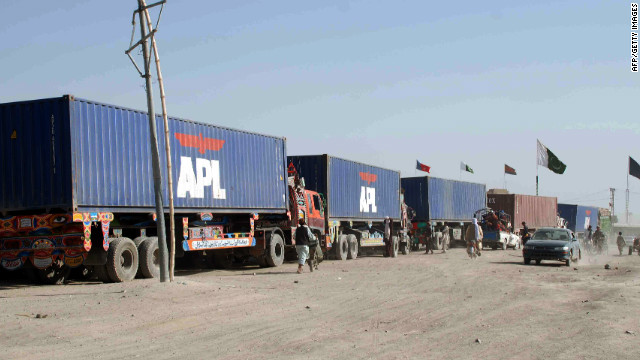
NATO supply trucks drive toward the border terminal in Chaman on July 17, 2012.
STORY HIGHLIGHTS
Islamabad, Pakistan (CNN) -- Gunmen opened fire on a convoy of trucks in northwestern Pakistan that were carrying provisions for NATO forces in Afghanistan, killing two people.
It was the first attack on the supply routes since they were reopened earlier this month, a local official said.
The assault was carried out by more than 12 men riding motorbikes, said Ubaid Ullah, an official in Khyber Agency, the district where the convoy was attacked. Khyber Agency and six other districts are part of Pakistan's volatile tribal region that borders Afghanistan.
Two people were killed, and three others were wounded, Ullah said.
No one immediately claimed responsibility for the attacks.
But after Pakistan reopened routes earlier this month, the Pakistani Taliban threatened to attack NATO trucks, saying the supplies are used to target its members fighting against occupation in Afghanistan.
Transporters who resume supplies will be "considered a friend of the U.S." and will face the consequences, a spokesman for the militant group said then.
Taliban have attacked NATO supplies in the past, and killed drivers and other crew.
On July 5, trucks carrying supplies to NATO troops crossed from Pakistan into Afghanistan for the first time in seven months after Islamabad agreed to reopen routes, officials said.
Because Afghanistan is landlocked, many supplies for NATO-led troops fighting Islamic militants have to be trucked in from Pakistan.
On July 3, Islamabad decided to reopen the crucial supply routes shut down on November 27, a day after coalition forces mistakenly killed 24 Pakistani troops.
The incident plunged U.S.-Pakistan relations to an all-time low.
The Pakistani routes offer a shorter and more direct route than the one NATO has been using since November that went through Russia and other nations, avoiding Pakistan altogether.
It has cost the U.S. $100 million more a month to use the alternative northern routes.
The talks to reopen routes had been stuck on two key issues -- Pakistan's demand to charge more per container shipped across its border, and Pakistan's demand that the United States apologize for the friendly fire incident in November 2011.
Eventually, U.S. Secretary of State Hillary Clinton did.
"We are sorry for the losses suffered by the Pakistani military. We are committed to working closely with Pakistan and Afghanistan to prevent this from ever happening again," Clinton's statement said on July 3.
Until her apology, the U.S. government had only expressed regret over the incident, but had not issued a direct apology.
Pakistan has now agreed not to impose any transit fee with the reopened routes, Clinton said in a statement.
The Pakistani route costs about $250 per truck. Pakistan had been seeking $5,000 per truck as a condition of reopening the supply lines, which the United States refused to pay.
The U.S. military will now pay Pakistan $1.1 billion it owes as part of the deal struck to reopen the NATO supply lines, according to U.S. officials who had knowledge of the agreement's details but weren't authorized to speak publicly.
The money is part of a U.S. military program called "coalition support funds," which reimburses the Pakistani military for counterterrorism efforts. The U.S. halted paying the bills from Pakistan as tension rose between the two countries.
The Pentagon will consult with Congress about paying the bills prior to paying Pakistan in full, according to one of the U.S. officials.
|




No comments:
Post a Comment