http://www.guardian.co.uk/business/2012/may/13/eu-leaders-showdown-eurozone-crisis
 Submitted by Tyler Durden on 05/13/2012 19:07 -0400
EU leaders set for showdown on fate of euro as crisis deepens
Angela Merkel and François Hollande to have first face-to-face talks in Berlin after eurozone finance ministers meet in Brussels
 Email
Email
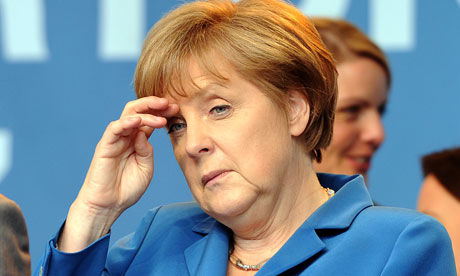
German chancellor Angela Merkel is to have face-to-face talks with François Hollande in Berlin. Photograph: Patrik Stollarz/AFP
Europe is braced for a crucial 48 hours of high-stakes summitry likely to decide whether Germany and France can strike a grand bargain aimed at dispelling growing pessimism over the chances of the single currency surviving in its current form.
While eurozone finance ministers are to meet on Monday in Brussels, apparently at a loss over how to respond to political paralysis in Greece and a worsening crisis in Spain, all eyes are on François Hollande, the new French leader, who is to go to Berlin for his first face-to-face meeting with the German chancellor, Angela Merkel, as soon as he is sworn in as president on Tuesday.
Hollande, Europe's new champion of growth policies, lines up against Merkel, the dominant cheerleader of austerity as the solution to the crisis. The German leader, increasingly isolated if inherently strong in the European contest, suffered a big setback on Sunday night, with her Christian Democrats slumping to a crushing defeat in an election in the big German state of North-Rhine Westphalia, according to German TV exit polls.
Against a background of intense volatility, Europe was pulled in opposing directions by voters, protests, and political paralysis at the weekend, deepening uncertainty over its future shape and gnawing away at the prospects for the euro's survival as a 17-country union.
Ed Balls, the shadow chancellor, and the former EU commissioner Lord Mandelson claim that the coalition government must commit with other European governments to a new growth strategy if the eurozone is to survive.
In a joint article for the Guardian, Balls and Mandelson call for a "new political settlement" across the continent to achieve growth.
The business secretary, Vince Cable, gave a bleak warning that if the eurozone fails to contain the problems facing Greece then Britain could face a huge economic impact. He said the UK could only hope that the eurozone's economic firewalls were strong enough to stop the financial turmoil from spreading. He said Britain did not have the problem of managing the issue, as it remained outside the eurozone, but could still be hit. "The problem would affect us if it spread, if you had these contagion effects in Italy and Spain," he said.
"[Michel] Barnier [EU commissioner for the internal market] has expressed optimism that those firewalls have now been created, and we must hope he's right – because if they're not, then of course it has a massive impact on our trade – half of our exports go to the eurozone countries, our banks are quite substantially exposed to those countries."
The large protests and minor clashes in Spain, political gridlock in Greece, the crucial regional election in Germany, and rising hostility to the EU in the Netherlands have all contributed to an air of crisis supplanting more than two years of financial panic and bitter argument over how to rescue the euro.
Hollande goes to Berlin on Tuesday with the psychological advantage, buttressed by a strong new mandate that has shifted the terms of European politics. After a string of setbacks among her political allies at home and in the EU, Merkel was weakened by the spectacular defeat in Düsseldorf.
The state election, involving almost one in four of German voters, was seen as a bellwether. Elections in North-Rhine Westphalia are often a gauge of the future of German national politics. The opposition Social Democrats and Greens were on the brink of securing an absolute majority, according to TV projections, with Merkel's CDU said to have dropped between eight and nine points on two years ago and four points below what the opinion polls had predicted.
After the French Socialists' presidential election triumph, the victory for Germany's Social Democrats – projected to be up four points from 34.5 – will be seen as a further fillip for the European centre-left.
Eurozone finance ministers are to meet in Brussels on Monday to ponder their options, but are unlikely to decide very much, given the political imponderables and the unresolved splits between German-led belt-tighteners and French-led proponents of growth policies as the answer to Europe's travails.
Tens of thousands of Spanish people took to the streets to protest at soaring unemployment in a country where anyone under 25 is now more likely to be out of than in work. The fourth attempt in less than a week to form a government in Greece looked destined for failure, signalling weeks of instability before fresh elections likely to strengthen the hard left, which rejects the terms of Greece's €240bn bailout and the restructuring of much of its national debt.
Opinion polls in the Netherlands, meanwhile, for the first time showed the hard left, anti-European Socialist party as the strongest single party before early elections in September in which Europe looks like being the central issue.
While the pressure from Spain, Greece, and France pointed towards a relaxation of cost-cutting austerity, the signals from Germany went in the opposite direction. The CDU's worst postwar performance in North-Rhine Westphalia, while weakening Merkel, is unlikely to cause her to abandon her tough line on a new fiscal pact for the eurozone and her arguments that Europe's debt crisis cannot be fixed by piling up more debt.
The cover of Monday's influential news weekly Der Spiegel declares "Adieu Greece", arguing that it is time to kick the country out of the euro. Almost four in five Germans believed Greece should forfeit its bailout cash if it does not comply with the stringent eurozone terms, according to a poll in the bestselling tabloid Bildzeitung. Against this background, Merkel is unlikely to expose herself to charges that she is going soft on the euro. More quietly, however, the government in Berlin and the German central bank have signalled over the past week that they favour tolerating greater inflation and higher wage increases in Germany in order to spur domestic demand and effect a partial rebalancing of the chronically imbalanced EU economy. Data being released on Tuesday will confirm that the EU is in recession, registering contraction of gross domestic product for the last two quarters. The figures are expected to show very slight growth in Germany while the French economy stagnated.
and......
http://www.zerohedge.com/news/complete-summary-next-weeks-global-events-and-manic-bond-issuance
Complete Summary Of Next Week's Global Events And Manic Bond Issuance
Now that Europe is all the rage again, below we again summarize the key Euro-centric events through the end of the month, as well as all the sovereign bond auctions to look forward to (we use the term loosely). Finally, the squid summarizes the key events in the past week as well as the expected global catalysts in the next several days. Somehow we get the impression it will be all about the unexpected developments in the next 168 hours, especially with Spain, Italy, France and Germany coming front and center with a boatload of bond issuance as soon as 9 hours from now...
- 14 May: Spain auction. Bills.
- 14 May: Italy auction. Bonds.
- 14-15 May: Eurogroup and ECOFIN finance ministers meetings.
- 15 May: Greece auction. Bills.
- 15 May: Flash Estimate EU and euro area GDP. Eurostat to publish preliminary estimates for Q1 2012 GDP.
- 17 May: Spain auction. Bonds.
- 22 May: Spain auction. Bills.
- 25 May: German parliament vote on Eurozone ‘Fiscal Compact’. The Fiscal Compact to strengthen budgetary discipline within the euro area will require a two-thirds majority in both the Bundestag and the Bundesrat, the upper house. Until now, cooperation between the coalition parties and the opposition has been smooth, underlining the pro-Europe sentiment. The SPD and the Greens are insisting on taxation of the financial sector and a growth package in return for their support. The latter fits into the broader debate on a European level, including modification of structural funds or even new financing instruments such as project bonds. However, we do not feel this will pose a risk to the Fiscal Compact being approved as the opposition has no interest in sending such a signal to the EU. Most probably the compact’s approval will be linked to i) deciding on a growth pact by the end of the year and ii) agreeing on a roadmap for introducing additional taxation on the financial sector, or at least give the go-ahead for national solutions (see article on German politics in Focus Europe on 23 March).
- 28 May: Italy auction. Bonds.
- 29 May: Italy auction. Bills.
- 31 May: Irish referendum on Euro zone ‘Fiscal Compact’. A recent opinion poll put the support for the Fiscal Compact at 47% (down 2pp), the No vote at 35% (up 2pp) and 19% Don’t Know. This equates to a 58%:42% Yes:No ratio when the undecided votes are excluded. The concern is the still high level of undecided voters. Although Ireland is making good progress through its EU-IMF adjustment programme — the sixth review was recently passed successfully — a ‘No’ to the referendum could compromise Ireland’s access to ESM funding should a second loan programme be required. Although a second referendum is a theoretical possibility (Ireland has a history of rejecting EU referenda before accepting), taking away the safety net could be a significant blow to Irish bonds.
- Global fwd issuance from MS:

- Monday May 14
- Spain to sell 12- and 18-mo bills
- Italy to sell up to EU3.5b 2.5% 2015 bonds
- Italy to sell 4.25% 2020 bonds
- Italy to sell 5% 2022 bonds
- Italy to sell 5% 2025 bonds
- Germany to sell EU4b 6-mo bills
- France to sell up to EU4b 92-day bills
- France to sell up to EU1.9b 168-day bills
- France to sell up to EU1.5b 351-day bills
- Tuesday May 15
- Greece to sell bills
- U.K. to sell GBP2.75b 5% 2025 bonds
- EFSF to sell up to EU1b 2% notes due 2017
- Wednesday May 16
- France to sell 0.75% 2014 notes
- France to sell 3.5% 2015 bonds
- France to sell 3.25% 2016 bonds
- France to sell 1.75% 2017 notes
- Germany to sell additional EU5b in 10-yr notes
- Thursday May 17
- Spain to sell bonds
- U.K. to sell GBP 1.5b 5% 2014 bonds
From Goldman SachsMacroeconomic developments remained unfriendly over the past week. Following up from the disappointment in US data prints two weeks ago, the last week has seen Europe and Asia as fresh sources of negative surprise. In the Euro area, crisis dynamics took a turn to the worse last Sunday with Greek election results opening the way for an early interruption of payments by international lenders in the months ahead. In Asia, Chinese data fell short of expectations particularly in the area of industrial production, export growth as well as new loan growth.Despite a positive start to the week, sentiment for risky assets quickly lost momentum and the SPX closed more than 1.1% lower for the week. In response the USD TWI strengthened by about 1% on the week. The USD strength was broad-based, affecting benchmark currencies such as the EUR (-1.2%), US growth driven currencies such as the MXN (-2.9%), commodity currencies such as the AUD (-1.5%), as well as NJA currencies such as the MYR (-1%).In terms of the surprise in Chinese data, the key question remains the desire of Chinese authorities to ease policy further despite sticky inflation prints. The RRR cut over the weekend can be seen as a potential signal in the direction of easing, but markets are likely to look for more dovish action, given the prevailing concerns that local authorities may currently be behind the curve.In Greece, developments are now highly path dependent. It is hard to contemplate that the current parliament can lead to a stable and long-lived government so elections will either be called in mid-June or they will be postponed for a few months, while a coalition government debates policy alternatives against an inflexible economic and external constraint. In either case, the odds that the adjustment program is interrupted have increased and the key question becomes whether the ECB will keep backing Greek banks during the period that follows a stop in Greek sovereign payments. In that sense, every marginal statement and every marginal decision can have an impact on the course of events. So far, markets have shown only limited signs of contagion, but it is unclear whether they will continue to trade in such a fashion should tensions escalate.For the week ahead we have a number of key events to watch closely. The ECOFIN meeting on Tuesday will discuss contingency options in the event that the crisis escalates further. Furthermore, a small international Greek bond (EUR430mn worth of notional), the owners of which have held out of the PSI process, matures on Tuesday; the decision on whether to pay the redeeming bond does not appear to have been finalized yet. It is also not clear whether failure to pay will have substantial market implications at this point. Several speeches by core Euro area policy makers, as well as Italian and Spanish bond auctions this week, are also worth following. Euro area GDP figures are also important to follow.In the UK, the Bank of England inflation report is worth watching for signs of an upwards revision to the expected inflation path, which would be an implicitly hawkish development, which could boost GBP further.Market interest will shift once again to the US with retail sales on Tuesday likely to disappoint market expectations. CPI is anticipated to come in sticky on the core measure while Philly Fed is broadly anticipated to show a moderate increase. FOMC minutes are also important to follow in order to gauge the Fed’s ongoing monitoring of the less-than-friendly data developments and to capture signs of a dovish shift. Data and policy developments will likely impact $/JPY trends. We continue to recommend short $/JPY positions, but we tightened our stops significantly last week (to 80.50) after a significant preceding decline.Monday May 14- Eurozone IP (Mar): Euro area IP was revised up from 0.5%mom to 0.8%mom for February. Consensus expects 0.7% in March.
- SNB Jordan Speech
- Italy BTP Auction
- Also Interesting: India WPI, Mexico IP.
Tuesday May 15- Germany GDP (Q1 2012): After a contraction (-0.2%qoq) in Q4 2011, we expect the print to improve to +0.2%qoq for the first quarter of 2012 (in line with consensus).
- Eurozone GDP (Q1 2012): We expect -0.3%yoy, below consensus at -0.2%yoy and down from 0.7%yoy in Q4 2011.
- US CPI (Apr): We expect a print of 0.05% for the headline, while consensus expects 0.1%mom, down from 0.3%mom in March
- US Empire Manufacturing (May): Consensus expects 9.0 up from 6.6 in April.
- US Retail Sales (Apr): After retail sales coming in at 0.8%mom in March, consensus expects a fall to a pace of increase of 0.2%mom for April; however, we expect that retail sales slightly contracted by -0.1%mom.
- US Long-Term TIC Data (Mar)
- EcoFin Meeting
- Redemption of Greek International Bond
- Also Interesting: Czech GDP, Hungary GDP, Poland CPI, Israel CPI, Turkey Unemployment.
Wednesday May 16- Eurozone CPI: We and consensus expect a softening in CPI numbers to 2.6%yoy after 2.7%yoy in March.
- US Housing Starts (Apr): Consensus expects 3.6%mom (680k), up from -5.8%mom (654k) in March.
- US Industrial Production (Apr): After a print of 0.0%mom in March, consensus expects 0.5%mom in April. Our estimate of 0.6% is not far from that.
- US Minutes of FOMC Meeting
- UK Bank of England Inflation Report
- Schauble Speech on Crisis, University of Aachen
- Spain Bonos Auction
- Also Interesting: Japan machine orders, Israel GDP, Russia GDP
Thursday May 17- Chile Central Bank Meeting (May): We and consensus expect the base rate to be unchanged at 5.00%.
- US Philadelphia Fed Survey (May) The Philadelphia Fed’s business activity index will provide an early indication of manufacturing sector momentum for April. We expect a print of +10, in line with consensus and up from +8.5 in April.
- Japan GDP Provisional (Q1 2012): Consensus expects 0.9% qoq after -0.2%qoq in Q4 2011.
- EU Rehn Speech
- ECB’s Gonzalez-Paramo Speech
- Also Interesting: Japan IP, Mexico GDP, Singapore GDP, Russia IP, Chile GDP
Friday May 18- Merkel Speech
- Schauble Speech
- Also Interesting: Canada CPI, G-8 summit
- Monday May 14


No comments:
Post a Comment