http://news.antiwar.com/2012/02/24/us-eu-arab-states-push-for-un-peacekeeping-forces-in-syria/
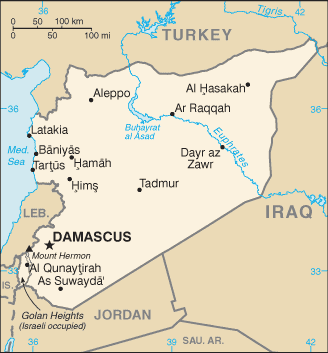 The United States, European and Arab nations, almost 70 in all, are preparing to demand that Syrian President Bashar Assad agree to an immediate cease-fire and allow humanitarian aid into certain areas, or face unspecified punitive action which could include additional sanctions or direct support to the opposition forces.
 Clinton’s comments come just days after other State Department officials said the option of directly arming the rebels was being considered, if Assad continued to refuse US demands for him to resign.
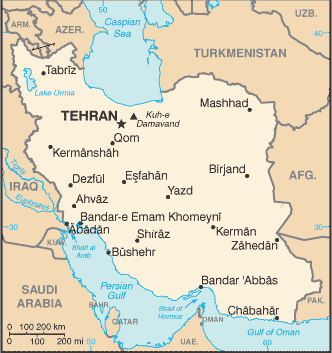 In a confidential document, the International Atomic Energy Agency (IAEA) claimed Iran hadstepped up its uranium enrichment at a number of facilities. According to the IAEA, the facility at Natanz, for example, is operating 52 cascades – each containing around 170 centrifuges – up from 37 in November.
If Syrian authorities agree to a ceasefire, UN troops will be sent in. Otherwise, Western powers insinuate military aid to opposition
by John Glaser, February 24, 2012
The nations making up the “Friends of Syria” group meeting in Tunisia are expected to call for the United Nations to send “peacekeeping” forces if and when the Assad regime agrees to a cease-fire.
The United States, European and Arab nations, almost 70 in all, are preparing to demand that Syrian President Bashar Assad agree to an immediate cease-fire and allow humanitarian aid into certain areas, or face unspecified punitive action which could include additional sanctions or direct support to the opposition forces.The UN peacekeeping force, which UN Secretary General Ban Ki-Moon would recruit, is supposed to be billed as a “nonmilitary” operation, which seems highly unlikely given the war zone that certain areas of Syria have become. Assad is unlikely to agree to a ceasefire, but assuming he did, the plan calls for the UN to send forces with the permission of the ruling authority in Syria, whether it is Assad or a successor.
The other aspect of the plan is to directly intervene on the side of Syria’s opposition fighters. “We will also intensify our links with the opposition,” said British Foreign Secretary William Hague. “We will treat them and recognize them as a legitimate representative of the Syrian people.” Hague also said he was meeting with the opposition umbrella group, the Syrian National Council.
As the conference began on Friday, several hundred pro-Assad demonstrators protested outside the hotel, only to be driven away by police after 15 minutes. They carried signs criticizing Secretary of State Hillary Clinton and President Barack Obama.
The meeting in Tunis was basically an effort to get around the established legal means of international intervention, which was blocked by Russia and China at the UN Security Council. Still, any kind of military intervention is likely to have terrible effects that would escalate the violence.
There are various options for intervention being considered, but U.S. officials have increasingly hinted at sending direct military support to Syria’s fragmented, violent, unreliable opposition. As Clinton said on Thursday, ”There will be increasingly capable opposition forces,” she said. “They will, from somewhere, somehow, find the means to defend themselves as well as begin offensive measures.”
and.....
http://news.antiwar.com/2012/02/23/clinton-syria-rebels-to-find-arms-somewhere/
Arriving in London today on the first leg of a tour of the region, Secretary of State Hillary Clinton said she believed that the Syrian rebels would be able to armthemselves better in the future, predicting “increasingly capable” forces who would find arms “somewhere.”
Clinton’s comments come just days after other State Department officials said the option of directly arming the rebels was being considered, if Assad continued to refuse US demands for him to resign.Clinton said today that she has “absolutely no doubt” that the Assad regime would eventually fall, but expressed hope that it would happen soon because “more lives would be saved” that way.
The rebels already have considerable arms, of course, as they include a significant force of defectors from the Assad-backed military. The Arab League has also committed to aid the rebel factions, and al-Qaeda in Iraq (AQI) has infiltrated the country to at least some extent.
and....
http://news.antiwar.com/2012/02/24/new-iaea-report-hypes-fear-on-irans-nuclear-program/
The IAEA has again issued speculations on possible military dimensions to Iran's program, in contradiction of US intelligence
by John Glaser, February 24, 2012
In its latest report, the U.N.’s nuclear watchdog said it continues to have serious concerns about a possible military dimension to Iran’s nuclear program, despite the highly questioned November report and U.S. intelligence to the contrary.
In a confidential document, the International Atomic Energy Agency (IAEA) claimed Iran hadstepped up its uranium enrichment at a number of facilities. According to the IAEA, the facility at Natanz, for example, is operating 52 cascades – each containing around 170 centrifuges – up from 37 in November.“The Agency continues to have serious concerns regarding possible military dimensions to Iran’s nuclear program,” the U.N. body said in its latest quarterly report about Iran’s atomic activities.
But the IAEA’s report in November has been widely criticized. Former IAEA director and nuclear engineer, who saw first hand the mistakes in Iraq, Robert Kelley wrote last month that “the evidence, contained in a November report of the International Atomic Energy Agency, is sketchy.” Beyond that, the report’s speculation was not enough to change their estimate that Iran has not diverted any declared nuclear material to facilities potentially engaged in weaponization.
But the basis for that speculation is incredibly weak. The IAEA claims that they have been “unable to provide credible assurance about the absence of undeclared nuclear materials and activities in Iran.” In other words, a lack of evidence for nuclear weapons is the primary concern.
The most extensive and widely accepted U.S. intelligence on the Iranian nuclear program says that Iran probably had a nuclear weapons program, but halted it completely in 2003. In a comprehensive New Yorker report by Seymour Hersh, the 2011 report from the U.S. National Intelligence Estimate (NIE) was “reinforcing the essential conclusion of the 2007 paper: Iran halted weaponization in 2003.”
In the November IAEA report, Kelley writes, almost all the evidence for a possible military dimension speaks to pre-2003 activity. That which points to post-2003 activity either “had suspicious similarities to a previous case [in 1995] that proved definitively to be a hoax” or was sourced from unnamed member states, which was vague and “impossible to evaluate.”
Greg Thielmann, a former State Department and Senate Intelligence Committee analyst told the New Yorker in November that the IAEA report was being politicized. He said “there is nothing that indicates that Iran is really building a bomb.” adding that “those who want to drum up support for a bombing attack on Iran sort of aggressively misrepresented the report.”
Numerous current high level U.S. officials have come out to explain that their best intelligence finds Iran is not developing nuclear weapons and has demonstrated no intention of doing so. An article published Thursday in the Los Angeles Timesreported that the most recent NIE, “which represents the consensus of 16 U.S. intelligence agencies, indicates that Iran is pursuing research that could put it in a position to build a weapon, but that it has not sought to do so.”
Iranian policy for some time now has been to abstain from developing nuclear weapons while having the know-how needed to get there; this essentially is an attempt, given constant threats and military provocations from the U.S. and Israel, to have a deterrent without having a deterrent.
In fact, other than hawkish politicians prone to rhetorical flourishes, the IAEA seems to be the only official body willing to claim Iran may have a military dimension to its nuclear program. Even the Israelis haven’t denied the U.S. intelligence demonstrating otherwise, but they have been insisting a preemptive strike is necessary in order to disable Iran’s enrichment activities before entering a “zone of immunity.”
This is very irrational since underground facilities like Fordo are beyond the reach of Israeli bombs and Iran, if attacked, would be likely to quickly reconstitute its nuclear weapons program, making a strike counterproductive. Various U.S. officials, from Defense Secretary Leon Panetta to Director of National Intelligence James Clapper, have cautioned against any preemptive strike on Iran. Chairman of the Joint Chiefs of Staff Gen. Martin Dempsey said an attack would be “not prudent.”
Iran’s Supreme Leader, Ayatollah Khamenei, said this week, “There is no doubt that the decision makers in the countries opposing us know well that Iran is not after nuclear weapons because the Islamic Republic, logically, religiously and theoretically, considers the possession of nuclear weapons a grave sin and believes the proliferation of such weapons is senseless, destructive and dangerous.”
and...
http://original.antiwar.com/porter/2012/02/23/iran-holds-up-access-to-parchin-for-better-iaea-deal/
The failure of a mission by the International Atomic Energy Agency (IAEA) to get Iranian permission to visit a military testing site mentioned in its latest report has been interpreted in media coverage as a stall to avoid the discovery of confirming evidence of past work on nuclear weapons.
But the history of Iranian cooperation with the IAEA on carrying out inspections at the Parchin military testing center, as well as a previous IAEA-Iran work program agreement, suggests that Iran is keeping permission for such a visit as bargaining leverage to negotiate a better deal with the agency.
The IAEA statement Wednesday emphasized the fact that the mission to Tehran had been denied permission to visit the site at Parchin. That prompted Associated Press correspondent in Vienna George Jahn to call Iran’s refusal to agree to an IAEA visit to Parchin “stonewalling” and evidence of “hard-line resistance” to international pressure on its nuclear program.
International Herald Tribune blogger Harvey Morris wrote that Iran’s strategy was to “play for time.”
But access to Parchin was discussed as part of broader negotiations on what the IAEA statement called a “document facilitating the clarification of unresolved issues” in regard to “possible military dimensions” of Iran’s nuclear program. The negotiations were focused on what cooperation the IAEA is demanding and what the agency is ready to offer in return for that cooperation.
Judging from past negotiations between Iran and the IAEA, Iran is ready to offer access to Parchin as well as other sites requested by the agency as part of an agreement under which the IAEA would stop accusing Iran of carrying out covert nuclear weapons experiments.
The IAEA’s position in the negotiations was revealed by the AP’s Jahn, who reported that the agency mission had hoped to get Iranian agreement to meetings with “scientists suspected of working on the alleged weapons program” and to “inspect documents related to nuclear weapons work.”
The September 2008 IAEA report said the agency had “proposed discussions with Iranian experts on the contents of the engineering reports (on the Shahab-3 missile) examining in detail modeling studies….”
Iran has rejected such demands as threatening its legitimate national security interests, in violation of the IAEA statute.
The scientists that the agency is demanding to see are publicly known officials of Iran’s military research institutions. Even before Israel had begun assassinating Iranian scientists, Iran had made it clear it will not give the IAEA physical access to any individual scientists.
The IAEA wants to visit a specific site at Parchin because of information from an unnamed member state, cited in its November 2011 report, that Iran had “constructed a large explosives containment vessel in which to conduct hydrodynamic experiments” — tests of nuclear weapons designs without the use of fissile material.
The report said the construction had been carried out at Parchin military complex in 2000 and that the IAEA had satellite imagery that was “consistent with” that information, meaning only that there were structures that could have housed such a vessel at Parchin in 2000.
The previous history of IAEA inspections at Parchin make it clear, however, that Iran knew it had nothing to hide at Parchin after 2000.
In 2004, John Bolton, the point man in the George W. Bush administration on Iran, who coordinated closely with Israel, charged that satellite imagery showed a bunker at Parchin appropriate for large-scale explosives tests such as those needed to detonate a bomb that would use a neutron trigger.
Bolton put heavy pressure on the IAEA to carry out an investigation at Parchin. A few months later, Tehran agreed to allow the agency to select any five buildings and their surroundings to investigate freely.
That gave U.S. and Israeli intelligence, as well as IAEA experts, an opportunity for which they would not have dreamed of asking: they could scan satellite imagery of the entire Parchin complex for anything that could possibly suggest work on a nuclear weapon, including a containment vessel for hydrodynamic testing, and demand to inspect that building and the grounds around it at their leisure.
In January 2005, an IAEA team visited Parchin and investigated the five areas they had chosen, taking environmental samples, but found nothing suspicious. In November 2005, Iran allowed the IAEA to do the same thing all over again on five more buildings of its own choice.
The Iranian military and nuclear establishment would never have agreed to such terms for IAEA inspection missions at Parchin — not once but twice — if they had been concealing a hydrodynamic test facility at the base.
Other information suggests that no such vessel ever existed at Parchin. The November report claimed the IAEA had obtained information on the dimensions of the containment vessel from the publication of a foreign expert identified as someone who worked “in the nuclear weapons program of the country of his origin.”
That was a reference to Vlachyslav Danilenko, a Ukrainian scientist who has acknowledged having lectured in Iran on theoretical physics and having helped the country build a cylinder for production of nano-diamonds, which was his research specialty. However, Danilenko has firmly denied ever having done any work related to nuclear weapons.
The claim that the dimensions of the putative bomb-test chamber at Parchin could be gleaned from a publication by Danilenko is implausible.
The report said the bomb-containment chamber at Parchin was “designed to contain the detonation of 70 kilograms of high explosives.” Danilenko’s patented 1992 design for a cylinder for nano-diamond production, however, was built to contain only 10 kg of explosives.
Former IAEA weapons inspector and nuclear weapons expert Robert Kelley has pointed out, moreover, that a container for only 70 kg of explosives could not possibly have been used for hydrodynamic testing of a nuclear weapon design.
The negotiations on a “framework” for Iran’s cooperation with the IAEA recall the negotiation of a “work program” in August 2007 aimed at resolving a series of issues on which the IAEA Safeguards Department suspected links to nuclear weapons. The issues included experiments involving the extraction of polonium-210, plutonium experiments, and possible military control of the Gchine uranium mine.
In previous years, Iran had failed to provide sufficient information to overcome those suspicions. But after the negotiation of the “work program,” Iran began to move with dispatch to provide documentation aimed at clearing up the six remaining issues.
The IAEA acknowledged that all six of the issues had been effectively resolved in two reports in late 2007 and early 2008.
The reason for the dramatic change in cooperation was simple: the IAEA had pledged that, in return for Iran’s resolving the six issues, “the implementation of safeguards in Iran will be conducted in a routine manner.” That was seen as a significant step toward finally getting a clean bill of health from the agency.
But the IAEA instead then began focusing its questioning entirely on the purported Iranian documents of unknown origin and doubtful authenticity which the IAEA called the “alleged studies.”


No comments:
Post a Comment