http://www.zerohedge.com/news/chinese-protesters-chant-down-us-imperialists-attack-car-us-ambassador-beijing
 Submitted by Tyler Durden on 09/19/2012 07:47 -0400
and.....
http://www.zerohedge.com/news/re-retaliation-fire-spotted-gate-chinese-school-kobe-japan
Submitted by Tyler Durden on 09/18/2012 19:51 -0400
http://freebeacon.com/chinese-general-prepare-for-combat/


and retaliation is being spoken out loud...
http://www.telegraph.co.uk/finance/china-business/9551727/Beijing-hints-at-bond-attack-on-Japan.html

and.....
http://www.zerohedge.com/news/bond-wars-chinese-advisor-calls-japanese-bond-dump
Submitted by Tyler Durden on 09/18/2012 17:34 -0400
and...
http://www.zerohedge.com/news/global-retaliation-qeternity-begin-boj-considers-additional-easing
Submitted by Tyler Durden on 09/18/2012 14:27 -0400

and.....
http://www.atimes.com/atimes/China/NI19Ad02.htmlBeijing faces protests dilemma
By Wu Zhong, China Editor
HONG KONG - Large anti-Japanese street protests took place in dozens of Chinese cities over the weekend after Tokyo's purchase of the disputed Diaoyu Islands (called Senkaku Islands in Japan) from their private Japanese owners in order to nationalize them. Japanese media described these as the largest scale anti-Japanese demonstrations since the two countries normalized their relations four decades ago.
Today marks the 81st anniversary of the September 18 Manchuria Incident - Japan's invasion of northeast China in 1931. More protests are expected in Chinese cities. Some Japanese-invested factories in China are reportedly to close down today to stay away from trouble.
Chinese people's anger over Japan's move to nationalize theDiaoyu Islands is quite understandable. The Chinese believe the islands belong to China since "ancient times" and regard Tokyo's unilateral move to change the status quo of the islands in the East China Sea as a provocation and also a fresh reminder of their collective memory of humiliations and misery inflicted by previous Japanese aggression.
To a certain extent, the Chinese Communist Party (CCP) may not be unhappy to see the rise of patriotic sentiments. In past decades, the Party has devoted great efforts to introduce patriotism to Chinese youths in the hope of filling the "ideological vacuum" orthodox Marxist believe was abandoned to pave the way for economic reform and opening up advocated three decades ago by Deng Xiaoping.
In practice, anti-Japanese protests could help divert the attention of Chinese people from worrying about the slowdown of economic development and other domestic problems. They could also lend support to Beijing for taking a tougher stance in territorial disputes with Japan and other neighboring countries. Of course, all this would work provided that street protests inspired by growing patriotism remain rational, peaceful and law-biding.
Unfortunately, the weekend protests in a number of cities turned out to be very violent, somehow reminding people of the Boxer (Yihetuan) Rebellion in the turn of the 20th century. In some places, protesters even turned their anger to the Chinese government and military, blaming them for being "too weak" in dealing with territorial disputed with other countries.
Riots have been reported in many cities such as Shenzhen, Guangzhou and Dongguan in Guangdong province; Changsha, Hunan's provincial capital; Xi'an, capital of Shaanxi province; and Qingdao, in Shandong province.
On footage of Hong Kong TV news broadcast on Sunday, one could see protesters in Dongguan smashing doors and windows of Japanese restaurants - though are all owned by Chinese investors. The Chinese owner of one such restaurant tried to stop the mobsters by waving a five-star red flag - China's national flag - and shouting: "I'm Chinese! I'm also a patriot!", but in vain. He then had to order his workers to chisel away the business sign board cemented on the wall, amid cheers of on-looking protestors. A Japanese man was reportedly attacked on street.
The Chinese owner of a Japanese restaurant in Beijing complained on his weibo mini-blog that these days, some people would often walk in and order food to eat but refuse to pay their bills. When asked to pay, "they would display the national flag, saying they won't pay because they don't want to become 'national traitors'."
Also in Beijing, some notices were posted on street lampposts to recruit a "dare-to-rape" team of men to rape Japanese women, according to Hong Kong's Economic Times.
Although many Japanese-brand products are manufactured in China, protesters not only called out for a boycott of Japanese products but to smash them.
In Xi'an, nearly 10,000 protesters took to the street on Saturday. They stormed into a four-star hotel to smash facilities, accusing it of accommodating Japanese visitors. On their way, they damaged shops selling Japanese-brand mobile handsets and Japanese restaurants. When they saw a Japanese-brand car driving by, they stopped it, pounded it and crush its windows, then gave the driver of the car a five-star flag. At least more than a dozen Japanese-brand cars were seen severely damaged that day, according to Hong Kong media reports. In Qingdao, protestors set fire to a retail shop of Guangzhou Toyota Motor Co. In Changsha, protestors stormed and looted a Japanese department, despite it being closed for business to avoid trouble. Everything valuable such as Rolex watches and Gucci products were robbed. Some protesters even set fires on streets. Later, a netizen boasted on the Internet that he was "lucky" to get a "free" Rolex watch.
On Sunday in Guangzhou, provincial capital of Guangdong, tens of thousands anti-Japanese protesters took to the streets. They also stopped Japanese-brand cars and damaged them. Some stormed the five-star White Swan Hotel by the Pearl River, home to the Japanese Consulate locates, smashing hotel facilities.
In Shenzhen, the richest and most open city in mainland China and bordering Hong Kong, the anti-Japanese demonstrations on Sunday turned out to be the most violent. Early in the morning, several hundred people gathered in the center of the city and began to march, shouting: "Down with Japanese devils!" "Boycott Japanese products!" "Diaoyu Islands belong to China!" "Declare war on Japan!"
Increasing numbers joined them and some people began to damage doors and windows of stores with Japanese names. It was estimated there were more than 10,000 protesters at the peak.
The Shenzhen government sent riot police to keep guard and protesters began to target the police, who earlier last week arrested four suspects for causing damage to several Japanese-brand private cars during anti-Japanese protests in mid-August after Japan detained several Hong Kong and Macau men landing on one of the Diaoyu Islands.
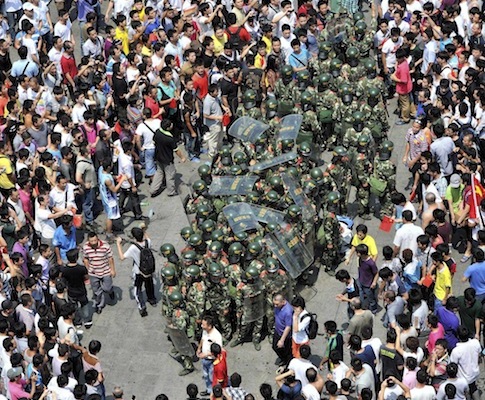
Protesters besieged a Shenzhen government complex demanding the immediate release of the arrested, throwing objects into the building. They confronted the police, turning a police vehicle upside down. At one time, some protesters even shouted: "Down with the People's Liberation Army", for not taking any action in the face of Japan's provocation. Hong Kong TV footage showed riot police tried to disperse them with tear gas and water cannon, but some protesters picked up tear gas grenades and threw them back at the police. Others managed to take control of a water cannon and smash it. It was not until the evening that the police managed to bring the situation under control.
It is astonishing to see that almost all protesters at the weekend were young people. Since China and Japan normalized their diplomatic relations in 1972, Chinese leaders have repeatedly expressed the hope of "letting the torch of China-Japan friendship pass down from one generation to the next". That hope now seems to be dashed given that young Chinese people have become the fresh anti-Japanese army.
It is also astonishing to see these young Chinese pick up the outdated slogan of "Boycott Japanese products!" When China was poor and weak, this slogan could be seen as the helpless moan of a weak nation in face of a stronger invader. In practice, it never worked. Thanks to globalization, China today can boast that it is the world's second-largest economy and an international manufacturing hub - so why are there some people still moaning?
In particular, many Japanese brand products are now manufactured in China - as much as 90% of some "Japanese-brand" cars are reportedly produced in China. "Boycotting Japanese products" - if it works at all - will only cost many Chinese workers their jobs. Hence this sounds like a stupid tactic of trying to hurt the enemy by hurting oneself first.
After the weekend violent protests, Canon, a leading Japanese multinational corporation involved in the manufacture of imaging and optical products, announced on Monday that it would suspend the operation of three of its four factories in China. Japanese electronic home appliance giant Panasonic also reportedly temporarily close down several factories in China. Certain Japanese investors are considering pulling out of the country altogether. Ironically, the latest identity cards for Chinese its citizens are made with Fujitsu-Xerox technology and equipment. Will those young people shouting "boycott Japanese products" set an example by destroying their Chinese ID cards first?
The riots with the anti-Japanese protests over the weekend have alarmed rational Chinese intellectuals. For example, Hu Xingdou, a professor with Beijing Institute of Technology, said the riots happened because the quality of citizenship in Chinese society is poor.
"In China there are either obedient people or mobsters. There is no real citizen. The masses in general lack the awareness of citizenship. Therefore they can be easily controlled by extreme nationalism and resort to 'Boxer-like' conduct," he told Hong Kong's Chinese-language Ming Pao daily. He also blamed authorities concerned for "dereliction of duty" as they failed to prevent the riots.
Whatever, the occurrence of riots amid anti-Japanese protests has damaged the legitimacy of the anti-Japanese protests themselves, brought shame to the Chinese nation and smeared the image of China's "peaceful rising" that Beijing has tried very hard to polish.
Innocent people's rights have been criminally violated and their property damaged. The Chinese government must launch investigations and punish the culprits, as well as take measures to prevent similar violence from happening again. Patriotism must not be used as a loincloth to cover up crime.
It should also be pointed out that overzealous patriotism can easily become xenophobic and narrow-minded nationalism, which is a double-edged sword. As in Shenzhen's case, anti-Japanese sentiments could be turned and directed at the Chinese government itself. If such sentiments continue to surge, then the Chinese government will have either to launch a harsh crackdown at home or allow its foreign policy to be "hijacked" by "popular will" to run into military conflict with Japan ... and then other neighboring countries. Surely, neither is desirable for the CPP - especially during a time of power transition. http://www.zerohedge.com/news/score-1-japan-chinese-protest-us-embassy-beijing
Submitted by Tyler Durden on 09/18/2012 11:50 -0400

http://www.zerohedge.com/news/protests-reignite-anniversary-japanese-invasion-china-boats-enter-japans-territorial-water
Submitted by Tyler Durden on 09/18/2012 07:16 -0400
 Anyone who thought that anti-Japan protests would quietly go away on the 81st anniversary of the Japanese invasion of Manchuria may have to reevaluate. First, overnight the HKEJ said that China is preparing economic sanctions against Japan, and as the situation again escalates, Reuters reports that at least two of 11 Chinese ocean surveillance and fishery patrol ships sailing near East China Sea islets claimed by both Tokyo and Beijing have entered what Japan considers its territory, public broadcast NHK said on Tuesday, quoting Japan's Coast Guard. Subsequently, NHK reported that "a Chinese fisheries patrol ship has departed after approaching Japan's territorial waters off the Senkaku Islands in the East China Sea. The Japan Coast Guard remains on the alert, saying the Chinese vessel may enter the area again. The Coast Guard spotted the boat some 43 kilometers north-northwest of the largest island, Uotsuri, early Tuesday morning. The Coast Guard confirmed the boat had left the area before 10:30 AM. It said at around 11:10 AM, the vessel again approached Japan's territorial waters off another island and left soon afterward. In response to warnings from Japan's Coast Guard, the Chinese vessel replied the islands are inherent Chinese territory and that its mission is legitimate." Watch this space carefully, especially once the Chinese armada of 1000 fishing boats, which is already en route to Senkaku, engages in a stand off with Japanese battleships: "China's state-run radio has reported 1,000 fishing boats have left the provinces of Zhejiang and Fujian for waters near the Senkaku Islands. But Japan's Coast Guard says it has not yet spotted a large fleet in the area." It will quite soon. Elsewhere, sentiment across mainland China is getting the opposite of better, fast.
and......
http://www.aljazeera.com/news/asia-pacific/2012/09/20129185557600905.html
(UPDATE) According to Nikkei Shinbun (9/17/2012), the Noda administration is dispatching the Self Defense Force ships to Senkaku Island.
(What Chinese clearly doesn't think much of: Article 5 of the Security Treaty between Japan and the US. US Defense Secretary Leon Panetta just affirmed it would apply to Senkaku Islands during his visit to Japan:


Submitted by Tyler Durden on 09/17/2012 09:27 -0400
http://www.aljazeera.com/news/asia-pacific/2012/09/201291743741714243.html
Hong Lei, a Chinese foreign ministry spokesman, said it was up to Japan to correct its ways, and that the direction of developments was now in Japan's hands.
China's pledge came after Canon announced that it will stop production at three of its four Chinese factories on Monday and Tuesday, citing concerns over employees' safety. Panasonic has taken similar steps at its plants in China.
Uniqlo, the chain of clothing stores owned by Japan's Fast Retailing, has also said they would close 19 outlets in the People's Republic on Tuesday.
Asia's largest apparel retailer had previously closed seven outlets on Monday.
Toyota Motor Corp said it is tallying losses from the violence, including a suspected arson attack on a dealership
in eastern China's Shandong province.
Fellow autmoaker Mazda Motor Corp will close its Nanjing factory for four days starting on Tuesday.
All Nippon Airways Co, Japan's largest airline, reported a rise in cancellations on Japan-bound flights from China.
Anti-Japanese protests across China in recent days erupted over a dispute regarding a group of small islands in the East China Sea claimed by both countries but controlled by Tokyo.
Diplomatic arena
Speaking to Al Jazeera from Singapore, Tony Nash, managing director of business consultancy IHS, said that as a result of the Japanese tsunami and the Thai floods last year, Japanese companies had already started reconsidering new locations for their supply chains, such as Indonesia and Myanmar.
"[But] It is a bit of surprise that it is a reaction to this kind of event," he said.
The ruling Chinese Communist Party, which rarely allows street protests, opened the door to the display of public anger after Japan's decision last week to buy from the private former Japanese owner the chain of islands which Tokyo calls the Senkaku and Beijing calls the Diaoyu.
China responded on Friday by sending patrol ships into the waters around them.
The protests flared in Beijing and other cities on Saturday, when demonstrators besieged the Japanese embassy, hurling rocks, eggs and bottles, and testing cordons of anti-riot police.
Chinese Protesters Chant "Down With US Imperialists", Attack Car Of US Ambassador In Beijing
Anti-Japan protests may have quieted down on the day after the anniversary of Japan's invasion of China (which is not saying much: after disappearing for two weeks, perhaps in some Las Vegas strip club, the Chinese leader-in-waiting Xi Jinping denounced Japan's decision to buy disputed islands "as a farce" on Wednesday and said Tokyo should "rein in its behavior"), but that does not mean anything has been resolved, and the Chinese 1000 boat armada is still supposedly on its way to the Senkakus. Elsewhere, the US foreign department may have to promptly find an anti-Buddhist hate tape made in the US, because otherwise the attack of the US ambassador Gary Locke's car in Beijing may have to be explained using good old fashioned simmering hatred and anti-American sentiment without an actual inflamatory event. LA Times reports: "The car of the U.S. ambassador to China was surrounded by a small group of demonstrators on Tuesday, who damaged the vehicle and briefly prevented it from entering the U.S. Embassy compound in Beijing. A YouTube video of the incident showed the protesters chanting slogans such as “down with the U.S. imperialists” and, in an apparent reference to the Chinese government’s purchase of U.S. government debt, “return the money!”
The five-minute video shows a black car approaching the embassy and attempting to turn into the gate. As the demonstrators surrounded the vehicle, several dozen Chinese police and uniformed guards rushed to the scene. Several water bottles were thrown at the car and one man could be seen banging on the hood of the vehicle.The security forces quickly surrounded the automobile and pushed the demonstrators away from it.A State Department spokesperson said Ambassador Gary Locke’s car sustained minor damage but the ambassador was unharmed. The spokesperson said the U.S. had “registered our concern” with China’s Ministry of Foreign Affairs.The U.S. Embassy is located near the Japanese Embassy, which has been targeted by thousands of Chinese protesters in recent days voicing complaints over the Japanese government’s move to purchase islands in the East China Sea that are also claimed by China.
Finally, it appears someone gets it:
In an apparent reference to that dispute and the United States’ security treaty with Japan, some of the demonstrators chanted: “The U.S. government is the mastermind.”Yesterday China already suggested dumping Japanese bonds as retaliation, following our earlier hypothetical of just who is more likely to dump US paper, should America pick the wrong side to support: recall that both China and Japan now hold over $1.1 trillion in US debt. Things are increasingly looking like China may be it, further explaining why the BOJ .
and.....
http://www.zerohedge.com/news/re-retaliation-fire-spotted-gate-chinese-school-kobe-japan
Re-Retaliation: Fire Spotted At Gate Of Chinese School In Kobe, Japan
All day long we read how today, on the 81st anniversary of Japan's invasion of Manchuria, anti-Japan protests flared up in 125 Chinese cities, for the most part peaceful, protesting what China believes is an illegal Japanese attempt at annexation of the Senkaku Islands as a proximal catalyst, but likely also an outlet for years of pent up anti-Japanese sentiment (of which there is plenty on both sides). For a good example of this see recent events in Muslim countries, US embassies and a certain film about Mohammed. Things got so heated, that late in the day there was some speculation that China may consider retaliating for what it considers an unprovoked territorial grab by the not so beloved eastern neighbor by selling its holdings of Japanese bonds. And while that may or may not occur, the probability of some serious escalation only gets largely greater as we read news of such development, this time out of Japan
- Fire Spotted At Gate Of Chinese School in Kobe, Japan:Kyodo
Well, if Japan wants this confrontation to get truly ugly, then by all means re-retaliate, and certainly bring the school children in it. One thing is certain: China will not step down, and neither will Japan. What happens next is thus anyone's guess.
And to think all of this is over a piece of uninhabited rock in the middle of nowhere.
http://freebeacon.com/chinese-general-prepare-for-combat/
Chinese General: Prepare for Combat
Top Chinese general in unusual move tells troops to ready for combat with Japan
Over-turned Japanese-branded car / AP
BY:
China’s most powerful military leader, in an unusual public statement, last week ordered military forces to prepare for combat, as Chinese warships deployed to waters near disputed islands and anti-Japan protests throughout the country turned violent.
Protests against the Japanese government’s purchase of three privately held islands in the Senkakus chain led to mass street protests, the burning of Japanese flags, and attacks on Japanese businesses and cars in several cities. Some carried signs that read “Kill all Japanese,” and “Fight to the Death” over disputed islands. One sign urged China to threaten a nuclear strike against Japan.
Gen. Xu Caihou, vice chairman of the Central Military Commission, considered the most senior military political commissar, said Friday that military forces should be “prepared for any possible military combat,” state run Xinhua news agency reported.
Heightened tensions over the Senkakus come as Defense Secretary Leon Panetta arrived in China Monday.
Panetta, in comments made in Japan shortly before traveling to China, said, “We are concerned by the demonstrations, and we are concerned by the conflict that is taking place over the Senkaku islands.”
“The message I have tried to convey is we have to urge calm and restraint on all sides,” he said, noting any “provocation” could produce a “blow up.”
Panetta repeated the U.S. position that it is neutral in the dispute over Japan’s Senkaku islands, a small chain of islets located south of Okinawa and north of Taiwan. But he also reaffirmed the U.S. defense commitment to Japan, a treaty ally.
“We stand by our treaty obligations,” Panetta said, echoing a similar commitment made during a 2010 standoff between Beijing and Tokyo over the Senkakus. ”They’re longstanding, and that has not changed.”
China claims the islands as its territory and calls them the Diaoyu islands.
Last week, following the Japanese government’s purchase of three of the Senkakus from private Japanese owners, six Chinese maritime security ships were deployed near the Senkaku islands, further heightening tensions.
Xu’s unusual comments followed reports in state-controlled Chinese media that opposed the Japanese government’s purchase of the three islands.
Xu said during a visit to military units near Taiyuan, in the northern province of Shanxi, “efforts should be made to ensure that the military is capable of resolutely performing its duty to safeguard the country’s national sovereignty, security, and territorial integrity whenever it is needed by the Party and the people.”
A U.S. official said the PLA’s most senior political general rarely makes such direct appeals to troops to prepare for combat.
Panetta told reporters en route to Japan, the first stop on a three-nation visit to Asia, “The United States does not take a position with regards to territorial disputes.”
In 2010, then-Defense Secretary Robert M. Gates invoked the U.S.-Japan defense treaty when tensions between China and Japan increased over Tokyo’s arrest of a Chinese fishing captain who rammed his boat against a Japanese coast guard vessel in waters near the Senkakus. Gates said the United States would “fulfill our alliance responsibilities” toward Japan.
Japan’s Coast Guard announced on Sept. 14 that six Chinese maritime patrol vessels sailed into Japanese-controlled waters near the Senkakus and the vessels ignored Japanese warnings for the ships to leave the area.
Other reports from China on Monday showed a convoy of hundreds of Chinese fishing vessels sailing toward the disputed islands.
The six Chinese ships entered Japanese waters near the island on Friday, and ignored Japanese coast guard orders for them to vacate what it said was its territorial waters.
The Chinese Foreign Ministry confirmed that six of its surveillance ships had entered the waters near the islands.
China’s aggressiveness in maritime disputes has garnered little attention in the presidential election campaign.
On Monday, President Obama criticized GOP nominee Mitt Romney for his attack on the administration for being soft on China through its weak response to China’s trade and currency policies.
The Chinese maritime warships near the Senkakus were reported last week by Xinhua as “routine patrols” near the islands to “assert the country’s sovereignty and protect fishermen.”
“The Diaoyou Islands and their affiliated islets have been China’s inherent territory since ancient times, and their surrounding waters are China’s traditional fishing ground,” the report said.
A classified Chinese government map from 1969 that was obtained by Japan’s government shows Beijing had labeled the islands as “Senkaku,” their Japanese name, and thus confirmed their control by Tokyo. The map, which was viewed by the Free Beacon, also had a dividing line south of the islands showing that they fall within Japanese territory.
Rep. Ileana Ros-Lehtinen (R., Fla.), chairman of the House Foreign Affairs Committee, said during a hearing last week that China’s behavior toward regional states was tantamount to bullying.
“While the world’s attention was turned to other crises, including Iran’s nuclear program and concerns over the faltering Euro, China has upped the ante, playing the role of a schoolyard bully towards its maritime neighbors,” Ros-Lehtinen said.
“From one end to the other of the South China Sea, Beijing has increased both in belligerence and bellicosity.”
Ros-Lehtinen said the United States, through the Navy, will stand by friends and allies in the region.
The Florida Republican said China is seeking to control the South China Sea and other coastal waters and sealanes because they are “central to the Chinese communist mandarins’ aspirations to re-establish the Middle Kingdom as the dominant power in Asia.”
“Whoever controls these sea lanes can dominate Asia—and beyond—by choking off that commerce and oil shipments to the major stakeholders in the Asian economic miracle,” she said.
Chinese efforts to dominate the western Pacific are increasing the possibility of naval clashes, Ros-Lehtinen said.
“Other global crises must not distract from our vital national interests in the South China Sea and the western Pacific,” she said during a hearing.
and retaliation is being spoken out loud...
http://www.telegraph.co.uk/finance/china-business/9551727/Beijing-hints-at-bond-attack-on-Japan.html
8:31PM BST 18 Sep 2012
 228 Comments
Jin Baisong from the Chinese Academy of International Trade – a branch of the commerce ministry – said China should use its power as Japan’s biggest creditor with $230bn (£141bn) of bonds to “impose sanctions on Japan in the most effective manner” and bring Tokyo’s festering fiscal crisis to a head.
Writing in the Communist Party newspaper China Daily, Mr Jin called on China to invoke the “security exception” rule under the World Trade Organisation to punish Japan, rejecting arguments that a trade war between the two Pacific giants would be mutually destructive.
Separately, the Hong Kong Economic Journal reported that China is drawing up plans to cut off Japan’s supplies of rare earth metals needed for hi-tech industry.
The warnings came as anti-Japanese protests spread to 85 cities across China, forcing Japanese companies to shutter factories and suspend operations.
Fitch Ratings threatened to downgrade a clutch of Japanese exporters if the clash drags on. It warned that Nissan is heavily at risk with 26p of its global car sales in China, followed by Honda with 20pc. Sharp and Panasonic both have major exposure. Japan’s exports to China were $74bn in the first half of this year. Bilateral trade reached $345bn last year.
and.....
http://www.zerohedge.com/news/bond-wars-chinese-advisor-calls-japanese-bond-dump
Bond Wars: Chinese Advisor Calls For Japanese Bond Dump
- Bank of Japan
- Bond
- China
- Hyperinflation
- Japan
- Mutual Assured Destruction
- None
- Reality
- Trade Wars
- Vigilantes
- Yen
Earlier today we casually wondered whether the US stands to lose more by supporting China or Japan in their escalating diplomatic spat, considering the threat of a US Treasury sell off is certainly not negligible, a dilemma complicated by the fact that as today's TIC data indicated both nations own almost the same amount of US paper, just over $1.1 trillion. In a stunning turn of events, it appears that China has taken our thought experiment a step further and as the Telegraph's Ambrose Evans Prichard reports, based on a recommendation by Jin Baisong from the Chinese Academy of International Trade (a branch of the commerce ministry) China is actively considering "using its power as Japan’s biggest creditor with $230bn (£141bn) of bonds to "impose sanctions on Japan in the most effective manner" and bring Tokyo’s festering fiscal crisis to a head." I.e., dump Japan's bonds en masse.
Should this stunning recommendation be enacted, not only would it be the first time in world history that insurmountable credit is used as a weapon of retaliation, it would mark a clear phase transition in the evolution of modern warfare: from outright military incursions, to FX wars, to trade wars, culminating with "bond wars" which could in the span of minutes cripple the entire Japanese fiscal house of cards still standing solely due to the myth that unserviceable debt can be pushed off into perpetuity (as previously discussed here).
Not needing further explanation is the reality that should China commence a wholesale Japanese bond dump, it may well lead to that long anticipated Japanese bond market collapse, as creditor after creditor proceeds to sell into a market in which the BOJ is the buyer of only resort in the best case, and into a bidless market in the worst.
The immediate outcome would be soaring inflation as the BOJ is forced to monetize debt for dear life, buying up first hundreds of billions, then trillions in the secondary market to avoid a complete rout, matched by trillions of reserves created out of thin air which may or may not be halted by the Japanese deflationary gate, and which most certainly could waterfall into the economy especially if Japanese citizens take this as an all clear signal that the Japanese economy is about to be crippled in all out economic warfare with the most dangerous such opponent, and one which just defected from the "global insolvent creditor" game of Mutual Assured Destruction.
Further complicating things is that Japan has no clear means of retaliation: it owns no Chinese bonds of its own it can dump as a containment measure. Instead, Japan is at best left with the threat of damages incurred on the Chinese economy should Japan be lost as a trading parting. It appears, however, that to China such a gambit is no longer a major concern:
Mr Jin said China can afford to sacrifice its “low-value-added” exports to Japan at a small cost. By contrast, Japan relies on Chinese demand to keep its economy afloat and stave off “irreversible” decline.“It’s clear that China can deal a heavy blow to the Japanese economy without hurting itself too much,” he said. It is unclear whether he was speaking with the full backing of the Politburo or whether sales of Japanese debt would do much damage. The Bank of Japan could counter the move with bond purchases. Any weakening of the yen would be welcome.
Yes, but any offsetting Japanese hyperinflation would not, which is precisely what would happen if after 30+ years of dormancy the Japanese bond vigilantes were woken up by none other than a cuddly Panda bear with very murderous intentions.
Ironically, this terminal bond war escalation would also mean that Japan's last ditch alternative is to threaten the US with dumping America's bonds in turn if the US i) does not step up on behalf of Japan and ii) if Japan is forced to promptly convert debt from one denomination into another. The fallout effect would be most dramatic.
It is unclear if China will proceed with this "scorched bond" step: should this happen there is likely no turning back as it would force a market test of the entire developed world. And as our readers know all too well, the entire developed world is insolvent, and the only reason why it has perpetuated the illustion that all is well, is because being a closed system, nobody has the incentive to defect. Until now that is, when suddenly over a piece of rock in the East China Sea, China may find itself pulling the pin on the global debt grenade.And even if this is not the final denouement, the market appears to already be pricing in several not much more favorable outcomes:Markets are already starting to price in an arms race in Asia. Shares of China’s North Navigation Control Technology, which makes missile systems, have jumped 30pc in recent days.China is becoming self-sufficient in defence. It was the world’s biggest net importer of weapons six years ago. It fell to fourth place last year.
Japan is at the other extreme. An official report this year – “A Strategy for Survival” – said Japan’s spending on its “Self-Defence Force” had shrunk by 4pc in 10 years. It called for “urgent” action to rebuild the country’s military.
One thing here is certain: Japan picked on the wrong country when two weeks ago it "purchased" the disputed Senkaku Islands. If it thought that China would just forgive and forget with a wink, it was dead wrong.
It now has several two options: undo all that has happened in the past fortnight, in the process suffering tremendous diplomatic humiliation, leaving Senkaku in the "no man's land" where they belong, or push on, and suffer the consequences. And the consequences for the country represented by the question market in the chart below, would be tragically severe, as would they for the entire "developed", insolvent and daisy-chained world.

and...
http://www.zerohedge.com/news/global-retaliation-qeternity-begin-boj-considers-additional-easing
Global Retaliation To QEternity Begin: BOJ Considers Additional Easing
Last week it was the Fed crossing the Rubicon with infinite easing. We explained very clearly that the next steps would be everyone else joining the infinite easing party. Sure enough, here comes the first one:
- BOJ TO CONSIDER ADDITIONAL EASING: NIKKEI
Keep in mind that the BOJ already monetizes ETFs and REITs, the very instruments which the Fed will soon be forced to buy. And so it begins - because when it comes to pushing CTRL and P, over and over, it really doesn't take much skill.

It also means that the next round of purchases of precious metals will come from everywhere else, in addition to just the US.
Finally, those wondering why there was absolutely no response out of the market to news that previously would have sent stocks soaring, the answer, as we explained before, is simple: the Fed has literally shot itself in the foot... and the head. Because when you tell the market to price in QEternity, you just can't hope any more QE anywhere, anytime, out of anyone, will be a surprise.
and.....
http://www.atimes.com/atimes/China/NI19Ad02.htmlBeijing faces protests dilemma
By Wu Zhong, China Editor
HONG KONG - Large anti-Japanese street protests took place in dozens of Chinese cities over the weekend after Tokyo's purchase of the disputed Diaoyu Islands (called Senkaku Islands in Japan) from their private Japanese owners in order to nationalize them. Japanese media described these as the largest scale anti-Japanese demonstrations since the two countries normalized their relations four decades ago.
Today marks the 81st anniversary of the September 18 Manchuria Incident - Japan's invasion of northeast China in 1931. More protests are expected in Chinese cities. Some Japanese-invested factories in China are reportedly to close down today to stay away from trouble.
Chinese people's anger over Japan's move to nationalize theDiaoyu Islands is quite understandable. The Chinese believe the islands belong to China since "ancient times" and regard Tokyo's unilateral move to change the status quo of the islands in the East China Sea as a provocation and also a fresh reminder of their collective memory of humiliations and misery inflicted by previous Japanese aggression.
To a certain extent, the Chinese Communist Party (CCP) may not be unhappy to see the rise of patriotic sentiments. In past decades, the Party has devoted great efforts to introduce patriotism to Chinese youths in the hope of filling the "ideological vacuum" orthodox Marxist believe was abandoned to pave the way for economic reform and opening up advocated three decades ago by Deng Xiaoping.
In practice, anti-Japanese protests could help divert the attention of Chinese people from worrying about the slowdown of economic development and other domestic problems. They could also lend support to Beijing for taking a tougher stance in territorial disputes with Japan and other neighboring countries. Of course, all this would work provided that street protests inspired by growing patriotism remain rational, peaceful and law-biding.
Unfortunately, the weekend protests in a number of cities turned out to be very violent, somehow reminding people of the Boxer (Yihetuan) Rebellion in the turn of the 20th century. In some places, protesters even turned their anger to the Chinese government and military, blaming them for being "too weak" in dealing with territorial disputed with other countries.
Riots have been reported in many cities such as Shenzhen, Guangzhou and Dongguan in Guangdong province; Changsha, Hunan's provincial capital; Xi'an, capital of Shaanxi province; and Qingdao, in Shandong province.
On footage of Hong Kong TV news broadcast on Sunday, one could see protesters in Dongguan smashing doors and windows of Japanese restaurants - though are all owned by Chinese investors. The Chinese owner of one such restaurant tried to stop the mobsters by waving a five-star red flag - China's national flag - and shouting: "I'm Chinese! I'm also a patriot!", but in vain. He then had to order his workers to chisel away the business sign board cemented on the wall, amid cheers of on-looking protestors. A Japanese man was reportedly attacked on street.
The Chinese owner of a Japanese restaurant in Beijing complained on his weibo mini-blog that these days, some people would often walk in and order food to eat but refuse to pay their bills. When asked to pay, "they would display the national flag, saying they won't pay because they don't want to become 'national traitors'."
Also in Beijing, some notices were posted on street lampposts to recruit a "dare-to-rape" team of men to rape Japanese women, according to Hong Kong's Economic Times.
Although many Japanese-brand products are manufactured in China, protesters not only called out for a boycott of Japanese products but to smash them.
In Xi'an, nearly 10,000 protesters took to the street on Saturday. They stormed into a four-star hotel to smash facilities, accusing it of accommodating Japanese visitors. On their way, they damaged shops selling Japanese-brand mobile handsets and Japanese restaurants. When they saw a Japanese-brand car driving by, they stopped it, pounded it and crush its windows, then gave the driver of the car a five-star flag. At least more than a dozen Japanese-brand cars were seen severely damaged that day, according to Hong Kong media reports. In Qingdao, protestors set fire to a retail shop of Guangzhou Toyota Motor Co. In Changsha, protestors stormed and looted a Japanese department, despite it being closed for business to avoid trouble. Everything valuable such as Rolex watches and Gucci products were robbed. Some protesters even set fires on streets. Later, a netizen boasted on the Internet that he was "lucky" to get a "free" Rolex watch.
On Sunday in Guangzhou, provincial capital of Guangdong, tens of thousands anti-Japanese protesters took to the streets. They also stopped Japanese-brand cars and damaged them. Some stormed the five-star White Swan Hotel by the Pearl River, home to the Japanese Consulate locates, smashing hotel facilities.
In Shenzhen, the richest and most open city in mainland China and bordering Hong Kong, the anti-Japanese demonstrations on Sunday turned out to be the most violent. Early in the morning, several hundred people gathered in the center of the city and began to march, shouting: "Down with Japanese devils!" "Boycott Japanese products!" "Diaoyu Islands belong to China!" "Declare war on Japan!"
Increasing numbers joined them and some people began to damage doors and windows of stores with Japanese names. It was estimated there were more than 10,000 protesters at the peak.
The Shenzhen government sent riot police to keep guard and protesters began to target the police, who earlier last week arrested four suspects for causing damage to several Japanese-brand private cars during anti-Japanese protests in mid-August after Japan detained several Hong Kong and Macau men landing on one of the Diaoyu Islands.
Protesters besieged a Shenzhen government complex demanding the immediate release of the arrested, throwing objects into the building. They confronted the police, turning a police vehicle upside down. At one time, some protesters even shouted: "Down with the People's Liberation Army", for not taking any action in the face of Japan's provocation. Hong Kong TV footage showed riot police tried to disperse them with tear gas and water cannon, but some protesters picked up tear gas grenades and threw them back at the police. Others managed to take control of a water cannon and smash it. It was not until the evening that the police managed to bring the situation under control.
It is astonishing to see that almost all protesters at the weekend were young people. Since China and Japan normalized their diplomatic relations in 1972, Chinese leaders have repeatedly expressed the hope of "letting the torch of China-Japan friendship pass down from one generation to the next". That hope now seems to be dashed given that young Chinese people have become the fresh anti-Japanese army.
It is also astonishing to see these young Chinese pick up the outdated slogan of "Boycott Japanese products!" When China was poor and weak, this slogan could be seen as the helpless moan of a weak nation in face of a stronger invader. In practice, it never worked. Thanks to globalization, China today can boast that it is the world's second-largest economy and an international manufacturing hub - so why are there some people still moaning?
In particular, many Japanese brand products are now manufactured in China - as much as 90% of some "Japanese-brand" cars are reportedly produced in China. "Boycotting Japanese products" - if it works at all - will only cost many Chinese workers their jobs. Hence this sounds like a stupid tactic of trying to hurt the enemy by hurting oneself first.
After the weekend violent protests, Canon, a leading Japanese multinational corporation involved in the manufacture of imaging and optical products, announced on Monday that it would suspend the operation of three of its four factories in China. Japanese electronic home appliance giant Panasonic also reportedly temporarily close down several factories in China. Certain Japanese investors are considering pulling out of the country altogether. Ironically, the latest identity cards for Chinese its citizens are made with Fujitsu-Xerox technology and equipment. Will those young people shouting "boycott Japanese products" set an example by destroying their Chinese ID cards first?
The riots with the anti-Japanese protests over the weekend have alarmed rational Chinese intellectuals. For example, Hu Xingdou, a professor with Beijing Institute of Technology, said the riots happened because the quality of citizenship in Chinese society is poor.
"In China there are either obedient people or mobsters. There is no real citizen. The masses in general lack the awareness of citizenship. Therefore they can be easily controlled by extreme nationalism and resort to 'Boxer-like' conduct," he told Hong Kong's Chinese-language Ming Pao daily. He also blamed authorities concerned for "dereliction of duty" as they failed to prevent the riots.
Whatever, the occurrence of riots amid anti-Japanese protests has damaged the legitimacy of the anti-Japanese protests themselves, brought shame to the Chinese nation and smeared the image of China's "peaceful rising" that Beijing has tried very hard to polish.
Innocent people's rights have been criminally violated and their property damaged. The Chinese government must launch investigations and punish the culprits, as well as take measures to prevent similar violence from happening again. Patriotism must not be used as a loincloth to cover up crime.
It should also be pointed out that overzealous patriotism can easily become xenophobic and narrow-minded nationalism, which is a double-edged sword. As in Shenzhen's case, anti-Japanese sentiments could be turned and directed at the Chinese government itself. If such sentiments continue to surge, then the Chinese government will have either to launch a harsh crackdown at home or allow its foreign policy to be "hijacked" by "popular will" to run into military conflict with Japan ... and then other neighboring countries. Surely, neither is desirable for the CPP - especially during a time of power transition. http://www.zerohedge.com/news/score-1-japan-chinese-protest-us-embassy-beijing
Score 1 For Japan As Chinese Protest At US Embassy In Beijing
Between the anti-Japanese tensions and the converging dominanceof the Japanese with the Chinese to our fiscal status quo, it seems the Chinese are increasingly pushing the US hand to supporting the Japanese. Via Ai Weiwei, contemporary Chinese artist, the US Embassy in Beijing is under protest by the Chinese marchersdemanding (Google Translated) "Pay Back The Money" and "Down with US Imperialism". Some embassy cars were attacked - apparently on the back of the US role in the China-Japan tensions. The question now is what happens to China's Treasury holdings? They already threatened Japan with economic sanctions and now thepopulist view is turning anti-American at a time of new leadership. We assume they will continue to sell down their USD-based Treasury holdings and convert to Gold as they have been for the past year. With 2 months until the election, this will be an interesting distraction of global importance as the US is forced to support Japan or throw them under the bus.

http://www.zerohedge.com/news/protests-reignite-anniversary-japanese-invasion-china-boats-enter-japans-territorial-water
Protests Reignite On Anniversary Of Japanese Invasion Of China; Boats Enter Japan's Territorial Waters
 Anyone who thought that anti-Japan protests would quietly go away on the 81st anniversary of the Japanese invasion of Manchuria may have to reevaluate. First, overnight the HKEJ said that China is preparing economic sanctions against Japan, and as the situation again escalates, Reuters reports that at least two of 11 Chinese ocean surveillance and fishery patrol ships sailing near East China Sea islets claimed by both Tokyo and Beijing have entered what Japan considers its territory, public broadcast NHK said on Tuesday, quoting Japan's Coast Guard. Subsequently, NHK reported that "a Chinese fisheries patrol ship has departed after approaching Japan's territorial waters off the Senkaku Islands in the East China Sea. The Japan Coast Guard remains on the alert, saying the Chinese vessel may enter the area again. The Coast Guard spotted the boat some 43 kilometers north-northwest of the largest island, Uotsuri, early Tuesday morning. The Coast Guard confirmed the boat had left the area before 10:30 AM. It said at around 11:10 AM, the vessel again approached Japan's territorial waters off another island and left soon afterward. In response to warnings from Japan's Coast Guard, the Chinese vessel replied the islands are inherent Chinese territory and that its mission is legitimate." Watch this space carefully, especially once the Chinese armada of 1000 fishing boats, which is already en route to Senkaku, engages in a stand off with Japanese battleships: "China's state-run radio has reported 1,000 fishing boats have left the provinces of Zhejiang and Fujian for waters near the Senkaku Islands. But Japan's Coast Guard says it has not yet spotted a large fleet in the area." It will quite soon. Elsewhere, sentiment across mainland China is getting the opposite of better, fast.
From Reuters:
Anti-Japan protests reignited across China on Tuesday, the sensitive anniversary marking Tokyo's occupation of its giant neighbour, escalating a maritime dispute which has forced major Japanese brandname firms to suspend business there.Relations between Asia's two biggest economies have faltered badly, with emotions running high on the streets and also out at sea where two Japanese activists landed on an island at the centre of the dispute.China reacted swiftly to the news of the landing, which risked inflaming a crisis that already ranks as China's worst outbreak of anti-Japan sentiment in decades. Beijing described the landing as provocative, lodged a complaint with Tokyo and said it reserved the right to "take further action".The dispute over the uninhabited group of islands in the East China Sea - known as the Senkaku in Japan and Diaoyu in China - led to another day of protests that were smothered by a heavy blanket of security.Japanese businesses shut hundreds of stores and factories across China and Japan's embassy in Beijing again came under siege by protesters hurling water bottles, waving Chinese flags, and chanting anti-Japan slogans evoking war-time enmity.Japanese Prime Minister Yoshihiko Noda urged Beijing again to protect Japanese citizens in China.
"Today is our day of shame," said a Beijing protester, Wei Libing, a waiter in his 40s. "Japan invaded China on this date.""Wipe out all Japanese dogs," read one banner held aloft by one of thousands of protesters marching on the embassy, which was ringed by riot police standing six rows deep. Japan's foreign ministry said some embassy windows had been smashed.Sino-Japanese ties have long been plagued by China's bitter memories of Japan's military aggression in the 1930s and 1940s and present rivalry over resources - the islands are believed to be surrounded by energy-rich waters.For China, Tuesday marks the day Japan began its occupation of parts of mainland China in 1931.Rowdy protests sprang up in other major cities including Shanghai, raising the risk they could get out of hand and backfire on Beijing, which has given tacit approval to them through state media. One Hong Kong newspaper said some protesters in southern Shenzhen had been detained for calling for democracy and human rights.
In the meantime, as we posted yesterday, up to $350 billion in bilateral annual trade is now at risk. And trillions in downstream consequences.
Other Japanese companies -- from Mazda and Mitsubishi Motors to Panasonic and Fast Retailing -- also shut plants and stores in China, sending Japanese share prices falling and prompting a warning from credit rating agency Fitch that the situation could hurt some auto and tech firms' creditworthiness.
Japan's top general retailer, Seven & I Holdings said it will resume business at all its 13 Ito Yokado supermarkets and 198 "7-11" convenience stores in the cities of Beijing and Chengdu on Wednesday.Some firms recalled workers back to Japan due to the unrest."The situation on the ground in China is not so good and I was advised by the locals not to go out. I couldn't get any work done," Japanese expatriate worker Hisato Takase said on arrival at Tokyo's Haneda airport.Japanese restaurants, a common target of protesters, barred their doors while many Japanese expatriates stayed home.
Expect the situation to deteriorate before it gets better.
and......
http://www.aljazeera.com/news/asia-pacific/2012/09/20129185557600905.html
| Japanese firms suspend work amid protests |
Major firms temporarily shut factories and offices in China as protests over disputed islands spread.
Last Modified: 18 Sep 2012 09:15
|
| Anti-Japan protests have reignited across China, forcing Japanese firms in the country to suspend operations, as a crisis over a territorial dispute escalates on the anniversary of Japan's pre-war invasion of its neighbour. As demonstrations continued on Tuesday, China pledged to protect Japanese firms, citizens and property and urged anti-Japan protesters to express themselves in an "orderly, rational and lawful" way. The pledge came as major Japanese firms closed factories on the mainland and urged expatriate workers to stay indoors after angry protests flared over a group of islands Tokyo calls the Senkaku and Beijing calls the Diaoyu.
Leading Japanese businesses such as car-makers Toyota and Honda were attacked at the weekend, causing them to suspend some of their China operations.
China and Japan have close trade and business ties, with numerous Japanese companies investing in their larger neighbour, and two-way trade totalled $342.9bn last year, according to Chinese figures. Canon also announced that it would stop production at three of its four Chinese factories on Monday and Tuesday, citing concerns over employees' safety. Panasonic has taken similar steps at its plants in China. Toyota, the world's biggest automaker, declined to offer specifics on shutdowns at its three assembly plants and six other factories in China, saying only that it viewed "employees' safety to be top priority". Honda Motor, which makes about 970,000 vehicles a year in China, said it had closed all five of its plants in the country for Tuesday and Wednesday, while Nissan, which has China as its biggest market, temporarily shut two of three factories. Fellow autmoaker Mazda Motor Corp will close its Nanjing factory for four days starting on Tuesday. Uniqlo, the chain of clothing stores owned by Japan's Fast Retailing, has also said they will close 19 outlets in the People's Republic on Tuesday. Asia's largest apparel retailer had previously closed seven outlets on Monday. Al Jazeera's Marga Ortigas, reporting from Hong Kong, said that it was not just large companies who were closing their operations, but smaller ones too, in addition to the Japanese embassy which has temporarily shut its doors. "[China and Japan] have had a love-hate relationship for generations, and what has brought them together in recent years are the economic ties between them," she said. "The last thing they can afford to do right now is rupture that trade relationship, as both of them rely on it." Disputed islands Relations between Asia's two biggest economies has faltered badly, with emotions running high on the streets and also out at sea where two Japanese activists landed on an island at the centre of the dispute. The Japanese nationals landed on one of the islands, Japanese media reported, potentially raising tensions in an area already patrolled by ships from both nations and increasing fears of direct clashes. Japanese national broadcaster NHK broadcast images of a Japanese fishing vessel, believed to be owned by the nationals, close to the shores of one of the disputed islands.
Japanese Chief Cabinet Secretary, Osamu Fujimura, said in an earlier news conference that the Japanese nationals later returned to their fishing vessel and headed back out to sea.
China's Foreign Ministry said on Tuesday that the landing of the two people was provocative and that it had complained to Tokyo. "The unlawful landing of the Japanese right-wingers on the Chinese territory of the Diaoyu islands was a gravely provocative action violating Chinese territorial sovereignty," ministry spokesman Hong Lei said in a statement. "We urge Japan to take effective measures to halt all actions that exacerbate conflict. At the same time, China retains the right to take further steps," he added. He earlier said it was up to Japan to correct its ways, and that the direction of developments was now in Japan's hands. Protests The ruling Chinese Communist Party has allowed protests to display public anger after Japan's decision last week to buy from the private former Japanese owner the chain of islands. The anti-Japanese protests flared in Beijing and other cities on Saturday, when demonstrators besieged the Japanese embassy, hurling stones, eggs and bottles, and testing cordons of anti-riot police. Speaking to Al Jazeera from Singapore, Tony Nash, managing director of business consultancy IHS, said the sight of Japanese investors, and potentially other investors, removing their investments could have a major effect on China over time, adding that the world was watching how China handles the situation. "China is an emerging diplomatic global player and as China addresses this issue, I think the world will watch how they handle it," he told Al Jazeera. "How they address Japan, how they address the domestic issues around Japanese embassies and commercial interests. "If China is not perceived as addressing this in a truly diplomatic way, it could really damage their credibility in diplomatic arenas."
The Japanese government has been warning its citizens about even larger scale protests on Tuesday, when China marks its memorial day for Japan's war-time occupation of parts of China.
|


MONDAY, SEPTEMBER 17, 2012
Senkaku Island Row: 1,000 Fishing boats to Senkaku, and Fake Brand Market in Beijing Refuses Japanese Goods, Noda Dispatches SDF Ships
(UPDATE) According to Nikkei Shinbun (9/17/2012), the Noda administration is dispatching the Self Defense Force ships to Senkaku Island.
(What Chinese clearly doesn't think much of: Article 5 of the Security Treaty between Japan and the US. US Defense Secretary Leon Panetta just affirmed it would apply to Senkaku Islands during his visit to Japan:
====================================Each Party recognizes that an armed attack against either Party in the territories under the administration of Japan would be dangerous to its own peace and safety and declares that it would act to meet the common danger in accordance with its constitutional provisions and processes. Any such armed attack and all measures taken as a result thereof shall be immediately reported to the Security Council of the United Nations in accordance with the provisions of Article 51 of the Charter. Such measures shall be terminated when the Security Council has taken the measures necessary to restore and maintain international peace and security.
Not to be late for the party of global unrest from Portugal to Syria to Afganistan to Indonesia, about 12,000 fishing boats have departed from mainland China, and 1,000 of them due at Senkaku Islands on September 18.
As Shanghai Stock Exchange Composite Index plunged more than 2% on Monday September 17 to the level last seen in early 2009, people in China look very happy smashing windows of evil Japanese establishments in China. Sankei Shinbun has several interesting photos from Reuters, and this one caught my attention:
As Shanghai Stock Exchange Composite Index plunged more than 2% on Monday September 17 to the level last seen in early 2009, people in China look very happy smashing windows of evil Japanese establishments in China. Sankei Shinbun has several interesting photos from Reuters, and this one caught my attention:

Young males in 20s, at most early 30s, smashing windows of Seibu Department Store in Shenzhen. China's draconian one-child policy has produced a severe, unnatural imbalance of males and females, 1.2 to 1. As the economy slows significantly in China, how to engage these excess males in gainful activities becomes a big issue. What better way than to egg them on to some destructive activities to relieve some pressure?
I thought this photo below was cute. A middle-aged man posing in front of a huge banner at a fake-brand goods market in Beijing, saying "We refuse to sell Japanese goods, the islands are ours!" Uh... fake Japanese goods made in China? Take a close look at the depiction of Senkaku Islands, with figures (soldiers, probably) propping up a Chinese flag. The US Marines in Iojima imagery. Very cute.
I thought this photo below was cute. A middle-aged man posing in front of a huge banner at a fake-brand goods market in Beijing, saying "We refuse to sell Japanese goods, the islands are ours!" Uh... fake Japanese goods made in China? Take a close look at the depiction of Senkaku Islands, with figures (soldiers, probably) propping up a Chinese flag. The US Marines in Iojima imagery. Very cute.

By making the banner in Chinese and English (not Japanese), it's rather obvious who they are appealing to.
and......
http://www.zerohedge.com/news/japanese-businesses-shuttering-chinese-facilities-mainland-anger-spreads
Japanese Businesses Shuttering Chinese Facilities As Mainland Anger Spreads
When you have central planners printing inverse-wealth (because money printing dilution by definition means less wealth for everyone), who needs that cornerstone of old school economics: trade. Certainly not Japan (which has been diluting its futures to prosperity for the past 30 years and somehow failing each and every time) and China, both of which are now starting to feel the consequences of the collapse in political relations as a result of the senseless spat of the Senkaku Islands (recorded in its full visual glory here). As the NYT reports, "major Japanese companies closed factories in China and urged expatriate workers to stay indoors Monday, after angry protests flared over a territorial dispute, which threatened to hurt trade ties between the two biggest Asian economies." What does the idiotic escalation in unprovoked Japanese tensions over a rock in the East China Sea (note: not West Japan Sea) for the bottom line of Japan? In a word: Lots.
and......."Increasing tensions further Monday, the Chinese state media warned Japan that it could suffer another “lost decade” if trade ties soured. China and Japan generated two-way trade worth $345 billion last year, and China is the biggest single trading partner of Japan. Protests broke out across dozens of Chinese cities over the weekend, some violent, in response to the Japanese government’s decision last week to buy some of the disputed islands from a private Japanese owner."
To summarize: in the past week alone, Japan has already suffered about $7 billion in lost benefit from trade as the trade relations between the two countries have frozen. But at least Japan's nationalistic pride is content: after all it managed to put up its flag on some completely meaningless island in the middle of nowhere, containing zero natural resources. Luckily for everyone, the central planners who are now in charge of everything, have a much better grasp on things.
More from the NYT:
The protests focused mainly on Japanese diplomatic missions but also struck shops, restaurants and car dealerships in at least five cities. Toyota and Honda reported that arson attacks had badly damaged their stores in Qingdao.However, Toyota said that its Chinese factories and offices were operating normally Monday and that it had not called its Japanese employees home.The Japanese electronics group Panasonic said that one of its plants had been sabotaged by Chinese workers and would remain closed through Tuesday, which is a memorial day in China to mark the 1931 occupation by Japan of parts of the mainland.The Japanese electronics firm Canon stopped production at three of its four Chinese factories Monday and Tuesday, citing concerns over employees’ safety, according to Japanese media reports. All Nippon Airways also reported a rise in cancelations on Japan-bound flights from China.
The dispute also hit shares of Japanese retailers listed in Hong Kong on Monday, with the department store operator Aeon Stores (Hong Kong) falling to a seven-month low.“All Japan-related shares are under selling pressure,” said Andrew To, a research director from Emperor Capital.As Japan is among China’s largest trade partners, any harm to business and investment ties would be bad for both economies at a time when China faces a slowdown.
Naturally, Pax Americana is threatened if something, somewhere in the world is in danger of no longer conforming to the status quo:
Mr. Panetta said that the United States would stand by its security treaty obligations to Japan, but would not take sides in the row, and urged both sides to exercise calm and restraint.It is in everybody’s interest “for Japan and China to maintain good relations and to find a way to avoid further escalation,” he said in Tokyo.
And while we are confident that Japan will promptly retract its neo-imperialistic ambitions especially versus an opponent it has no chance against, a far more troubling development is how China will react when food prices across the mainland soar once hot money flows can find no more parking spots in the US, whose economic collapse will eventually catch up with the farce that is the market, and reallocate toward China. How soon until we see the same Chinese demonstrations as targeting Japan, only this time focusing on the central printer in the subbasement of the Marriner Eccles building?
http://www.aljazeera.com/news/asia-pacific/2012/09/201291743741714243.html
| Islands dispute hits China-Japan trade ties |
Major firms temporarily shut factories and offices in response to attacks on Japanese shops and diplomatic posts.
Last Modified: 17 Sep 2012 17:07
|
| Escalating tensions in China over disputed islands have forced some Japanese companies there, including electronics-production giants Canon and Panasonic, to suspend work. As protests continued on Monday over the territorial dispute, China pledged to protect Japanese citizens and property and urged anti-Japan protesters to express themselves in an "orderly, rational and lawful" way. |
China's pledge came after Canon announced that it will stop production at three of its four Chinese factories on Monday and Tuesday, citing concerns over employees' safety. Panasonic has taken similar steps at its plants in China.
Uniqlo, the chain of clothing stores owned by Japan's Fast Retailing, has also said they would close 19 outlets in the People's Republic on Tuesday.
Asia's largest apparel retailer had previously closed seven outlets on Monday.
Toyota Motor Corp said it is tallying losses from the violence, including a suspected arson attack on a dealership
in eastern China's Shandong province.
Fellow autmoaker Mazda Motor Corp will close its Nanjing factory for four days starting on Tuesday.
All Nippon Airways Co, Japan's largest airline, reported a rise in cancellations on Japan-bound flights from China.
Anti-Japanese protests across China in recent days erupted over a dispute regarding a group of small islands in the East China Sea claimed by both countries but controlled by Tokyo.
Diplomatic arena
Speaking to Al Jazeera from Singapore, Tony Nash, managing director of business consultancy IHS, said that as a result of the Japanese tsunami and the Thai floods last year, Japanese companies had already started reconsidering new locations for their supply chains, such as Indonesia and Myanmar.
"[But] It is a bit of surprise that it is a reaction to this kind of event," he said.
 |
China responded on Friday by sending patrol ships into the waters around them.
The protests flared in Beijing and other cities on Saturday, when demonstrators besieged the Japanese embassy, hurling rocks, eggs and bottles, and testing cordons of anti-riot police.
Thousands of people continued protesting in Beijing and dozens of other locales on Sunday.
The Japanese government has been warning its citizens about even larger scale protests on Tuesday, when China marks its memorial day for Japan's war-time occupation of parts of China.
Meanwhile, Chinese warships have been conducting live ammunition drills in the East China Sea.
China's warning
The mouthpiece of China's Communist Party said on Monday that Japan's economy could suffer for up to 20 years if China chose to impose sanctions over the escalating territorial row.
Trade sanctions between Asia's two biggest economies could cast a pall over growth on the continent, which major Western countries are counting on to drive recovery from the global slowdown.
A commentary in the People's Daily newspaper said the Japanese economy had already experienced two lost decades from the 1990s and was suffering further weakness in the aftermath of the world financial crisis and 2011 earthquake.
"Japan's economy lacks immunity to Chinese economic measures," the commentary said - although it added that, given the interdependency of the two, sanctions would be a "double-edged sword" for China.
The commentary - which only appeared in the paper's overseas edition - said that China in principle opposes economic sanctions to solve international disputes and would have to weigh carefully any decision to impose them.
"Amidst a struggle that touches on territorial sovereignty, if Japan continues its provocations China will inevitably take on the fight," the commentary said.
Numerous Japanese companies invest in China and two-way trade totalled $342.9bn last year, making Japan China's fourth-largest trade partner, according to Chinese official data.
Nash of IHS said the sight of Japanese investors, and potentially other investors, removing their investments could have a major effect on China over time, Nash said, adding that the world is watching how China handles the situation.
The Japanese government has been warning its citizens about even larger scale protests on Tuesday, when China marks its memorial day for Japan's war-time occupation of parts of China.
Meanwhile, Chinese warships have been conducting live ammunition drills in the East China Sea.
China's warning
The mouthpiece of China's Communist Party said on Monday that Japan's economy could suffer for up to 20 years if China chose to impose sanctions over the escalating territorial row.
Trade sanctions between Asia's two biggest economies could cast a pall over growth on the continent, which major Western countries are counting on to drive recovery from the global slowdown.
 |
| Panetta, the US defence secretary, is hoping to calm China-Japan tensions in meetings with Japanese officials in Tokyo [EPA] |
"Japan's economy lacks immunity to Chinese economic measures," the commentary said - although it added that, given the interdependency of the two, sanctions would be a "double-edged sword" for China.
The commentary - which only appeared in the paper's overseas edition - said that China in principle opposes economic sanctions to solve international disputes and would have to weigh carefully any decision to impose them.
"Amidst a struggle that touches on territorial sovereignty, if Japan continues its provocations China will inevitably take on the fight," the commentary said.
Numerous Japanese companies invest in China and two-way trade totalled $342.9bn last year, making Japan China's fourth-largest trade partner, according to Chinese official data.
Nash of IHS said the sight of Japanese investors, and potentially other investors, removing their investments could have a major effect on China over time, Nash said, adding that the world is watching how China handles the situation.
"China is an emerging diplomatic global player and as China addresses this issue, I think the world will watch how they handle it," he told Al Jazeera.
"How they address Japan, how they address the domestic issues around Japanese embassies and commercial interests.
"If China is not perceived as addressing this in a truly diplomatic way, it could really damage their credibility in diplomatic arenas."
Panetta's remarks
Against this backdrop, Leon Panetta, US defence secretary, sought to calm Japan-China tensions in meetings with officials in Tokyo on Monday.
The Pentagon chief, who previously served as director of the CIA, first met Koichiro Gemba, Japan's foreign minister, on Monday and was due to hold a longer session with his counterpart, Satoshi Morimoto.
The US has steered clear of explicitly taking sides on territorial questions and it remained unclear what role it could play in the dispute, given the troubled history between Japan and China - and America's uneasy relations with Beijing.
Nash said that there are diplomatic avenues available to China and Japan through ASEAN or the UN, but noted that a solution to the dispute would not happen overnight.
"These things take a long time. It's not as if this is going to be decided in a day or two days or a week or two weeks - it's going to be months," he told Al Jazeera. "That's the speed at which diplomacy works."
"How they address Japan, how they address the domestic issues around Japanese embassies and commercial interests.
"If China is not perceived as addressing this in a truly diplomatic way, it could really damage their credibility in diplomatic arenas."
Panetta's remarks
Against this backdrop, Leon Panetta, US defence secretary, sought to calm Japan-China tensions in meetings with officials in Tokyo on Monday.
The Pentagon chief, who previously served as director of the CIA, first met Koichiro Gemba, Japan's foreign minister, on Monday and was due to hold a longer session with his counterpart, Satoshi Morimoto.
The US has steered clear of explicitly taking sides on territorial questions and it remained unclear what role it could play in the dispute, given the troubled history between Japan and China - and America's uneasy relations with Beijing.
Nash said that there are diplomatic avenues available to China and Japan through ASEAN or the UN, but noted that a solution to the dispute would not happen overnight.
"These things take a long time. It's not as if this is going to be decided in a day or two days or a week or two weeks - it's going to be months," he told Al Jazeera. "That's the speed at which diplomacy works."

