The London P.M. gold fix is $1,589.75 versus the previous London P.M. fixing of $1,595.50.
http://www.telegraph.co.uk/finance/financialcrisis/9404574/Debt-crisis-Moodys-downgrades-13-Italian-banks.html
The ratings fell by one to two notches, with Unicredit and Intesa Sanpaolo both falling to Baa2 from A3.
"Today's actions follow the weakening of the Italian government's credit profile," Moody's said in a statement.
"Along with the increase in the risk of sovereign bond defaults, the downgrade of Italy's long-term ratings to Baa2 also indicates a similarly increased risk that the government might be unable to provide financial support to its banks in financial distress."
Moody's said that banks are normally rated no higher than a government "due to multiple channels of shared exposure and contagion."
Italian banks, it said, have substantial exposure to the domestic economy and "high direct exposure" to sovereign debt.
Last Thursday Moody's cut the Italian government's rating two steps to Baa2 from A3, saying that Italy was now "more likely to experience a further sharp increase in its funding costs or the loss of market access" for borrowing to service its budget deficit.
and...
http://www.zerohedge.com/news/cretan-writes-heartfelt-letter-greek-irs
A Cretan Writes A Heartfelt Letter To The Greek IRS

The Greeks, who have long since become Guniea Pigs for Europe's real time experiment in restructuring itself without actually i) impairing any debt, ii) injecting new capital, or iii) having any idea what the endgame really is, are increasingly starting to just say no and revolt. Yes - the small Mediterranean country may have fallen off the front page news briefly, or until the current government is also ejected bringing us to a repeat of late May, early June, its citizens are getting ever bolder in refusing to comply with the relentless attempts of the European superstate to syphon off as much wealth as it possible can from the weakest and the poorest.
To wit, in the letter below, posted in Greek website aixmi.gr, comes from a disgruntled taxpayer who was "assessed" some rather crushing taxes. Showing his outrage at the manner in which- especially this year- the Greek IRS tax hikes are crushing weaker, lower income families, the Cretan citizens has sent the following letter to the Tax Office of Ierapetra.
Read on for the the full text of his letter:
To: Dept of the Treasury, Ierapetra Tax District
Taxpayer Aretouli C. Nicholas, a resident of the County of Ierapetra.
In the Income Tax Assessment Notice that you sent me you claim a “purported” income of 8863 euros, which I never saw and never wanted to earn.
1. For my residence with an assessed value by you of 13653.68 euros as of 10/08/2010, situated in the village of Panakiana Municipality of Ierapetra, without even working electricity, you assume & declare a presumptive taxable income of 4,080 euros, about 1/3 of the property's value, while one can easily locate homes in our area with only 150 euros a month rent (1.800/annually).
2. You presume a basic subsistence income of 3,000 euros. Unfortunately for you, because of my anti-consumerist and eco-friendly ideology and lifestyle I’ve been living since 1995, me and my partner (2 persons total) survived with only 2126.5 euros for an entire year, including the cost of gasoline for my car which is used principally for agricultural work. So you’re asking for taxes representing 1/4 of my annual level of basic subsistnce!
3. For my vehicle, '91 model with engine capacity 750cc and with €300 annual insurance & registration fees costs, and maintenance covered by myself personally (as a former engineer), you assume & declare a presumptive taxable income of 2,000 euro.
After all that I analyzed above, and hereby invoking the last article of the Constitution I declare the following:
a) Faced with the choice not to eat for three (3) months or to pay the tax you’re demanding I’ll choose not to pay a single penny.
b) Faced with the choice to commit suicide or become a murderer, I’ll choose to murder you.
c) If you have not made an error with this Income Tax Assessment Notice that you’ve sent me, then you’re a bunch of cheats and scoundrels and thieves.
and......
http://www.zerohedge.com/news/senate-throws-book-hsbc-accusing-it-massive-money-laundering-drug-trafficking-and-terrorist-fin
Senate Throws The Book At HSBC Accusing It Of Massive "Money Laundering, Drug Trafficking And Terrorist Financing"
- Comptroller of the Currency
- Drug Money
- Iran
- Mexico
- national security
- Office of the Comptroller of the Currency
- Real estate
- Saudi Arabia
- Testimony
Just because there is already an overflow of confidence in the financial system, here comes the Senate's Permanent Subcommittee On Investigations with a 340 page report detailing how HSBC "exposed the U.S. financial system to a wide array of money laundering, drug trafficking, and terrorist financing risks due to poor anti-money laundering (AML) controls." Of course, since HSBC is one of the world's largest banks, what it did was not in any way unique, and it is quite fair to say that every other bank has the same loose anti-money "laundering" provisions. What HSBC was likely most at fault for was not providing sufficient hush money to the appropriate powers in the highest US legislative administration. But at least tomorrow we will have yet another dog and pony show, accusing that HSBC did what the NAR does every single day. Because let's not forget that the National Association of Realtors is exempt for anti-money laundering provision checks: after all how else will US real estate remain at its current elevated levels if not for drug, blood, and fraud money from abroad various Russian, Chinese, and petrodollar kingpins? But one can't possibly pursue the real truth if it just may impair the fair value of that backbone of honest, hard-working US society: still massively overpriced housing in a world in which those who need mortgages will never get them.
From the WSJ:
The findings will be aired Tuesday when senior HSBC officials are scheduled to testify before a Senate subcommittee looking into the matter. In a nearly 400-page report, the subcommittee detailed a regulatory culture at the bank where some officials allegedly engaged in risky behavior in pursuit of profits.The report said that HSBC did little to clean up operations that should have raised concerns, including its Mexico bank. That bank had a branch in the Cayman Islands with no offices or staff but held 50,000 client accounts and $2.1 billion in 2008, the report said.The report said that HSBC did little to clean up operations that should have raised concerns, including its Mexico bank. That bank had a branch in the Cayman Islands with no offices or staff but held 50,000 client accounts and $2.1 billion in 2008, the report said.
The Mexico operation, Senate investigators allege in the report, should have been the global bank's most worrisome because it continued doing business with money-changing businesses known as "casas de cambio." These businesses were cited by U.S. authorities to be fronts for drug-cartel money laundering, and HSBC conducted business with them years after other big banks cut them off.HSBC Mexico's top anti-money laundering official, as he prepared to leave the bank, told an official from HSBC's London compliance office in 2008 that he believed there was "a culture [of] pursuing profits and targets at all costs" and that it "was only a matter of time before the bank faced criminal sanctions," Senate investigators found.
And from the Senate:Global banking giant HSBC and its U.S. affiliate exposed the U.S. financial system to a wide array of money laundering, drug trafficking, and terrorist financing risks due to poor anti-money laundering (AML) controls, a Senate Permanent Subcommittee on Investigations probe has found.“In an age of international terrorism, drug violence in our streets and on our borders, and organized crime, stopping illicit money flows that support those atrocities is a national security imperative,” said Sen. Carl Levin, D-Mich., subcommittee Chairman. “HSBC used its U.S. bank as a gateway into the U.S. financial system for some HSBC affiliates around the world to provide U.S. dollar services to clients while playing fast and loose with U.S. banking rules. Due to poor AML controls, HBUS exposed the United States to Mexican drug money, suspicious travelers cheques, bearer share corporations, and rogue jurisdictions. The bank’s federal bank regulator, the OCC, tolerated HSBC’s weak AML system for years. If an international bank won’t police its own affiliates to stop illicit money, the regulatory agencies should consider whether to revoke the charter of the U.S. bank being used to aid and abet that illicit money.”
The Subcommittee conducted a year-long investigation into HSBC and has detailed its findings in a 330-page report to be released at the hearing Tuesday, along with more than 100 documents, including bank records and internal emails. The hearing, which begins at 9:30 a.m., will include testimony from HSBC officials and federal regulators.The Subcommittee investigation focused on HSBC’s key U.S. affiliate, HSBC Bank USA, N.A., known as HBUS, which functions as the U.S. nexus for HSBC’s worldwide network. HSBC has 7,200 offices in more than 80 countries and 2011 profits of $22 billion; HBUS has 470 branches across the United States with 4 million customers. HBUS provides accounts to 1,200 other banks including more than 80 HSBC affiliates. Called correspondent banking, HBUS provides these banks with U.S. dollar services, including services to move funds, exchange currencies, cash monetary instruments, and carry out other financial transactions. Correspondent banking can become a major conduit for illicit money flows unless U.S. laws to prevent money laundering are followed.
In 2010, HSBC was cited by its federal regulator, the Office of the Comptroller of the Currency (OCC), for multiple severe AML deficiencies, including a failure to monitor $60 trillion in wire transfer and account activity; a backlog of 17,000 unreviewed account alerts regarding potentially suspicious activity; and a failure to conduct AML due diligence before opening accounts for HSBC affiliates. Subcommittee investigators found that the OCC had failed to take a single enforcement action against the bank, formal or informal, over the previous six years, despite ample evidence of AML problems.The Subcommittee investigation focused on five areas of abuse:
--Servicing High Risk Affiliates. HSBC’s U.S. bank, HBUS, offered correspondent banking services to HSBC Bank Mexico, and treated it as a low risk client, despite its location in a country facing money laundering and drug trafficking challenges, high risk clients like casas de cambio, high risk products like U.S. dollar accounts in the Cayman Islands, a secrecy jurisdiction, and weak AML controls. The Mexican affiliate transported $7 billion in physical U.S. dollars to HBUS from 2007 to 2008, outstripping other Mexican banks, even one twice its size, raising red flags that the volume of dollars included proceeds from illegal drug sales in the United States.
--Circumventing OFAC Safeguards. Foreign HSBC banks actively circumvented U.S. safeguards at HUBS designed to block transactions involving terrorists, drug lords, and rogue regimes. In one case examined by the Subcommittee, two HSBC affiliates sent nearly 25,000 transactions involving $19.4 billion through their HBUS accounts over seven years without disclosing the transactions’ links to Iran.--Disregarding Terrorist Financing Links. HBUS provided U.S. dollars and banking services to some banks in Saudi Arabia and Bangladesh despite links to terrorist financing.--Clearing Suspicious Bulk Travelers Checks. In less than four years, HSBC cleared $290 million in obviously suspicious U.S. travelers cheques for a Japanese bank, benefiting Russians who claimed to be in the used car business.
--Offering Bearer Share Accounts. HSBC offered more than 2,000 accounts to bearer share corporations, despite the high risk of money laundering and illicit conduct that results since their ownership can be readily transferred without a trail.The report recommends a number of changes at HSBC’s U.S. bank, including higher scrutiny of HSBC affiliates for money-laundering risk, closing accounts of banks linked to terror financing, and steps to ensure the bank does not process transactions with prohibited entities such as terrorists, drug lords, and rogue regimes. It also recommends overhauling the AML controls on travelers cheques and eliminating bearer share accounts.
Full Senate report:
and will Barclays and HSBC really be the featured players in the Perp walks contemplated shortly......
DOJ Pursuing Criminal Cases Against US Bankers in Rate-Fixing

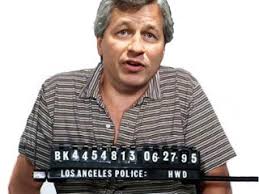 Something tells us Jamie Dimon has been smashing the Ambien lately, and it’s not anxiety over CIO losses, it’s due to the liklihood JP Morgan will be implicated in LIBOR rate fixing in the coming days and weeks.
From the NY Times:
As regulators ramp up their global investigation into the manipulation of interest rates,the Justice Department has identified potential criminal wrongdoing by big banks and individuals at the center of the scandal.
The department’s criminal division is building cases against several financial institutions and their employees, including traders at Barclays, the British bank, according to government officials close to the case who spoke on the condition of anonymity because the investigation is continuing. The authorities expect to file charges against at least one bank later this year, one of the officials said.
The prospect of criminal cases is expected to rattle the banking world and provide a new impetus for financial institutions to settle with the authorities. The Justice Department investigation comes on top of private investor lawsuits and a sweeping regulatory inquiry led by the Commodity Futures Trading Commission. Collectively, the civil and criminal actions could cost the banking industry tens of billions of dollars.
and as far as Greece corruption goes , here is a taste ....
http://hat4uk.wordpress.com/2012/07/16/greece-more-astonishing-graft-in-senior-ranks-of-athens-banking-system/
GREECE: More astonishing graft in senior ranks of Athens banking system…
….but the Troikanauts don’t care
Caligula rules apply in the last days of the Euroblown experiment
In a terrific piece of sleuthing by Reuters in recent weeks, the news agency has established beyond reasonable doubt that offshore companies owned by Piraeus Chairman Michael Sallas and his two children bankrolled shares he bought in the Bank…..by borrowing money from a rival bank. The purchase also represented insider trading, as Sallas knew the bank was about to be recapitalised. Unsurprisngly, the Athens stock exchange were not informed of the carefully disguised 6% stake he had taken.
Today, none of the IMF, the ECB or Brussels were prepared to comment. But the Slog’s Brussels mole commented, “The Troika has no interest at all in bringing Greek fraudsters to justice. It just isn’t even on their agenda. They want to keep the whirligig going for as long as possible, and anyway they’re dealing with Samaras and Venizelos, whom they know to be corrupt beyond belief. Before that they were dealing with Papandreou, whose family salted away millions from State funds. This isn’t about justice, it’s about stability.”
“This [the Greek financial system] is a closed circuit, operating as a system of power with no transparency and effective supervision,” said Louka Katseli, professor of economics at the University of Athens and former Greek minister of economy. “Through triangle deals between banks, businessmen and other banks, capitalisation requirements were fulfilled without new money being injected.”
And so the cynicism goes on, but these are looking increasingly like the last days of a eurozone with 17 members…and Merkel’s fabled Fiskal Union will most probably not happen in anything like its intended fashion – if at all. Although Mario Draghi was buying enough euros today to paper the entire Frankfurt head office, the IMF announced that Spain is going to fall short on its debt repayment targets for 2012, and its debt/GDP ratio is unlike to fall before 2016. Reflecting this reality, Spanish 10-year bond yields rose for a third day, rising 14 basis points to 6.8%. Not too much higher than that is the point at which pc software will start flashing to point up the fact that the markets are saying they have given up on Spain. At that point, Berlin-am-Brussels will have to stop pretending that Spain only needs a banking bailout…and Angela Merkel will have to face her own citizens.
With the extra yield investors demand to hold Spanish 10-year bonds instead of German bunds stretching a further 17 basis points to 557, Italy too was in trouble: the spread between Italian 10-year bonds and their German counterparts broadened to 495 basis points, almost a record and the highest since January. In both fiscal and economic terms, the obvious-from-day-one likelihood of a eurozone in which the North/South divide gets wider and wider is now an undeniable reality.
Future observers and historians will look back at this euromess, and probably have three main reactions: first, they will wonder why the populace allowed gravy-train bureaucrats and hubris-blinded politicians to continue the pointless pavane for so long; and second, they will gasp at the smug inaction of Camerlot in failing to spot when an imponderable outcome became an impossible nightmare for the British.
But most of all, I suspect, they will be repelled at the heartless cynicism of those who put the creation of a pointless, undemocratic, and illiberal superstate before the prosecution of rampant pocket-lining by the elites of its member countries. Or perhaps not: maybe by then, the whole concept of ethics will have disappeared – to be replaced by a perverted utilitarianism in which no holds are barred if increased geopolitical power is the result of a given set of actions.
I am more optimistic than that: not through some kind of fluffy sentimentalism, but because as a student of history, I know that it represents a constant back and forth ping-pong of action, reaction, forward thrust and backlash in which our more than slightly bonkers species veers crazily from one daft extreme to another. It would thus not surprise me if England (and it will be just us by then) is by 2040 a land ruled by aescetic Quaker farmers with a zero tolerance policy towards bankers, Islamists, taxation, the Scots, and an ageing pensioner nuisance-caller pervert by the name of Simon Cowell.
I will be long gone by then. But it would be nice to think that my grandchildren might have a firmer grasp on reality than our lot.
http://www.zerohedge.com/news/battle-berlin
The Battle Of Berlin
Via Mark J. Grant, author of Out of the Box,
“When you say you agree to a thing in principle you mean that you have not the slightest intention of carrying it out in practice.”
-Otto von Bismarck
In what has become a typical pattern; Europe has a summit, everyone says this, that, their own variation of that and the other to appease their citizens and it is not until days later that some sort of reality begins to be released to the Press.Not only has this become the pattern but it generally comes over the weekend when the markets are not open and when no one is paying much attention. It is a purposeful scheme and useful I suppose for dampening effects and it allows the bliss to continue. In the meantime there is no ESM in place, only $65 billion left in the EFSF after Spain and Cyprus are funded and the German Constitutional Court declared over the weekend that there would be no ruling on the ESM until September 12. For those that believe in the usefulness of firewalls, which would not include me, you are now staring at bricks to build dollhouses and it is not just the flank but the center that is fully exposed and vulnerable.Not long ago I wrote a piece about how to rank the statements be various European governments and governmental agencies. Germany got the top score as they are the paymaster and because nothing in the European Union will be happening without their acquiescence and the Golden Rule lives on; “He that has the Gold rules.”Over the weekend Ms. Merkel made her position quite clear; there will be no money lent to any banks until there is a financial oversight authority that has the regulatory powers to control the finances, the economy and the banks of every nation in Europe. There are several ways to read this of course with the first being “that Berlin, through Brussels, will control the money of every nation in Europe before any help will be provided” and the second viewpoint is “that Berlin, through Brussels, will control the money of every nation in Europe before any help will be provided.” You may choose number one or number two because both are exact and exactly correct. It is not just a loss of some sovereignty that is being requested but absolute control of the economy of every nation in Europe, fiscal domination centered in Belgium and a Brussels that is the puppet of Berlin. He that controls the finances and the banks of a country controls the country; make no mistake here and this is exactly what Germany is trying to accomplish.
Ms. Merkel cited various attempts by any number of political leaders to get at the money without all of this being in place as she responded, “All of these attempts will have no chance with me or with Germany.” In other words, a resounding “Nein” to Spain, Ireland, Greece, Portugal and Italy that any money would be lent directly to their banks without full and absolute submission. Now you can make nice all you like and you may think it impolite to foster ill intentions on Germany but the facts speak resolutely for themselves; Germany has banged the gavel and stated that any money for any banks will not be given until they control the nations of Europe and that is “period and end of story.”World War I was fought with rifles and tanks and World War II was fought with planes and aircraft carriers and World War III is being fought with Euros and Capital and in each case, without exception, Germany has tried to control the Continent of Europe.-Otto von Bismarck
In what has become a typical pattern; Europe has a summit, everyone says this, that, their own variation of that and the other to appease their citizens and it is not until days later that some sort of reality begins to be released to the Press.Not only has this become the pattern but it generally comes over the weekend when the markets are not open and when no one is paying much attention. It is a purposeful scheme and useful I suppose for dampening effects and it allows the bliss to continue. In the meantime there is no ESM in place, only $65 billion left in the EFSF after Spain and Cyprus are funded and the German Constitutional Court declared over the weekend that there would be no ruling on the ESM until September 12. For those that believe in the usefulness of firewalls, which would not include me, you are now staring at bricks to build dollhouses and it is not just the flank but the center that is fully exposed and vulnerable.Not long ago I wrote a piece about how to rank the statements be various European governments and governmental agencies. Germany got the top score as they are the paymaster and because nothing in the European Union will be happening without their acquiescence and the Golden Rule lives on; “He that has the Gold rules.”Over the weekend Ms. Merkel made her position quite clear; there will be no money lent to any banks until there is a financial oversight authority that has the regulatory powers to control the finances, the economy and the banks of every nation in Europe. There are several ways to read this of course with the first being “that Berlin, through Brussels, will control the money of every nation in Europe before any help will be provided” and the second viewpoint is “that Berlin, through Brussels, will control the money of every nation in Europe before any help will be provided.” You may choose number one or number two because both are exact and exactly correct. It is not just a loss of some sovereignty that is being requested but absolute control of the economy of every nation in Europe, fiscal domination centered in Belgium and a Brussels that is the puppet of Berlin. He that controls the finances and the banks of a country controls the country; make no mistake here and this is exactly what Germany is trying to accomplish.
There is a long history of lambs being led to slaughter and all of the reasons given for Germany’s position does not change the result one whit. You may cloak it all under the banner of financial responsibility and Germany wanting to control how their money is spent and the masquerade is obviously wonderfully successful as hardly any objections are heard but where this is going is no different than Germany rolling in with her tanks and assuming control. This is Vichy reborn and Anschluss déjà vu and the takeover of Poland just accomplished on a different battlefield. The weapon is money and not armaments and while the stench is more polite the demand for victory has not lessened.“The art of concentrating strength at one point, forcing a breakthrough, rolling up and securing the flanks on either side, and then penetrating like lightning deep into his rear, before the enemy has time to react.”
-General Erwin Rommel
and....
http://www.zerohedge.com/news/guest-post-are-rajoy%E2%80%99s-broken-campaign-promises-delegitimizing-his-government
Guest Post: Are Rajoy’s Broken Campaign Promises Delegitimizing His Government?
Submitted by Juan Luis Guzman, director of Truman Factor; originally published in El Confidencial
Are Rajoy’s Broken Campaign Promises Delegitimizing His Government?
The debate on how to deal with false or misguiding campaign speech is neither new nor likely to be resolved soon, but as Europe’s economic crisis continues to deepen, and as social and political tensions rise, elemental questions of democracy once limited to seemingly distant European Union institutions are now spilling over to national governments.
In the case of Spain, broken campaign promises coupled with the notion thatBrussels and Berlin may have de factohijacked the national political process are seeding the ground for an imminent political crisis.
Indeed, Spanish Prime Minister Mariano Rajoy’s systematic adoption of policies that are in complete breach of the promises which took him to power only a few months ago are casting doubts on the legitimacy of his political leadership.
Broken campaign promises
"Political language ... is designed to make lies sound truthful and murder respectable, and to give an appearance of solidity to pure wind." (George Orwell, "Politics and the English Language," 1946)
The issue of adding checks and balances to political speech, or somehow raising the standards of society’s most pivotal decision-making process, is one that affects most democracies.
In the United States, the issue has even been addressed through the judicial system on several occasions, yet the constitutional right to freedom of speech in that country has thwarted most attempts to regulate political speech.
Penalizing false political promises, bringing more transparency to campaign funding, and preventing defamation and the use of manipulated data in political campaigns is a daunting task in what many consider to be the most advanced democracy in the world.
Therefore, the subject remains open for debate while most professionals, from accountants and medical doctors to journalists and scientists, are measured by higher standards of accountability than the men and women running the government.
However, when foreign forces are seen as the cause for a nation’s elected officials to act against the will of the people – as it is now the case in Spain – the question of political legitimacy becomes a much more serious matter than the everlasting intellectual debate over domestic electoral processes.
The loss of national sovereignty in Spain
In Spain, a young democracy with a rather complicated electoral law, which also suffers from the vices inherent to two-party systems, political campaigns per se are quite meaningless in aiding voters to choose the more qualified candidate.
However, while there may be ways to improve a country’s democratic processes (by means of requiring specific information in campaign programs by law, for example) and even when electoral system reform seems to always be present in the political debate (only no party in power has ever had the willingness to shoot its own foot), a new problem affecting Spanish democracy is surfacing at the worse possible time: thegrowing loss of sovereignty the single currency is causing on economically weaker nations in favor of the EU’s core.
The irony for Spain is that while its political leaders (on both sides of the dominating political spectrum) are keen on the concept of further European integration, thus to transfer national sovereign powers to an eventual “United States of Europe,” the current crisis, the constrains of a mangled monetary system, and a one-size-fits-all European economic strategy are alreadyforcing such a transfer – without the citizen’s approval and in favor of highly undemocratic supranational institutions.
Europe’s financial crisis, its unfinished monetary union and the competing interests among its members are giving place to a new crisis of democratic nature where we now see how a country such as Finland may have more to say about the budget policy of the Spanish region of, say, Andalusia than Spain’s prime minister.
Rajoy’s U-turn
"You are masters at doing one thing and saying the opposite..." (Mariano Rajoy on Twitter, 7 November 2011)
Mariano Rajoy’s general elections campaign last autumn was simply an extension of his seven-year act as leader of the opposition: to continue to hammer the socialist government for its flip-flops and “lies”about Spain’s dire economic situation.
In essence, Rajoy’s center-right Popular party (PP) embraced a rather moral discourse which portrayed the socialist administration as inept, unpredictable and deceitful. In addition, PP also underlined how Brussels was in fact imposing policy on former Prime Minister José Luis Rodríguez Zapatero.
Although Rajoy’s campaign program was scant on details, he specifically promised to lead the country out of the crisis through a reformist agenda which would empower small businesses and entrepreneurs, limit the size of the government and lower taxes – an agenda which was neatly tucked inside PP’s “join the change” (súmate al cambio) campaignmotto.
On November 20 last year, Rajoy’s campaign strategy proved successful as almost 11 million Spaniards joined the change, giving PP an absolute majority in parliament.
Rajoy’s promise of change did not last long, however, as it only took him nine days into his administration to break his promise not to raise taxes and less than seven months to put the final nail in the coffin of his entire political discourse.
Fending off criticism
Rajoy has fended off criticism for his own flip-flops by pointing to his predecessor’s “legacy,” namely, that the socialist government had lied about the country’s deficit, which in turn negated Rajoy’s own program (though Rajoy never followed through on such grave accusation by demanding any type of accountability from Zapatero, and actually decorated his predecessor as per tradition).
Similarly, Rajoy has also placed much of the blame for his U-turn on the Spanish 17 regional governments’ reckless spending (most of which his party now rules), as well as on Europe’s slow decision-making process.
Perhaps a more telling indication of Rajoy’s true motivation to act against everything he had promised may be found in his speech at the Spanish parliament last Wednesday.
Once Rajoy had outlined his government’s fourth package of budget cuts and austerity measures (repeatedly citing EU “recommendations”), he sentenced: “We do what we have no choice to do, whether we like it or not… [We] have reached a point where we cannot choose not to make sacrifices. We do not have that freedom. The circumstances are not generous.”
Quite a remarkable reversal from a leader who only a few months ago defended his country’s sovereign right to decide on matters of national budget controls and deficit reduction policies, and who proudly declared that it was he who had pressured Brussels into funding the bailout of Spain’s troubled banks.
To add insult to injury, as El Mundoreported yesterday, while members of Rajoy’s government avoided specific questions about the new tax hikes made official during last Friday’s Council of Ministers press conference, a press release in English detailing unannounced additional measures was made available to the foreign press.
Calls for a referendum
While rival political leaders and the news media constantly point to Rajoy’s blatant U-turn (El País has put together a series of YouTube videos depicting Rajoy’s previous stance on the matter raising the value added tax), Wednesday’s €65bn austerity packagehas triggered open calls for a referendum on the government’s economic policies.
Upon Rajoy’s speech in parliament, the leader of the trade union Comisiones Obreras, Ignacio Fernández Toxo, openly denounced Rajoy’s “democratic fraud,” demanded a referendum on the prime minister’s austerity package, and called for a massive demonstration on July 19.
Cayo Lara, the leader of Spain's United Left (IU) party group, also raised the need for a referendum, and warned that the prime minister’s budget cuts and tax hikes were akin to “pouring gasoline onto the streets.”
Rosa Díez, co-founder of the rapidly-emerging social liberal party, Union, Progress and Democracy (UPyD), also blamed Rajoy for “fading the hope [Spaniards] had confided in him.” (UPyD is the political party which has brought the lawsuit against Bankia’s 33 board members, including former chairman and PP heavyweight Rodrigo Rato).
On his part, Socialist party (PSOE) leader Alfredo Pérez Rubalcaba said yesterday that Spaniards felt “cheated” by the Rajoy administration, and added, “[Rajoy] is doing the opposite of what he said.”
The last thing Spain (and Europe) needs
As we warned last week, the potential for social tension boiling over in Spain is great. The general population has thus far demonstrated a stoic stance on the continuous worsening of their country’s economic environment, as well as a rather contained attitude toward the corruption scandals surrounding the Spanish financial sector.
However, the latest budget cuts and tax hikes may push Spaniards over the limit, particularly as they begin to question their government’s legitimacy.
Should a political crisis unfold, Rajoy will not be able to put the blame on his predecessor’s “legacy,” but rather on his own broken campaign promises. All in all, the Spanish prime minister faces a seemingly impossible task: to assert his country’s sovereignty at the same time as he pushes for the diametric process of European integration that he believes will ultimately save the country.
and....
http://www.zerohedge.com/news/spanish-bank-borrowings-ecb-soar-%E2%82%AC50-billion-june-hit-record-%E2%82%AC337-billion
Spanish Bank Borrowings From ECB Soar By €50 Billion In June, Hit Record €337 Billion
Contrary to popular delusions, money flows in Spain are once again deteriorating rapidly, with the country's bank borrowings from the ECB soaring by €50 billion in June according to the Bank of Spain, the second highest ever, to a record €337 billion. While this is bad for Spain, it is good for Italy, which saw its June Eurosystem borrowings rise by only €9 billion, to a record €281 billion, although well below Spain's total - something Italy, which led Spain in ECB borrowings since mid-2011 will be delighted by. What however, is rather curious, is that the Spanish TARGET2 net liability soared to €371 billion (-€40 billion in autonomous factors accounting for the lower total number), forcing the ongoing implicit German bailout of the periphery to accelerate to a record €729 billion as noted previously. As a result, for the first time ever, Spanish TARGET2 liabilities represented over half of total Germany TARGET2 claims. Just as we predicted several months ago, German funding of peripheral current account balances is the only "source of capital" for these countries in what is rapidly becoming the latest 'flow of funds' mercantilist scheme, one which can only sustain for so long by definition. In the meantime, now that we are in the exponential phase of the TARGET2 blow out, expect the next German update to indicate well over €2 billion per day in implicit European bailout spending.
Spain and Italy ECB borrowings:

And a European TARGET2 summary, courtesy of Diapason's Sean Corrigan:
Numbers show that the once yawning deficit on Spain's merchandise trade balance is almost closed - i.e., the internal devaluation + the credit crunch is 'working' to restore much needed balance, however slowly and with whatever other costs...
The problem is still capital withdrawal & flight.... The TARGET2 balance has now jumped to a monstrous €408 billion... for the past year it has run at €1 billion a day - or 33% of GDP (almost an order of magnitude greater than the current account gap). YTD the run rate is €1.4 bln a day (~50% of GDP) and in QII it was up to €1.7 bln p.d. (getting on for 60% of GDP)..........Something's gotta give!

and.....
http://www.telegraph.co.uk/finance/debt-crisis-live/9402130/Debt-crisis-live.html
12.50 Yet more protests in Spain. After civil servants took to the streets on Friday to protest against sweeping cuts, AFP reports that hundreds of firemen, police officers and nurses demonstrated today against Spain's latest austerity plan.
 "Hands up, it's a hold-up," the protestors cried, repeating a slogan echoed across the country in the ever-frequent protests.
The Madrid demonstration was in response to calls to protest on social networking sites, including under the hashtag £graciasfuncionarios on micro-blogging site Twitter.
Mass discontent has grown following a new €65bn austerity package announced by Prime Minister Mariano Rajoy last week, after the European Union ordered new cuts and tax increases to meet deficit-cutting commitments.
12.29 Madrid's regional government is to sell 100 office buildings in the centre of the city over three years, reports Bloomberg, to cut its deficit and pay for services as the country makes its deepest budget cuts on record.
Jose Luis Moreno Casas, the government official who is overseeing the sales, said:
We’re not a real estate company. Our job is to ensure there is adequate health care, education and mobility for our people.
The first 15 properties to go on sale have a total value of €62m, according to Tinsa, Spain biggest appraisals company.
and note how the spread between spanish ten year debt and german ten year bunds has spiked again - spread about 554 bps at 13.18 BST update...
http://www.guardian.co.uk/business/2012/jul/16/eurozone-crisis-imf-world-economy-forecasts
Another protest took place in Spain today - with a broadcaster in Valancia being taken over by its own staff to express their anger over the Spanish €65bn austerity plan.
Giles Tremlett reports:
A bleak vignette from Valencia illustrates both some of the causes and the devastating consequences of Spain's fall into double-dip recession, high deficits, rampant unemployment and bank bailouts.
Regional Valencia broadcaster RTVV had become infamous as one of the most overstaffed, underwatched broadcasters in the country – with a reputation for working as a propaganda outfit for its owners in the conservative regional government of this part of eastern Spain.
Having helped build its staff to 1,700 (more than that of three of Spain's biggest national private broadcasters put together) the People's party (PP) regional government today announced plans to sack three quarters of them. That is the same PP run by Rajoy.With some 1,300 people set to lose their jobs, the workers “occupied” the mid-day news today to denounce the planned sackings.Giles continues:The PP's Valencia branch has become a constant headache for Rajoy. It runs a government that has produced one of the worst regional deficits in Spain and is at the centre of several long-running corruption scandals. The regional government's debt has been given junk status by ratings agencies.
Last week a parliamentary deputy from Valencia, Andrea Fabra (daughter of one of those regional PP leaders now being investigated for alleged corruption), shouted “they can go fuck themselves!” while Rajoy was announcing 65bn euros in austerity measures, including a cut in unemployment benefits.Ms Fabra says she was insulting opposition socialist deputies, not the unemployed – but party officials are upset. So are the unemployed.Fabra's 'plain-speaking' has captured the attention of Spanish activists, who used it as their slogan for Saturday's protests (as Erik Wesseliuskindly flags up - see this tweet for a link to the photo):PS I mentioned this morning (see 11.53 for photos and details) that there were lively protests against the austerity programme last night in Madrid.Updated at 16:57 BSTThe IMF is pretty gloomy about Spain's prospects. It's new fiscal outlook contains a graph showing when it expects the debt/GDP ratios of various major economies to peak.For Spain, and for Japan, the IMF cannot see a peak within the next five years:Advanced Economies - how will debt ratios peak. Photograph: IMF
The IMF had more bad news for Spain; it now expects this year's recession to stretch deeper into 2013.From Madrid, Giles Tremlett writes:The IMF has downgraded Spanish growth from 0.1 percent to minus 0.6 percent in 2013, though this year's recession looks slightly better at only minus 1.5 percent against a drop of 1.8 percent in the last predictions.The IMF figures were calculated before prime minister Mariano Rajoy announced a €65bn further austerity package last week. That is expected to hit growth further, so it may be reasonable to expect that the next revision is even gloomier.Updated at 16:21 BSTWarning that the eurozone crisis remains the biggest single threat to the world economy, the IMF laid out a five-point plan. It includes closer integration ASAP, new measures to stimulate the euro economy, and more action from the European Central Bank.From the report:
- A credible commitment toward a robust and complete monetary union. By setting in motion a process toward a unified supervisory framework, the European summit put in place the first building block of a banking union. But other necessary elements, including a pan-European deposit insurance guarantee scheme and bank resolution mechanism with common backstops, need to be added.
- The viability of the monetary union must also be supported by wide-ranging structural reforms throughout the euro area to raise growth and resolve intra-area current account imbalances.
- Demand support and crisis management are essential in the short term to cushion the impact of the region's adjustment efforts and maintain orderly market conditions (as assumed in the baseline projections).
- There is room for monetary policy in the euro area to ease further. In addition, the ECB should ensure that its monetary support is transmitted effectively across the region and should continue to provide ample liquidity support to banks under sufficiently lenient conditions. This might require nonstandard measures, such as reactivation of the securities market programme, additional LTROs with lower collateral requirements, or the introduction of QE-style asset purchases.
- Fiscal consolidation plans in the euro area must be implemented. In general, attention should be paid to meeting structural fiscal targets, rather than nominal targets that will likely be affected by economic conditions. Automatic stabilisers should thus be allowed to operate fully in economies not subject to market pressure. Considering the large downside risks, economies with limited fiscal vulnerability should stand ready to implement fiscal contingency measures if such risks materialize.
Updated at 15:30 BSTHere are the links to the IMF's world economic outlook update and theglobal financial stability report.Updated at 15:30 BSTThe IMF's World Economic Outlook includes this photo, showing how conditions in the eurozone have deteriorated since the crisis began:Photograph: IMFThe left-hand graph of bond spreads shows how the 'risk premium' on each country's debt compared to Germany has changed in the last two years. The right-hand graph shows how much more money has been poured into the system by the European Central Bank (blue barchart), after Euro banks saw their borrowing costs jump (red graph).Updated at 15:06 BSTAfter taking a knife to its forecasts for the world economy (and particularly the UK - see 2.31), the IMF warned that its forecasts could still be too optimistic, as they presume that European leaders will solve the eurozone debt crisis.Should they fail, or should emerging markets such as China stumble, the slowdown could be even bigger.The IMF warned of several "downside risks":In Europe, the measures announced at the European Union (EU) leaders’ summit in June are steps in the right direction. The very recent, renewed deterioration of sovereign debt markets underscores that timely implementation of these measures, together with further progress on banking and fiscal union, must be a priority.
In the United States, avoiding the fiscal cliff, promptly raising the debt ceiling, and developing a medium-term fiscal plan are of the essence. In emerging market economies, policymakers should be ready to cope with trade declines and the high volatility of capital flows.


Details of Spanish bank loan
Spain's economy minister is revealing some details of the funding support being offered to its banks.
Luis de Guindos said the loan would be pegged around 3%, and would come with a 10-year grace period – which means Spain would get an extra decade to repay, if needed.
Guindos added that the memorandum of understanding, which would finalise the loan, should be signed on Friday.
The minister also aimed a short blast at the financial markets, saying that current interest rate spreads (the difference between the borrowing costs of various countries) were "not logical", and show "there's something wrong with EU institutions".
Spanish bond yields have risen this morning, with the 10-year bond how trading at a yield of 6.78%. In contrast, Germany's 10-year bund has strengthened again, pulling its yield down to 1.241%.
Updated at 13:18 BST
While angry Spaniards were protesting in Madrid (see 11.53), the thinktank Open Europe was examining the details of the country's new austerity plan.
A government document explaining the details of the plan to foerign investors emerged over the weekend. It shows that a large slice of the programme – €22bn – is meant to come through hiking VAT to 22%. Spending cuts will bring in €9.22bn, with tax rises also bringing in billions. But €8.5bn of the package remains unexplained.
Open Europe warned:
The potentially regressive nature of VAT is well known and with unemployment at record levels and large amounts of the population struggling to manage their finances, the move may not be well received and could be incredibly harmful. Increasing a tax on transactions could also dent consumer activity at a time when it needs to be boosted;
Another hurdle is that Spain's regions must implement much of the plan, and may not fancy imposing austerity measures that will hurt economic growth in their areas.
In summary, Open Europe said:
this is the most detail we have seen on the planned cuts but yet falls woefully short of providing a clear picture on how exactly the Spanish government will go about making the necessary savings within the necessary time frame.
Updated at 12:39 BST
Protests have continued over the weekend in Spain over the €65bn austerity plan announced last week.
This photo, taken on Sunday night, shows how crowds gathered in Madrid to chant slogans against Mariano Rajoy's government. According to local reports, hundreds of civil servants took part in the protests, unhappy about plans to cut their pay:

Protesters near the Puerta del Sol square, Madrid, Spain, late on 15 July 2012. EPA/BALLESTEROS

One fireman (almost certainly not the one pictured below) told euronews.com that:
Spain is in a difficult situation, but the solution will not only come from the civil servants. Everyone has to help.[Instead, we have] Fiscal amnesty for those who stole money and for me, they lowered my salary three times already.
A fireman, center, protests against the recent austerity measures announced by the Spanish government in Madrid, Spain, on Monday, July 16, 2012. (AP Photo/Andres Kudacki)
 A riot police officer arrests a demonstrator during a protest against government austerity measures in Madrid early July 16, 2012. REUTERS/Juan Medina.
Some demonstrators had planned to sleep on the streets overnight. At least one arrest were made in the early hours of this morning:
A riot police officer arrests a demonstrator during a protest against government austerity measures in Madrid early July 16, 2012. REUTERS/Juan Medina.
There's also a good write-up of the protests here, via the Kuwait Times. Here's a flavour:
Surrounded by 20 police vans, they stood outside the headquarters of the Popular Party (PP) of Prime Minister Mariano Rajoy and shouted “resign, resign!” and “they are lining their pockets!” Carrying signs that read “They call it democracy, and it isn’t”, they then headed for the headquarters of the opposition Socialist Party, which they also accuse of incompetence in the face of the crisis.
Updated at 12:11 BST
In the bond markets, Netherlands just sold short-term debt at negative interest rates – as investors accepted a small loss in return for the chance to own its debt.The Dutch treasury sold €1.25bn of 3.5 month bills at a yield of -0.041%, and €1.13bn of 6.5 month bills at -0.029%. Both are record lows.The auction came as traders continue to pile into debt issued by stronger members of the eurozone. This pushed the yield on French five-year bonds to a record low of 0.883% (in the secondary bond market, not in a new auction).Negative yields are a sign that some investors sre scrabbling to find a safe asset, before the crisis escalates.Chris Beauchamp of IG Index commented:German, Dutch, Austrian and French bonds have all seen their yields drop into negative territory, showing that Friday's bounce in equity markets has not fundamentally changed the gloomy outlook
Fears over the global economy are weighing on markets across the world, though. Overnight, China's Shanghai composite index fell 1.7% to its lowest level in three years.Updated at 12:06 BST
Some good news for Greece – bookings from German tourists have picked up again.Thomas Cook's German arm reported this morning that the slump in bookings (down by nearly a third at one stage) has reversed since the second Greek general election in early June.Peter Fankhauser, chief executive for central Europe, said:The booking trend runs parallel to what's in the papers. If the headlines are bad, bookings fall, if it's quiet, then they rise again.
A quick explanation about the IMF's world economic outlook, due to be published at 2.30pm BST.
This is the first time that the IMF has published growth forecasts since April (when the eurozone crisis was just starting to flare up again). Today's report will include new projections for GDP growth (or contraction) across all regions and major countries.
The WEO also comes with a detailed explanation of the IMF's view of the global economy, and the issues it is most concerned about.
As a reminder, here's what the IMF predicted in April:
World economy: to grow by 3.6% in 2012, and 4.1% in 2013
Eurozone: to shrink by 0.3% in 2012, and grow by 0.9% in 2013
UK: to grow by 0.8% in 2012, and 2.0% in 2013
US: to grow by 2.1% in 2012, and 2.4% in 2013.
The Independent predicts this morning that "continuing financial woes in Europe, the stagnant US economy and slowing growth in China" will force the IMF to cut its forecasts (as Christine Lagarde has already indicated –see 8.54am).
Updated at 10:29 BST
Eurozone inflation unchanged
Eurozone inflation came in at 2.4% year-on-year in June, Eurostat just reported. That's in line with forecasts, and matches May's figure (which was a 16-month low).
On a monthly basis, the consumer prices index slipped by 0.1%.
Updated at 10:09 BST
A bad start to the week for the euro, which has slid to a new three and a half year low against sterling this morning.
The euro hit a low of 78.55p, making one pound worth €1.273.
Matthew Black of Clear Currency says sterling has become a safe haven for currency traders:
This Euro weakness is likely the result of general fears over rising yields on peripheral Eurozone debt, and once again we have seen the British Pound sought as an asset of relative local safety.
Updated at 10:07 BST
Reinforcing the point about how the crisis has further to run, the head of the European Investment Bank (EIB) warned yesterday that the eurozone debt crisis will still be raging in 2014.
Werner Hoyer told German magazine Focus that:
The pressure on member states and on the European Union itself to get their house in order will continue for a long time.This is not simply going to last one or two years.
Hard to argue with that! But it's worth remembering that Mario Monti, back at the end of March, claimed that the cisis was "nearly over".
The Wall Street Journal is reporting today that the European Central Bank has begun arguing that senior bond holders should share the pain of Spain's banking bailout.
In what looks like a stunning U-turn, Mario Draghi apparently argued last week that these senior creditors (typically large financial institutions who hold such bonds) should take on some of the cost of the Spanish bank rescue. Finance ministers, though, rejected the idea – sticking to the status quo that taxpayers and investors should take the burden.
From the WSJ:
The European Central Bank, in a sharp turnaround, advocated imposing losses on holders of senior bonds issued by the most severely damaged Spanish savings banks—though finance ministers have for now rejected the approach, according to people familiar with discussions.
The ECB’s new position was made clear by its president, Mario Draghi, at a meeting of euro-zone finance ministers discussing a rescue for Spain’s struggling local lenders in Brussels the evening of July 9…..In the July 9 meeting, Mr. Draghi argued in favor of including senior bank creditors in burden-sharing between taxpayers and investors in the case of Spain, three people familiar with the discussions said. Two said Mr. Draghi favored forcing losses on senior bondholders only when a bank was pushed into liquidation.
As FT Alphaville points out, it's extremely rare for a European bank to actually be liquidated. But the suggestion that the ECB has changed sides in this argument could alarm senior creditors – and may suggest that Draghi is preparing for further shocks to the system ...
Updated at 09:43 BST
Some early breaking news – the German constitutional court has announced that it will rule on 12 September on whether the European bailout fund is legal.
The court could potentially conclude that the European Stability Mechanism (ESM) contravenes the German constitution, which would effectively detail the entire strategy to save the euro.
The financial markets had hoped for an early decision (the case began last week), so there will be disappointment that the issue will hang over the eurozone for another two months.
http://www.athensnews.gr/portal/11/56994
| 11.6 bn euros of cuts to be announced by the end of the week | ||||||||||||||||
| ||||||||||||||||

Finance Minister Yannis Stournaras will hold a series of meetings with cabinet members, starting Monday, in a bid to put together a proposal for 11.6 bn euros in savings for the troika’s consideration.
Stournaras will submit a double proposal in Brussels on Friday; a short-term proposal for 3 bn euros in savings for 2012 and a mid-term proposal for 11.6 bn euros for 2014. The latter could be extended to 2016 if the troika of lenders accept the government’s request for a two-year extension in order to meet its targets.
The 11.6 bn euro savings are expected to come from cuts in pensions, social benefits and the public sector. The government has pledged not to proceed with layoffs of public servants, but abolish and merge state agencies instead.
Stournaras will meet on Wednesday with Prime Minister Antonis Samaras in order to finalise the proposal. They will be joined by Pasok leader Evangelos Venizelos and Democratic Left leader Fotis Kouvelis.
The proposal will on Friday be submitted to the EC, ECB and IMF lenders for approval.
and......
| ||||||||||||||||


No comments:
Post a Comment