http://www.youtube.com/watch?v=kkyUMmNl4hk
http://imgur.com/DxWer
http://www.zerohedge.com/news/whack-mole-algo-back-0
 Submitted by Tyler Durden on 08/09/2012 18:58 -0400


Submitted by Tyler Durden on 08/09/2012 07:53 -0400
http://www.zerohedge.com/news/knights-berserk-algo-bought-26-million-worth-stock-every-second
Submitted by Tyler Durden on 08/08/2012 22:58 -0400

Hal won't Open the Pod Bay Door
http://imgur.com/DxWer
August 5, 2011 - "Rise Of The HFT Machine" - Visual Confirmation How SkyNet Broke The Stock Market On US Downgrade Day
http://www.zerohedge.com/news/whack-mole-algo-back-0
The Whack-A-Mole Algo Is Back
Because as we showed today on not one but two occasions, humans no longer trade the casino formerly known as the 'stock market', we were glad to see that our old friend - the Whack-A-Mole algo - is back. As the following animated chart from Nanex shows, the algorithm is one which merely cycles in a broad, 10%+ sawtooth pattern blasting out empty quotes to feel the market in a test of other algos' responsiveness, and during a period of 6000 quote blasts, executes just under 20 actual trades. We will launch a catalog of all the various algos as we see them. After all, now that nobody else is left, it makes sense to at least make the acquaintance of all those robotic parasites that are the only entities left quote stuffing each other to death all the while, in true Knightian fashion, levitate the general market higher.
And as a special bonus, here is a reminder of what happened during the "BATS crash." From IPO to death in 750 milliseconds.
and......
http://www.zerohedge.com/news/rbs-algo-went-berserk
"RBS Algo Went Berserk"
This Monday, a few shorts days after the Knight algorithm decided to do what it and the Fed does best, and go on a shopping spree, gobbling up $7 billion in stocks in 45 minutes and in the process almost destroying its host like any self-respecting virus, something weird happened with the 1.20-pegged EURCHF in the minutes after the marked closed: it shot up for no reason, only to slam right back down. Some speculated it was a fat finger.

Turns out they were right. Only with a twist, as first it appears it was purely human error, which in turn set of an avalanche of algo trades which had no idea why they were buying, except that someone else was buying, so they had to be buying: the purest definition of momentum trading insanity, where one buys or sells with no rhyme or reason, but simple because someone else, marginal enough, is moving the market. And that is why every single capital market: stocks, bonds, commodities and FX, is always one trade away from total collapse.
From Reuters:
When the incident happened, traders had speculated that it was a faulty algorithmic system at RBS that caused the run-up in the euro, although that turned out to be not the case."RBS algo went berserk," said one UK-based trader at the time it happened.Another trader, who spoke to Reuters on Monday, had the impression that an RBS algo took euro/Swiss franc from the 1.2015 level to he 1.2050 bid, and then the U.S. algorithmic systems took over.As a result of the spike in euro/Swiss, there was a lot of confusion as to whether the high of 1.20928 francs was valid. That prompted EBS to issue a statement to traders late on Monday.
As for the primary catalyst: it was simply the bank which has time after time proven it is the most incompetent (and nationalized) banking institution in the world: RBS.
and......An error by a U.S.-based trader at RBS Securities caused a sharp and unexpected rise in the euro against the Swiss franc on Monday, a spokesman for the bank told Reuters.The transaction caused a stir because it triggered a wave of computer-generated, or algorithmic trades from other banks. It took place on the EBS foreign exchange platform and briefly pushed the euro up near a five-month high against the Swiss franc.
The mistake occurred amid heightened concern over market mishaps after computer trading gone awry in the U.S. stock market nearly caused Knight Capital Group Inc to go under. However, an RBS spokesman said the incident was contained with quick action.Of course, with peak animosity toward algo errors of any kind, RBS would hardly admit it took was the victim of runaway technology and would rather throw some carbon-based trader under the bus.The ultimate driver of the move is, however, largely irrelevant. The markets continue to be broken, and are just getting worse. Every day it is something, whether in currencies, in stocks, in commodities, or heaven forbid, bonds. And one of these days, there will be no fixing the algo-driven problem as SkyNet finally takes its revenge.
http://www.zerohedge.com/news/knights-berserk-algo-bought-26-million-worth-stock-every-second
Knight's Berserk Algo Bought $2.6 Million Worth Of Stock Every Second
- Ben Bernanke
- BWIC
- Gambling
- Goldman Sachs
- goldman sachs
- HFT
- Merrill
- Merrill Lynch
- Purchasing Power
- Reality
While we already presented, courtesy of Nanex, the modus operandiof the Knight berserker algo, there was one outstanding question. What was the bottom line. And no, not how much the loss on Knight's Income Statement would be as a result of this glimpse into what really happens in the market: we already knew that would be $440 million. The question is what is the notional amount of stock that this algo bought in the 45 minutes in which it was operational. We now know: $7 billion. Or $155 million per minute. Or $2.6 million per second. Or, assuming the algo impacted just 150 stocks as previously reported, it was buying on average $17,333 in each name every second. Or, assuming an average stock price of the universe of 150 stocks of $30/share, the Knight algo lifted the offer roughly 600 times each second. For 45 minutes straight! That's right - the market making algorithm of a designated market maker which is responsible for 10% of the order flow in the US stock market, entered a pre-programmed mode (because the computer was told to do whatever it did by someone, and not without reason) that saw it buy up $2.6 million worth of stock every second.
Now there has long been speculation that HFTs are a central planner's best friend because they traditionally provide not only a floor to the stock market, but a gradual levitation bias especially in a low volume environment (as well as liquidity its advocates claim, but that is total BS - HFT only provides volume and churn - liquidity disappears at the drop of a bat when real selling pressure appears). They do this not because they are evil instruments of Bernanke collusion (although who knows) but simply because they accelerate and accentuate legacy momentum bias, which at least historically, has been up. Now in the aftermath of the Knight debacle we can also extrapolate what would happen if, say, reality were to creep in one day, and all those mutual and hedge funds which have carbon-based life forms making the buy and sell decisions suddenly decided to sell. Well, at $7 billion in 45 minutes, or 1/10th of the trading day, this means that had the Knight algo been running all day, it could have bought $70 billion worth of stock. Throw in the remaining flow routers, aka DMMs in the market which account for the remaining 90% of order flow, and we get a total of $700 billion in vacuum tube mediated purchasing power.
In other words, this is the market "worst case" shock absorber, or inverse escape velocity, that Bernanke has at his disposal if things turn sour. That said, with hedge funds, aka fast money, holding about $3 trillion in unlevered assets, and about $6-9 trillion with leverage (ignoring plain vanilla slow mutual funds), and one can see why not even the HFT levitation bid would be sufficient to offset a wholesale market dump.
There is one last open question remaining on Knight: what discount did Goldman extract out of the firm to rid it of its residual position which as the WSj explains declined slightly from its peak as "traders worked frantically Aug. 1 to sell shares while trying to minimize losses due to a software problem, ultimately paring the total position to about $4.6 billion by the end of the trading day" (one wonders if the market would have just blown up if the Knight algo were to run in reverse, and just take out layer after layer of bids to unwind the inventory asap). We now know thanks to the WSJ:
Knight avoided that scenario by agreeing in the early morning hours last Thursday to sell the portfolio to Goldman Sachs Group Inc., after rejecting an offer from UBS.The terms sought by the banks reflected how dire Knight's situation was: UBS wanted an 8% to 9% discount on the position, according to people familiar with the matter.The equities trading desk at UBS, headed by Mike Stewart, bid for the portfolio around 6:30 p.m. Wednesday, people familiar with the discussions said. Mr. Stewart was a former colleague of Knight Chief Executive Thomas Joyce's at Merrill Lynch. The talks with UBS fell apart later that night.
Goldman ultimately negotiated buying the portfolio at a 5% discount, or about $230 million less than the value of the stocks, the people said. That amount, not previously reported, represents more than half the loss Knight disclosed on Thursday that it incurred as a result of the technology errors.The deal with Goldman allowed Knight to move ahead. Last weekend, Knight negotiated a rescue package with six financial firms that injected $400 million in capital in exchange for securities that can convert to ownership of 73% of the trading firm.
And now you know why having cash on your balance sheet in a ZIRP environment may well be the best investment, because just like Goldman, one never knows just where a slam dunk distressed opportunity could come from in exchange for an immediate 5% pick up.
More importantly, the Goldman deal demonstrates what the true liquidity cost is in this market when one wishes to do a wholesale stock transaction (either BWIC or OWIC): it is not less than 5% and tops out at 9%.
Keep that in mind, because if and when the day when VWAPing in and out of positions is no longer possible, each and every fund will have no choice but to assume a guaranteed 5% minimum (up to 9%) haircut on one's entire portfolio of allegedly liquid stocks.
We dread to think what the wholesale implied liquidity premium is on less liquid products than stocks, which nowadays is virtually everything...
* * *
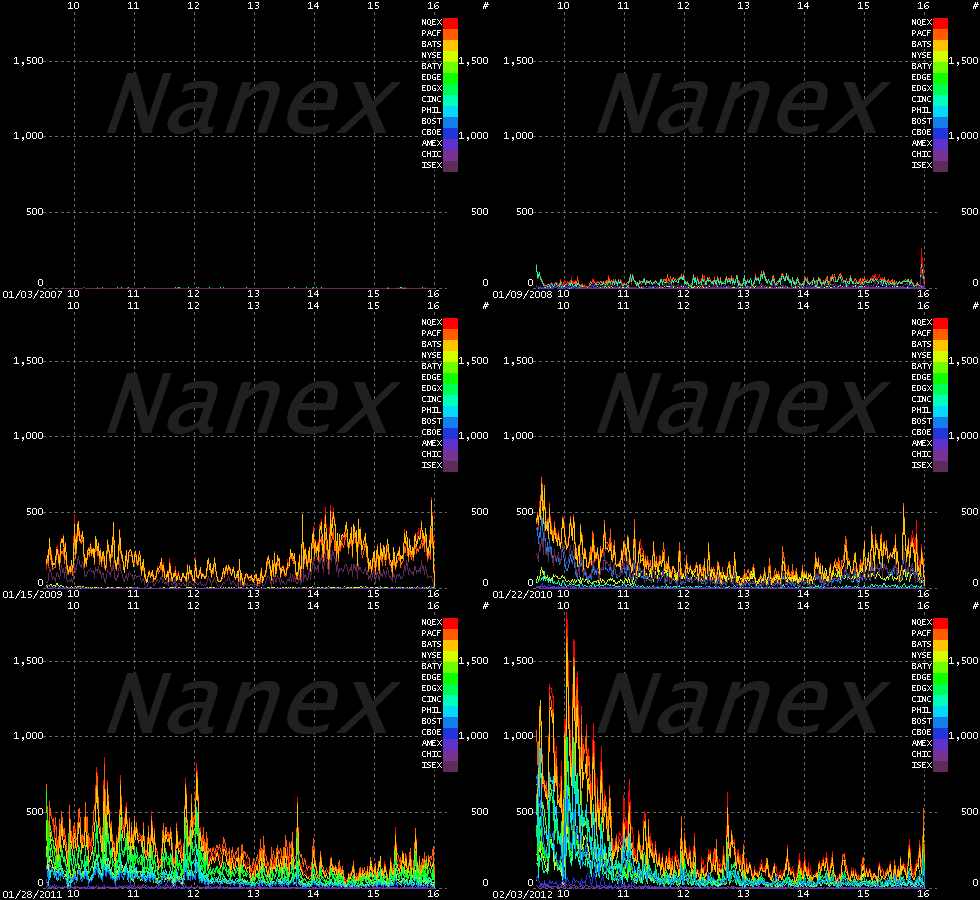
Finally, we leave readers with yet another transformative animation from Nanex, after our first rendition of the "rise of the machines" back in February left many speechless, and which recently appears to have been rediscovered by some of the slower elements in the blogosphere. Why: because it's pretty, and we feel like it. And because it once again confirms that only vacuum tubes with infinite balance sheets should be gambling in this loaded market.


No comments:
Post a Comment