http://www.tfmetalsreport.com/blog/4039/wrapping
Dropping to the pertinent parts......


http://finviz.com/futures_charts.ashx?t=GRAINS&p=d1
 ( daily charts )
http://news.blogs.cnn.com/2012/07/19/drought-sends-mighty-mississippi-river-levels-near-record-lows/?hpt=hp_c1
http://www.telegraph.co.uk/finance/newsbysector/retailandconsumer/9413696/Worst-drought-since-1956-threatens-world-food-crisis.html

 Submitted by Tyler Durden on 07/19/2012 17:51 -0400

Submitted by Tyler Durden on 07/19/2012 12:31 -0400
Dropping to the pertinent parts......
And the grains are, quite literally, ON FIRE. Though they are susceptible to a sharp pullback here, the forecast isn't getting any better. And it's still July. Yikes. Here's the latest forecast for Kansas City, Missouri. Right in the middle of corn and soybean country.

And here are your weekly charts showing new all-time highs in both corn and beans. The DAG, which we first discussed here a few weeks ago near $9, is closing in on $15, too.
( weekly charts )


http://finviz.com/futures_charts.ashx?t=GRAINS&p=d1
( daily charts )http://news.blogs.cnn.com/2012/07/19/drought-sends-mighty-mississippi-river-levels-near-record-lows/?hpt=hp_c1
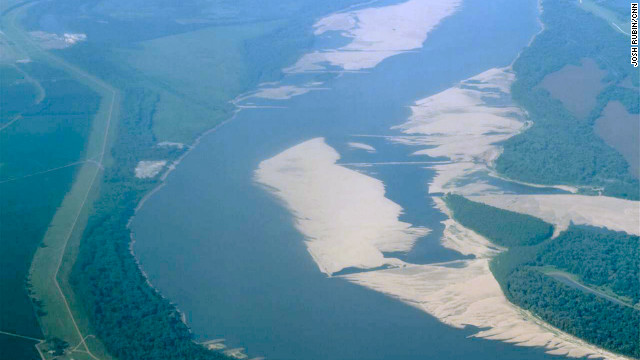
An aerial photo of the Mississippi river shows sandy areas where water had been before the drought. The river's levels are now nearing record lows.
Drought sends 'mighty Mississippi' river levels near record lows
The "mighty Mississippi" has lost some of its might with the season's epic drought taking its toll on river levels, which are falling to near historic lows.
The U.S. Army Corps of Engineers will spend nearly $7 million dredging in an attempt to keep ports operational and keep the river open for barge traffic in the coming weeks. River levels in Memphis have dropped to within three feet of their historic lows from the 1988 drought.
In just one year, the river has gone through extreme fluctuation. Last May, it was within a foot of its record-high crest because of massive flooding, and today it's 55 feet lower and experiencing historic lows due to drought.
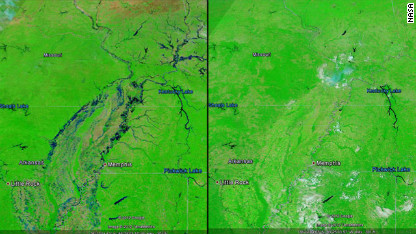
Dramatic images taken from NASA’s Terra satellite show the swollen river in late April of last year compared with images from early July this year. The expanse of the water was over 3 miles wide in parts of Missouri and Arkansas as levees were blown up in order to help protect the town of Cairo, Illinois from flood waters. The image taken July 2012 this year shows a much different story with the river less than a half mile wide in spots.
NASA’s Terra satellite shows the Mississippi River late April 2011 compared with images from early July 2012.
New data from U.S. Drought Monitor issued Thursday shows the drought has worsened in the past week, and now ranks as the second worst drought in U.S. history over the lower 48 since records began in 1895.
Nearly 64% of the contiguous United States is now in moderate to exceptional drought, second only to the summer of 1934, the height of the dust bowl era. Nearly 40% of the corn crop is now considered in poor or very poor condition, and this went up a sharp 8% in only a week.
During the 2012 crop year, the U.S. Department of Agriculture (USDA) has designated 1,297 counties across 29 states as disaster areas, making all qualified farm operators in the areas eligible for low-interest emergency loans. And on Monday the USDA designated 39 additional counties in eight states as primary natural disaster areas due to damage and losses caused by drought and excessive heat.
A dozen states on Thursday were under some sort of heat advisory or warning, many of them over the worst-hit drought areas. The heat wave is expected to last through much of the weekend, which means conditions will likely continue to worsen over the coming weeks.
And the Army Corps said that the shrinking of the Mississippi means that saltwater is beginning to work its way upriver, which could threaten some water supplies.
That's not unprecedented, and there's no current threat to water supplies, but officials are prepared to start building an underwater barrier to block the denser saltwater from moving further upstream, Corps spokesman Ricky Boyett said Friday. The Corps last had to do that in 1999, he said.
http://www.telegraph.co.uk/finance/newsbysector/retailandconsumer/9413696/Worst-drought-since-1956-threatens-world-food-crisis.html
10:46PM BST 19 Jul 2012
 16 Comments
A month of scorching temperatures across the country's midwest has sent corn and soybean prices to record highs, while wheat prices have reached levels not seen since the last food crisis in 2008.
The severest drought since 1956 in America's agricultural heartland has dashed the hopes that were alive just a couple of months ago of a bumper harvest. Traders and economists warned that the effect will ripple out from the US because it is the world's biggest producer of corn and a major supplier of soybeans and wheat.
"This year we have a rally in prices that is driven by the fundamentals," said Shawn McCambridge, an analyst at Jefferies Bache. "I really do anticipate these prices staying strong and producers will have to try to pass the cost onto consumers."
The dizzying gain in prices has shocked many in the industry. Corn prices have surged 51pc over the last month, wheat is up 40pc and soybeans have gained almost 20pc. The prospect of another bout of food inflation will alarm governments in developing countries where the run-up in prices in 2008 caused widespread hunger and revolts. It also presents a new headwind for western countries trying to kickstart economic recoveries.
For now - at least - all eyes are on the weather forecast for those US states that have been hardest hit, including Iowa, Nebraska, Indiana, Ohio and Illinois. While light rain fell in some parts day, there is little more forecast over the next two weeks.
The drought forced the US government last week to cut its forecast for corn production this year to 12.9bn bushels from a prediction of 14.8bn it made last month. "I get on my knees every day and I'm saying an extra prayer right now," Tom Vilsack, the US agricultural secretary, said today. "If I had a rain prayer or a rain dance I could do, I would do it."
Dan Basse, president of AgResources in Chicago, said that the government's prediction will prove too optimistic if the dry weather persists. "We've been traipsing through the fields of southern Illinois and it is worse than the government says," explained Mr Basse.
A sharp difference with 2008 is that speculative money is playing a far smaller role this time, said Mr McCambridge. Although rapid, analysts say the sharp increases over the last month are an appropriate response to the pullback in production and uncertainty over the eventual size of the corn, wheat and soyabean crops. Corn futures hit a record $8.16 a bushel on the Chicago Mercantile Exchange today, while soybeans touched $17.49 a bushel. If there is some good news, it is that rice - a staple for many of the world's poorest - has escaped the increases.
and....
http://www.zerohedge.com/news/deja-food-will-social-unrest-surge-corn-prices-soar
Deja Food: Will Social Unrest Surge As Corn Prices Soar?
With Corn hitting its highs again, we are reminded that global food production has been hitting constraints as rising populations and changing diets hit against flattening productivity, water and fertility constraints, and the likely early effects of climate change. As was described in the recent all-encompassing theory of global-collapse, there is general agreement that one of the contributing factors to the rolling revolutions beginning at the end of 2010 was increasing food prices eating into already strained incomes. It is unclear how much impact easing has had on food prices this time, weather has very much made its presence felt (as we noted here). From one omnipotent force (central bankers) to another (hand of god), the fear is that more broadly, food is likely to be a more persistent problem than oil supply. This is because we require almost continual replenishment of food to stay alive and avoid severe social and behavioral stress -food is the most inelastic part of consumption. This says nothing of the pernicious inflationary impact that will likely quell the kind of free-flowing printing so many hope to see from China et al.
The FAO food price index and outbreaks of social unrest. (Lagi et. al.)

Global food production has been hitting constraints as rising populations and changing diets hit against flattening productivity, water and fertility constraints, and the likely early effects of climate change.
One of the main effects of the Green Revolution of the 1950's, 60’s and 70's was to put food production onto a fossil fuel platform. Modern food production relies on pesticides, fertilisers, machinery, drying systems, long-haul transport, packaging, freezing and so on, all fossil fuel dependent. Modern seed varieties require more water, which requires more complex irrigation and aquifer pumping, again requiring more fossil fuel input, and putting more strain on already stressed water supplies. By various estimates, between six and ten fossil fuel calories are used to produce every calorie of food.
More directly, food is now being converted into fuel, adding further pressure to already strained supplies. Today, 40% of the US corn crop is used to produce biofuels, and globally, biofuels consume 6.5% of grains and 8% of vegetable oil production. The rise and fall in oil prices has been matched by food prices.
Food is the most inelastic part of consumption. Like oil, rising prices drive out other consumption, which can lead to job losses, unemployment, and defaults. The most developed countries spend about 10% of their disposable income on food, however in many parts of the world it is over 50%.
At this point it is illustrative to look at how the interactions between the financial, oil and food economies can have major unexpected repercussions. When major stresses are transmitted along complex and increasingly vulnerable inter-dependencies, there is a greater risk of system wide contagion and instability.
While food prices remained high, they received a further stimulus and increased volatility via massive quantitative easing in the US. The two rounds of QE were to support battered financial institutions. This injection helped drive a global commodity bubble, affecting an already stressed global food market. Pressure was displaced from the US onto the plates of citizens in the Middle-East and North Africa.
There is general agreement that one of the contributing factors to the rolling revolutions beginning at the end of 2010 was increasing food prices eating into already strained incomes. Food is, and always has been a mainstay of welfare and social peace. Figure:9 shows the recent correlation between the FAO index and outbreaks of political and social unrest.
One outcome was the revolution in Libya, a result of which was the loss of nearly two million barrels of high quality oil a day to the global economy. Thus oil prices remained high, averaging well over $100 even as fears for the global economy increased and growth in many major economies began to stall. From this perspective, QE temporally displaced risk to banks that returned as higher oil and food prices, via the real economy and a distant revolution.
More broadly, food is likely to be a more persistent problem than oil supply. Firstly, this is because we require almost continual replenishment of food to stay alive and avoid severe social and behavioral stress. Secondly, the loss of food in society had a far deeper impact than oil. Finally, the implications of evolving systemic risk means food production, access and affordability would be undermined.
http://www.zerohedge.com/news/us-drought-spreads-india-will-black-swan-be-deep-fried
As The US Drought Spreads To India, Will The Black Swan Be Deep Fried
By now it should be more than clear that the entire hope-based, short-squeeze driven, algo-mediated rally is the result of the last traces of hope: with the US economy openly in free-fall mode, housing supported only by once again increasing shadow inventory(and even that myth is starting to falter following today's existing home sales update), corporate profits just barely holding in as a result of the last possible cuts into the bone via personnel terminations now that YoY revenue numbers have once again sloped lower and the corporate growth cycle has turned, there is little sustaining the market aside from the mysterious seller of endless vol, which could be well, anyone, and some quiet prayer that China may step in and once again, like back in 2009, be the marginal economic dynamo that restarts the global economy one more time. It would do that in the conventional way, of course: by easing as much as it possibly can. There is, however, one problem with this: food prices. As everyone knows the product the PBOC pays more attention to than anything else is food: pork, soy, corn, etc., and particularly food prices. Because if there is one thing that can cause social upheavals in the world's most populous country, it is a rerun of the spring of 2011 when as a result of global easing, we saw not only the Arab Spring, but violent flare ups throughout China. Which brings us to today's topic: black swans. Deep fried black swans.
As UBS explains the record drought that has gripped America may well have far-reaching implications beyond just the price of corn in the US. If, indeed, adverse US climatic conditions spread, and it appears they already have as "the monsoon season, which is critical for that country’s agricultural production, is 22% below normal conditions for the year" it means that Asian food prices will broadly be the next commodity sector to go sky high, and with that kill any hope of either an RRR cut, or an outright reduction in the PBOC's Interest Rate.
And with that the last leg behind the hope-rally will be gone, leaving only Simon Potter doing his magic until he finally sells enough VIX to bring it to single digits. And then what?
From UBS:
Asian food prices have generally trended down since late last year, but that could change. US agricultural prices are on course to increase a whopping 25%m/m in July due to a severe drought. That translates into about a 6%y/y gain. If US agricultural prices stop rising sequentially they should finish the year up 20%y/y. By itself that doesn’t justify panicking over Asian food inflation based on the traditional relationship with US agriculture (not yet anyway). Chart 1 shows the relationship is positive, but far from one-to-one. There have been times over the last decade when US agricultural prices and Asian food inflation have even decoupled. That could happen for example if weather conditions in Asia are favourable (particularly in India and China) or in other parts of the world that compensate for US agricultural output. However, our fear is that poor weather on one side of the world tends to be followed by poor conditions on the other side.
If you’ve been following Philip Wyatt’s work on India then you know that the monsoon season, which is critical for that country’s agricultural production, is 22% below normal conditions for the year. That’s not a catastrophe, but it’s also not helpful given what’s happening in the US. The good news is that Chinese weather conditions have remained favourable for agriculture so far and that’s a positive. So this is where we stand. Recent US agricultural price increases are a negative for Asian food inflation, but not necessarily disastrous as long as local agricultural production can be sustained and that in turn depends mainly on the weather – something nobody seems very good at predicting.
Then again, praying for rain is oddly more appropriate and realistic than hoping that the central bankers will ease more with the US stock market at its 2012 highs.


