http://elpais.com/elpais/2012/07/18/inenglish/1342639984_952652.html
No money” to pay public sector workers without tax hike: minister
Spain’s risk premium jumps after Montoro says that civil servants know wages depend on tax hikes
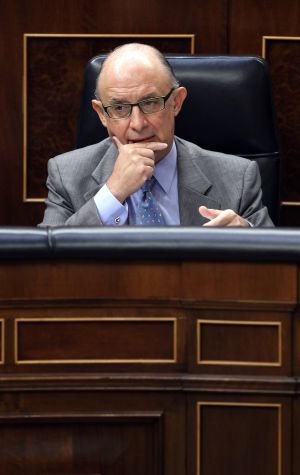
Cristóbal Montoro in Congress. / GORKA LEJARCEGI
Finance Minister Cristóbal Montoro on Wednesday warned that without the tax hikes and cuts in spending approved last Friday the state would not be in a position to pay public sector wages.
“There is no money in the state coffers,” Montoro told Congress. “What we have comes from taxes and if revenues don’t increase, we are at risk of not being able to meet the payroll.”
The Cabinet on Friday approved the largest austerity package since democracy was restored in Spain over 30 years ago. The measures include a hike in the standard value-added tax rate to 21 percent from 18 percent and in the reduced rate to 10 percent from eight percent. The payment of the traditional Christmas bonus for state workers was also suspended.
However, Montoro on Tuesday said lower income civil servants would be exempt from the move.
The austerity drive aims to trim the public deficit from 8.9 percent of GDP last year to 2.8 percent in 2014. Spain was given an extra year by the Eurogroup to bring the shortfall back within the European Union ceiling of three percent. The deficit target for this year was relaxed to 6.3 percent from 5.3 percent and to 4.5 percent from three percent next year.
Market players said Montoro’s remarks sparked a spike in Spain’s risk premium. The spread between the yield on the benchmark 10-year Spanish government and the German equivalent widened by 17 basis points to 576. It reached a euro-era record high of 576 basis points on June 18.
Civil servants have held a series of protest against the cuts and the CSI-F labor union that represents public workers has called for a strike in September.
In Wednesday’s debate in the lower house, Joan Tardà, a lawmaker for the ERC republican leftwing Catalan party, warned Montoro about the reaction to the cutbacks. “The protests that are being readied will wipe the smile off your face,” Tardà said.
Montoro claimed public sector workers are aware of the need for belt-tightening. “They know better than anyone that there is no money in the state coffers and that their wages depend on taxes,” the minister said.
The spokesman on public administration for the main opposition Socialist Party, Meritxel Batet, accused the government of pursuing cutbacks for “ideological” reasons.
“No country grows and creates confidence by undermining public services,” Batet said.
and......
Economic crisis sparks growing exodus of Spaniards
Over 200,000 immigrants move on to boost massive outflow
The number of Spaniards driven to seek work in other countries by the economic crisis and particularly heavy unemployment jumped in the first half of this year.
According to figures released Tuesday by the National Statistics Institute, the number of Spaniards seeking better fortune abroad in the period January-June soared 44.2 percent to 40,625.
Spain slipped back into recession again for the second time in three years at the start of 2012. About a quarter of the working population is currently out of a job.
Immigrants drawn to the country during an economic bonanza fueled by a property boom that turned to bust at the start of 2008 are also departing in droves, with 228,890 leaving to seek a living elsewhere in the period.
The exodus cleared exceeded the number of Spaniards returning and new immigrants, which together amounted to 195,539 in the first half. As a result, the overall population fell by 33,162 from the start of the year but was up 37,962 from a year earlier at 46.163 million.
"Currently, we have become a country of emigration after having been one of immigration. More people are leaving than arriving because we are not able to keep them," said Antonio Izquierdo, a sociology professor at the University of A Coruña, in response to the figures. "If the riches of a country are its population, we are losing wealth."
Demographer Albert Sabater of the Autònoma University of Barcelona believes most of those leaving are nationalized Spaniards rather than people who were born here.
and....
Government cuts to dependency law "most barbaric of all measures yet"
The last great bastion of the former Socialist government's social welfare program has become the latest target for the government's all-out assault on public spending. The Dependency Law, which was enshrined by José Luis Rodríguez Zapatero as an inalienable right for all Spaniards and would have brought the country closer to the levels of social protection offered in some other European nations, is to suffer a 15-percent cut in funding.
This comes on top of the loss of an equal amount to non-professional caregivers - family members, and in the large part women - in the recent state budget and the rescindment of government Social Security system contributions for carers announced earlier this month, which effectively leaves more than 178,000 people without the right to a state pension.
The government has promoted the initiative as an attempt to regularize the current system, which is administered by the regions, in order to provide a similar level of care across the board. But this is far from guaranteed as each region can still further reduce the amount it sets aside for carers, of whom there are some 430,000 in total in Spain.
The health chief in Castilla y León, Milagros Marcos, admits aid will likely suffer further cuts in her region. "It is an attempt to make payments to families less attractive, so that citizens will opt for existing services, as the best way to generate employment." However, traditional social services are not obliged to offer the same conditions that home carers can provide and, despite the government's affirmation that dependents will be taken care of by the state, cuts in funding to local authorities from the state coffers have already fallen 40 percent.
Further muddying the water is the new grading system for illnesses and disabilities. Those people classified as Grade 3 - the least serious cases - who are not already in the system must wait until 2015 to qualify for dependent status. Under the new regulation, local authorities will have two years to process applications instead of the current six months. They will also not be obliged, as before, to make retroactive payments for time spent on the waiting list.
"Of all the measures that have been taken to cut this law into pieces, this is the most barbaric of all," said the president of the State Association of Managers and Directors of Social Services, José Manuel Ramírez.
"It's the same as telling a cancer patient to wait two years to receive chemotherapy - probably they won't be around to receive it. Furthermore, from the management point of view, it rewards those regions with the biggest backlogs because it gives them legal carte blanche for it. It could even have a contagion effect in other regions, as it is now permitted."
At present, the waiting list for dependency aid stands at around 260,000 people. Calculations show that some 60,000 new cases enter the system each two years. The government, though, does not forecast a spike in the waiting lists but quite the opposite, basing its predictions on the increased healthcare liquidity afforded the regions through the 15-percent reduction in payments to non-professional carers and because dependency funding will be smaller not greater: already the regions receive 500 million euros less annually.
Therefore, the government believes, more people will fall back on professional social services and the central administration assumes the regions will invest the money saved back into their healthcare sectors.
However, family carers and social services are far from comparable. State carers may spend just a few hours a day providing home attention, leaving the family to care for the dependent the rest of the time.


No comments:
Post a Comment