http://exiledonline.com/letter-from-athens-inside-the-greek-crisis-with-anarchists-and-the-radicalized-ex-middle-class/
(Photos by the author)
I arrived in Athens only hours after the February 12 anti-austerity riots, the acrid odor of burnt-out banks still lingering downtown, and checked into a familiar haunt, the Hostel Zorbas on Victoria Square. The last time I stayed there, in the summer of 2001, the place still took drachmas and buzzed with backpackers just returned from Piraeus, where the ferries fan out to the pleasure islands of the Aegean. A decade later, those memories felt like the flashback scenes in The Road. This time the hostel had only two other guests. There was Anas, a young Syrian refugee planning his way north to Sweden — “They called me up for military service, and I’m not going to shoot my own people,” he was telling the desk clerk when I arrived — and there was Guy, an 18-year-old anarchist from Brooklyn. Guy was in town to forge relationships with his brothers in black and study Greek riot tactics.
I arrived in Athens only hours after the February 12 anti-austerity riots, the acrid odor of burnt-out banks still lingering downtown, and checked into a familiar haunt, the Hostel Zorbas on Victoria Square. The last time I stayed there, in the summer of 2001, the place still took drachmas and buzzed with backpackers just returned from Piraeus, where the ferries fan out to the pleasure islands of the Aegean. A decade later, those memories felt like the flashback scenes in The Road. This time the hostel had only two other guests. There was Anas, a young Syrian refugee planning his way north to Sweden — “They called me up for military service, and I’m not going to shoot my own people,” he was telling the desk clerk when I arrived — and there was Guy, an 18-year-old anarchist from Brooklyn. Guy was in town to forge relationships with his brothers in black and study Greek riot tactics.
Welcome to the Austerity Athens hostel scene.
Just before my arrival, a hundred thousand Greeks made international headlines with a day of rage against the terms of the latest ECB/IMF bailout. The terms required Greece step inside a familiar Iron Maiden of structural reform: deep cuts to public services, wages, and pensions; major privatizations; some Constitutional edits. Sitting atop it all was a Eurocrat baby-sitter clause that will place veto-wielding EU monitors — shadow ministers — inside each Greek government ministry. This last bit seemed designed for humiliation. The riots occurred the day the unelected government signed the deal, and it’s hard to find Greeks willing to condemn without qualification the destruction caused by the kids who took their anger out on anything that reminded them of international finance, and a few things that didn’t.
YouTube clips of those street fights were dramatic by any standard. But none captured February’s most cinematic moments around Syntagma Square. What no cameras caught was Greek anarchists using Ewok tactics on the streets of Athens. More than one proud anarchist told me of the trip-ropes and oil slicks used to neutralize a new motorcycle-based riot police unit called the Zeus-Deltas. Such innovations straight out of theSeven Samurai are of a piece with the deep lore of Greek anarchist protest. Among the war stories I heard in Athens, my favorite came from a well-known veteran anarchist named Alex Aristopoulus. In the early 1980s, during the annual November 17 protests commemorating the 1967 colonels’ coup, anarchists lured seven cops down a dead-end street, surrounded them, made them strip, and frog-marched them out naked. Later that night the uniforms were burned in an oil-drum in the heart of Exarchia, Athens’ anarchist quarter.
This is the stuff that had drawn my Zorbas bunkmate Guy to Athens. Last August, Guy was among the handful who gathered at the Bowling Green bull and participated in the small assemblies that became Occupy Wall Street. There he met and was enraptured by the Greek-born artist and anarchist Georgia Sagri. He decided to experience for himself the culture of resistance that produced people like her. With Occupy in winter hibernation, he bought a one-way ticket to Athens just after the anti-austerity riots. Guy was a junior high school dropout, but his plan was to return to New York with a master’s in mayhem, ready for the series of actions he referred to collectively as the “Spring Offensive.”
Just before my arrival, a hundred thousand Greeks made international headlines with a day of rage against the terms of the latest ECB/IMF bailout. The terms required Greece step inside a familiar Iron Maiden of structural reform: deep cuts to public services, wages, and pensions; major privatizations; some Constitutional edits. Sitting atop it all was a Eurocrat baby-sitter clause that will place veto-wielding EU monitors — shadow ministers — inside each Greek government ministry. This last bit seemed designed for humiliation. The riots occurred the day the unelected government signed the deal, and it’s hard to find Greeks willing to condemn without qualification the destruction caused by the kids who took their anger out on anything that reminded them of international finance, and a few things that didn’t.
YouTube clips of those street fights were dramatic by any standard. But none captured February’s most cinematic moments around Syntagma Square. What no cameras caught was Greek anarchists using Ewok tactics on the streets of Athens. More than one proud anarchist told me of the trip-ropes and oil slicks used to neutralize a new motorcycle-based riot police unit called the Zeus-Deltas. Such innovations straight out of theSeven Samurai are of a piece with the deep lore of Greek anarchist protest. Among the war stories I heard in Athens, my favorite came from a well-known veteran anarchist named Alex Aristopoulus. In the early 1980s, during the annual November 17 protests commemorating the 1967 colonels’ coup, anarchists lured seven cops down a dead-end street, surrounded them, made them strip, and frog-marched them out naked. Later that night the uniforms were burned in an oil-drum in the heart of Exarchia, Athens’ anarchist quarter.
This is the stuff that had drawn my Zorbas bunkmate Guy to Athens. Last August, Guy was among the handful who gathered at the Bowling Green bull and participated in the small assemblies that became Occupy Wall Street. There he met and was enraptured by the Greek-born artist and anarchist Georgia Sagri. He decided to experience for himself the culture of resistance that produced people like her. With Occupy in winter hibernation, he bought a one-way ticket to Athens just after the anti-austerity riots. Guy was a junior high school dropout, but his plan was to return to New York with a master’s in mayhem, ready for the series of actions he referred to collectively as the “Spring Offensive.”
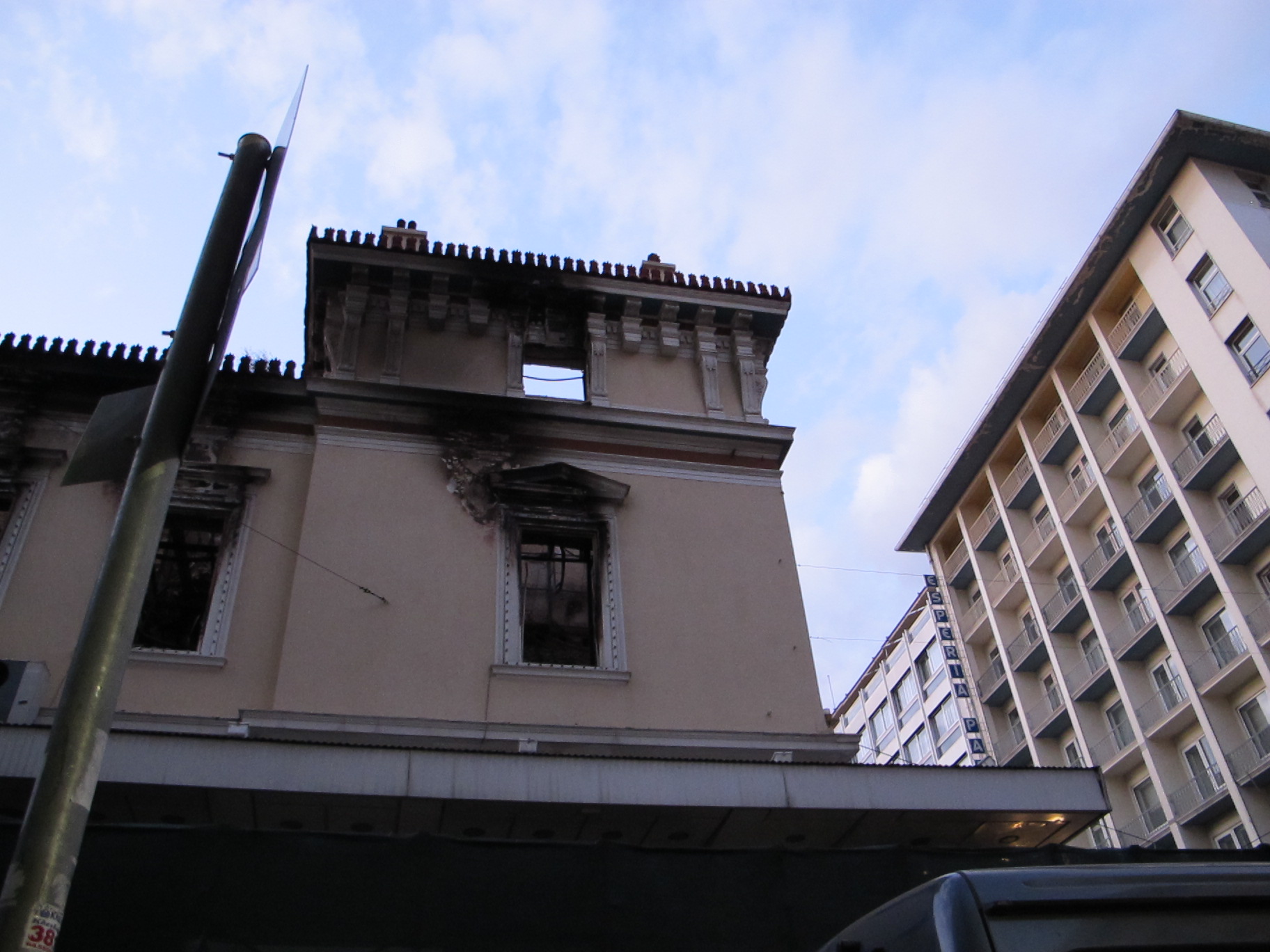
Among the architectural victims of the February 12 riots was this old theater in downtown Athens
As a “Day Two” Occupy activist, Guy was a popular kid in Athens. It was strange to see how the movement has become the Greeks’ first connection to the States. Not Serbia, not Iraq, not NATO — but Occupy. It was a reminder that in Greece, Most Hated Foreign Power (MHFP) has always been a revolving honorary. After a long run, we’ve finally ceded it back to the Germans. When the CIA helped institute military rule in 1967, we displaced the Brits, who had themselves displaced the Germans by returning King George to power after the war and refusing to recognize the leftist guerilla government which fully functioning by 1944 in the mountains of central Greece. When the country began sliding towards civil war, British troops participated in the violent crushing of leftist demonstrations around the country and even deployed machine-gun squads in armed clashes in the center of Athens. Just to make sure everyone knew where they stood, the Brits shipped thousands of leftist anti-Nazi partisans to concentration camps in Eritrea and Libya, where most of them died.In any case, now the Germans have regained MHFP status with force. There’s Merkel, of course. But the secondary figures associated with the most extreme austerity measures, such as delaying elections, also have names like Wolfgang Schäuble. The European Commission task force representative in charge of the shadow minister program is actually named Horst Reichenbach. And the German tabloids have been New York Post brutal.
Greeks are not in the mood for insult on injury. Everywhere you turn you see signs of a country in collapse. On the day I arrived, a state mortgage agency had just closed around the corner from my hostel, and an employee was threatening to jump from the top floor, screaming about losing her insurance and being unable to care for a sick child. A couple days later, thieves waltzed into the Olympia Museum in broad daylight and stole dozens of ancient artifacts. The Minister of Culture offered to resign, but nobody cares anymore about the Minister of Culture.
Walk around Athens with a local, and within a few minutes they’ll point at something and say, “That’s new — you never used to see that before.” Usually it’s a sight Americans have long grown inured to, but in Greece still causes pain and wonder. Like an old woman rummaging through garbage for food. Often these “That’s new” moments are the spark behind the new forms of mutual aid and self-organization spreading throughout Greek society. This was the case of a 47-year-old former Internet marketer that I met one afternoon named Kostas Polychronopoulus. I found him in a downtown park called Klafthmonos, or Square of Tears, while he was giving away food to the newly hungry.
In December, Polychronopoulus had been unemployed for more than a year when he came upon two young Greek boys fighting over scraps of rotten food in a garbage can. The sight was too much for him. He went home and made ten sandwiches and tried to hand them out in the streets. He discovered that hungry people were often too ashamed to accept the handouts, so he got some friends together and started cooking communal meals on the streets. Slowly, people began to gather and join. Now he cooks almost every day in different places around city, including overcrowded refugee centers. His kitchen is part of a widening network of street aid institutions.
Greeks are not in the mood for insult on injury. Everywhere you turn you see signs of a country in collapse. On the day I arrived, a state mortgage agency had just closed around the corner from my hostel, and an employee was threatening to jump from the top floor, screaming about losing her insurance and being unable to care for a sick child. A couple days later, thieves waltzed into the Olympia Museum in broad daylight and stole dozens of ancient artifacts. The Minister of Culture offered to resign, but nobody cares anymore about the Minister of Culture.
Walk around Athens with a local, and within a few minutes they’ll point at something and say, “That’s new — you never used to see that before.” Usually it’s a sight Americans have long grown inured to, but in Greece still causes pain and wonder. Like an old woman rummaging through garbage for food. Often these “That’s new” moments are the spark behind the new forms of mutual aid and self-organization spreading throughout Greek society. This was the case of a 47-year-old former Internet marketer that I met one afternoon named Kostas Polychronopoulus. I found him in a downtown park called Klafthmonos, or Square of Tears, while he was giving away food to the newly hungry.
In December, Polychronopoulus had been unemployed for more than a year when he came upon two young Greek boys fighting over scraps of rotten food in a garbage can. The sight was too much for him. He went home and made ten sandwiches and tried to hand them out in the streets. He discovered that hungry people were often too ashamed to accept the handouts, so he got some friends together and started cooking communal meals on the streets. Slowly, people began to gather and join. Now he cooks almost every day in different places around city, including overcrowded refugee centers. His kitchen is part of a widening network of street aid institutions.
“Poverty is more in your face than ever,” he says. “We are a team of unemployed and they can call us what they want — socialist, anarchist. But we don’t care about labels. We believe in social justice and employment.”
Like most Greeks I spoke with, Polychronopoulus thinks the threat of bankruptcy is a bankers’ bogeyman made of straw. “They try and threaten us with bankruptcy,” he says. “We’ve already gone bankrupt! What is bankruptcy if not hungry people in the streets? For years the banks and the politicians shared the profits with themselves, but now that there are losses we have to pay for them?”
Embracing bankruptcy is steadily becoming less of a radical position. The other week the influential Financial Times editor and columnist Wolfgang Munchau wrote in favor of bankruptcy as the only way to save Greek democracy, and criticized the other Wolfgang for suggesting Greeks postpone elections. But elections seem beside the point in Greece. Trust in institutions is depleted.
Take the media. When Greeks watch state television now, they see the aliens from They Live! mouthing someone else’s empty words. Blatant corruption has been uncovered inside every studio and under every signal tower. The financial editor of a major tv station promoting austerity medicine was recently exposed for being on the payroll of a company handling the privatization of state property. Athens municipal radio, meanwhile, has been tied to the press office of the Eurobank.
“There is a corrupt triangle of interest between the banks, the media, and the politicians,” says Maria Louka, a reporter with Eleftherotypia (Press freedom), the first leftist publication to emerge after the restoration of civil rule in 1974. Like many Greek media organs, the paper is currently striking, though staff has managed to publish two strike issues.
“Pundits are often on the payroll of political interests or the press minister, and they all press the message of ‘There is no alternative’,” she says. “But the measures have taken such a violent form that the propaganda has lost its power. The media has been discredited along with the unions and the parties. One-time celebrity journalists are now verbally attacked on the street.”
Like most Greeks I spoke with, Polychronopoulus thinks the threat of bankruptcy is a bankers’ bogeyman made of straw. “They try and threaten us with bankruptcy,” he says. “We’ve already gone bankrupt! What is bankruptcy if not hungry people in the streets? For years the banks and the politicians shared the profits with themselves, but now that there are losses we have to pay for them?”
Embracing bankruptcy is steadily becoming less of a radical position. The other week the influential Financial Times editor and columnist Wolfgang Munchau wrote in favor of bankruptcy as the only way to save Greek democracy, and criticized the other Wolfgang for suggesting Greeks postpone elections. But elections seem beside the point in Greece. Trust in institutions is depleted.
Take the media. When Greeks watch state television now, they see the aliens from They Live! mouthing someone else’s empty words. Blatant corruption has been uncovered inside every studio and under every signal tower. The financial editor of a major tv station promoting austerity medicine was recently exposed for being on the payroll of a company handling the privatization of state property. Athens municipal radio, meanwhile, has been tied to the press office of the Eurobank.
“There is a corrupt triangle of interest between the banks, the media, and the politicians,” says Maria Louka, a reporter with Eleftherotypia (Press freedom), the first leftist publication to emerge after the restoration of civil rule in 1974. Like many Greek media organs, the paper is currently striking, though staff has managed to publish two strike issues.
“Pundits are often on the payroll of political interests or the press minister, and they all press the message of ‘There is no alternative’,” she says. “But the measures have taken such a violent form that the propaganda has lost its power. The media has been discredited along with the unions and the parties. One-time celebrity journalists are now verbally attacked on the street.”
* * * *


No comments:
Post a Comment